

Greenland is not a typical family holiday destination; it is an expedition into the Arctic that rewards curiosity and resilience. As the world's largest non-continental island, it offers a landscape dominated by the massive Inland Ice Sheet and a coastline dotted with small, isolated settlements. For families, the appeal lies in the raw power of nature and the opportunity to experience a way of life entirely dictated by the elements. It is best suited for school-aged children and teenagers who can handle colder temperatures and the logistics of travel in a remote region.
Ice and Ocean Adventures
The most iconic stop for visitors is Ilulissat in Disko Bay. Here, the UNESCO-listed Ilulissat Icefjord pushes massive icebergs into the sea. Families can take boat tours to navigate among these frozen giants, a safe but awe-inspiring experience. During the summer months, these waters are teeming with wildlife; it is common to see humpback, minke, and fin whales surfacing near the boats. For a view from land, a wooden boardwalk leads to the Sermermiut settlement, offering an accessible hike with views of the icebergs grounded at the fjord's mouth.
Arctic Wildlife and Sled Dogs
Beyond marine life, Greenland is home to unique land animals. Near the international airport in Kangerlussuaq, families can join 4x4 tundra safaris to spot herds of musk oxen-large, shaggy prehistoric beasts-and reindeer. Sled dogs are integral to Greenlandic culture, particularly north of the Arctic Circle. While working dogs are not pets, many local operators offer "meet the puppies" experiences or short sled rides (on snow in winter or wheels in summer), allowing children to interact with the huskies safely.
Culture and Capital Life
Nuuk, the capital, provides a glimpse of modern Arctic living mixed with tradition. The incredible National Museum houses the famous Qilakitsoq mummies and offers context on Inuit hunting tools and kayaks. The city's colorful wooden houses and the calm colonial harbor are perfect for walking. Families can also experience a kaffemik, a traditional social gathering where locals invite visitors into their homes for coffee and cake, providing a personal connection to local life.
Practical Travel Logistics
Travel here requires planning. There are no roads between towns; transportation is exclusively by plane or boat. The Sarfaq Ittuk coastal ferry is a practical way for families to travel between settlements, serving as a lifeline for locals and a scenic cruise for visitors. Summer (June to August) brings the Midnight Sun, meaning 24 hours of daylight, which maximizes time for exploration but requires eye masks for sleeping. Temperatures typically range from 5°C to 10°C in summer, so waterproof layers, wool, and sturdy boots are essential. Note that mosquitoes can be intense in July, so bug nets are highly recommended for hikers.

Explore Regions
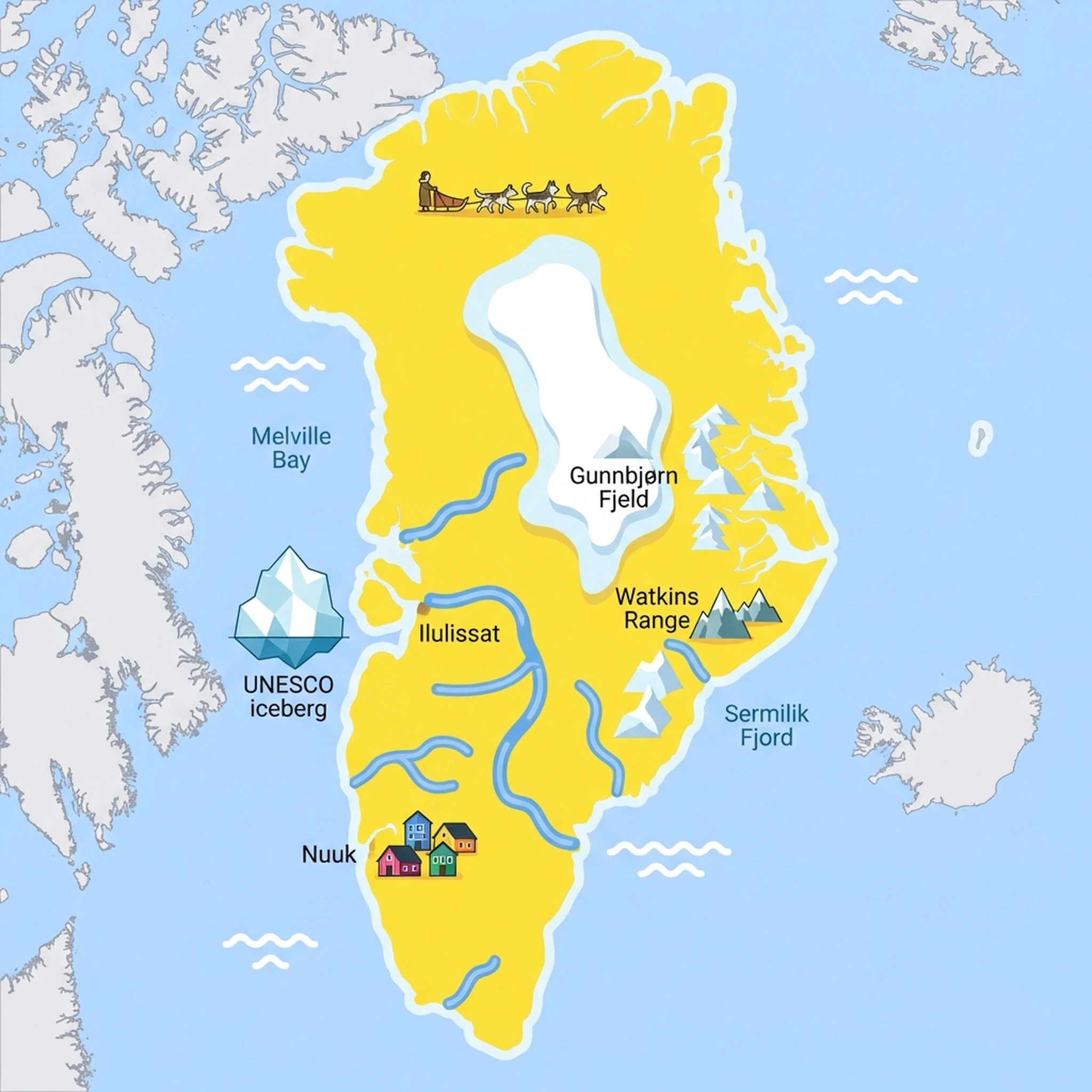
4 Regions
East Greenland (remote)
Raw Arctic adventures and dramatic peaks 🏔️
Ilulissat & Disko Bay (icebergs)
Where giants of ice float by the town ❄️🐋
North Greenland (very remote)
Home of Santa and the heart-shaped mountain ❤️🎅
Nuuk & Southwest
Viking history and capital city comforts 🏛️🐑
Click on a region marker to explore details. Use the dropdown to color regions by activity suitability.

Activities & Best Times

Adventure & Nature
ExcellentHiking, wildlife, outdoor exploration, ecotourism
Offers an incomparable high-Arctic wilderness experience with iconic heart-shaped mountains and iceberg-choked fjords. July is the only month with above-freezing average temperatures and constant sunlight, whereas extreme cold below -20°C and polar darkness make other months hazardous for families.
A globally unique UNESCO site offering unparalleled access to the world's most productive glacier and massive icebergs in Disko Bay. Peak summer months provide optimal visibility, 24-hour daylight, and peak whale-watching opportunities; shoulder months are cooler but accessible, while winter extremes limit non-specialized exploration.
A premier global destination for high-end wilderness exploration, featuring dramatic fjord systems and rare Arctic megafauna like polar bears and muskoxen. July and August offer the only viable window for boat-based exploration and trekking, though temperatures remain near freezing even in peak season.

City & Cultural
Very GoodUrban tourism, museums, historical sites, architecture
Nuuk is a sophisticated hub of modern Nordic architecture and high-end gastronomy, offering a unique fusion of Inuit tradition and cosmopolitan flair. Summer months allow for pleasant urban exploration and outdoor dining; winter conditions are too harsh for comfortable city walking for families.
An authentic Arctic town where sophisticated hotels like Hotel Arctic meet traditional Inuit lifestyle and world-class heritage sites. Peak summer is the most vibrant period for town life and accessibility; shoulder months offer a glimpse into local winter culture, while mid-winter is extremely isolated.
Qaanaaq has ~650 residents with no cultural institutions, museums, or urban infrastructure. While traditional Inuit life is culturally authentic, 'good' implies a level of city/cultural offering that doesn't exist. Marginal is consistent with East Greenland's rating for similar-scale settlements.

Educational & Exploratory
Very GoodLearning experiences, scientific sites, historical education
A profound destination for families to learn about glaciology, climate change, and Arctic survival skills in a real-world laboratory. Scientific visibility and accessibility are highest in late summer, while winter extremes make educational expeditions and outdoor learning logistically impossible.
Home to the world-class Ilulissat Icefjord Centre and the ancient Inuit settlement of Sermermiut, offering profound insights into glaciology and Arctic history. Summer months allow for full access to interpretive hiking trails and scientific exhibits; winter weather significantly restricts educational site accessibility.
Offers profound insights into Thule culture, ancient Inuit hunting traditions, and the front lines of global climate research in a pristine environment. Summer months provide the necessary access to remote archaeological sites and research outposts that are otherwise locked in pack ice.

Festivals & Seasonal
Very GoodEvents, celebrations, seasonal attractions
Authentic events like the Nuuk Snow Festival (Mar) and National Day (Jun) provide deep cultural immersion, complemented by world-class Northern Lights viewing. Peak Aurora season starts in September with more stable weather, while deep winter months offer high visibility but require extreme cold-weather gear.
Centered on the globally unique Midnight Sun phenomenon where the sun never sets, creating a surreal and memorable family experience. June and July offer 24-hour daylight for outdoor celebrations, while the region experiences months of total polar darkness during the off-season.
Features extraordinary natural phenomena including the Midnight Sun (Jun-Jul) and the Northern Lights (best in Feb-Mar alongside traditional dog sledding events). Peak months align with maximum celestial activity and traditional celebrations; shoulder months offer transitioning light, while late spring and late autumn lack both snow stability and dark skies.

Sports & Active
Very GoodSport tourism, fitness activities, active recreation
Distinguished by authentic Arctic kayaking among icebergs and long-distance dog sledding expeditions. March and April are peak for ice-based sports with returning light, while July is optimal for water sports; winter months are too dark and dangerously cold for safe active recreation.
World-class destination for elite sea kayaking and technical mountaineering in some of the most remote alpine peaks on Earth. Activity is strictly limited to the short ice-free window in July and August; winter and spring months present extreme survival conditions unsuitable for most sports.
Offers world-class sea kayaking in its ancestral birthplace and the challenging Nuuk Marathon in August. Active pursuits are restricted to the brief summer window when the fjords are navigable and coastal trails are free of deep snow.

Ski & Snow
GoodWinter sports, ski resorts, snow activities
Nuuk has no developed ski resorts or lift infrastructure. Heli-skiing exists but is ultra-niche and expedition-grade, not comparable to 'very_good' ski destinations like Norwegian or Icelandic resorts. Dog sledding is limited in the southwest. 'Good' reflects the authentic but undeveloped winter sports offering.
Dog sledding is culturally vital but represents traditional transport, not a developed winter sports offering. No ski infrastructure exists. 'Very_good' implies a level of winter sports accessibility and variety that this extremely remote region cannot provide. 'Good' acknowledges the authentic dog sledding tradition.
Offers world-class, authentic winter experiences like long-distance dog sledding and heli-skiing in a pristine Arctic environment. Late winter (Mar-Apr) provides the best balance of stable snow and returning daylight; the region lacks traditional lift infrastructure, and summer months see a total loss of snow cover at sea level.

Relaxation & Wellness
MarginalSpa retreats, wellness centers, peaceful getaways
While not a primary wellness destination, high-end hotels offer sauna culture with dramatic views of icebergs and mountains. The peaceful silence of the Arctic summer provides a unique mental retreat, though it lacks the extensive spa infrastructure found in more developed Nordic regions.
Sophisticated travelers can enjoy remote luxury in high-end 'igloo' lodges with direct views of calving icebergs. Peak summer provides the best conditions for terrace relaxation under the midnight sun; shoulder months are suitable for indoor-focused stays with scenic views, while the dark winter limits the visual experience.
Theme Park & Entertainment
MarginalAmusement parks, family entertainment venues
Airports & Flight Routes
Toggle options to view domestic routes and international airports. Click an airport for details.
Climate & Weather
East Greenland (remote)
Show Details
| Month | Temp °C | Rain | Humidity |
|---|
North Greenland (very remote)
Show Details
| Month | Temp °C | Rain | Humidity |
|---|
Nuuk & Southwest
Show Details
| Month | Temp °C | Rain | Humidity |
|---|

Travel Advisory
The majority of international agencies classify Greenland as a low-risk destination regarding security and crime, though all highlight significant environmental hazards.
Safety Topics
Traveller Advice (2 groups)

Exploration of glaciers, national parks, or remote wilderness areas requires special permits from the Ministry of Domestic Affairs. Self-sufficiency is mandatory as search and rescue response times can exceed several days in isolated areas.

Visitors should always share their detailed itineraries with family or local authorities and carry emergency communication devices, such as satellite phones or personal locator beacons, when leaving settled areas.