
Overview
⚠️ SAFETY WARNING: Exercise increased caution in Algeria due to the potential for terrorism and kidnapping. Do not travel to areas near the eastern and southern borders or the deep Sahara without a certified guide and security escort. Urban areas like Algiers and Oran are generally safer, but vigilance is required at all times.
Algeria is the largest country in Africa, a sleeping giant that offers an incredible variety of landscapes and experiences for adventurous families. To the north, the Tell Atlas mountains drop into the Mediterranean Sea, creating a coastline dotted with ancient ruins and bustling cities. To the south lies the vast, silent beauty of the Sahara Desert. Culturally, it is a fascinating blend of Amazigh (Berber), Arab, and French influences, evident in its architecture, food, and language. For families, Algeria offers a chance to explore Roman history without the crowds of Italy, and to experience the warmth of North African hospitality where children are adored and welcomed everywhere.
Traveling here requires a bit more planning than in typical European destinations, but the rewards are immense. The climate varies wildly; the coast enjoys mild, wet winters and hot summers, while the desert is scorching in summer and freezing at night in winter. The best time for families to visit is spring (March–May) or autumn (October–November), when temperatures are pleasant for exploring the cities and the desert fringes. While the tourism infrastructure is still developing, this adds to the charm of a genuine, unmanufactured travel experience that curious older children and teenagers will especially appreciate.
Key Attractions
Start your journey in the capital, where the Jardin d'Essai du Hamma offers a lush, green escape for families; kids will love the massive banyan trees and the nearby zoo. Just a short drive away is the Casbah of Algiers, a UNESCO World Heritage site. Its maze of narrow, whitewashed streets is like stepping back in time, though it is best explored with a local guide who can navigate the winding paths and share stories of its history. For a panoramic view that will wow the whole family, take the cable car up to Maqam Echahid, the soaring Martyrs' Memorial overlooking the bay.
West of Algiers lies the Tipasa Archaeological Park, arguably the most family-friendly ancient site in the country. Here, Roman ruins tumble down into the sea, allowing children to scramble over ancient stones and explore an amphitheatre surrounded by pine trees and ocean spray. Further west in Oran, the Fort Santa Cruz offers history and spectacular views, while the Mosta Zoo (Mostaland) provides a fun day out with animals and amusement rides. In the east, the city of Constantine is unmissable; known as the "City of Bridges," its dramatic suspension bridges like Sidi M'Cid Bridge connect cliffs separated by a deep gorge, offering a thrilling walk that feels like floating in the air.
For a true adventure, families with older children might consider a guided expedition to the Tassili n'Ajjer National Park in the deep south. This lunar landscape of sandstone forests and prehistoric rock art is unlike anywhere else on Earth, though it requires domestic flights and organised tours.
Practical Advice
Visas & Logistics: Most Western visitors need a visa in advance, which can be a bureaucratic process; apply well ahead of your trip. The currency is the Algerian Dinar (DZD), and Algeria is very much a cash economy. International credit cards are rarely accepted outside luxury hotels, so bring sufficient cash (EUR or USD) to exchange. The weekend falls on Friday and Saturday, with Friday being the main day of prayer when many shops close.
Health & Comfort: Tap water is generally not recommended for tourists; stick to bottled water. Public toilets can be basic (squat toilets are common), so carrying your own hygiene supplies is a must. Dress modestly to respect local culture-shoulders and knees should be covered, especially for women and girls.
Food & Drink
Typical meal times: Lunch is the main meal, typically served from 12:00 pm to 2:30 pm. Dinner is usually eaten later, from 7:30 pm to 9:30 pm.
Typical meal costs: 600–1,500 DZD (approx. $4.50–11.00 USD / €4–10 EUR) for a casual meal; 2,000–4,000 DZD (approx. $15–30 USD / €14–28 EUR) for a mid-range restaurant dinner.
Dietary requirements: Vegetarian options are available but can be repetitive (mostly salads, vegetable stews, or pizza). Veganism is not widely understood. Nuts (almonds, pistachios) and gluten (couscous, bread) are staples, so allergy sufferers must be vigilant and carry translation cards.
Family-friendly dining: Children are welcome everywhere. "Fast food" in Algeria often means rotisserie chicken or pizza, which are safe bets for fussy eaters. Highchairs are rare outside of international hotels.
Signature dishes:
- Couscous – The national dish of steamed semolina granules, served with a stew of tender lamb or chicken and vegetables (carrots, courgettes, chickpeas).
- Rechta – A specialty of Algiers featuring thin, flat noodles served with a white sauce of chicken, cinnamon, and turnips. Kids usually love the pasta-like texture.
- Chorba Frik – A hearty, tomato-based soup made with crushed green wheat (frik) and meat, traditionally eaten to break the fast during Ramadan but delicious year-round.
- Mahjouba – A popular street food pancake stuffed with a spicy mixture of tomatoes and onions. Ask for a non-spicy version ("sans piquant") for children.
- Makroud – Semolina pastries filled with date paste and soaked in honey, perfect for a sweet treat.

Algeria is very affordable for families. A typical day for a family of four might cost 15,000–25,000 DZD (approx. $110–185 USD / €100–170 EUR) covering mid-range accommodation, meals, and transport. Local food and trains are extremely cheap, but imported goods and international-standard hotels in the capital charge Western prices.
Age Suitability



Explore Regions
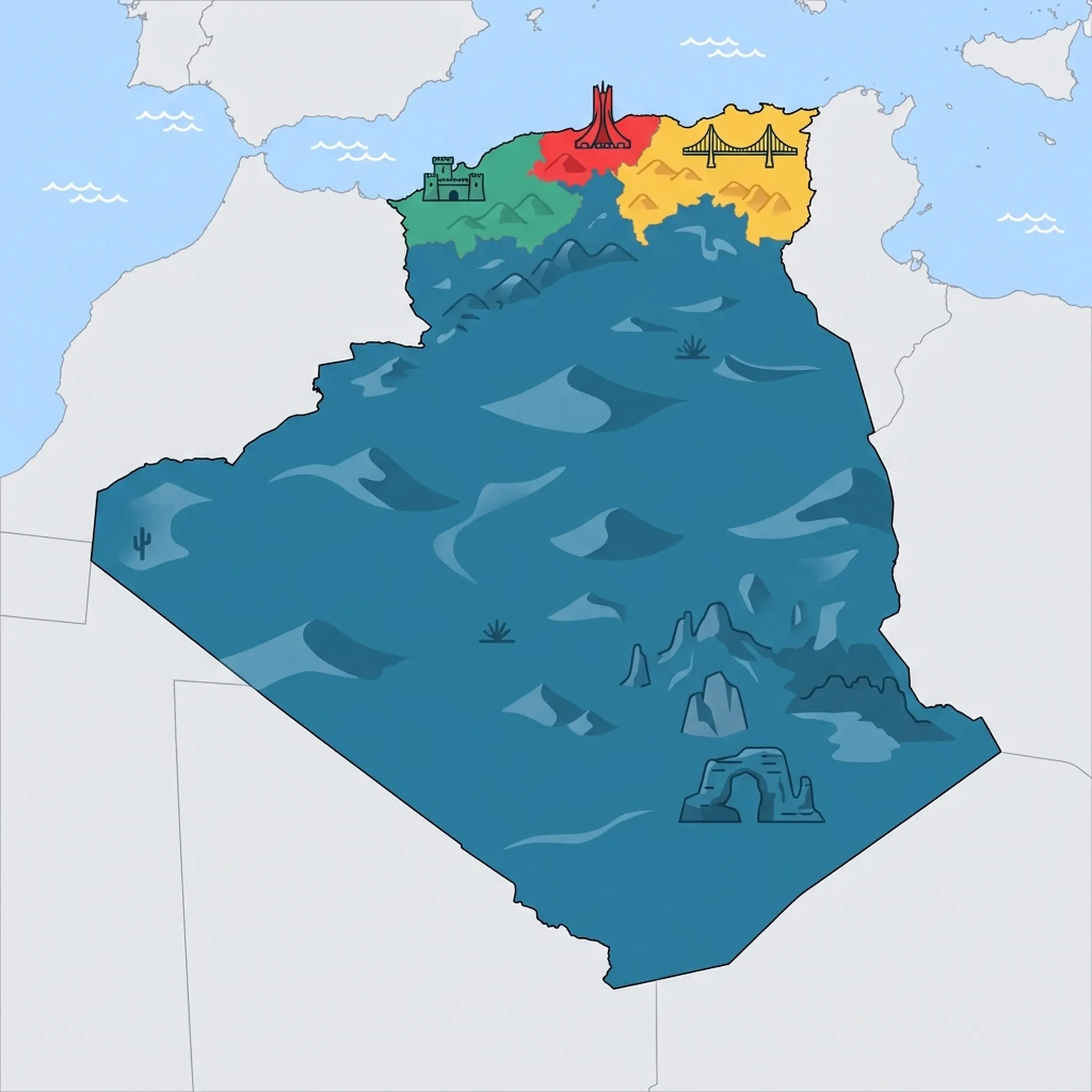
4 Regions
Algiers & Tell Atlas
Where the Mediterranean meets the mountains 🌊🏔️
Constantine & East
A city floating on rock and history 🌉🦅
Oran & West
Golden beaches and Spanish vibes 🏖️💃
Sahara & South (Tassili, Hoggar)
The greatest open-air museum on Earth 🏜️✨
Click on a region marker to explore details. Use the dropdown to color regions by activity suitability.

Getting There & Around
Getting There
- By Air – Houari Boumediene Airport (ALG) in Algiers is the main hub, with direct flights from major European cities (Paris, London, Frankfurt) and the Middle East. It is the primary gateway to Algiers & Tell Atlas.
- By Sea – Ferries operate regular services from Marseille (France) and Alicante (Spain) to Algiers and Oran. This can be a fun option for families wanting to bring their own vehicle.
- Visa Requirements – Most Western citizens (US, UK, EU, Canada) require a visa before arrival. The process can be strict and requires a hotel confirmation or invitation letter. A new "settlement visa on arrival" scheme exists for tourists visiting the Sahara via approved travel agencies, but check specific rules carefully. Check your government website for the latest visa requirements, or use the IATA Travel Centre entry-requirements checker.
Getting Around
- Trains – Operated by SNTF, the train network is one of the best in Africa, connecting major northern cities like Algiers & Tell Atlas to Oran and Constantine. It is safe, comfortable, and very cheap. Children under 4 travel free; ages 4–12 get 50% off.
- Taxis & Ride-Hailing – The "Yassir" app is the Algerian equivalent of Uber and is indispensable for families in cities, avoiding the need to haggle. Standard yellow taxis are also plentiful but require fare negotiation before you get in.
- Domestic Flights – Essential for visiting the Sahara & South. Air Algérie operates frequent flights from Algiers to Djanet and Tamanrasset.
- Car Hire – Possible but challenging due to aggressive local driving styles. For families, hiring a car with a driver is often a stress-free and affordable alternative.
Official Links

Packing List
International cards are rarely accepted outside 5-star hotels; you must bring cash to exchange.
Public restrooms often lack paper; traditional water hoses are the norm.
Family beaches can be conservative; t-shirts over swimwear are common for women/girls.
French is widely spoken and much more useful than English for taxis and menus.
European-style 2-pin plugs are standard; hotel availability of adapters is low.

Activities & Best Times

City & Cultural
ExcellentUrban tourism, museums, historical sites, architecture
Home to UNESCO World Heritage sites Djémila and Timgad, this region offers some of the best-preserved Roman ruins globally alongside Constantine's dramatic suspension bridges. Spring and autumn provide ideal walking temperatures, while the high summer heat and cold winter rains are less suitable for exploring outdoor archaeological sites.
Home to the UNESCO-listed Casbah of Algiers and world-class museums that offer deep historical immersion without mass commercialization. Spring and autumn provide the most comfortable walking temperatures for exploring the steep, narrow streets of the old city.
Home to world-class Neolithic rock art and deep Tuareg cultural heritage centered in Djanet and Tamanrasset. The cultural experience is best enjoyed during cooler months; extreme summer temperatures limit movement within the vast archaeological parks.

Adventure & Nature
Very GoodHiking, wildlife, outdoor exploration, ecotourism
Chréa National Park provides an authentic mountain wilderness experience with ancient cedar forests and significant biodiversity. Ideal conditions for exploration occur in late spring and early autumn; summer is often too hot for strenuous trekking, while winter brings heavy mountain snow.
Features the UNESCO-listed Tassili n'Ajjer and Hoggar Mountains, offering globally unique desert landscapes and wilderness trekking. Peak visits occur from October to March to avoid the extreme Saharan summer heat which makes outdoor exploration dangerous.
The spectacular Ghoufi Canyons and Aurès Mountains offer world-class hiking and dramatic scenery comparable to the American Southwest. Peak conditions occur in the shoulder seasons to avoid the extreme heat of the canyons in summer and the snow-blocked trails of the high summits in winter.

Beach & Sea
GoodBeach resorts, marine activities: diving, snorkelling, kite surfing, wind surfing, sailing
Features a unique blend of Mediterranean beaches and nearby Roman ruins at Tipaza, offering more historical depth than standard beach resorts. Peak season aligns with the warmest sea temperatures and best conditions for the Sidi Fredj marina.
The eastern coast offers beautiful, authentic Mediterranean beaches such as Stora and Ain Achir, though tourism facilities are largely domestic-focused. The short peak season in July and August aligns with optimal water temperatures and the seasonal operation of local coastal services.
Features notable Mediterranean beaches like Les Andalouses and Madagh with clear waters, though resort infrastructure is developing rather than world-class. Summer months offer the most reliable conditions for swimming and coastal recreation.

Relaxation & Wellness
GoodSpa retreats, wellness centers, peaceful getaways
Renowned for its historic thermal stations like Hammam Righa, providing an authentic North African spa tradition rooted in antiquity. The experience is most restorative during the cooler winter months when the thermal heat is most welcome.
Hosts established thermal stations like Zelfana and Hammam Salihine, providing authentic Saharan wellness experiences. These desert springs are most restorative during the cooler winter months when the air temperature contrasts with the hot thermal waters.
Famous for the spectacular calcified cascades of Hammam Debagh and the authentic Roman thermal baths of Hammam Essalihine. These thermal experiences are best enjoyed during the cooler winter months when the steam and hot waters provide maximum therapeutic contrast to the air temperature.

Road Trips & Scenic
GoodScenic drives, countryside tours, route-based travel
Dramatic coastal drives along the Turquoise Coast and the scenic Gorges de la Chiffa offer spectacular Mediterranean and mountain vistas. Travel is best in transitional seasons to avoid the peak summer traffic and winter fog in the high mountain passes.
Iconic routes like the Trans-Saharan Highway and the Assekrem Circuit provide dramatic, world-class desert scenery for adventurous families. Travel is discouraged from May to September due to extreme heat and the risk of seasonal sandstorms.
The Corniche Jijelienne (RN43) is one of North Africa's most scenic coastal drives, featuring dramatic cliffs and forest-backed beaches. Driving is most pleasant in late spring and early autumn when visibility is high and mountain passes in the Aurès are clear of winter snow.

Sports & Active
GoodSport tourism, fitness activities, active recreation
The region features dedicated hiking routes in the Tell Atlas and adventure centers like Tikjda for active families. Infrastructure supports organized outdoor activities best during the temperate months when heat and precipitation are manageable.
Offers renowned high-altitude trekking and cycling routes in the Ahaggar and Tassili regions. Active pursuits are strictly seasonal, as peak summer heat makes high-intensity physical activity unfeasible.
Features significant infrastructure for hiking and outdoor activities in the Djebel Edough and Mont Chelia areas. The region's diverse topography suits active families seeking authentic trail experiences, though infrastructure remains more rustic than European benchmarks.

Ski & Snow
MarginalWinter sports, ski resorts, snow activities
Theme Park & Entertainment
MarginalAmusement parks, family entertainment venues
Regional facilities like Ben Aknoun and local water parks provide family entertainment but lack the world-class innovation and scale required for a primary international draw. These are best visited during peak summer when water-based attractions are fully operational.
Regional entertainment hubs like Lompi Family Park and Park Mall Sétif offer modern family diversions but lack the unique, world-class scale required to be primary motivators for international travel.
Local entertainment parks like Mostaland and Eden Park serve regional needs but lack the scale or unique themes of global destination parks. Peak visitation occurs during the school summer holidays when evening operations are most active.

Educational & Exploratory
MarginalLearning experiences, scientific sites, historical education
The Tassili and Ahaggar National Park museums offer specialized archaeological and geological insights for curious families. Access is dictated by the primary tourism season, as regional infrastructure is most active when the climate is manageable.
The region provides specialized learning opportunities at the El Kala Ecomuseum and Sétif Museum, focusing on natural history and archaeology. These facilities serve as excellent educational supplements to the primary cultural and historical attractions in the region.
The Oran Aquarium and Tlemcen Ecomuseum offer niche educational value, though they are secondary attractions rather than primary travel motivators. These sites are best visited during mild weather windows when local schools and groups are also active.

Public Holidays & Calendar Next 12 months
Public holidays, festivals, cultural celebrations, and seasonal natural phenomena coming up in Algeria over the next 12 months.
Loading holidays and events...
Climate & Weather
Algiers & Tell Atlas
Show Details
| Month | Temp °C | Rain | Humidity |
|---|
Constantine & East
Show Details
| Month | Temp °C | Rain | Humidity |
|---|
Oran & West
Show Details
| Month | Temp °C | Rain | Humidity |
|---|
Sahara & South (Tassili, Hoggar)
Show Details
| Month | Temp °C | Rain | Humidity |
|---|

Travel Advisory
All major agencies recommend exercising a high degree of caution throughout Algeria. While urban centers like Algiers are accessible, there are severe, standing 'Do Not Travel' warnings for all border regions and the Sahara due to extreme risks of terrorism, kidnapping, and banditry.
Safety Topics
Traveller Advice (4 groups)

Homosexuality is illegal in Algeria and can lead to imprisonment. There is little social acceptance, and LGBTQ+ individuals should exercise extreme discretion to avoid legal or safety issues.
Overland travel through the Sahara is extremely dangerous and subject to 'Do Not Travel' advisories. Travel to southern cities should be conducted only by air with reputable tour operators.

Female travellers should dress conservatively and avoid travelling alone, particularly at night. Harassment can occur, and adhering to local customs regarding attire is recommended to minimize attention.

Avoid all political gatherings and protests, which are frequent and can become violent. Photography of sensitive government or military sites is strictly prohibited and can lead to arrest.
Agency Summaries
Travellers should remain highly vigilant throughout Algeria due to the persistent threat of terrorism and kidnapping. There are strict 'Avoid all travel' warnings for all border areas and several northern provinces due to extreme security risks from banditry and militant activity.
Maintain a high level of personal security awareness. Serious risks of terrorist attacks and kidnapping exist, particularly in the south and near international borders. Protests are common and can escalate into violence with little notice.
While general travel is possible, the FCDO maintains strict warnings against all travel to within 30km of borders with Libya, Mauritania, Mali, Niger, and parts of Tunisia. Terrorism remains a high threat, with extremist groups active in remote and mountainous regions.
Increased safety and security concerns exist due to terrorism and kidnapping risks. Avoid all travel to border zones. Protests and civil unrest are frequent; travellers should avoid all demonstrations and follow local authority directives.
Heightened vigilance is required in all areas, including coastal cities. Non-essential travel to desert and border regions is strongly discouraged due to the acute threat of terrorism and the possibility of foreign nationals being targeted.
Exercise heightened awareness across the country because of terrorism and the risk of abduction. Do not travel to areas near the eastern and southern borders or into the Sahara Desert, where the U.S. government has extremely limited ability to assist citizens.
Information is provided for general guidance only and does not constitute travel, safety, medical, or legal advice. Conditions may change. Users are responsible for independently verifying information before travel.