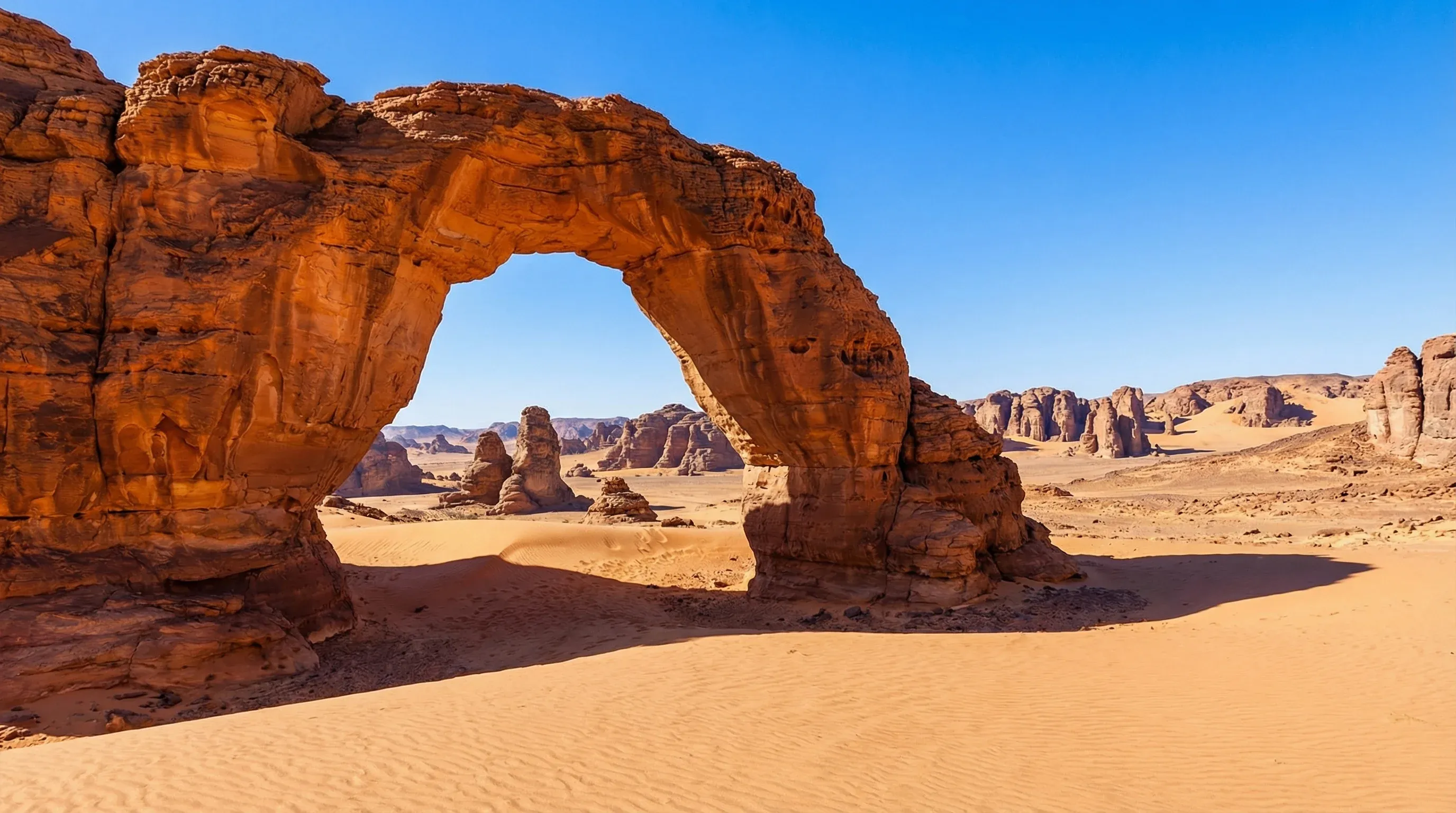

Sahara & South (Tassili, Hoggar)
The greatest open-air museum on Earth 🏜️✨
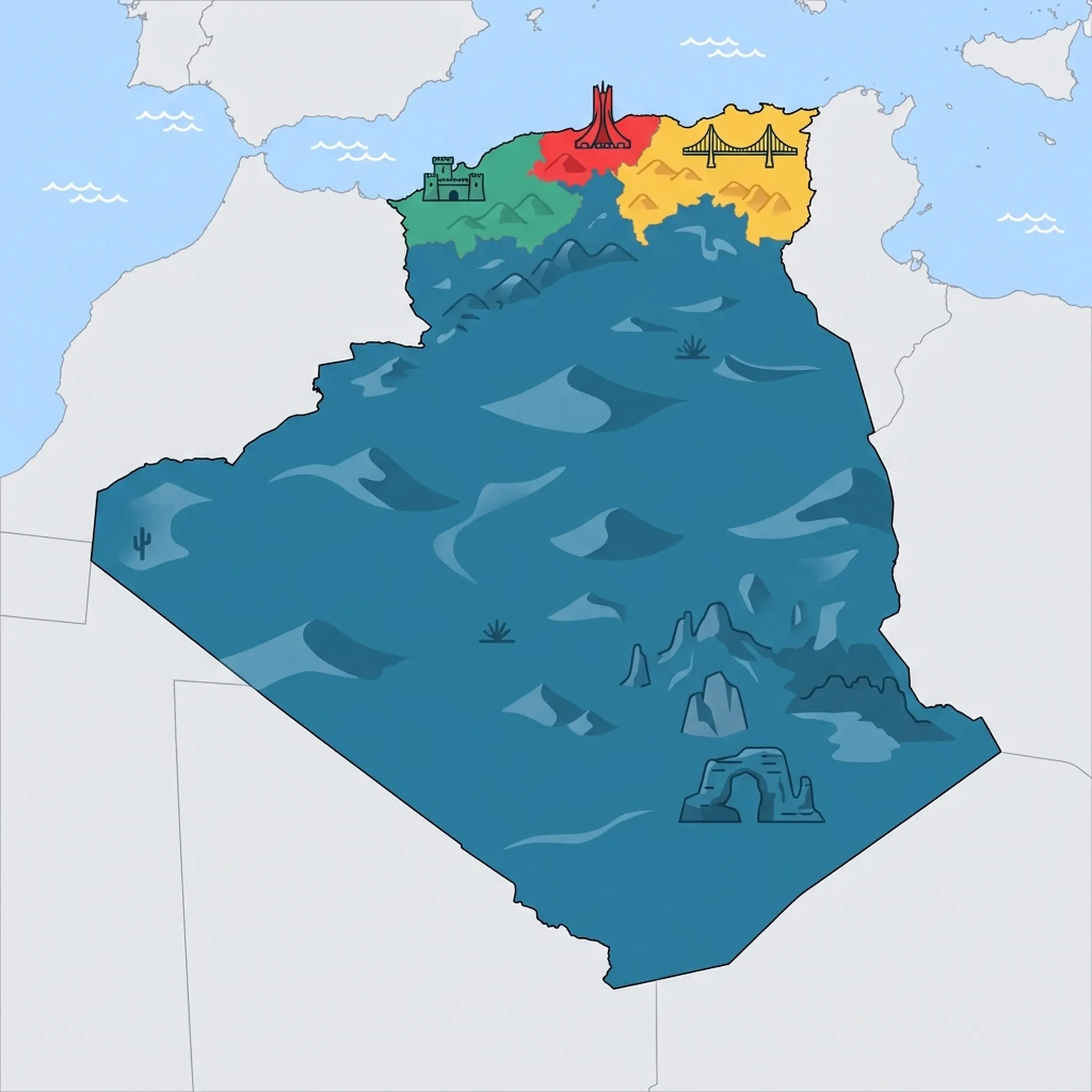
Click a region to explore
⚠️ SAFETY WARNING: The Sahara and southern Algeria carry significant security risks including terrorism and kidnapping threats. Governments (including CA, USA, UK, AU, IE, NZ) advise to Avoid All Travel to border areas and most of the deep south. However, specific "secure tourist corridors" exist for Djanet and Tamanrasset when accessing via direct flight and using certified guides. Families must consult their government's specific travel advice before booking. Overland travel from the north is dangerous and largely prohibited.
Overview
For adventurous families, the Algerian Sahara is arguably the most spectacular desert landscape on the planet. This is not just sand dunes; it is a geological wonderland of sandstone forests, black volcanic peaks, and canyons that look like the surface of Mars. The silence here is absolute, and the night skies are so clear that satellites are visible to the naked eye. The region is home to the Tuareg people, whose indigo robes and tea ceremonies are central to the cultural experience. Visiting here is an expedition, not a typical holiday, usually involving 4x4 camping trips where you sleep in tents or under the stars.
The two main hubs are Djanet and Tamanrasset. Djanet is the gateway to the Tassili n'Ajjer, a UNESCO World Heritage site famous for thousands of prehistoric rock paintings and engravings showing that this desert was once a savannah teeming with giraffes and elephants. It is a profound educational experience for children to see 6,000-year-old art in situ. The environment is harsh but manageable in winter, and the Tuareg guides are legendary for their hospitality and skill in navigating the terrain.
Key Attractions
Tassili n'Ajjer National Park is the highlight. Here, the "forest of rocks" creates natural playgrounds where kids can scramble over dunes and through stone arches. The famous Tadrart Rouge offers iconic red sand dunes that glow fiery orange at sunset—perfect for rolling down. Hidden within these rocks are the ancient paintings depicting cattle, hunters, and mysterious "Martian" figures.
Near Tamanrasset, the Ahaggar Cultural Park features the Atakor volcanic field. A trip to the Assekrem hermitage (where Charles de Foucauld lived) offers one of the most famous sunrises in the world, overlooking a landscape of jagged black peaks that feel utterly prehistoric. The "Weeping Cows" (Tigharghart) engraving near Djanet is a masterful piece of Neolithic art that is easily accessible and deeply moving.
Practical Advice
Travel here is only possible with a registered agency. You cannot travel independently. The agency arranges the visa invitation, airport pickup, 4x4s, food, and camping gear. The season is strictly October to April; summer is lethally hot. It is best suited for children aged 6+ who can handle car rides and camping.
Food & Drink
Typical meal times: On expedition, lunch is a picnic around 1:00 pm. Dinner is prepared by the Tuareg guides at camp around 7:30 pm.
Typical meal costs: Food is almost always included in the tour package price. Buying snacks in town is cheap.
Dietary requirements: Guides cook over open fires—expect stews, pasta, and bread. They can adapt to vegetarian needs if warned in advance, but options are simple. Gluten is hard to avoid as Taguella (bread) is a staple.
Signature dishes:
- Taguella – A thick, unleavened bread kneaded by the guides and baked under hot sand and embers. It is broken into pieces and covered in sauce.
- Tuareg Tea – A foamy, sweet green tea served in three rounds (the first is "bitter as death," the second "mild as life," the third "sweet as love").
- Mella – Similar to Taguella, a sand-baked bread often served with lamb stew.
Why this score?
This is one of the world's premier adventure regions, featuring vast sand dunes, volcanic peaks, and ancient rock art accessible only by multi-day treks or 4x4 expeditions. Travelers face extreme isolation, harsh climates, and a complete absence of modern conveniences outside of small oasis towns.
Why this score?
Medical facilities in towns like Djanet and Tamanrasset are very basic and intended for essential care only. In the event of a serious injury or illness, the only viable option is a complex and costly medical evacuation to Algiers or Europe.
Why this score?
Despite hosting the UNESCO-listed Tassili n'Ajjer, the extreme remoteness and logistical hurdles keep international visitor numbers very low. It is a bucket-list destination for niche adventure travelers but receives almost no mainstream tourism.

While daily costs are low, the requirement for a full-service expedition makes this a higher-cost trip. A one-week all-inclusive tour (transport, guide, food, camping gear) typically costs 100,000–160,000 DZD (approx. $750–1,200 USD / €690–1,100 EUR) per person, excluding flights. Tipping the Tuareg crew is customary and expected.

Getting Here & Around
Getting Here
- Airports – You must fly. Djanet (DJG) and Tamanrasset (TMR) have flights from Algiers. Direct charters from Paris to Djanet sometimes operate in winter season.
- Driving – Overland travel from the north is widely prohibited for tourists due to safety risks and immense distances. Do not attempt to drive here from Algiers.
Getting Around
- 4x4 Expedition – This is the only way to move. You will be in a Toyota Land Cruiser or similar with a local driver/guide. Most tours involve 2-4 hours of driving per day interspersed with hiking.
- Walking – While the 4x4s cover the distance, the best parts of Tassili n'Ajjer National Park are explored on foot.
- Camel – Some agencies offer camel trekking (Meharée), which is slower but magical for children.
Nearby Airports (21 airports)
Touat Cheikh Sidi Mohamed Belkebir
AZRAdrar
Bordj Badji Mokhtar Airport
BMWBordj Badji Mokhtar
Biskra
BSKBiskra
Bechar
CBHBechar
Tiska
DJGDjanet
El Bayadh Airport
EBHEl Bayadh
El Golea
ELGEl Golea
Guemar Airport
ELUEl Oued
Noumerate
GHAGhardaia
Oued Irara
HMEHassi Messaoud
In Amenas
IAMIn Amenas
In Guezzam Airport
INFIn Guezzam
In Salah
INZIn Salah
Laghouat
LOOLaghouat
Matsu
MZWMechria
Ouargla
OGXOuargla
Sidi Mahdi
TGRTouggourt
Tindouf
TINTindouf
Tamanrasset
TMRTamanrasset
Timimoun
TMXTimimoun
Illizi Airport
VVZIllizi
View full flight map for Algeria →
Official Links

Packing List
Desert nights in winter can drop to freezing (0°C/32°F), despite hot days.
There is no electricity in the desert for the entire duration of the camping trip.
The air is extremely dry; nosebleeds and cracked lips are common without care.
Essential for camp life at night; red light preserves night vision for stargazing.
Showers are rare or non-existent on expedition; this is your main way to wash.
International cards are rarely accepted outside 5-star hotels; you must bring cash to exchange.
Public restrooms often lack paper; traditional water hoses are the norm.
Family beaches can be conservative; t-shirts over swimwear are common for women/girls.
French is widely spoken and much more useful than English for taxis and menus.
European-style 2-pin plugs are standard; hotel availability of adapters is low.

Activities & Best Times

Hiking, wildlife, outdoor exploration, ecotourism
Features the UNESCO-listed Tassili n'Ajjer and Hoggar Mountains, offering globally unique desert landscapes and wilderness trekking. Peak visits occur from October to March to avoid the extreme Saharan summer heat which makes outdoor exploration dangerous.

Urban tourism, museums, historical sites, architecture
Home to world-class Neolithic rock art and deep Tuareg cultural heritage centered in Djanet and Tamanrasset. The cultural experience is best enjoyed during cooler months; extreme summer temperatures limit movement within the vast archaeological parks.

Spa retreats, wellness centers, peaceful getaways
Hosts established thermal stations like Zelfana and Hammam Salihine, providing authentic Saharan wellness experiences. These desert springs are most restorative during the cooler winter months when the air temperature contrasts with the hot thermal waters.

Scenic drives, countryside tours, route-based travel
Iconic routes like the Trans-Saharan Highway and the Assekrem Circuit provide dramatic, world-class desert scenery for adventurous families. Travel is discouraged from May to September due to extreme heat and the risk of seasonal sandstorms.

Sport tourism, fitness activities, active recreation
Offers renowned high-altitude trekking and cycling routes in the Ahaggar and Tassili regions. Active pursuits are strictly seasonal, as peak summer heat makes high-intensity physical activity unfeasible.

Learning experiences, scientific sites, historical education
The Tassili and Ahaggar National Park museums offer specialized archaeological and geological insights for curious families. Access is dictated by the primary tourism season, as regional infrastructure is most active when the climate is manageable.

Attractions (10 total)



Public Holidays & Calendar Next 12 months
Public holidays, festivals, cultural celebrations, and seasonal natural phenomena coming up in Sahara & South (Tassili, Hoggar) over the next 12 months.
Loading holidays and events...

Travel Advisory
All major agencies recommend exercising a high degree of caution throughout Algeria. While urban centers like Algiers are accessible, there are severe, standing 'Do Not Travel' warnings for all border regions and the Sahara due to extreme risks of terrorism, kidnapping, and banditry.
Safety Topics
Traveller Advice (4 groups)

Homosexuality is illegal in Algeria and can lead to imprisonment. There is little social acceptance, and LGBTQ+ individuals should exercise extreme discretion to avoid legal or safety issues.
Overland travel through the Sahara is extremely dangerous and subject to 'Do Not Travel' advisories. Travel to southern cities should be conducted only by air with reputable tour operators.

Female travellers should dress conservatively and avoid travelling alone, particularly at night. Harassment can occur, and adhering to local customs regarding attire is recommended to minimize attention.

Avoid all political gatherings and protests, which are frequent and can become violent. Photography of sensitive government or military sites is strictly prohibited and can lead to arrest.
Agency Summaries
Travellers should remain highly vigilant throughout Algeria due to the persistent threat of terrorism and kidnapping. There are strict 'Avoid all travel' warnings for all border areas and several northern provinces due to extreme security risks from banditry and militant activity.
Maintain a high level of personal security awareness. Serious risks of terrorist attacks and kidnapping exist, particularly in the south and near international borders. Protests are common and can escalate into violence with little notice.
While general travel is possible, the FCDO maintains strict warnings against all travel to within 30km of borders with Libya, Mauritania, Mali, Niger, and parts of Tunisia. Terrorism remains a high threat, with extremist groups active in remote and mountainous regions.
Increased safety and security concerns exist due to terrorism and kidnapping risks. Avoid all travel to border zones. Protests and civil unrest are frequent; travellers should avoid all demonstrations and follow local authority directives.
Heightened vigilance is required in all areas, including coastal cities. Non-essential travel to desert and border regions is strongly discouraged due to the acute threat of terrorism and the possibility of foreign nationals being targeted.
Exercise heightened awareness across the country because of terrorism and the risk of abduction. Do not travel to areas near the eastern and southern borders or into the Sahara Desert, where the U.S. government has extremely limited ability to assist citizens.
Information is provided for general guidance only and does not constitute travel, safety, medical, or legal advice. Conditions may change. Users are responsible for independently verifying information before travel.