

Overview
Armenia is a destination that surprises families with its warmth, safety, and sheer variety of landscapes. Located at the crossroads of Europe and Asia, this mountainous country offers a unique blend of ancient history and outdoor adventure that captures the imagination of children and adults alike. The geography is defined by the Armenian Highlands-rolling green valleys, extinct volcanoes, and dramatic gorges that make every road trip a scenic event. For families, the country’s compact size is a huge advantage; you can explore the bustling pink-tuff streets of Yerevan in the morning and be hiking in the cool, forested hills of Northern Armenia (Dilijan) by the afternoon.
Culturally, Armenia is one of the most family-centric societies in the world. Children are adored here, and you will find that locals go out of their way to make young travelers feel welcome, often offering sweets or friendly conversation. The vibe is relaxed and safe, with city squares in Yerevan coming alive at night with families strolling together until late. Beyond the cities, the countryside offers a rugged playground where kids can clamber over ancient fortress walls, explore cave dwellings, and spot eagles soaring over canyons. It is a place where history isn't just in a museum-it's etched into the cliffs and valleys you explore together.
Key Attractions
The capital city is the perfect starting point, where Republic Square serves as the mesmerizing heart of the country. Families gather here in the evenings to watch the spectacular singing fountains, a light and music show that captivates children. Just a short walk away, The Cascade Gardens offer a massive limestone stairway adorned with modern art sculptures that kids love to climb and explore. For a day of animal encounters, the Yerevan Zoo is beautifully modernized and provides a green escape within the city limits.
Heading north to Lake Sevan, families can enjoy one of the highest freshwater lakes in the world. Lake Sevan itself is perfect for swimming in July and August, while the nearby Sevanavank Monastery offers panoramic views that are worth the climb. Further north in the "Little Switzerland" of Armenia, Dilijan National Park is a haven for nature lovers. Here, you can hike easy trails or visit Lake Parz, a serene spot offering zip-lining and boat rides that are ideal for younger kids. For thrill-seeking teenagers, the Yell Extreme Park in the nearby mountains offers world-class ziplines and off-road tours.
In the south, the adventure truly scales up. The journey to Tatev & Southern Armenia is a highlight, featuring the Wings of Tatev-the world's longest reversible aerial tramway. The ride soars over a massive gorge to reach the historic Tatev Monastery, an experience that feels like flying. Nearby, the Old Khndzoresk Cave Village allows families to walk across a swinging suspension bridge to explore ancient dwellings carved into the soft rock, a real-life exploration experience that feels like discovering a lost world.
Practical Advice
Best Time to Visit: Late May to June and September to October are ideal, offering pleasant temperatures for hiking and sightseeing. July and August can be very hot in Yerevan (often over 40°C/104°F) but are perfect for the cooler mountain regions like Dilijan and Lake Sevan. Winters are cold and snowy, great for skiing but less suitable for general touring.
Water & Health: Tap water is generally safe, but the real highlight is the pulpulak-stone drinking fountains found on nearly every street corner. The water is fresh, cold mountain spring water and completely safe to drink, which is a huge convenience for families. Healthcare in Yerevan is good, but carry a basic first-aid kit for remote regions.
Food & Drink
Typical meal times: Lunch is typically served from 1:00 pm to 3:00 pm. Dinner is a leisurely affair, usually starting around 7:00 pm to 8:00 pm, though restaurants in Yerevan stay open very late, often until 11:00 pm or midnight.
Typical meal costs: A meal at an inexpensive restaurant costs around 3,000–5,000 AMD (approx. $7.50–12.50 USD / €7–12 EUR). A three-course mid-range meal for two costs roughly 15,000–25,000 AMD (approx. $38–64 USD / €35–60 EUR).
Dietary requirements: Armenian cuisine is exceptionally friendly to vegetarians and those with dietary restrictions. Fresh salads, grilled vegetables, and legume-based dishes are staples. Dairy and walnuts are common ingredients, so those with nut allergies should communicate clearly, but staff are generally helpful.
Family-friendly dining: Children are welcome everywhere. Most restaurants in Yerevan and major towns have highchairs and often provide coloring materials. The culture of sharing small plates (mezze) is perfect for kids who want to try a bit of everything without committing to a single large dish.
Signature dishes:
- Khorovats – Armenian barbecue, typically pork, lamb, or chicken grilled on skewers over a wood fire, often served with grilled vegetables wrapped in lavash.
- Tolma (Dolma) – Grape leaves or vegetables stuffed with a mix of minced meat, rice, and herbs, usually served with a side of garlic matsun (yogurt).
- Lavash – The traditional thin flatbread, baked in an underground clay oven (tonir); watching it being made is a fascinating experience for kids.
- Ghapama – A festive dish of roasted pumpkin stuffed with rice, dried fruits, nuts, and honey-sweet, wholesome, and visually impressive.
- Zhingyalov Hats – A unique flatbread from the south packed with over 20 types of finely chopped fresh herbs, a delicious way to eat greens.
Safety
Armenia is generally very safe for tourists, with low crime rates in cities. However, due to the geopolitical situation, some border areas are strictly off-limits. Avoid all travel to the border with Azerbaijan, particularly the eastern parts of the Gegharkunik and Syunik regions, which are subject to military tension. The main tourist routes connecting Yerevan, Dilijan, and Tatev are secure, but always stick to major roads and check the latest government travel advisories before visiting the southern Syunik province.

Armenia is a high-value destination for families. A family of four can expect to spend around 60,000–100,000 AMD (approx. $150–250 USD / €140–235 EUR) per day, covering mid-range accommodation, generous meals, and transport. Local street food like lahmajo is incredibly cheap at 500–1,000 AMD (approx. $1.30–2.50 USD), while entry fees for attractions are often negligible or free, with the exception of the ropeway at Tatev.
Age Suitability




Did you know? Armenia welcomes approximately 2.2 million international visitors per year. Most visitors come from Europe.
Explore Regions
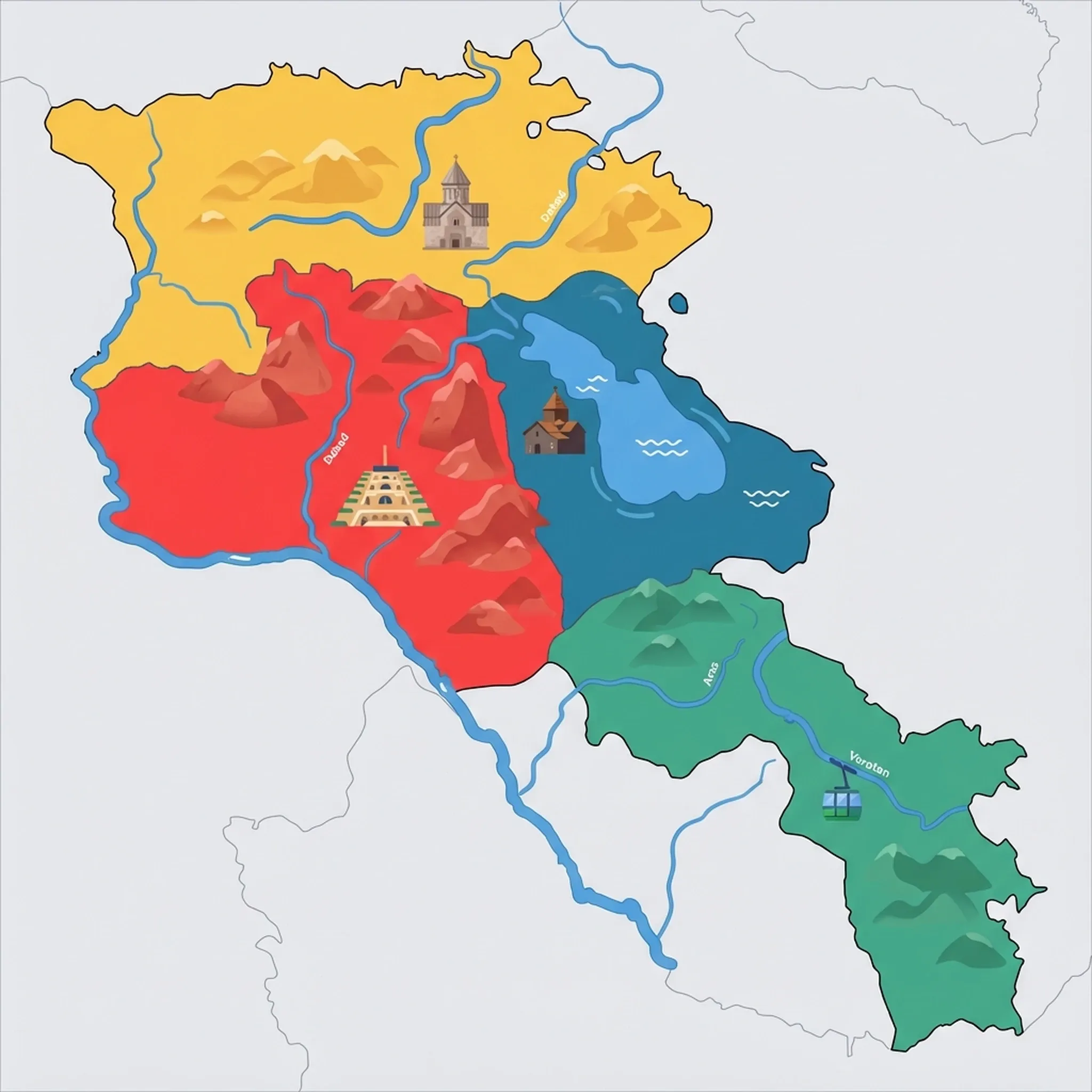
4 Regions
Lake Sevan
High-altitude beaches and ancient history 🌊⚓
Northern Armenia (Dilijan)
Forest adventures and fairy-tale monasteries 🌲🍄
Tatev & Southern Armenia
Soaring above gorges and ancient caves 🚠⛰️
Yerevan
A pink city of fountains and friendly streets ⛲☀️
Click on a region marker to explore details. Use the dropdown to color regions by activity suitability.

Getting There & Around
Getting There
- By Air – Zvartnots International Airport (EVN) is the main gateway, located just 12km from Yerevan. It receives direct flights from major European hubs like Paris, Vienna, and Frankfurt, as well as frequent connections from Dubai and Doha.
- By Train – An overnight sleeper train connects Tbilisi (Georgia) to Yerevan. It is a comfortable and atmospheric family option, running daily in summer and every other day in winter.
- By Land – The land borders with Georgia (Bagratashen, Bavra, Gogavan) and Iran (Norduz) are open. Note that borders with Turkey and Azerbaijan are closed.
- Entry Requirements – Citizens of the US, EU, UK, and many others can enter visa-free for up to 180 days. Check your government website for the latest visa requirements, or use the IATA Travel Centre entry-requirements checker.
Getting Around
- Taxis & Ride Apps – The most convenient way to travel within cities. Apps like Yandex Go and GG are reliable, very affordable, and avoid the need to negotiate fares. A ride across Yerevan typically costs 1,000–2,000 AMD (approx. $2.50–5.00 USD).
- Car Hire – Renting a car is excellent for families wanting to explore Northern Armenia (Dilijan) or Lake Sevan at their own pace. Roads to major tourist sites are generally good, though mountain passes can be winding.
- Marshrutkas – These shared minibuses are the primary inter-city public transport. They are extremely cheap (often 500–2,000 AMD) but can be crowded, hot, and less comfortable for small children or those with motion sickness.
- Trains – A seasonal electric train connects Yerevan to Lake Sevan and Gyumri. It is slower than driving but scenic and very cheap, making it a fun adventure for kids.

Packing List
To use the 'pulpulaks' (free spring water fountains) found on almost every street corner.
Women generally need to cover heads/shoulders when entering active monasteries.
Essential for children on the winding mountain roads to Tatev or Dilijan.
Useful for exploring cave dwellings in Khndzoresk and navigating dimly lit village streets.
The high altitude air (often dry) and strong sun can crack lips quickly.
Convenient for visiting local homes where removing shoes is mandatory custom.

Activities & Best Times

Adventure & Nature
ExcellentHiking, wildlife, outdoor exploration, ecotourism
Lake Sevan is the largest alpine lake in the Caucasus at 1,900m elevation, offering a globally unique high-altitude aquatic environment. The combination of dramatic Geghama mountain landscapes, rare high-altitude diving, and pristine alpine setting justifies international 'excellent' calibration for adventure/nature seekers.
Features the world-class Transcaucasian Trail and the stunning Vorotan Gorge, offering exceptional wilderness immersion. Peak months provide mild trekking temperatures and clear views, while winter snows close high-altitude trails.
Dilijan National Park offers an authentic alpine wilderness experience with the Transcaucasian Trail providing world-class hiking through lush forested mountains. Peak visitation occurs during the warm summer months when trails are dry and the ecosystem is fully accessible.

City & Cultural
ExcellentUrban tourism, museums, historical sites, architecture
Yerevan anchors three UNESCO World Heritage Sites within day-trip range (Etchmiadzin, Zvartnots, Geghard/Azat Valley), hosts the world-renowned Matenadaran manuscript collection, and offers concentrated urban cultural infrastructure (Cascade, Republic Square, museums). As Armenia's capital with this heritage density, 'excellent' is internationally calibrated and distinguishes it from regional monastery clusters.
Home to the iconic Sevanavank Monastery and the world's largest collection of khachkars at Noratus Cemetery. These ancient sites are best visited during the warmer months to avoid the biting winds that sweep across the peninsula in winter.
Home to the spectacular 9th-century Tatev Monastery and the ancient Khndzoresk cave village, providing a unique look into medieval life. Best visited from May to October for full accessibility, as winter conditions can make remote historical sites difficult to reach.

Sports & Active
Very GoodSport tourism, fitness activities, active recreation
Yell Extreme Park provides internationally competitive adventure infrastructure including professional-grade ziplines and MTB loops. The high-adrenaline season is concentrated in the dry summer months when outdoor safety and facility operations are optimal.
Provides internationally recognized long-distance hiking and mountain biking infrastructure via the Legends Trail, alongside world-class aerial activities at Wings of Tatev. The season peaks when trails are dry and temperate, while snowy winters halt most outdoor activity.
The region features significant hiking infrastructure and adventure facilities like Yerevan Zipline and specialized climbing routes in Garni Gorge. Activity is concentrated in the warmer months when mountain trails are clear and outdoor adventure parks are fully operational.

Educational & Exploratory
GoodLearning experiences, scientific sites, historical education
Yerevan hosts specialized institutions like the National Museum of Natural History and the Planetarium, offering high-quality scientific engagement. These indoor facilities are best visited during the city's pleasant transitional seasons when walking between museums is comfortable for families.
The Dilijan National Park Visitor Center and local museums provide respectable educational insights into Caucasian ecology and regional history. These facilities are most engaging during the main tourist season when guided tours and discovery programs are fully active.

Road Trips & Scenic
GoodScenic drives, countryside tours, route-based travel
Scenic drives such as the Semyonovka Pass offer spectacular mountain vistas and access to remote monasteries on well-maintained routes. Travel is best from late spring to autumn to avoid hazardous ice and fog on high-altitude mountain passes.
The region is a hub for iconic drives to Garni-Geghard and Lake Sevan, featuring dramatic volcanic scenery and well-maintained highways. Spring and autumn offer the best visibility and landscape colors, while winter brings hazardous driving conditions on high-altitude passes.
Features the spectacular Vardenyats (Selim) Pass, a remarkably preserved segment of the Silk Road with an ancient caravanserai. Driving is most reliable in summer as high mountain passes frequently close due to snow during the long winter season.
Theme Park & Entertainment
MarginalAmusement parks, family entertainment venues
While not a global theme park hub, Verev Rope Park offers localized family entertainment within a natural setting. Operations are strictly seasonal, peaking during the dry summer school holiday window.
Local aquatic centers like Aquatek and Water World provide seasonal family entertainment but are modest compared to international theme park standards. Peak visitation is strictly limited to the hot summer months when outdoor water facilities are viable.

Ski & Snow
MarginalWinter sports, ski resorts, snow activities

Relaxation & Wellness
MarginalSpa retreats, wellness centers, peaceful getaways

Public Holidays & Calendar Next 12 months
Public holidays, festivals, cultural celebrations, and seasonal natural phenomena coming up in Armenia over the next 12 months.
Loading holidays and events...
Climate & Weather
Lake Sevan
Show Details
| Month | Temp °C | Rain | Humidity |
|---|
Northern Armenia (Dilijan)
Show Details
| Month | Temp °C | Rain | Humidity |
|---|
Tatev & Southern Armenia
Show Details
| Month | Temp °C | Rain | Humidity |
|---|
Yerevan
Show Details
| Month | Temp °C | Rain | Humidity |
|---|

Travel Advisory
While most of Armenia is safe for standard travel, the majority of international agencies suggest increased vigilance due to regional security tensions and military activity near the borders. Travelers should avoid specific conflict zones.
Safety Topics
Traveller Advice (4 groups)

Solo female travelers should follow standard safety protocols and remain observant of their surroundings, particularly at night and in less populated areas.

Accessibility infrastructure in Armenia can be limited; travelers should research specific venues and transport options in advance.

It is recommended to check local customs and legal status regarding sexual orientation before traveling, as public attitudes can be conservative.

Dual citizens should be aware that Armenia shares visitor data with Russian security services. Additionally, those entering from Iran should exercise extreme care as consular support is restricted in that region.
Agency Summaries
While the country is generally safe for visitors, a high level of vigilance is necessary near the border with Azerbaijan due to the threat of military activity. Landmines and armed skirmishes make these specific regions extremely hazardous.
Authorities strongly advise against visiting any area within 5km of the eastern border with Azerbaijan. Tensions between the two nations remain high, and certain highways near the border are also considered unsafe.
Armenia is relatively safe with low crime rates, but travelers are encouraged to keep their valuables secure and avoid sensitive border areas where political tensions exist.
The security level has been heightened because of the unstable situation in the broader region, especially concerning Iran. Travel to border zones with Azerbaijan should be avoided entirely due to the threat of conflict.
Standard safety measures are sufficient for most parts of the country. However, regional instability means travelers must avoid the borders with Azerbaijan and stay informed about local protests.
Visitors should be more alert due to potential military confrontations. Certain areas near the border with Azerbaijan are designated as 'Do Not Travel' zones because of the ongoing risk of armed conflict.
Information is provided for general guidance only and does not constitute travel, safety, medical, or legal advice. Conditions may change. Users are responsible for independently verifying information before travel.