

Overview
Austria is a landlocked jewel in the heart of Europe, defined by the majestic Alps which cover nearly two-thirds of the country. For families, it offers a rare combination of safety, cleanliness, and diverse geography that changes from the flat Pannonian plain in the east to the jagged, snow-capped peaks of the west. The culture is deeply rooted in tradition yet modern and efficiency-loving, meaning trains run on time, streets are pristine, and hospitality (Gemütlichkeit) is a national pastime. Whether you are wandering the cobbled streets of a baroque city or hiking a green alpine pasture, the vibe is relaxed and family-centric.
The country is particularly well-suited for children because of its emphasis on outdoor living and "Kinderhotels" (specialised family hotels). In summer, the focus is on swimming in drinkable lakes, hiking accessible trails, and exploring historic ruins. In winter, Austria transforms into a skiing paradise with world-class schools for beginners. Beyond the postcard scenery, families will find a wealth of interactive museums and wildlife parks that make learning history and nature fun rather than a chore.
Key Attractions
Austria's attractions range from imperial grandeur to high-adrenaline nature. In the capital, families should visit the Haus des Meeres - Aqua Terra Zoo, a massive aquarium housed in a WWII flak tower, offering both sea life and panoramic views. For a breath of fresh air within the city limits, the Donauinsel offers miles of swimming, cycling, and playgrounds. West of Vienna, the Danube & Wachau Valley is home to the Ars Electronica Center in Linz, a "Museum of the Future" that captivates older children with AI and robotics displays.
Heading into the mountains, the Tyrolean Alps boast the Alpenzoo Innsbruck-Tirol, Europe's highest zoo, where kids can see bears, wolves, and eagles in their natural habitat. For active families, Area 47 is a massive outdoor adventure park offering rafting and climbing. In the picturesque Salzkammergut Lakes & Mountains, the fairytale village of Hallstatt Old Town is a must-see, while younger kids will love Fantasiana Erlebnispark Straßwalchen, a fantasy theme park. Further south in Carinthia, Burg Landskron captivates with its "Monkey Mountain" and eagle shows.
Finally, for a mix of history and fun in the east, the Familypark Neusiedlersee (Filippo's Farm) is Austria's largest theme park, located near the UNESCO-listed Lake Neusiedl (Neusiedler See). In Styria, the Austrian Open-Air Museum Stübing allows families to walk through centuries of rural history with authentic farmhouses and craft demonstrations.
Practical Advice
The best time to visit for hiking and swimming is May to September, while ski season runs from December to March. Austria is part of the Schengen Area; ensure passports are valid for at least 3 months beyond departure. Healthcare is excellent, but tick-borne encephalitis (TBE) is a risk in tall grass, so vaccination or careful checks are recommended if hiking. ATMs are widespread, but carrying cash is essential for mountain huts.
Food & Drink
Typical meal times: Lunch is the main meal, served strictly between 12:00 pm and 2:00 pm. Dinner is usually eaten between 6:00 pm and 9:00 pm.
Typical meal costs: €40–60 (approx. $45–65 USD / £35–50 GBP) for a mid-range family lunch; €70–100 (approx. $75–110 USD / £60–85 GBP) for dinner.
Dietary requirements: Vegetarian options are common (especially sweet mains and cheese dishes), and EU laws require allergen labelling on menus. Vegan options are growing in cities but limited in rural alpine huts.
Family-friendly dining: Most traditional inns (Gasthäuser) are very child-friendly, often offering a Kinderschnitzel (small portion) and highchairs. It is polite to say "Grüß Gott" when entering.
Signature dishes:
- Wiener Schnitzel – A breaded, pan-fried veal (or pork) cutlet, usually served with potato salad or fries-the ultimate kid favourite.
- Kaiserschmarrn – Fluffy, shredded pancakes served with stewed plums or apple sauce, often eaten as a main meal.
- Käsespätzle – Small egg dumplings baked with copious amounts of mountain cheese and topped with crispy fried onions.
- Brettljause – A cold wooden board piled high with cured meats, cheeses, pickles, and dark bread, perfect for hiking breaks.
- Sachertorte – A dense chocolate cake with a thin layer of apricot jam, invented in Vienna.
Family Travel Notice
Single parents or guardians traveling with minors who are not their own should carry notarized consent letters and proof of relationship to prevent delays at border control.

Austria is a Western European destination with prices comparable to Germany or the UK. A family of four should budget approximately €250–350 (approx. $270–380 USD / £215–300 GBP) per day for mid-range accommodation, meals, and activities. While supermarket food is affordable, mountain cable cars and sit-down dinners can add up quickly. Children under 6 often travel and visit museums for free.
Age Suitability



Did you know? Austria welcomes approximately 26.2 million international visitors per year. Most visitors come from Europe.
Explore Regions
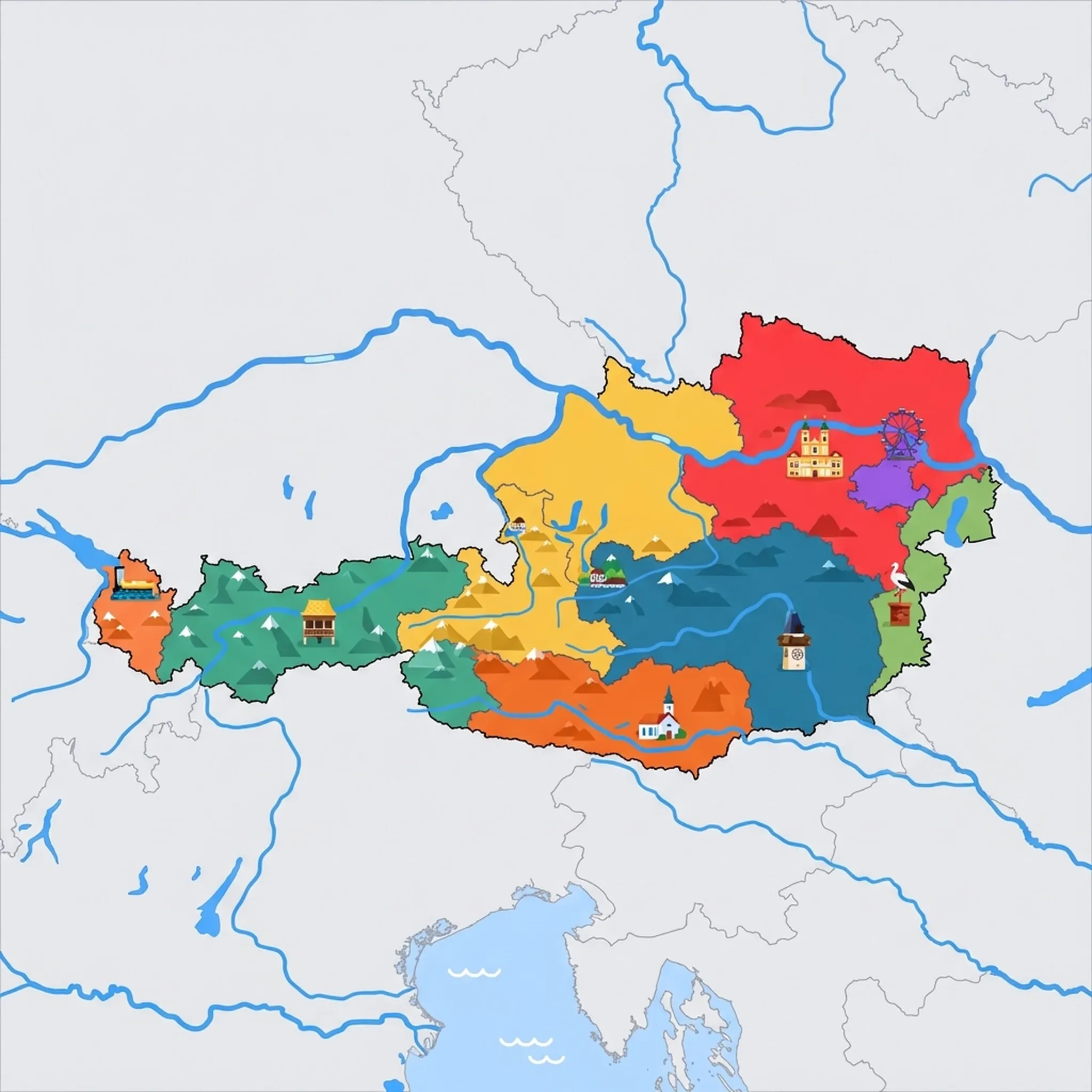
8 Regions
Burgenland & Neusiedlersee
Sunny days, shallow waters, and stork-spotting adventures ☀️
Carinthian Lakes & Southern Alps
Austria's sunny southern riviera where mountains meet warm lakes 🏊♂️
Danube & Wachau Valley
Cycle through history along Europe's majestic blue river 🚴
Salzkammergut Lakes & Mountains
The cinematic land of salt mines and crystal-clear lakes ⛰️
Styria & Southern Alpine Greens
The green heart of Austria full of castles and white horses 🏰
Tyrolean Alps
An Alpine playground of peaks, glaciers, and adventure parks 🏔️
Vienna & Wienerwald
Imperial grandeur meets the world's most livable family city 🎻
Western Alps (Vorarlberg & Arlberg)
Where modern culture meets wild Alpine peaks and vast lakes 🎭
Click on a region marker to explore details. Use the dropdown to color regions by activity suitability.

Getting There & Around
Getting There
- By Air – Vienna International Airport (VIE) is the main hub, with smaller airports in Salzburg (SZG) and Innsbruck (INN) serving the Tyrolean Alps.
- By Train – The Nightjet sleeper train network connects Austria to major European cities like Paris, Zurich, and Venice, making for an exciting family adventure.
- Entry Requirements – Austria is a Schengen member. US, UK, Canadian, and Australian citizens do not need a visa for tourist stays up to 90 days. Check your government website for the latest visa requirements, or use the IATA Travel Centre entry-requirements checker.
Getting Around
- Trains – The Vienna & Wienerwald area and major cities are connected by the ÖBB Railjet, which is fast, clean, and family-friendly. Children under 6 travel free, and under-15s are often half-price.
- Car Hire – Essential for exploring rural regions like the Tyrolean Alps or Styria & Southern Alpine Greens. A "Vignette" (toll sticker) is mandatory for highway driving.
- City Transport – Vienna, Graz, and Salzburg have excellent trams and buses. In Vienna, children travel free on public transport during school holidays and on Sundays.

Packing List
Tick-borne encephalitis is a risk in tall grass and forests; essential for hikers.
Many mountain huts (Almhütten) and small rural cafes do not accept cards.
Tap water is pure alpine spring water almost everywhere—don't buy plastic.
Essential for safe traction on alpine trails and walking on city cobblestones.
Austria has no ocean, but its crystal-clear lakes are a summer highlight.

Activities & Best Times

Adventure & Nature
ExcellentHiking, wildlife, outdoor exploration, ecotourism
A world-class destination for alpine immersion, featuring the Adlerweg trail and sophisticated nature-based parks like Area 47. Optimal conditions for mountain exploration occur from June to September when high-altitude trails are accessible and snow-free.
Offers world-class alpine immersion with extensively mapped trails and wildlife parks like Pfänder. Peak conditions occur in summer and early autumn when high-altitude trails are accessible and flora is in full bloom.
Home to the UNESCO-listed Hallstatt-Dachstein landscape, offering spectacular limestone massifs and crystalline lakes. Peak summer months provide optimal conditions for high-altitude hiking and lake-based exploration, while shoulder months offer stunning autumn foliage.

City & Cultural
ExcellentUrban tourism, museums, historical sites, architecture
Vienna is a global cultural benchmark featuring imperial architecture, world-class museums like the Kunsthistorisches, and a vibrant coffee house culture. Peak months provide ideal walking weather and the atmospheric Christmas market season in December.
Home to UNESCO World Heritage sites like Melk Abbey and Dürnstein, offering a dense concentration of medieval architecture and high-end art galleries. Peak season aligns with the cultural vitality of the valley and Christmas markets in December, while late winter sees reduced accessibility to historic sites.
Rich in Habsburg history with the Kaiservilla and world-famous Hallstatt salt heritage. Summer is the cultural peak for sightseeing, while December is internationally renowned for authentic Advent markets and traditional Krampus parades.

Ski & Snow
ExcellentWinter sports, ski resorts, snow activities
St. Anton/Arlberg is one of the world's most legendary ski destinations with top-tier infrastructure, world-cup circuits, and global brand recognition. Notes describe 'legendary resorts' and 'top-tier infrastructure' - this clearly meets the 'excellent' threshold for international ski destinations.
Reliable alpine skiing at major resorts like Nassfeld and Bad Kleinkirchheim, offering sophisticated infrastructure for families. The season is strictly winter-focused, with March providing acceptable spring skiing conditions.
Home to the legendary Arlberg region with premium infrastructure, though limited in the database to three major hubs. The season is highly reliable from December through March with modern snow-making and lift facilities.

Road Trips & Scenic
Very GoodScenic drives, countryside tours, route-based travel
The Wachau Valley Scenic Drive and Austrian Romantic Road offer world-class driving through historic landscapes and vineyard terraces. Spring blossoms and autumn harvest provide the most visually stunning conditions, while summer months see higher traffic congestion on the narrow riverside roads.
The Silvretta and Timmelsjoch High Alpine Roads offer some of Europe's most spectacular driving experiences with world-class engineering. These high-altitude passes are typically only fully open and safe from June through September due to heavy winter snow.
Spectacular high-alpine driving on celebrated routes like the Nockalm Road and Malta High Alpine Road. These scenic roads are closed by snow in winter, making the summer and early autumn the only viable windows for touring.

Sports & Active
Very GoodSport tourism, fitness activities, active recreation
Outstanding infrastructure for high-performance outdoor sports, including major bike parks and internationally recognized hiking routes. The optimal window for active sports tourism is from June to September when the terrain is clear and facilities are fully operational.
World-class cycling and hiking infrastructure, including the Drau Cycle Path and Alpe-Adria-Trail. Optimal weather and full facility availability make June through September the premier window for active families.
The Neusiedler See Cycle Path (B10) is a world-class route for families, complemented by unique activities like the Sonnenland Draisinentour. Ideal conditions for cycling and sailing are found in the mild, breezy periods of spring and late summer.
Theme Park & Entertainment
Very GoodAmusement parks, family entertainment venues
Swarovski Crystal Worlds is a unique, world-recognized attraction that combines art and entertainment, complemented by high-end alpine adventure parks. Peak family visitation occurs during the summer holidays and the festive winter period.
Features world-class thermal water complexes like KärntenTherme that are primary draws for families. Peak periods align with summer school holidays and the winter wellness season.
Features Familypark Neusiedlersee, Austria's largest amusement park, alongside high-quality water parks like Sonnentherme Lutzmannsburg. These facilities are primarily summer-focused for international visitors, with seasonal closures in the colder winter months.

Educational & Exploratory
GoodLearning experiences, scientific sites, historical education
The region features high-quality discovery centers like Audioversum and the historically significant Ötzi Village. These facilities are most accessible and engaging for families during the main summer and transitional travel seasons.
Features top-tier educational sites including the ZOOM Kindermuseum and Naturhistorisches Museum that serve as major motivators for families. Visitation peaks during major school holiday windows and the broader city tourism season.
Features the Ars Electronica Center and voestalpine Stahlwelt, providing internationally significant perspectives on science and technology. These indoor facilities are accessible much of the year, though peak visitation correlates with broader cultural tourism and school-age family travel windows.

Festivals & Seasonal
GoodEvents, celebrations, seasonal attractions
Features internationally recognized events like the Snowbombing festival in April, traditional cattle drives in September, and iconic Christmas markets in December. These months provide the most authentic and culturally significant seasonal experiences.
Host to world-famous events like the New Year's Concert, the Opera Ball, and the Rathausplatz Christmas markets. Seasonal peaks are precisely aligned with these specific international events and the large-scale Donauinselfest in June.
Hosts unique international events such as the World Bodypainting Festival and European Bike Week. Visitation is highly concentrated around these specific event dates and the regional Advent celebrations.

Relaxation & Wellness
GoodSpa retreats, wellness centers, peaceful getaways
The Aqua Dome provides a world-class thermal spa experience, set against a dramatic mountain backdrop that is particularly appealing in winter. While open year-round, the authentic 'wellness' atmosphere is strongest during the colder months from December to February.
Known for high-end thermal retreats like St. Martins Therme & Lodge, which offers a unique 'spa-safari' concept. The winter and late autumn months are the traditional peak for thermal tourism, providing a restorative contrast to the cold weather.
The historic spa town of Baden and high-end thermal complexes offer authentic Austrian wellness traditions and thermal bathing. These indoor restorative experiences are most appealing during the colder months when the contrast with the outdoor climate is greatest.

Public Holidays & Calendar Next 12 months
Public holidays, festivals, cultural celebrations, and seasonal natural phenomena coming up in Austria over the next 12 months.
Loading holidays and events...
Climate & Weather
Burgenland & Neusiedlersee
Show Details
| Month | Temp °C | Rain | Humidity |
|---|
Carinthian Lakes & Southern Alps
Show Details
| Month | Temp °C | Rain | Humidity |
|---|
Danube & Wachau Valley
Show Details
| Month | Temp °C | Rain | Humidity |
|---|
Salzkammergut Lakes & Mountains
Show Details
| Month | Temp °C | Rain | Humidity |
|---|
Styria & Southern Alpine Greens
Show Details
| Month | Temp °C | Rain | Humidity |
|---|
Tyrolean Alps
Show Details
| Month | Temp °C | Rain | Humidity |
|---|

Travel Advisory
All major agencies agree that Austria is a low-risk destination where standard personal safety awareness is sufficient.
Safety Topics
Traveller Advice (3 groups)

Single parents or guardians traveling with minors who are not their own should carry notarized consent letters and proof of relationship to prevent delays at border control.

The social environment is inclusive and same-sex relationships are legally recognized. Travelers are unlikely to face issues, though standard discretion in less urban areas is always a balanced approach.
Mountain enthusiasts should monitor avalanche warnings closely before skiing or hiking. It is essential to have specialized insurance that covers alpine rescue and medical evacuation by air.
Agency Summaries
Austria is considered a safe destination where travelers should apply standard safety measures. Risks are comparable to those found in Canada.
Austria maintains a low threat profile. While general vigilance is recommended due to global trends, the local situation is very safe.
The country is categorized at the lowest risk level. Visitors are advised to follow standard security protocols and stay informed of local conditions.
No specific warnings against travel are in place. The environment is stable, though visitors should remain aware of their surroundings in urban centers.
Ireland advises its citizens to follow typical safety routines while visiting. The country remains a low-risk destination for international visitors.
General safety levels are high. Travelers are advised to use common sense and be alert to petty crime in areas popular with tourists.
Information is provided for general guidance only and does not constitute travel, safety, medical, or legal advice. Conditions may change. Users are responsible for independently verifying information before travel.