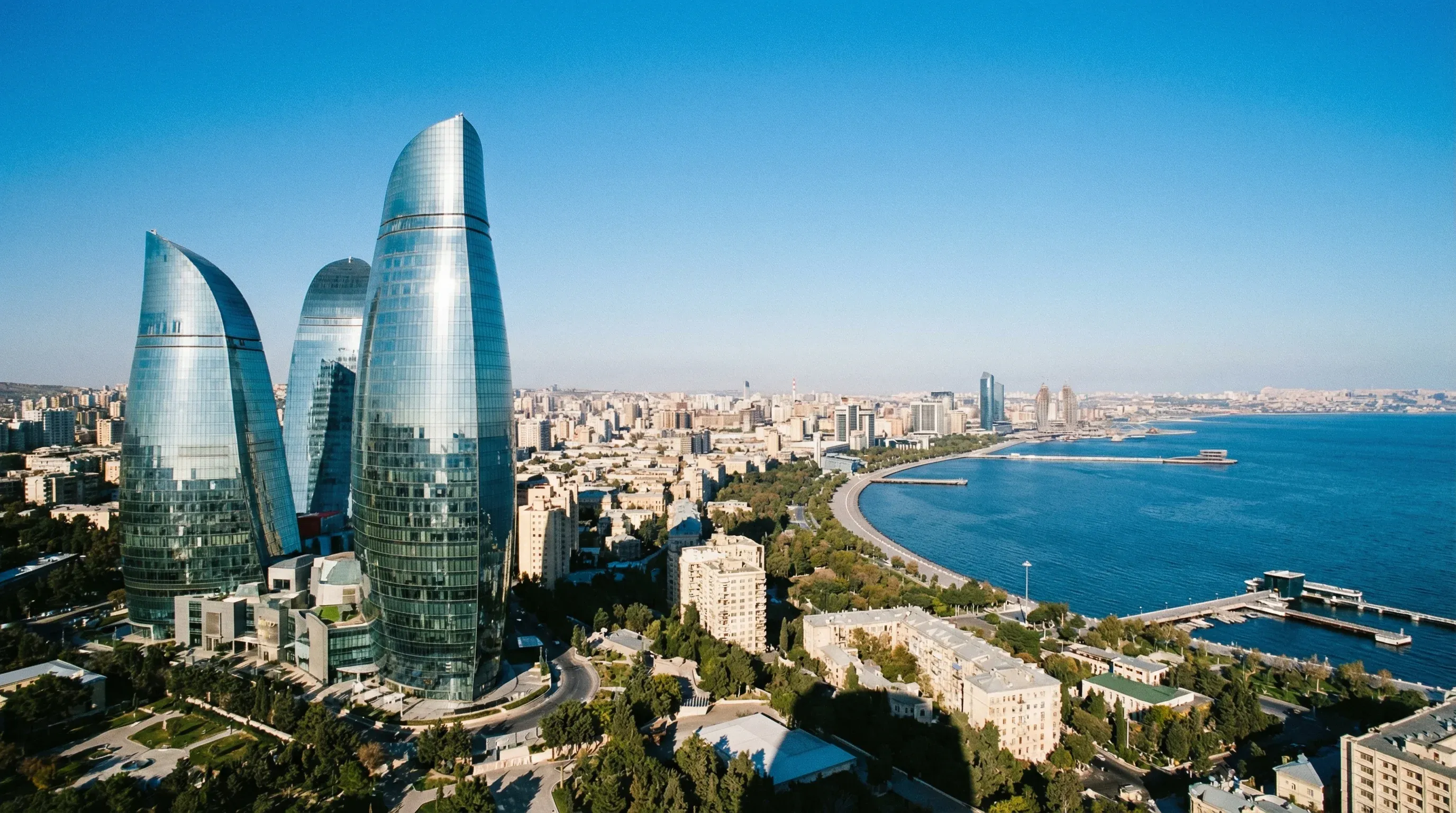

Baku
The City of Winds: Ancient walls and futuristic flames 🏙️🔥
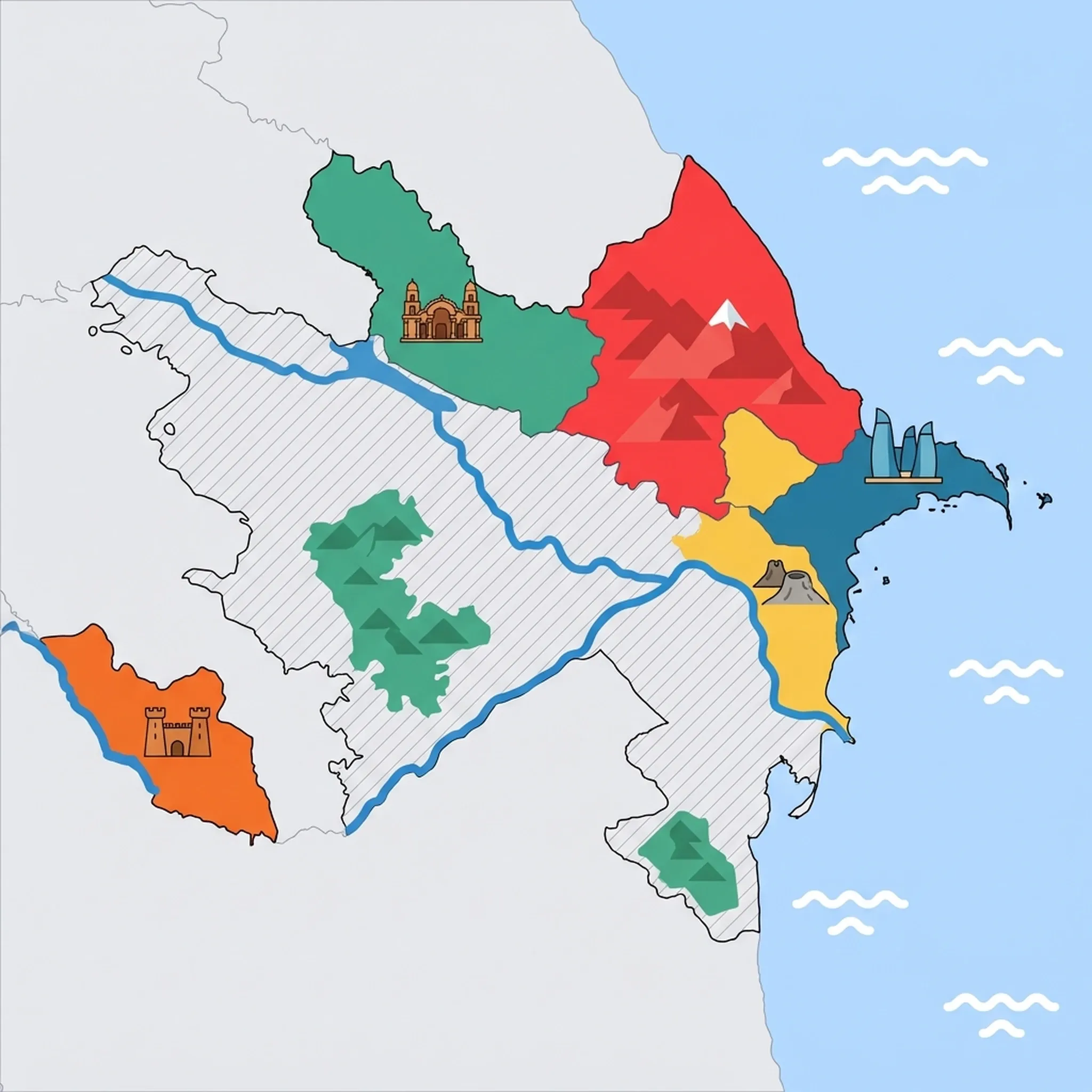
Click a region to explore
Baku is a city of dramatic contrasts that engages children's imaginations immediately. Perched on the edge of the Caspian Sea, the capital offers a sensory mix where the scent of saffron tea competes with the salty sea breeze. For families, Baku is surprisingly navigable and welcoming; the locals adore children, and you will often find restaurant staff entertaining toddlers while parents finish their meals. The city is nicknamed the "City of Winds" for a reason—the Khazri wind blows cold from the north, and the Gilavar blows warm from the south, keeping the air fresh and the skies dramatic.
The urban landscape is a timeline of history. You start in the UNESCO-listed Old City, enclosed by 12th-century crenellated walls, and within minutes you are standing beneath LED-covered skyscrapers that mimic tongues of fire. The broad, pedestrian-friendly Baku Boulevard stretches for miles along the coast, providing a safe, car-free zone where families can rent bikes, ride a Ferris wheel, or simply run off energy. It is a cosmopolitan hub where Europe meets Asia, offering modern malls alongside traditional caravanserais.
Key Attractions
Start your exploration at Icherisheher (Old City). It feels like a living movie set; the narrow cobblestone streets are car-restricted, making them safer for wandering little ones. Inside, the Palace of the Shirvanshahs is a complex of sandstone domes and courtyards that allows children to visualize life as a medieval royal. It is not just a dusty museum; the scale is intimate enough for kids to grasp.
For a complete change of pace, visit the Azerbaijan National Carpet Museum. The building itself is shaped like a giant rolled-up rug, which kids find hilarious. Inside, the exhibits are visually striking, and there are often weaving demonstrations that mesmerize young eyes. Just a short taxi ride away is the Heydar Aliyev Center, designed by Zaha Hadid. Its flowing, white curves possess no sharp angles—children love sliding down the grassy banks outside, and the "Mini Azerbaijan" park nearby displays tiny models of the country's landmarks, making for fantastic photo opportunities.
Practical Advice
The best times to visit are spring (April–June) and autumn (September–October) when the intense summer heat subsides, and the winds are manageable. Strollers are easy to use on the Boulevard and the main shopping streets (Nizami Street), but the Old City's cobblestones can be bumpy—a carrier is better for infants there. Public restrooms are available in malls and museums but can be scarce elsewhere; carry small change (coins) as some park facilities charge a small entry fee.
Food & Drink
Typical meal times: Lunch is typically served from 1:00 pm to 3:00 pm. Dinner is a late affair for locals, often starting from 8:00 pm to 10:00 pm, though restaurants serve tourists earlier.
Typical meal costs: A mid-range family dinner costs roughly 50–90 AZN (approx. $30–53 USD / €27–49 EUR). Street snacks like qutab cost 2–5 AZN (approx. $1.20–3 USD / €1–2.70 EUR).
Dietary requirements: Vegetarian options are decent but require specification. Grilled vegetables (mangal salad) and egg-based dishes (pomidor-yumurta) are common. Gluten-free is harder to guarantee due to the prevalence of bread, but rice plov is a safe staple.
Signature dishes:
- Shah Plov – The "King of Pilafs," encased in a crispy crust of flatbread (gazmaq) and filled with saffron rice, dried apricots, chestnuts, and meat.
- Qutab – Thin, savory pancakes stuffed with pumpkin, greens, or meat, often served with yogurt and sumac; perfect finger food for kids.
- Dushbara – A comforting soup containing tiny dumplings; locals say a good housewife can fit twelve dumplings on a single spoon.
Why this score?
The region is primarily a modern metropolitan area with a well-developed coastal promenade and urban infrastructure. Adventure is limited to light coastal exploration and day trips to the arid outskirts of the Absheron Peninsula, providing very little ruggedness.
Why this score?
Baku offers the country's most advanced medical facilities, including several private international hospitals like Bona Dea that employ English-speaking staff. It serves as the primary medical hub for the country, though specialized care for complex cases is still developing compared to Western standards.
Why this score?
As the national hub and host of major events like Formula 1, Baku receives the vast majority of Azerbaijan's 1.5 million annual visitors. While it is a regional powerhouse with iconic sites like the Flame Towers and Old City, it remains a mid-tier destination on a global scale compared to major European capitals.

Baku caters to all budgets. Luxury hotels are priced internationally, but dining and transport are very affordable. A comfortable family apartment rents for 80–150 AZN (approx. $47–88 USD / €44–82 EUR) per night. Museum entries are modest, typically 10–20 AZN (approx. $6–12 USD / €5.50–11 EUR) per adult.

Getting Here & Around
Getting Here
- Airports – Heydar Aliyev International Airport (GYD) is a modern hub roughly 25km from the center. The Aero Express bus connects to the city, but families usually prefer the affordable "London Taxi" cabs.
- Train – The central Baku Railway Station connects to regional hubs like Ganja and Gabala. It is located directly above the 28 May Metro station.
Getting Around
- Metro – The Baku Metro is extremely cheap and efficient, though deep escalators can be daunting for small children. It does not reach the Icherisheher (Old City) directly inside the walls, but the station is just outside the gates.
- Ride-hailing – Apps like Bolt and Uber are widely used, very affordable, and spare you the hassle of negotiating taxi fares. This is the most family-friendly option.
- Walking – The Baku Boulevard is perfect for walking, but the distances between major sights like the Heydar Aliyev Center and the Old City are too far to walk with small kids.
Nearby Airports (1 airport)
Heydar Aliyev International Airport
GYDBaku
View full flight map for Azerbaijan →
Official Links

Packing List
The 'City of Winds' lives up to its name; strong gusts occur year-round even on sunny days.
The combination of dust and strong wind can irritate children's eyes.
Required for women entering active mosques like Bibi-Heybat; useful for sun protection too.
Baku uses Type C/F plugs (European), which differs from UK/US standards.
If you plan to dip into the mud volcanoes, the grey mud can be difficult to wash out of expensive fabrics.
Essential for visiting mosques and carpeted museums where frequent shoe removal is required.
Baku is famously called the 'City of Winds' and can get very gusty even on sunny days.
To clean up mud after volcano visits and for general hygiene before eating street food like qutab.

Activities & Best Times

Hiking, wildlife, outdoor exploration, ecotourism
The Mud Volcanoes of Gobustan and prehistoric rock art provide unique, high-quality nature and heritage experiences. These semi-arid sites are best explored during mild transitional months to avoid the oppressive heat of July and August and the biting coastal winter winds.

Urban tourism, museums, historical sites, architecture
Baku features a sophisticated juxtaposition of the UNESCO-listed Icherisheher and avant-garde Zaha Hadid architecture, appealing to discerning travelers. Spring and autumn offer ideal temperatures for urban exploration, while summer humidity and winter's notorious winds are less comfortable for walking.

Sport tourism, fitness activities, active recreation
With world-class facilities like the Baku City Circuit and professional shooting centers, the city caters well to sport enthusiasts. Spring and autumn provide the best climate for outdoor cycling and activity, avoiding the extreme heat and peak winter wind chill.

Learning experiences, scientific sites, historical education
The Mud Volcanoes Tourism Complex and specialized natural history museums provide internationally significant learning opportunities for families. Visiting is best aligned with mild weather to facilitate travel to geological sites outside the city center.

Spa retreats, wellness centers, peaceful getaways
Historic hamams like Taza Bey offer an authentic and high-standard wellness experience deeply rooted in local culture. These indoor facilities are most appealing during the cold, windy winter months as a restorative escape.

Scenic drives, countryside tours, route-based travel
Scenic drives such as the Candy Cane Mountain road offer visually unique landscapes on well-maintained infrastructure. Clear visibility and comfortable temperatures in spring and autumn enhance the experience of the Absheron Peninsula's natural highlights.

Beach resorts, marine activities: diving, snorkelling, kite surfing, wind surfing, sailing
Caspian Sea lacks tides, marine biodiversity, and international beach destination appeal. Functional but not competitive with true sea destinations.
Amusement parks, family entertainment venues
Baku Eye and urban entertainment are not comparable to international theme parks. Should be downgraded to marginal.

Attractions (20 total)



Public Holidays & Calendar Next 12 months
Public holidays, festivals, cultural celebrations, and seasonal natural phenomena coming up in Baku over the next 12 months.
Loading holidays and events...

Travel Advisory
All major agencies maintain a consensus that travellers should exercise a high degree of caution in Azerbaijan, primarily due to the ongoing threat of terrorism and the volatile security environment in regions bordering Armenia.
Safety Topics
Traveller Advice (4 groups)

Personnel working near conflict-affected zones should be extremely wary of unmarked landmine fields and avoid travel off paved roads in liberated territories.

Same-sex relationships are not illegal but remain socially taboo. Public displays of affection are generally discouraged and may lead to unwanted attention or discrimination.

Ensure you obtain an e-visa before travel and be aware that land borders are closed; all entry must be by air. Always carry your passport as local police conduct frequent identity checks.

While Baku is cosmopolitan, women should dress more conservatively when travelling to rural regions. Exercise caution when walking alone late at night in less-populated areas.
Agency Summaries
While general conditions are stable, there is a risk of terrorism and civil unrest. The UK government advises against all travel to areas near the Armenian border. Travellers are warned of strict local laws regarding photography and identification.
Increased vigilance is recommended due to terrorism risks. Significant danger exists in border regions with Armenia and former conflict zones due to unexploded ordnance and active military presence. Land borders remain closed for entry.
A high level of vigilance is required due to the threat of terrorist attacks and regional instability. Military activity and landmines make border areas highly dangerous. Foreigners should avoid large gatherings and protests.
New Zealand notes an unpredictable security situation and terrorism threat. Travel to the border with Armenia is extremely dangerous. Public demonstrations should be avoided as they can lead to police intervention.
Travellers should be very vigilant due to the threat of terrorism and volatile security near the Armenian border. All travel is advised against to Nagorno-Karabakh and within 5km of the border with Armenia because of potential armed conflict and landmines.
Ireland advises heightened caution across the country. There is a strong recommendation to avoid the south-western border regions and Nagorno-Karabakh due to the high risk of landmines and intermittent military clashes.
Information is provided for general guidance only and does not constitute travel, safety, medical, or legal advice. Conditions may change. Users are responsible for independently verifying information before travel.