
Sundarbans
Wild adventure in the world's largest mangrove forest 🐅🌳
Click a region to explore
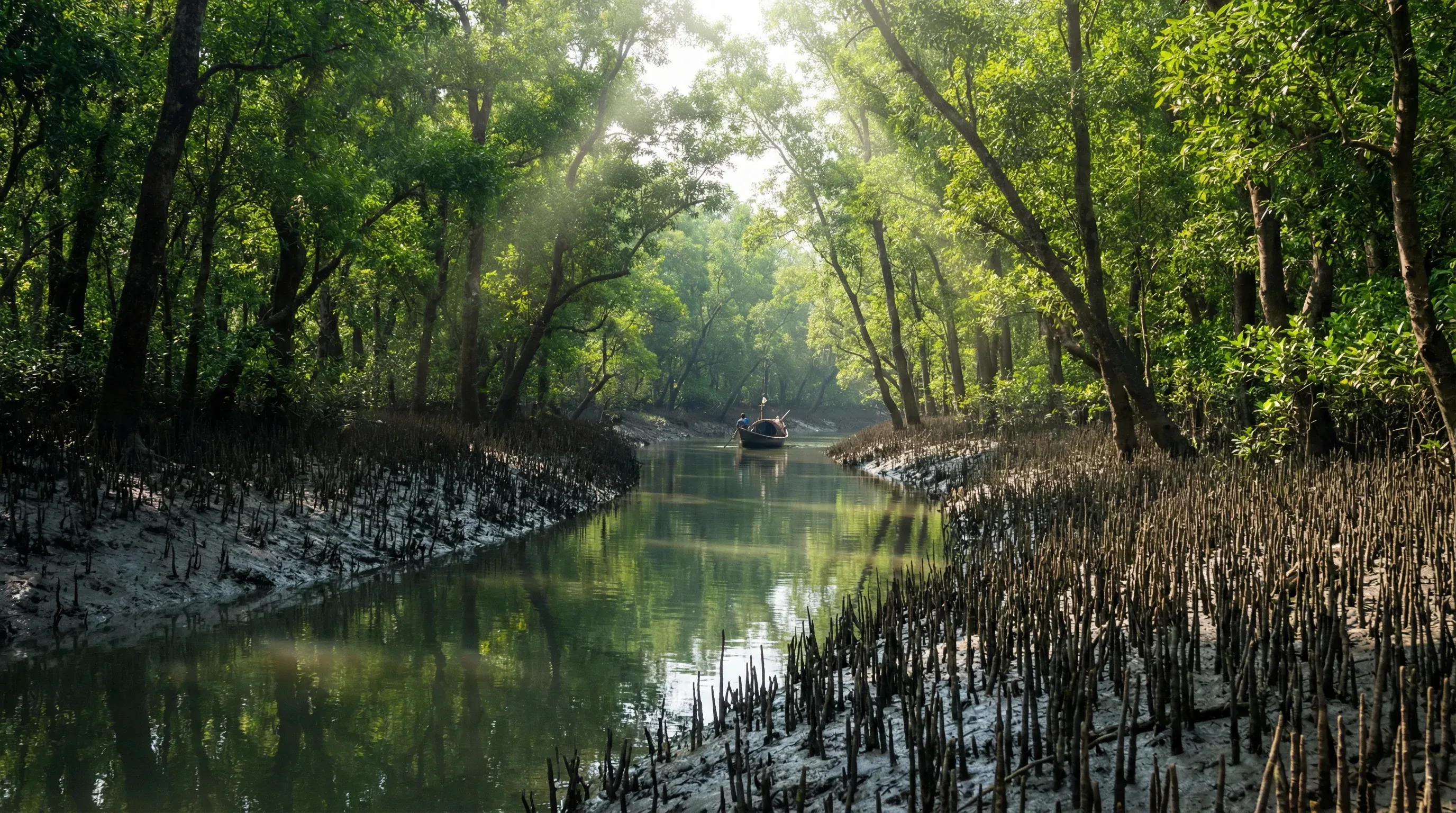
The Sundarbans offers a true jungle adventure that feels like stepping into a storybook. It is a labyrinth of tidal waterways, mudflats, and small islands covered in salt-tolerant mangrove trees. This is not a zoo; it is a raw, breathing ecosystem where nature rules. For families, the primary way to explore is by boat, living on board for a few days while cruising through silent creeks. The sense of isolation and peace is profound, broken only by the call of birds or the splash of a river dolphin.
Visiting the Sundarbans is an educational journey. Children learn about the delicate balance of the ecosystem, the brave 'mouals' (honey collectors), and the unique 'pneumatophores' (breathing roots) that stick out of the mud. While spotting a tiger is rare and requires luck, the forest is teeming with other life. Spotted deer graze by the water's edge, crocodiles bask on sunny banks, and monitor lizards scuttle through the undergrowth. It is a place that teaches patience and observation.
Key Attractions
The journey often begins near Bagerhat, home to the UNESCO-listed Sixty Dome Mosque (Shat Gombuj Masjid). This 15th-century architectural marvel with its thick walls and terracotta unmatched in the region is a perfect history lesson before entering the wild. Inside the forest, Kotka Beach is a popular stop where deer are frequently seen and families can walk on a wild, muddy beach (swimming is not advised due to currents and wildlife).
Harbaria Eco-Tourism Centre offers a safer, raised wooden walkway that lets families walk through the forest above the mud, minimizing risk while maximizing visibility. Karamjal is the most accessible point, essentially a mini-zoo and breeding center where kids can definitely see crocodiles and deer up close if they don't spot them in the wild.
Practical Advice
The only way to visit is via an organized tour operator. Day trips are possible but exhausting; a 3-day/2-night boat tour is best. The best season is winter (October to March). Avoid the monsoon (June–September) when waters are rough.
Food & Drink
Typical meal times: On boat tours, meals are strictly scheduled. Breakfast at 8:00 am, Lunch at 1:30 pm, Dinner at 8:30 pm.
Typical meal costs: Food is almost always included in the tour package price. Independent meals in Khulna city cost BDT 300–600 (approx. $2.50–5.00 USD / €2.30–4.80 EUR).
Dietary requirements: Tour operators can cater to vegetarians if notified in advance. The menu is usually local Bengali cuisine (rice, fish curries, vegetables).
Signature dishes:
- Shrimp/Prawn Curry – The Khulna region is famous for freshwater golda chingri (prawns) and saltwater bagda chingri (shrimp).
- Sundarbans Honey – Not a meal, but a signature product. It is dark, thin, and has a distinct wild floral taste.
- Chepa Shutki – Fermented fish preparations are common in the gateway cities.
Why this score?
Exploring the world's largest mangrove forest requires multi-day boat expeditions into tiger and crocodile habitat. The lack of land-based roads and the extreme isolation of the delta's interior make it one of the most adventurous regions in South Asia.
Why this score?
On-site medical care is virtually non-existent once a boat enters the deep forest reserves, with evacuation to a city taking many hours. Tour operators typically only carry basic first-aid kits, and there are no modern hospitals within the immediate forest vicinity.
Why this score?
Despite its status as a UNESCO World Heritage site and a global ecological icon, the logistical complexity of boat-based travel keeps international visitor numbers low. Most visitors are dedicated eco-tourists or domestic travelers on group river cruises.

Costs depend entirely on the tour package. A budget 3-day boat tour costs BDT 10,000–15,000 (approx. $85–130 USD / €80–120 EUR) per person. Luxury cruises with AC cabins can cost BDT 25,000–40,000 (approx. $215–345 USD / €200–320 EUR). Children under 5 are often free or 50%. Tips for boat staff are expected.

Getting Here & Around
Getting Here
- Bus – AC buses run from Dhaka to Khulna (the gateway city). The journey takes 8–9 hours via the Padma Bridge.
- Train – The 'Sundarban Express' and 'Chitra Express' run from Dhaka to Khulna. It is a comfortable 9-hour journey.
- Airports – Fly to Jashore (Jessore) Airport (JSR), then take a 1.5-hour car transfer to Khulna.
Getting Around
- Tourist Boat – The only way to explore the forest. These range from small launches to luxury cruisers with AC cabins.
- Country Boat – Small, silent wooden rowboats are attached to the main cruisers for entering narrow creeks where engines are forbidden.
- Walking – Only allowed in designated spots like Harbaria or Kotka, and always with an armed forest guard.
Nearby Airports (2 airports)
Barisal Airport
BZLBarisal
Jessore
JSRJessore
View full flight map for Bangladesh →

Packing List
Wildlife (deer, birds, tigers) is often spotted from a distance on the boat.
Bright colors startle wildlife; wear greens, browns, and beiges.
Walking trails can be slippery and muddy; flip-flops will get stuck.
No ATMs in the forest; needed for tips and small purchases at village stops.
Hotels in remote areas may not provide them, and dengue/malaria protection is vital.
You will frequently remove shoes when entering homes, mosques, and some shops.
Running water and soap are not always available in public restrooms or roadside stops.
Essential for quick recovery from dehydration due to heat or stomach upsets.
Power outages (load shedding) are common, especially outside the capital.
Dhaka is one of the loudest cities in the world; essential for sleeping and sensory relief.

Activities & Best Times

Hiking, wildlife, outdoor exploration, ecotourism
As the world's largest mangrove forest and home to the Royal Bengal Tiger, this region offers a unique and authentic wilderness experience via boat-based expeditions. Peak months correspond with the dry, cooler season which is optimal for wildlife sightings, while the monsoon brings extreme humidity and navigational hazards.

Urban tourism, museums, historical sites, architecture
Bagerhat mosque city is a single historic site complex in a remote mangrove region. While UNESCO-listed and significant, this doesn't constitute a 'very_good' city/cultural destination by international standards. Tourists visit Sundarbans for nature, not urban culture.

Beach resorts, marine activities: diving, snorkelling, kite surfing, wind surfing, sailing
Jamtola and Katka are muddy mangrove beaches for wildlife watching, not recreational beach experiences. Accessed by boat through tiger habitat. Misleading to rate as 'good' when compared to actual beach destinations.

Learning experiences, scientific sites, historical education
The Karamjal Wildlife Breeding and Ecotourism Center offers destination-level learning about mangrove ecosystems and crocodile conservation. While significant for the region, it is typically visited as part of a broader nature tour during the accessible winter months.

Sport tourism, fitness activities, active recreation
Tiger-tracking routes are guided boat tours through mangroves, not hiking trails or sports activities. This is ecotourism/wildlife watching. Limited sports/active infrastructure.




Public Holidays & Calendar Next 12 months
Public holidays, festivals, cultural celebrations, and seasonal natural phenomena coming up in Sundarbans over the next 12 months.
Loading holidays and events...

Travel Advisory
The security situation in Bangladesh is categorized by significant volatility following a period of civil unrest and political transition. Major international agencies are evenly split between recommending extreme caution (L1) and advising travelers to reconsider the necessity of their visit (L2). The higher assessment (L2) reflects persistent concerns regarding terrorism, kidnapping in regional areas, and the unpredictability of violent protests.
Safety Topics
Traveller Advice (5 groups)

Be aware that verbal and physical harassment is commonly reported. It is advised to dress modestly, avoid travelling alone at night, and stay away from isolated or poorly lit areas.

Companies are advised to provide private security escorts for personnel traveling outside of major hotels or business districts in Dhaka. Ensure insurance policies specifically cover civil unrest and terrorism.

Stay away from all political gatherings, demonstrations, and large crowds as they can escalate into violence without warning. Closely monitor local news and follow the guidance of security forces.

There is a heightened risk of kidnapping and politically motivated violence in the Chittagong Hill Tracts. Dedicated security protocols and local government notification are essential for travel to these regions.

Same-sex relationships are illegal and can lead to criminal prosecution. Societal attitudes are generally conservative, and public displays of affection may attract negative attention or legal risk.
Agency Summaries
Due to persistent civil unrest, the threat of terrorism, and the potential for large gatherings to become violent, travelers should reconsider the necessity of their trip to the country.
While the 2026 national election period has concluded, the potential for political rallies and sudden unrest remains. Irish citizens are advised to exercise heightened alertness and avoid all demonstrations.
The government recommends avoiding non-essential travel to specific districts like the Chittagong Hill Tracts. Elsewhere, visitors should be alert to shifting security conditions and the likelihood of terrorist activity.
Significant security and safety concerns, including the threat of terrorism and civil disorder, necessitate a recommendation to avoid all but essential travel to the country.
Travelers are urged to rethink their plans to visit Bangladesh because of significant risks related to crime, terrorism, and civil instability. Specific regions carry a higher danger level of 4 (Do Not Travel).
Visitors should maintain a high level of vigilance due to a volatile security environment, frequent political demonstrations, and the risk of civil unrest. A regional advisory is in effect for the Chittagong Hill Tracts.
Information is provided for general guidance only and does not constitute travel, safety, medical, or legal advice. Conditions may change. Users are responsible for independently verifying information before travel.