

⚠️ SAFETY WARNING: Due to the ongoing regional conflict, arbitrary enforcement of laws, and the risk of sudden border closures, government agencies (including the US, UK, Canada, Australia, Ireland, and New Zealand) advise travelers to avoid all travel (L3/L4) to Belarus. The security situation is unpredictable, and western consular assistance is extremely limited or unavailable. Families are strongly urged to consult their own government's official travel advisory before considering a trip, as circumstances and risk assessments vary.
Known as the "blue-eyed country" for its thousands of glacial lakes, Belarus is a flat, forested land where nature and history intertwine. Unlike its busier neighbours, it offers a quieter, off-the-beaten-path atmosphere where vast primeval woodlands meet well-kept Soviet-style avenues. For families who do visit, the country reveals a rich tapestry of Slavic folklore, from the wooden farmsteads of Minsk & Central Belarus to the marshes of Gomel & Polesie. The climate is continental, with warm, green summers perfect for lakeside camping and snowy winters that transform the landscape into a scene from a storybook.
Culturally, Belarus is a bridge between East and West, though currently leaning heavily East. Families will find a strong emphasis on traditional crafts, music, and wholesome food. The capital, Minsk, is remarkably clean and spacious, featuring expansive parks, a world-renowned circus, and wide pedestrian areas safe for children. Outside the cities, the pace slows significantly; rural tourism (agrotourism) is highly developed, allowing families to stay in wooden cottages, learn pottery, or simply enjoy the pristine countryside of the Belarusian Lakeland.
Key Attractions
The country's crown jewels are its UNESCO-listed castles. The Mir Castle Complex is a 16th-century masterpiece mixing Gothic, Baroque, and Renaissance styles that children will love exploring, from the towers to the courtyard. Just a short drive away, the Nesvizh Castle offers a more palatial experience with vast landscaped gardens and opulent interiors that tell the story of the powerful Radziwill family.
For a deep dive into nature, Belovezhskaya Pushcha National Park in the Brest & Belovezhskaya Pushcha region is unmissable. It is the last remnant of the primeval forest that once covered Europe and home to the European bison. Deep within the woods lies the Estate of the Belarusian Father Frost, a year-round attraction where children can meet the Belarusian equivalent of Santa Claus in his magical residence. Nearby, the Brest Hero-Fortress Memorial Complex provides a sombre but visually striking history lesson suitable for older children.
Near the capital, the Dudutki Museum of Folk Crafts is a fantastic open-air museum where families can watch potters, blacksmiths, and bakers at work, and even taste fresh local produce. For a relaxing day out, the Gorky Park in Minsk offers classic amusement rides and leafy walking paths along the river.
Practical Advice
Money & Sanctions: This is the most critical logistical challenge. Most Western credit cards (Visa/Mastercard) do not work in Belarus due to sanctions. You must bring enough cash (USD or EUR) for your entire trip. Bills must be crisp, new (post-2009 for USD), and undamaged, or exchange offices will reject them.
Visas & Borders: Citizens of many European countries (including UK and EU) can currently enter visa-free via land borders for up to 30 days, but queues can take 10–20 hours. Check the latest rules immediately before travel. Mandatory medical insurance must be purchased at the border (approx. €2–5 EUR).
Food & Drink
Typical meal times: Lunch is the main meal, typically taken between 1:00 pm and 2:00 pm. Dinner is usually eaten between 7:00 pm and 9:00 pm.
Typical meal costs: 30–50 BYN (approx. $9–15 USD / €8–14 EUR). Cafeterias (stolovaya) are much cheaper, while upscale Minsk restaurants will cost more.
Dietary requirements: Belarusian cuisine is heavy on meat, potatoes, and dairy. Vegetarians will find options like potato pancakes and salads, but vegan food is rare outside trendy Minsk cafes. Gluten-free awareness is low in rural areas.
Family-friendly dining: Restaurants are generally welcoming to children. Many larger venues in Minsk have designated play corners (detskaya komnata).
Signature dishes:
- Draniki – Crispy potato pancakes served with sour cream or mushroom sauce; the absolute national staple.
- Kholodnik – A cold beetroot soup made with kefir, cucumber, and dill, refreshing in summer and often served with a boiled egg.
- Machanka – A rich pork stew (usually ribs and sausage) served with thick crepes for dipping.
- Kletski – Boiled potato dumplings, sometimes stuffed with meat or onions, offering a hearty, kid-friendly texture.
Safety
Strict laws govern public behaviour. Avoid photographing government buildings, police, or military personnel. Do not wear political colours (red and white combinations) or participate in any gathering that could be construed as a protest. Police checks can be frequent; always carry your passport. Drug laws are extremely severe with zero tolerance. If you enter via a land border, ensure you have the correct stamps. The border with Ukraine is closed and dangerous; do not approach it.

Travel costs are low by Western standards, though inflation is present. A family of four can expect to spend around 250–350 BYN (approx. $75–105 USD / €70–100 EUR) per day for mid-range accommodation, meals, and entry fees. Cash is essential as foreign cards rarely work.
Age Suitability
Did you know? Belarus welcomes approximately 1.5 million international visitors per year. Most visitors come from Europe.
Explore Regions
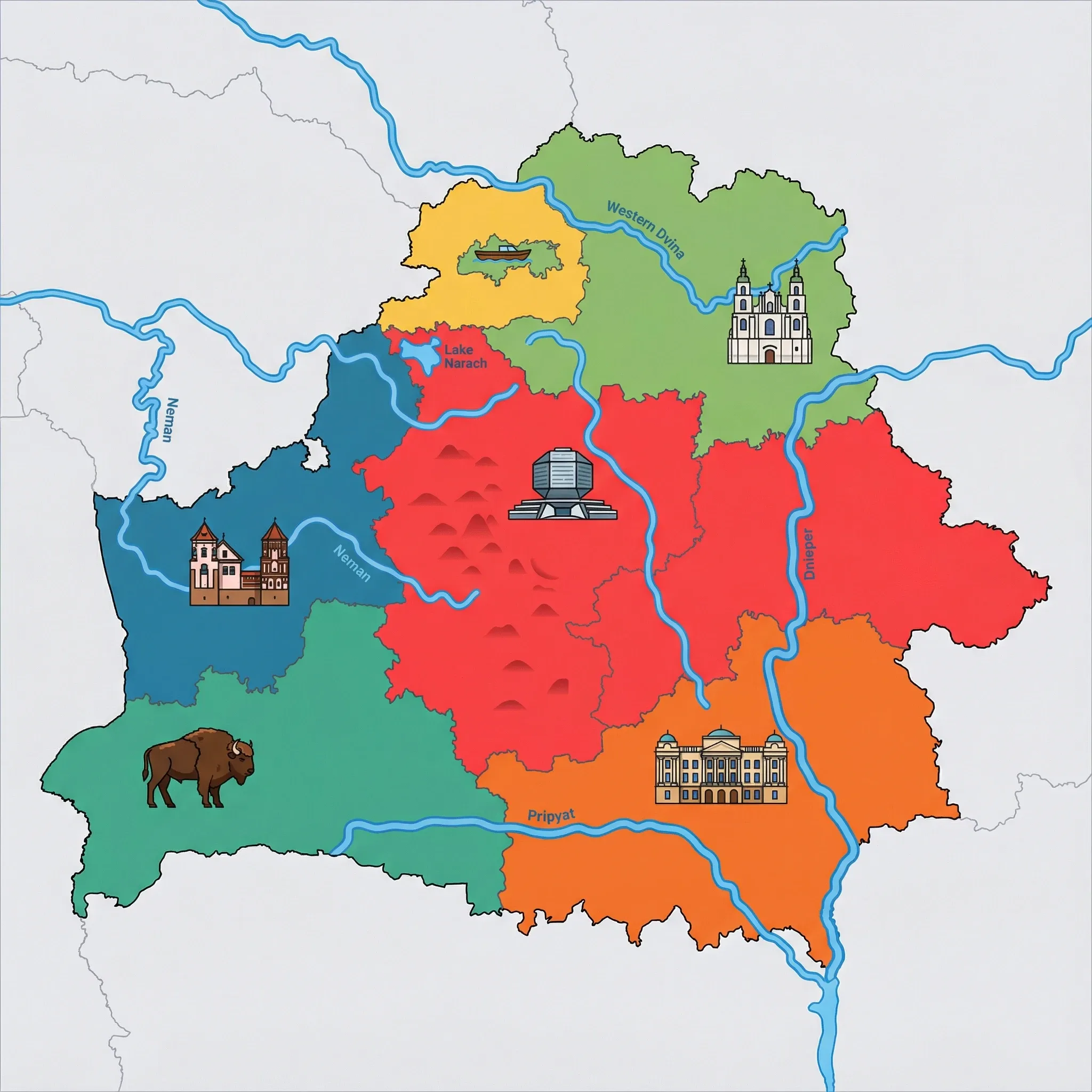
6 Regions
Belarusian Lakeland
A pristine sanctuary of glacial lakes and ancient pine forests 🌲💧
Brest & Belovezhskaya Pushcha
Ancient primeval forests and legendary fortresses 🦬🏰
Gomel & Polesie (Pripyat Marshes)
The mysterious marshlands and golden palaces of the south 🌿🛶
Minsk & Central Belarus
The vibrant capital surrounded by rolling hills and heritage 🏙️🎡
Vitebsk & Historic North
The cultural capital of festivals and ancient cathedrals 🎨⛪
Western Castles & Grodno
Fairytale castles and royal history on the western frontier 🏰👑
Click on a region marker to explore details. Use the dropdown to color regions by activity suitability.

Getting There & Around
Getting There
- By Air – Direct flights from Western Europe are currently suspended. Most travellers fly via Istanbul, Dubai, or Tashkent to Minsk National Airport (MSQ).
- By Land – Bus services run from Vilnius (Lithuania) and Warsaw/Biała Podlaska (Poland) to Minsk and Brest. Warning: Border crossing times are unpredictable and can exceed 24 hours. Some crossings may close without notice.
- Entry Requirements – Citizens of 38 European countries (including UK & EU) can currently enter visa-free via land borders for up to 30 days. US citizens usually require a visa or must use the airport visa-free regime (if flights allow). Mandatory state medical insurance must be bought at the border. Check your government website for the latest visa requirements, or use the IATA Travel Centre entry-requirements checker.
Getting Around
- Car Hire – Essential for visiting rural national parks like Belarusian Lakeland. An International Driving Permit (IDP) is required. Note that fuel is cheap, but rental agencies may not accept foreign credit cards for deposits.
- Trains – The state rail network (BC) is reliable, safe, and very cheap. It connects major hubs like Minsk, Brest, and Gomel. Sleeper trains are an adventure for kids.
- Marshrutkas – These private minibuses are faster than trains and cover routes to smaller towns like Mir and Nesvizh. You usually pay the driver in cash.
- City Transport – Minsk has an efficient metro, bus, and tram network. Tickets are very cheap (approx. 0.85 BYN). Children under 7 travel free.

Packing List
Foreign cards rarely work; exchange bureaus reject bills with even tiny tears or marks.
Legally mandatory for pedestrians to wear reflective items in the dark; fines apply.
GPS signals can be jammed near borders/military zones and roaming is expensive.
Border guards often require physical proof of medical insurance, not digital copies.
Border crossings can take 10-20+ hours with no access to charging points.

Activities & Best Times

Adventure & Nature
ExcellentHiking, wildlife, outdoor exploration, ecotourism
Known as the 'Amazon of Europe', the Pripyat Marshes offer an authentic wilderness experience with unique spring flooding and exceptional biodiversity. May and June provide peak birdwatching and boating through flooded forests, while September offers crisp air and autumn colors for trekking.
The Augustow Canal and Karobchytsy agrotourism complex provide unique opportunities for river exploration and rural immersion in a pristine landscape. The short summer window offers the best conditions for outdoor activities and wildlife observation.
The region features a unique post-glacial landscape with the Braslav Lakes National Park and Safari Park offering authentic wildlife encounters and rugged trekking. Peak summer provides the necessary warmth and accessibility for exploring the water-rich ecosystems and the Slobodka Esker Ridge.

City & Cultural
Very GoodUrban tourism, museums, historical sites, architecture
Home to the UNESCO-listed Mir Castle and the historic city of Grodno, this region offers a sophisticated mix of Grand Duchy heritage and well-preserved architecture. Peak visitation occurs from late spring through early autumn when gardens are in bloom and walking conditions are optimal.
Minsk offers a unique mix of Soviet-era architecture and world-class museums, while nearby Nesvizh Castle provides UNESCO-listed heritage. Late spring and early autumn provide comfortable walking conditions for exploring urban landmarks and botanical gardens.
The Gomel Palace and Park Ensemble is a standout neoclassical site of international quality, complemented by the hilly, historic charm of Mozyr. Spring and early autumn offer the most pleasant atmosphere for exploring the region's architectural heritage and manicured urban parks.

Sports & Active
Very GoodSport tourism, fitness activities, active recreation
Well-developed cycling routes like AvgustVelo and infrastructure for kayaking on the Augustow Canal cater to active families. Peak season aligns with the warmest, driest months suitable for long-distance cycling and water sports.
The region offers established cycling and hiking routes through the Braslav Lakes National Park and specialized adventure centers. Ideal infrastructure is most accessible during the warm, dry summer months; shoulder months are cooler but suitable for active pursuits.
The region maintains dedicated cycling and hiking infrastructure, notably the Slobodkovskaya Ozernaya Gryada trail and specific lake-circuit routes. Activity is strictly seasonal, with peak conditions restricted to the dry and warm summer months.

Educational & Exploratory
GoodLearning experiences, scientific sites, historical education
Includes the significant Museum of Nature and the outdoor Museum of Railway Technology, offering deep dives into local ecology and engineering. These facilities are most engaging during the warmer months when outdoor exhibits are comfortably accessible.
Specialized venues like the Grodno Pharmacy Museum offer niche historical insights, though they are secondary to the city's broader cultural appeal. Most families visit these indoor facilities during the primary tourism season when combined with castle tours.
Local museums and the Yelnya Ecological Visit-Center offer insights into the region's unique glacial formation and conservation efforts. These facilities lack the scale of major international centers but provide useful context during the primary summer visiting season.

Road Trips & Scenic
GoodScenic drives, countryside tours, route-based travel
The Castle Road of Belarus provides a structured and scenic touring route connecting the region's major fortifications and historical estates. Optimal driving conditions and visibility are found during the brighter, snow-free months from May to September.
The Braslav Lakes Scenic Loop and the Ancient Northern Road offer picturesque driving through a landscape of over 300 lakes and hills. Optimal driving conditions and visibility occur in summer and during the autumn foliage peak in September and October.
The Castle Route (Minsk-Mir-Nesvizh) offers a high-quality driving experience through historic landscapes on well-maintained roads. May, June, and September offer the best visibility and scenic rural vistas before the harsh winter season sets in.
Ski & Snow
GoodWinter sports, ski resorts, snow activities
Silichy and Logoysk provide modern infrastructure for skiing and snowboarding, though they lack the elevation of major alpine resorts. Reliability of snow coverage is highest in January and February, supported by artificial snow-making facilities.
Small-scale winter sports centers like Korobchitskiy Olimp provide basic skiing and snowboarding facilities for the local market. The season is highly dependent on sub-zero temperatures, usually peaking in January and February.
Small-scale winter sports facilities like the Mozyr Alpine Skiing Center offer basic downhill skiing and tubing for families, though snow reliability is inconsistent. The season is short and appeals primarily to local travelers rather than international ski enthusiasts.
Theme Park & Entertainment
GoodAmusement parks, family entertainment venues
Karobchytsy offers a high-quality regional theme park experience centered on folklore and rural life, complemented by several modern aquatic centers. Families typically visit during the summer months when outdoor attractions and splash parks are fully operational.
Home to Lebyazhiy Water Park, one of the largest in Eastern Europe, and classic Soviet-style amusement parks like Gorky Park. Peak season aligns with school holidays and warm weather when outdoor rides and aquatic facilities are fully operational.
Regional water parks in Zhlobin and Gomel, alongside the unique Lyaskovichi Safari Park, provide solid family entertainment. These facilities are most enjoyable during the warm summer months when outdoor amusement rides and safari drives are fully operational.

Festivals & Seasonal
MarginalEvents, celebrations, seasonal attractions

Public Holidays & Calendar Next 12 months
Public holidays, festivals, cultural celebrations, and seasonal natural phenomena coming up in Belarus over the next 12 months.
Loading holidays and events...
Climate & Weather
Belarusian Lakeland
Show Details
| Month | Temp °C | Rain | Humidity |
|---|
Brest & Belovezhskaya Pushcha
Show Details
| Month | Temp °C | Rain | Humidity |
|---|
Gomel & Polesie (Pripyat Marshes)
Show Details
| Month | Temp °C | Rain | Humidity |
|---|
Minsk & Central Belarus
Show Details
| Month | Temp °C | Rain | Humidity |
|---|
Vitebsk & Historic North
Show Details
| Month | Temp °C | Rain | Humidity |
|---|
Western Castles & Grodno
Show Details
| Month | Temp °C | Rain | Humidity |
|---|

Travel Advisory
All major international agencies maintain their highest risk rating for Belarus. Extreme caution is required due to the country's involvement in the Ukraine conflict, the high risk of arbitrary political detention, and the lack of accessible consular services.
Safety Topics
Traveller Advice (3 groups)

Dual citizens are treated exclusively as local nationals and may be subject to mandatory military service or travel bans when attempting to leave. All visitors should assume electronic devices and communications are monitored by authorities.
Severe restrictions apply to non-governmental activities, and staff may face legal action or detention for participating in programs not explicitly approved by the regime.
Media professionals are at heightened risk of targeted harassment and arrest for any reporting deemed critical of the administration. Accreditation does not guarantee safety from prosecution.
Agency Summaries
Ongoing volatility in the security environment and the risk of harsh penalties for vaguely defined crimes make travel extremely dangerous. Travelers are urged to depart immediately while commercial options remain available.
Travel is strongly discouraged due to the risk of arbitrary detention, the presence of Russian military forces, and the possibility of localized civil unrest. Consular services have been suspended following the closure of the embassy in Minsk.
Irish citizens are warned against all travel due to the high risk of detention and the unstable regional security situation. Consular assistance is only available through the embassy in Lithuania.
Avoid visiting the country due to the ongoing regional conflict and the unpredictable enforcement of local laws. The Canadian government provides extremely limited consular assistance through its embassy in Poland.
A maximum level warning is in place due to Russian military activity and the high risk of arbitrary law enforcement. Departure routes are limited, and the government has no diplomatic presence to assist citizens.
British nationals face a high risk of arrest for past or present political activities. The security situation is volatile due to the war in neighboring Ukraine, and official support for travelers is severely restricted.
Information is provided for general guidance only and does not constitute travel, safety, medical, or legal advice. Conditions may change. Users are responsible for independently verifying information before travel.