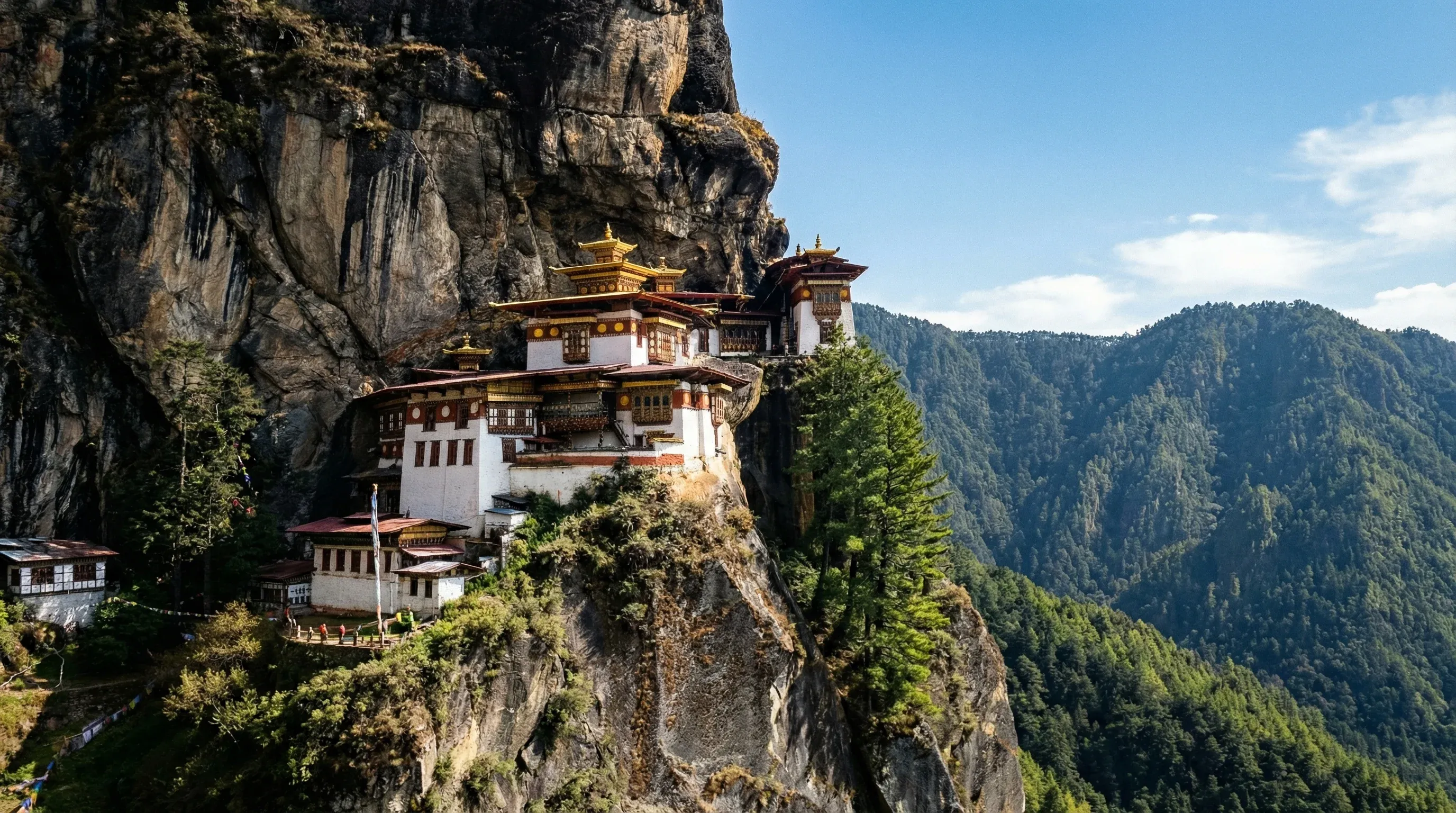

Paro (Tiger's Nest)
Where your Himalayan adventure begins and history clings to the cliffs 🐅
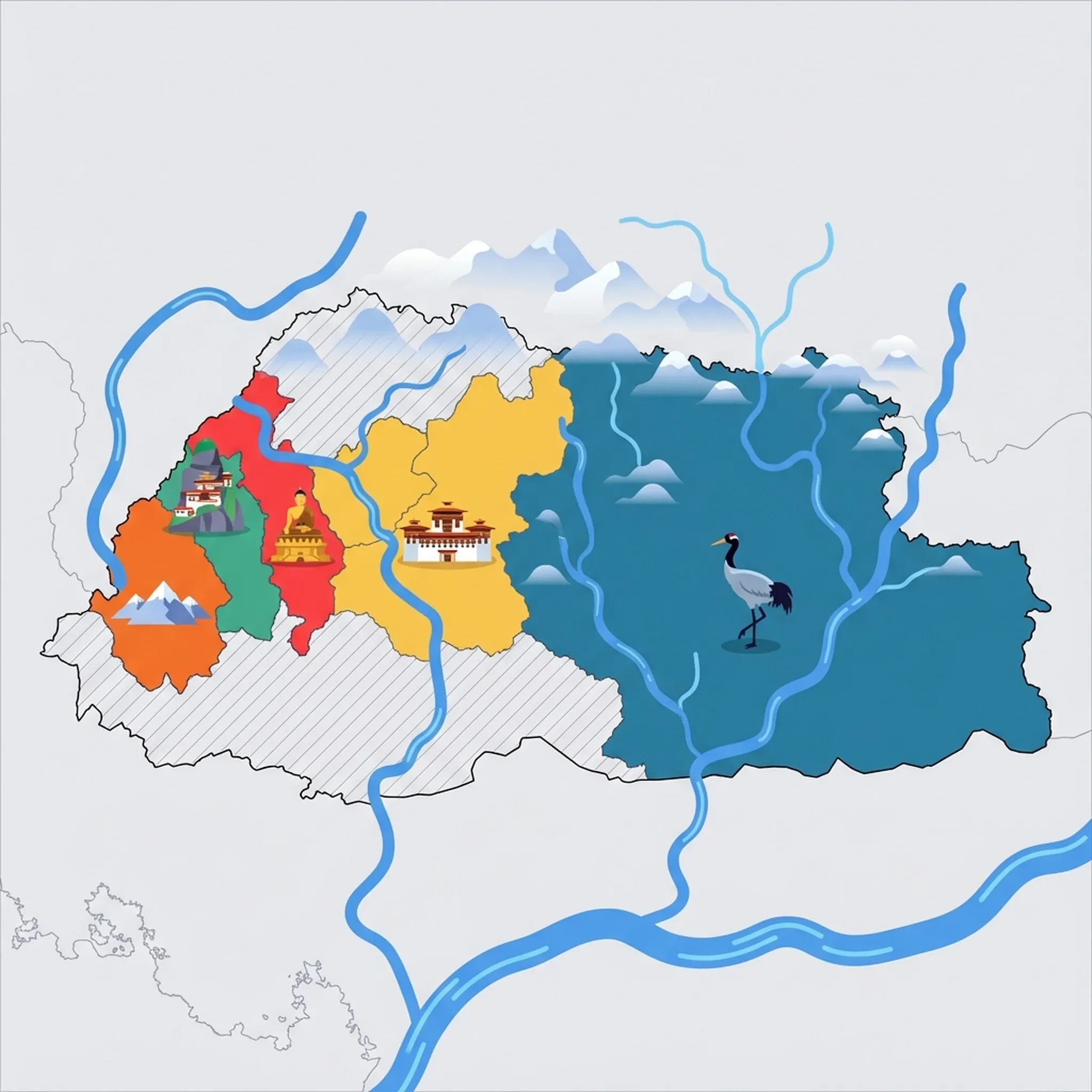
Click a region to explore
Safety Note: The hike to Tiger's Nest is strenuous and reaches high elevations (over 3,000m). Watch children carefully on the narrow paths near the top, and do not attempt the full hike if you are suffering from altitude sickness.
Overview
Paro is likely the first and last place families will see in Bhutan, as it houses the only international airport. Unlike the chaotic arrival experience in many capital cities, landing in Paro is breathtaking—the plane weaves through the valley, passing close to green hillsides and traditional farmhouses. This sets the tone for the region: a blend of dramatic nature and deep-rooted culture. The valley itself is wide and flat, covered in a patchwork of rice paddies that turn vibrant green in spring and golden in autumn. It is one of the most fertile areas in the country, and the traditional architecture here is among the finest, with intricate wooden window frames adorning almost every building.
For families, Paro strikes the perfect balance. It has the infrastructure (good hotels, cafes, souvenir shops) but retains a village feel. It is the base for Bhutan's most famous adventure—the hike to the Tiger's Nest—but it also offers easier pleasures. You can try your hand at traditional archery (the national sport) in local fields, visit the National Museum housed in an ancient watchtower, or simply wade in the crystal-clear waters of the Pa Chhu river. The proximity to the airport reduces travel stress, making it an ideal anchor for the beginning or end of a family trip.
Key Attractions
The undisputed highlight is Paro Taktsang (Tiger's Nest). Legend says Guru Rinpoche flew here on the back of a tigress to subdue a demon. For families, the hike is a challenge but a rewarding one. You can hire ponies to carry children (and tired adults) up to the cafeteria, which is the halfway point offering stunning views. From there, it is a walk on stone steps. It is a full-day adventure that kids will brag about when they get home.
Back on the valley floor, Rinpung Dzong ('Fortress on a Heap of Jewels') is a must-visit. It is accessible via a beautiful traditional cantilever bridge that is perfect for family photos. The Dzong's courtyards are spacious, and the monks are often friendly to respectful children. Just above the Dzong is the National Museum of Bhutan, which has curious masks and natural history exhibits that explain the country's unique flora and fauna, including the mythical Yeti. To the north, the ruins of Drukgyel Dzong offer a great open space for kids to run around and explore ancient fortifications with fewer restrictions than active monasteries, all with the backdrop of Jigme Dorji National Park's peaks.
Practical Advice
Plan the Tiger's Nest hike for the end of your trip, not the beginning. This allows your body to acclimatize to the altitude, making the climb much easier and more enjoyable. Paro has the best shopping for souvenirs, so save your luggage space for the final days here. The weather is generally mild, but afternoons can get windy.
Food & Drink
Typical meal times: Lunch 12:30 pm to 2:00 pm, Dinner 7:00 pm to 9:00 pm. Paro has many tourist-standard restaurants.
Typical meal costs: Tourist buffets are standard. A la carte in town: BTN 500–900 (approx. $6.00–10.80 USD / €5.50–10.00 EUR).
Dietary requirements: excellent for vegetarians. Western options (pizza, pasta) are readily available in Paro town for fussy eaters.
Signature dishes:
- Ema Datshi – The ubiquitous chili and cheese stew. In Paro, it is often served with ample red rice.
- Shakam Paa – Dried beef cooked with dried chilies and radish. It is chewy, jerky-like, and rich in flavor.
- Red Rice – Paro is famous for its red rice paddies; the nutty, pink-hued rice here is the freshest in the country.
Why this score?
The steep, high-altitude hike to Paro Taktsang (Tiger's Nest) provides a significant physical challenge for families, reaching an elevation of over 3,000 meters. The region also serves as the trailhead for several multi-day treks, including the Druk Path, though the town itself offers high-end luxury lodge comforts.
Why this score?
Paro has decent medical facilities by national standards, including a district hospital that frequently handles minor tourist ailments and hiking injuries. However, for serious conditions, patients are usually transferred to the more advanced national referral hospital in nearby Thimphu.
Why this score?
As the site of Bhutan's only international airport and the world-famous Tiger's Nest Monastery, Paro is the most visited region in the country. While Bhutan's total tourist numbers are low globally, Paro is a well-recognized bucket-list destination for international hikers and spiritual seekers.

Paro is one of the more expensive districts due to the concentration of high-end luxury resorts (like Amankora and Como). However, standard tourist hotels are included in the daily package. Souvenirs here are pricier than in Thimphu. Entry to Tiger's Nest is BTN 1,000 (approx $12 USD / €11 EUR) for adults, usually included in tour costs.

Getting Here & Around
Getting Here
- Airports – Paro International Airport (PBH) is the sole entry point by air. Flights arrive from Bangkok, Delhi, Kathmandu, Kolkata, and Singapore. The approach is thrilling and scenic.
- Driving – Connected to Thimphu via a well-maintained double-lane highway (approx. 1 hour).
Getting Around
- Car – Your tour vehicle will take you to all trailheads and sites. The valley roads are good.
- Walking – Paro town is small and walkable. The hike to Paro Taktsang (Tiger's Nest) is on foot or pony only. Ponies cost approx BTN 800–1000 ($10–12 USD) to the halfway point.
Nearby Airports (1 airport)
Paro
PBHParo
View full flight map for Bhutan →
Official Links

Packing List
Saves knees on the steep descent from Tiger's Nest.
The sun at high altitude is intense during the Tiger's Nest hike.
To carry water and layers; you cannot leave bags on the pony.
Paro has many stray dogs that bark at night (barking is a national issue).
Roads are famously winding with endless hairpin turns; essential for kids even if they don't usually get car sick.
You must remove shoes at every temple and dzong. Laces become frustrating after the fifth stop of the day.
Currency exchange is strict; notes with any tears, marks, or folds are often rejected by banks and shops.
Street lighting is minimal and power cuts can occur; useful for evening walks or navigating hotel grounds.
Helps naturally with both mild altitude symptoms and motion sickness on long drives.

Activities & Best Times

Hiking, wildlife, outdoor exploration, ecotourism
Paro offers world-class high-altitude trekking and access to the Jigme Dorji National Park for authentic Himalayan wilderness exploration. Optimal conditions occur in spring for blooming rhododendrons and autumn for clear mountain visibility, while monsoon rains and winter snow hinder trail access.

Events, celebrations, seasonal attractions
The Paro Tshechu is one of Bhutan's flagship cultural events and a primary international draw. The notes describe it as 'globally significant' - this contradicts the 'marginal' rating. Bhutanese tshechus are internationally renowned and travelers specifically time visits around them.

Urban tourism, museums, historical sites, architecture
The region features iconic heritage sites like Tiger's Nest and Rinpung Dzong, providing a unique and authentic window into Bhutanese culture. Travel is most rewarding in the dry, temperate windows of spring and autumn to avoid monsoon-related travel disruptions and limited visibility.

Scenic drives, countryside tours, route-based travel
Spectacular high-mountain drives like the Chele La Pass offer dramatic vistas and culturally rich loops through western Bhutan. Peak months provide the safest driving conditions and best scenery, whereas the monsoon season brings risks of landslides and cloud-obscured views.

Sport tourism, fitness activities, active recreation
Paro provides specialized infrastructure for trekking and traditional archery, the national sport of Bhutan, which is practiced at designated grounds. The infrastructure is best utilized during the dry seasons to ensure safety on mountain routes and pleasant conditions for outdoor competitions.




Public Holidays & Calendar Next 12 months
Public holidays, festivals, cultural celebrations, and seasonal natural phenomena coming up in Paro (Tiger's Nest) over the next 12 months.
Loading holidays and events...

Travel Advisory
All major global agencies consistently rate Bhutan as a low-risk destination. Standard safety awareness is sufficient for travelers, though they must navigate a highly regulated tourism framework.
Safety Topics
Traveller Advice (5 groups)

Ensure all visas and Sustainable Development Fees (SDF) are paid in advance through licensed operators. Carry physical copies of your visa clearance and proof of insurance.
Accessibility is very limited throughout the country. Steep terrain and lack of specialized infrastructure make travel challenging for those with mobility impairments.

While same-sex activity was decriminalized in 2021, the society remains traditional. Public displays of affection may attract unwanted attention.

Be prepared for altitude sickness when traveling above 2,500 meters. Guides are mandatory for all treks, and emergency medical evacuation insurance is strongly recommended.

Bhutan is generally safe for women, but conservative dress (covering shoulders and knees) is required at all religious and official sites.
Agency Summaries
The security environment is comparable to New Zealand. Travelers should focus on health preparations, specifically for high altitudes, and ensure they have robust medical evacuation coverage.
The country is stable and safe for travelers. Standard security measures are sufficient. Visitors should be aware of the daily sustainable development fee and limited medical infrastructure in remote areas.
Bhutan maintains a low crime rate. Primary risks involve the physical environment, such as high altitude and seasonal monsoon weather. Visitors must comply with entry fee requirements and use licensed operators.
Travelers face no significant security threats but must adhere to strict entry rules, including pre-approved visas and environmental fees. Respect for local Buddhist customs and modest dress is expected.
Tourism is highly regulated. Irish citizens must secure a visa and a guide for travel beyond the main urban centers. Comprehensive medical insurance is essential due to limited local assistance.
Bhutan is considered a safe destination for visitors. All tourists must arrange their travel through approved agents and pay a daily sustainability fee. Travel outside major cities usually requires a government-authorized guide.
Information is provided for general guidance only and does not constitute travel, safety, medical, or legal advice. Conditions may change. Users are responsible for independently verifying information before travel.