

⚠️ SAFETY WARNING: Exercise increased caution in Bolivia due to the potential for civil unrest and roadblocks, which can disrupt travel with little warning. Altitude sickness is a genuine medical concern for families arriving in the highlands; ascend gradually and consult a doctor before travel. Avoid the Chapare region due to crime risks.
Overview
Bolivia is a destination that defies imagination, offering families a raw and authentic South American experience. It is a country of dramatic contrasts, split between the towering Andes mountains, the high Altiplano plateau, and the lush Amazon basin. For families, this means you can be throwing snowballs in the morning and watching monkeys swing through tropical trees by the afternoon. The culture is deeply indigenous, colorful, and welcoming to children, who are often treated with great warmth by locals. While it lacks the polished infrastructure of some neighbors, its wild beauty and affordability make it a top choice for families seeking genuine adventure over luxury resorts.
Traveling here requires a bit more logistical planning-especially regarding altitude and transport-but the rewards are immense. The pace of life is slower, and the landscapes are like nothing else on Earth. Whether it’s navigating the reed islands of Lake Titicaca (Copacabana) or taking funny perspective photos on the salt flats, Bolivia engages kids' imaginations constantly. It is a place to disconnect from screens and reconnect with nature in its most spectacular forms.
Key Attractions
The undisputed highlight for most families is the Salar de Uyuni. This massive white desert turns into a giant mirror during the rainy season and a geometric crystalscape in the dry season. Tours here are an adventure in 4x4 jeeps, visiting the cactus-covered Isla Incahuasi and the bright red Laguna Colorada filled with flamingos. It is a long journey, but the alien landscapes are captivating for children of all ages.
In the administrative capital, La Paz & Surroundings, the Mi Teleférico system is a must-do. It functions as a subway in the sky, gliding silently over the canyon city and offering spectacular views that thrill kids without the fatigue of walking at 3,600 meters. Just outside the city, the Moon Valley (Valle de la Luna) offers a maze of eroded clay spires that feels like exploring another planet. For a warmer, historical experience, the city of Sucre is lower in altitude, rich in colonial history, and famous for its nearby dinosaur park (Cal Orck'o) featuring thousands of real footprints.
For wildlife lovers, the Bolivian Amazon, accessible via Amazon (Rurrenabaque) and Madidi National Park, offers a chance to see capybaras, monkeys, and pink river dolphins in the wild. Alternatively, a boat trip on Lake Titicaca to visit the Pilko Kaina (Inca Palace) on Isla del Sol provides a magical mix of Inca legends and stunning blue waters.
Practical Advice
Best time to visit: The dry season (May to October) is best for travel reliability, though nights are freezing. The rainy season (November to April) offers the "mirror effect" on the salt flats but can cause transport delays. Health: Altitude sickness (soroche) is the biggest challenge. Plan to land in Santa Cruz or Sucre first to acclimatize before heading to La Paz or Uyuni. Keep kids hydrated and rested. Logistics: Public toilets often lack paper (carry your own). Wi-Fi can be slow in remote areas.
Food & Drink
Typical meal times: Lunch is the main meal, typically 12:00 pm to 2:00 pm. Dinner is served from 6:00 pm to 9:00 pm.
Typical meal costs: 20–50 BOB (approx. $3–7.50 USD / €2.50–6 EUR) for a local set lunch (almuerzo); 60–120 BOB (approx. $8.50–17.50 USD / €7.50–15 EUR) for a dinner in a tourist-oriented restaurant.
Dietary requirements: Vegetarian options are growing in tourist hubs like La Paz and Sucre but can be scarce in rural areas. Sopa de maní is a delicious staple but often has a beef base; always ask. Vegan cheese/milk is rare outside specialist cafes.
Family-friendly dining: Bolivian food is generally not spicy. Kids will love the fresh tropical fruit juices and empanadas. Highchairs are uncommon in local eateries but available in higher-end hotels.
Signature dishes:
- Salteñas – Sweet-and-savory baked pastries filled with a juicy stew of meat, egg, and vegetables. Eaten exclusively before noon and perfect for a messy, delicious breakfast.
- Pique Macho – A massive sharing plate of bite-sized beef, sausage, onions, peppers, and boiled eggs piled high over french fries.
- Silpancho – A thin, breaded meat cutlet served over rice and potatoes, topped with a fried egg and fresh salsa.
- Sopa de Maní – A creamy, hearty peanut soup often containing pasta or fries, widely loved by children.
Safety
Besides the altitude, be aware that protests and roadblocks are a common method of political expression in Bolivia and can strand travelers for days. Always monitor local news. Petty theft is a risk in crowded markets and bus terminals; keep valuables close. Tap water is not safe to drink-stick to bottled or purified water to avoid stomach bugs.

Bolivia is one of South America's most affordable destinations. A family of four can travel comfortably for 600–900 BOB (approx. $85–130 USD / €75–110 EUR) per day, covering mid-range lodging, meals, and transport. Local street food is incredibly cheap, often under 10 BOB ($1.50 USD). Tours to the Salt Flats are the main expense but remain high value.
Age Suitability





Did you know? Bolivia welcomes approximately 724,000 international visitors per year. Most visitors come from Americas.
Explore Regions
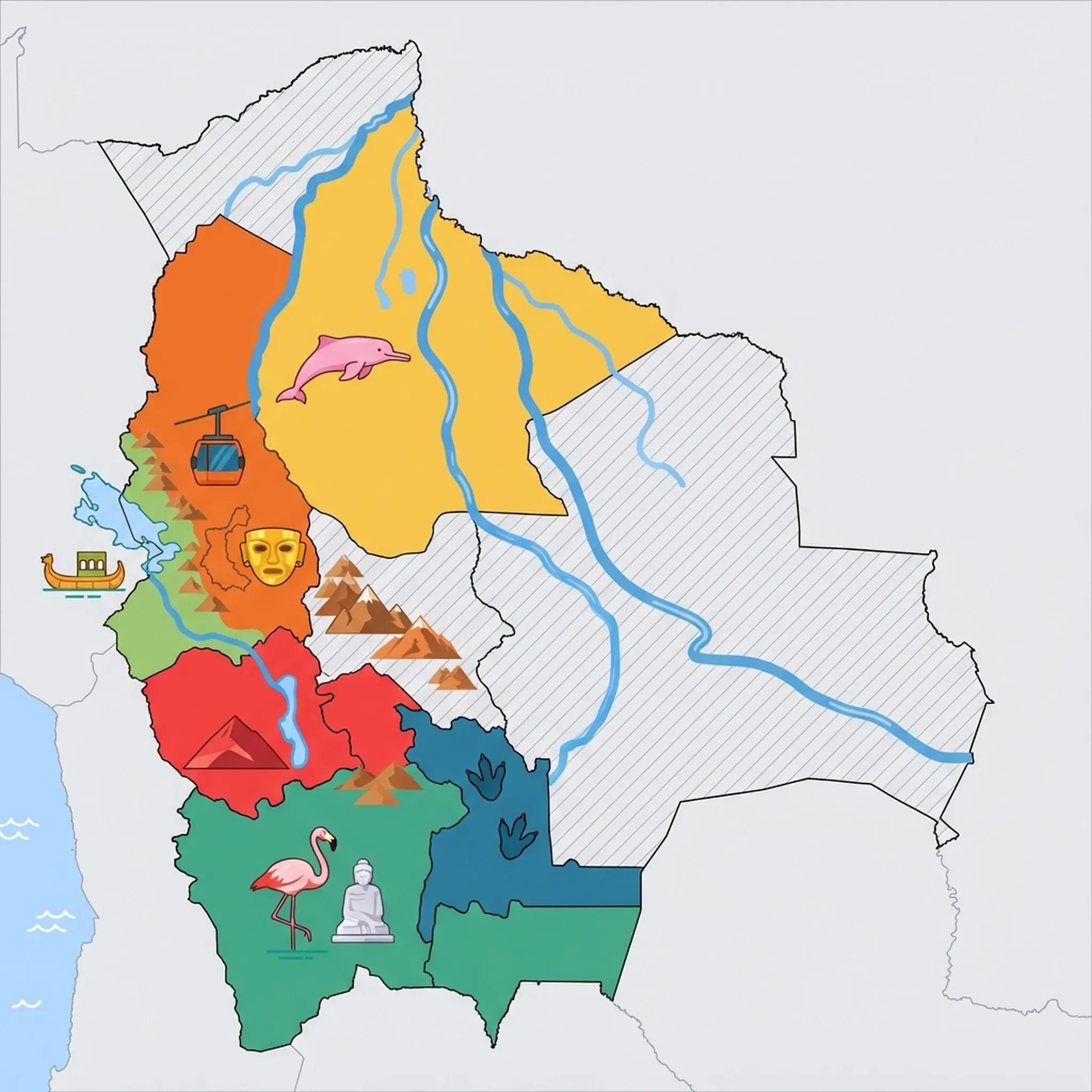
6 Regions
Amazon (Rurrenabaque)
Where wild jungle rivers meet pink dolphins and endless adventure 🐒🌿
La Paz & Surroundings
A city in the clouds where cable cars replace buses 🚠🏙️
Lake Titicaca (Copacabana)
Sail the world's highest lake where Inca legends come alive 🛥️☀️
Potosí
The Silver City that changed the world 🥈🏔️
Sucre
Dinosaurs, chocolate, and colonial charm 🦕🍫
Uyuni Salt Flats
Walk on clouds and play with perspective in a world of white ☁️📸
Click on a region marker to explore details. Use the dropdown to color regions by activity suitability.

Getting There & Around
Getting There
- By Air – The main international gateways are El Alto International Airport (LPB) near La Paz and Viru Viru International Airport (VVI) in Santa Cruz. Santa Cruz is lower altitude and a gentler place to land.
- By Land – Buses connect Copacabana to Puno (Peru), making Lake Titicaca a popular entry point. Crossings from Chile (San Pedro de Atacama) enter directly into the Uyuni Salt Flats region.
- Entry Requirements – As of late 2025, U.S. citizens no longer require a tourist visa for short stays (90 days). UK and EU citizens also enjoy visa-free entry. Check your government website for the latest visa requirements, or use the IATA Travel Centre entry-requirements checker.
Getting Around
- Domestic Flights – The best option for families to avoid long, winding bus rides. BoA (Boliviana de Aviación) connects major hubs like La Paz, Sucre, and Uyuni efficiently.
- Cable Car (Teleférico) – In La Paz, Mi Teleférico is not just a tourist attraction but a safe, clean, and fun public transport network essential for getting around the city.
- Buses (Flotas) – Long-distance buses are cheap but often uncomfortable and prone to delays. If you must use them, book "Bus Cama" (lie-flat seats) for overnight journeys.
- Taxis/Ride Apps – Uber and local apps work in major cities and are very affordable. Always use radio taxis or apps rather than hailing from the street for safety.

Packing List
The high-altitude air is extremely dry and often causes nosebleeds, especially in children.
Budget hotels and hostels rarely have plugs in the sinks, making it hard to wash hands or clothes.
Heating is rare in hotels, and nights on the Altiplano drop well below freezing.
Power cuts can occur in remote areas like the Salt Flats; useful for nighttime bathroom trips.
The dry, dusty air at altitude can be very irritating to eyes, particularly for contact lens wearers.

Activities & Best Times

Adventure & Nature
ExcellentHiking, wildlife, outdoor exploration, ecotourism
Madidi National Park and the Pampas provide world-class biodiversity and wildlife encounters, ranking this among the planet's premier ecotourism destinations. The dry season (June–September) is optimal for families as animals congregate near shrinking water sources, making sightings frequent and accessible.
A globally unique wilderness featuring high-altitude lagoons, volcanoes, and the world's largest salt flat. Peak dry season ensures full accessibility to remote trails and deep-desert landscapes that become impassable during summer rains.
Home to the Eduardo Avaroa Reserve and Torotoro National Park, offering high-altitude volcanic landscapes and dinosaur tracks. Peak season aligns with the dry winter months when remote wilderness tracks are accessible and skies are clear.

City & Cultural
ExcellentUrban tourism, museums, historical sites, architecture
A truly unique high-altitude metropolis featuring the world's most extensive cable car system and the ancient Tiwanaku ruins. The dry season (May-Sep) is ideal for exploring the atmospheric streets and markets, while heavy rain in Jan-Mar can hinder outdoor sightseeing and site access.
A UNESCO World Heritage site with exceptional colonial architecture and the globally significant National Mint. The dry season is ideal for navigating the steep, high-altitude streets, while heavy summer rains can make the city damp and cold.
A beautifully preserved UNESCO colonial center featuring significant historical sites like Casa de la Libertad and world-class indigenous art at the ASUR museum. The clear, sunny weather of the dry winter months is ideal for exploring the iconic white-washed architecture on foot.

Sports & Active
Very GoodSport tourism, fitness activities, active recreation
A premier destination for high-altitude mountaineering on Huayna Potosi and world-class downhill mountain biking on recognized routes. The dry season (May-Sep) offers stable conditions for these technical activities, while the summer rains (Nov-Mar) make trails and peaks dangerous.
Offers challenging high-altitude trekking and internationally recognized cycling routes toward Uyuni. The lack of rainfall from May to October provides the necessary stability for these strenuous physical activities.
Authentic pre-Hispanic Inca trails provide challenging high-altitude trekking routes for active families seeking immersive physical experiences. The wet season from December to March makes these ancient stone paths extremely slippery and difficult to navigate safely.

Educational & Exploratory
GoodLearning experiences, scientific sites, historical education
Parque Cretácico hosts the world's largest collection of dinosaur footprints, offering a unique scientific destination for families interested in paleontology. Heavy rainfall between December and March can degrade the outdoor viewing experience and access to the fossil tracks.
Specialized facilities like the Llama and Salt Museum offer unique geological and anthropological insights into the Altiplano. These facilities are primarily visited during the dry season as part of broader regional expeditions.
Purpose-built science and natural history facilities, including the national planetarium and aquarium, offer valuable family learning opportunities. Access is best during the dry season (May-Sep) to avoid the transport disruptions and heavy rains common during the summer months.

Relaxation & Wellness
GoodSpa retreats, wellness centers, peaceful getaways
Features authentic thermal experiences like Termas de Polques in the high Altiplano and Balneario de Tarapaya. These natural hot springs are most restorative during the freezing dry winter months, though logistics can be rugged for families.
Natural thermal baths provide a rustic restorative experience within the jungle, though they lack the world-class infrastructure found in luxury spa destinations. These sites are most pleasant during the cooler months (June–August) when the surrounding tropical humidity is at its lowest.
Natural thermal springs at Polques offer a rustic restorative experience in a dramatic high-altitude setting. The coldest winter months provide the most atmospheric contrast for bathing, though logistics remain challenging.

Road Trips & Scenic
GoodScenic drives, countryside tours, route-based travel
The Lagunas Route is a world-renowned off-road expedition through surreal landscapes, though roads are unpaved and demanding. Travel is strictly recommended in the dry season to avoid impassable muddy tracks and seasonal snow.
Dramatic high-altitude routes connect Sucre to Potosí and Tarabuco, offering spectacular Andean landscapes and access to authentic rural markets. Driving is safest and most scenic during the dry months, as heavy summer rains increase the risk of landslides on mountain passes.
The salt flat crossing and Southwest Circuit are iconic scenic drives through surreal, high-contrast landscapes. Driving conditions are only viable for the full circuit during the dry season when the salt crust is solid.

Theme Park & Entertainment
MarginalAmusement parks, family entertainment venues
The Balneario Tarapaya offers a regional aquatic experience, though it lacks international theme park standards. Best visited during the warmer southern summer months, as winter temperatures at this altitude make outdoor swimming less appealing.
Features regional family entertainment venues like Parque de las Culturas, though they lack the world-class scale of global tier-one destinations. Best visited during the dry winter months (Jun-Aug) for comfortable outdoor play, as summer rainfall frequently disrupts activities.

Festivals & Seasonal
MarginalEvents, celebrations, seasonal attractions
The world-renowned mirror effect occurs exclusively during the rainy season when a thin layer of water covers the salt flats. While spectacular, this phenomenon is highly time-specific and restricts travel to the edges of the Salar.
Hosts the world-renowned Fiesta del Gran Poder and the unique Alasitas miniature festival which attract international interest. Peak months align with these specific events in January and May/June; other months lack similar internationally significant cultural celebrations.

Public Holidays & Calendar Next 12 months
Public holidays, festivals, cultural celebrations, and seasonal natural phenomena coming up in Bolivia over the next 12 months.
Loading holidays and events...
Climate & Weather
Amazon (Rurrenabaque)
Show Details
| Month | Temp °C | Rain | Humidity |
|---|
La Paz & Surroundings
Show Details
| Month | Temp °C | Rain | Humidity |
|---|
Lake Titicaca (Copacabana)
Show Details
| Month | Temp °C | Rain | Humidity |
|---|
Potosí
Show Details
| Month | Temp °C | Rain | Humidity |
|---|
Sucre
Show Details
| Month | Temp °C | Rain | Humidity |
|---|
Uyuni Salt Flats
Show Details
| Month | Temp °C | Rain | Humidity |
|---|

Travel Advisory
All six major agencies recommend a baseline level of elevated caution for Bolivia. While most of the country is open for travel, there is a strong consensus on the risks posed by frequent civil unrest and roadblocks, as well as high-risk pockets like the Chapare region where crime levels are critical.
Safety Topics
Traveller Advice (4 groups)

Stay informed via local media regarding roadblocks and strikes which can strand travellers for days. Always carry extra food, water, and warm clothing on long road trips. Avoid any large gatherings or protests, as they can turn violent unexpectedly.

Information on accessibility is limited; travellers with physical or sensory disabilities should prepare for infrastructure challenges and research medical facility locations in advance.

Be aware of local attitudes and social norms; travellers are encouraged to review specific advice regarding safety and legal considerations for the LGBTQ+ community in Bolivia.

Female travellers should consult gender-specific safety guides and take standard precautions, especially when travelling solo or at night in urban centres.
Agency Summaries
Heightened caution is necessary because of the potential for violent crime and sudden civil unrest. New Zealanders should avoid all protests and avoid the Chapare region for any non-essential purposes due to kidnapping and extortion risks.
Australians are encouraged to be particularly careful due to the dual threats of violent crime and civil instability. Demonstrations and roadblocks are common and unpredictable, potentially leading to significant travel delays or violence.
The UK government advises against any non-essential travel to the Chapare region in Cochabamba. Across the country, visitors should prepare for disruptions caused by political demonstrations and marches, which can emerge with very little notice and block major transport routes.
Irish citizens should be aware of a continuous risk of social unrest and strikes that can impact tourist infrastructure and domestic travel. Vigilance is required near large crowds, and travellers are warned not to attempt to bypass road blockades.
Increased caution is advised nationwide because of civil unrest, which often manifests as sudden strikes and demonstrations. Specifically, the Chapare region is designated as 'Do Not Travel' due to high levels of violent crime and limited emergency support for foreign nationals.
Travellers should remain highly vigilant due to persistent political and social tensions that frequently result in roadblocks throughout the country. While the general advice is to be cautious, there is a specific warning to avoid non-essential travel to the Chapare region because of risks related to drug trafficking and kidnapping.
Information is provided for general guidance only and does not constitute travel, safety, medical, or legal advice. Conditions may change. Users are responsible for independently verifying information before travel.