

Overview
Botswana is widely regarded as one of the finest safari destinations on Earth, and for families, it offers a deeply moving connection to the natural world. This landlocked nation is defined by its dramatic contrasts-from the lush, waterlogged channels of the Okavango Delta to the stark, salty expanse of the Makgadikgadi Pans. For parents, the country’s biggest draw is its safety and stability; often cited as Africa’s longest-running democracy, it is peaceful, welcoming, and well-organised. The government's “low volume, high value” tourism policy means parks are never crowded, giving your family a front-row seat to the wildlife.
Travelling here with children does require planning-distances are vast and many lodges have age restrictions (often 6+ or 12+)-but the rewards are immense. Imagine your children learning to track footprints in the sand with San Bushmen, watching a matriarch elephant lead her calf across the river, or sleeping under a sky so clear the Milky Way casts a shadow. Whether you choose a self-drive 4x4 adventure through the Kalahari Desert or fly into luxury tented camps, Botswana creates a profound sense of wonder that video games simply cannot replicate.
Key Attractions
The headline act is undoubtedly Chobe National Park in the north. Famous for having the highest concentration of elephants in Africa, it is the perfect introduction to safari for kids. A boat cruise on the Chobe River allows safe, close-up encounters with hippos, crocodiles, and bathing elephants that will leave children wide-eyed. Further south lies the Okavango Delta, a UNESCO World Heritage site. Here, families can visit the Moremi Game Reserve for exceptional Big Five viewing. For older children, a ride in a mokoro (traditional canoe) offers a silent, magical perspective of the water lilies and reed frogs.
For a completely different landscape, the Makgadikgadi Pans offers surreal white salt flats. In Makgadikgadi Pans National Park, families can often interact with habituated meerkat colonies-a highlight for kids who can sit still while these curious creatures scramble over them to scan for predators. Nearby, the ancient Baines' Baobabs look like trees turned upside down and make for fantastic climbing and photo backdrops. In the Gaborone & Southeast region, the Mokolodi Nature Reserve is excellent for families starting or ending their trip, offering rhino tracking and educational game drives just outside the capital.
Culturally, a visit to the Tsodilo Hills in the northwest is hauntingly beautiful. Known as the “Louvre of the Desert,” this spiritual site features over 4,500 rock paintings dating back thousands of years. It’s a hike, but the stories of the San people bring the rocks to life. Adventurous families might also camp at Kubu Island, a granite rock island in a sea of salt, which feels like landing on another planet.
Practical Advice
The best time to visit for wildlife is the dry winter (May to October), when animals congregate around water sources and grass is low. However, mornings can be freezing, so pack warm layers. The “Green Season” (November to April) is hotter and wetter, but brings newborn animals and lower prices. Malaria is a risk in the north (Chobe, Okavango), so consult a doctor for child-appropriate prophylaxis; the south (Gaborone, Kalahari) is generally lower risk. Tap water in major towns is often chlorinated and safe, but bottled water is recommended for short-term visitors to avoid tummy upsets.
Food & Drink
Typical meal times: Breakfast is early (often 5:30 am – 6:30 am) in safari camps before game drives. Lunch is served 1:00 pm – 2:00 pm, and dinner typically 7:30 pm – 9:00 pm. In towns, restaurants follow standard hours (lunch 12:00 pm – 2:30 pm, dinner 6:30 pm – 10:00 pm).
Typical meal costs: 120–250 BWP (approx. $9–18 USD / €8–16 EUR) for a main course in a mid-range town restaurant. Safari lodges are usually all-inclusive, but self-drivers can eat cheaply at local takeaways for 40–80 BWP (approx. $3–6 USD / €2.50–5 EUR).
Dietary requirements: Safari lodges are excellent at catering to allergies, vegetarian, and gluten-free needs if notified in advance. In towns like Maun or Gaborone, vegetarian options are available but limited; vegan travellers should pack snacks or be prepared for simple salads and sides.
Family-friendly dining: Lodges will often arrange early dinners for children and provide simple “kid favourites” (pasta, chicken). In towns, restaurants are casual and welcoming to children, though highchairs are not guaranteed in smaller establishments.
Signature dishes:
- Seswaa – The national dish of pounded beef or goat meat, slow-cooked until tender and served with maize meal. Simple, salty, and generally liked by kids.
- Vetkoek (Magwinya) – Deep-fried dough balls, crisp outside and fluffy inside. Often eaten for breakfast with jam or stuffed with mince for lunch.
- Bogobe jwa Lerotse – A unique porridge made from sorghum and local melon, giving it a distinct flavour and colour.
- Morogo – Wild spinach/bean leaves, usually stewed with onions and tomatoes. A healthy, mild side dish.
Family Travel Notice
Minors under 18 must present a certified copy of their full unabridged birth certificate at the border. If traveling with only one parent, a signed affidavit from the absent parent is mandatory.

Botswana is a premium destination. While self-drive camping costs around 2,000–3,000 BWP (approx. $150–220 USD / €140–210 EUR) per day for a vehicle and camp fees, fly-in safari lodges range from expensive to ultra-luxury, often costing 13,000–40,000+ BWP (approx. $950–2,900+ USD / €900–2,800+ EUR) per person per night. Restaurant food in towns is reasonably priced.
Age Suitability





Did you know? Botswana welcomes approximately 314,000 international visitors per year. Most visitors come from Africa.
Explore Regions
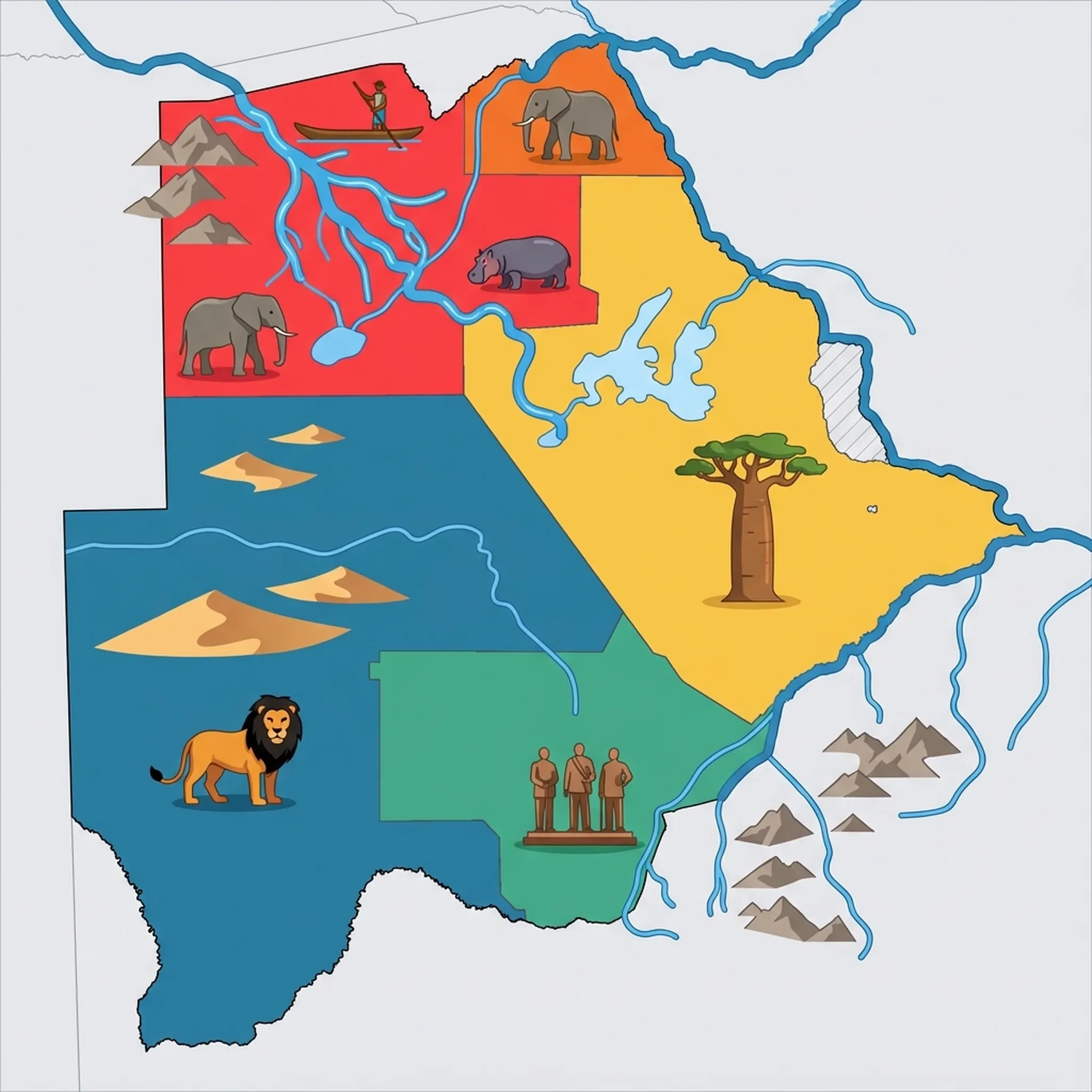
5 Regions
Chobe National Park
Where the giants of Africa gather by the water 🐘🌊
Gaborone & Southeast
City lights meet bushveld nights 🏙️🦒
Kalahari Desert
Ancient sands and endless starry skies ✨🦁
Makgadikgadi Pans
Where the earth meets the sky on endless salt 🧂🦓
Okavango Delta
Africa's emerald Eden 🌿🛶
Click on a region marker to explore details. Use the dropdown to color regions by activity suitability.

Getting There & Around
Getting There
- By Air – Sir Seretse Khama International Airport (GBE) in Gaborone is the main capital hub, but most tourists fly into Maun (MUB) or Kasane (BBK) via Johannesburg (JNB) or Cape Town (CPT). Maun is the gateway to the Okavango Delta.
- By Land – Adventure travellers often drive in from South Africa or Namibia. The Kazungula Bridge is a modern crossing point linking Botswana and Zambia over the Zambezi River, making a Victoria Falls side-trip easy.
- Entry Requirements – US, UK, and EU citizens generally do not need a visa for stays up to 90 days. However, families travelling with minors must carry certified copies of birth certificates. Check your government website for the latest visa requirements, or use the IATA Travel Centre entry-requirements checker.
Getting Around
- Bush Taxis (Light Aircraft) – The most common way to reach remote lodges in the Okavango Delta. Small planes (Cessna Caravans) act as taxis; flight times are short (20–60 mins) and offer incredible aerial views. Strict soft-bag luggage limits apply (usually 15kg).
- 4x4 Car Hire – Essential for self-drive safaris. Renting a fully equipped 4x4 with roof tents is popular for adventurous families visiting Chobe National Park or the Kalahari. Driving is on the left. Sand driving experience is recommended.
- Transfers – Lodges provide 4x4 game drive vehicles for transfers from airstrips. In towns like Kasane and Maun, taxis are available but unmetered (negotiate fare first).

Packing List
Light aircraft flights to the Delta have strict luggage rules: no hard shells or wheels allowed.
Many campsites and eco-lodges are unfenced and very dark at night; essential for hands-free safety.
Avoid dark blue and black, which attract painful tsetse flies in the bush. Wear khaki or tan.
Sharing frustrates kids. Having their own pair keeps them engaged in spotting wildlife.
The air in Botswana is incredibly dry; lips and skin crack quickly without frequent application.
Morning game drives are freezing (often near 0°C) even in shoulder seasons due to open vehicles.

Activities & Best Times

Adventure & Nature
ExcellentHiking, wildlife, outdoor exploration, ecotourism
A world-class safari destination renowned for its massive elephant herds and the unique Savuti Marsh and Chobe Riverfront ecosystems. Peak dry season (June-October) offers unparalleled wildlife density as animals congregate at water sources, while the wet season sees animals disperse into thick, inaccessible bush.
A premier global wilderness destination offering unique mokoro safaris and exceptional wildlife viewing in the Moremi Game Reserve. Peak conditions occur during the dry winter (Jun-Oct) when the annual flood creates a unique aquatic oasis and animals congregate around permanent water sources.
Mokolodi Nature Reserve and Kgale Hill provide high-quality wildlife encounters and wilderness immersion easily accessible from the capital. Peak season occurs during the dry winter when vegetation is thin and animals congregate at waterholes, while the hot, rainy summer limits visibility and comfort.

City & Cultural
Very GoodUrban tourism, museums, historical sites, architecture
As the nation's capital, the region offers significant heritage sites like the Three Dikgosi Monument and the National Museum that showcase Botswana's unique history. The cooler winter months are ideal for walking tours and cultural exploration, whereas the mid-summer heat can be oppressive for urban activities.
Offers deep immersion into San (Bushmen) heritage and spectacular prehistoric sites like Kubu Island and Baines' Baobabs. Best visited in the dry season when these remote archaeological and cultural landmarks are easily accessible via desert tracks.
While primarily a wilderness area, the region features unique landmarks like the Kazungula Bridge and ancient Savuti rock paintings that offer genuine cultural depth. Access to remote heritage sites is most reliable during the dry winter months, whereas summer rains can make the necessary off-road tracks impassable.

Sports & Active
Very GoodSport tourism, fitness activities, active recreation
Established infrastructure for mountain biking at Mokolodi and well-traversed hiking trails on Kgale Hill offer world-class active experiences for families. Peak activity aligns with the cool winter season to avoid the intense subtropical heat and summer afternoon thunderstorms that make strenuous exercise difficult.
Provides unique active infrastructure like the Old Hunters Road and Seboba Nature Trails for hiking and specialized cycling. The cooler months of May to August are essential for physical exertion in this climate, as the extreme heat of the 'suicide months' (September-October) and subsequent rains make activity uncomfortable.
Provides specialized infrastructure for traditional mokoro excursions and guided walking safaris on designated trails like the Rhino and Lion routes. The high flood months (Jun-Aug) offer the best water levels for paddling, coinciding with the coolest weather for physically active trekking.

Road Trips & Scenic
GoodScenic drives, countryside tours, route-based travel
The region serves as the gateway for the Trans-Kalahari Highway and scenic routes through the Southeast Hills, offering well-maintained infrastructure for regional touring. Dry winter months provide the best driving conditions and visibility, while summer rains can occasionally impact secondary roads and scenic vistas.
Offers iconic routes such as the Elephant Highway and the scenic Chobe Riverfront Drive, popular with sophisticated self-drive overlanders. The dry season ensures safe navigation on sandy tracks; however, the 'black cotton soil' in Savuti becomes notoriously difficult for vehicles during the peak summer rains.
Classification notes describe 'internationally recognized 4x4 self-drive routes through Moremi' - the use of 'internationally recognized' suggests this deserves 'good' rather than 'marginal'. Aligns better with Chobe and Kalahari ratings for similar infrastructure.

Festivals & Seasonal
GoodEvents, celebrations, seasonal attractions

Educational & Exploratory
MarginalLearning experiences, scientific sites, historical education
The Mokolodi Education Centre provides structured natural history learning, though it is a niche draw compared to global scientific hubs. Visiting is most productive during the cooler, drier months when outdoor classroom activities and guided nature-based learning are most feasible.
The CARACAL Biodiversity Center offers high-quality, specialized education on local conservation and wildlife rescue for visiting families. Suitability is tied to the general tourism season, with the best visiting conditions occurring during the dry, temperate winter months when the center is most accessible.
Specialized learning opportunities include the Adrian Gale Diamond Museum, focusing on Botswana's pivotal diamond industry. While a significant facility, it serves primarily as a brief educational stop within a broader safari itinerary rather than a standalone travel motivator.

Public Holidays & Calendar Next 12 months
Public holidays, festivals, cultural celebrations, and seasonal natural phenomena coming up in Botswana over the next 12 months.
Loading holidays and events...
Climate & Weather
Chobe National Park
Show Details
| Month | Temp °C | Rain | Humidity |
|---|
Gaborone & Southeast
Show Details
| Month | Temp °C | Rain | Humidity |
|---|
Kalahari Desert
Show Details
| Month | Temp °C | Rain | Humidity |
|---|
Makgadikgadi Pans
Show Details
| Month | Temp °C | Rain | Humidity |
|---|
Okavango Delta
Show Details
| Month | Temp °C | Rain | Humidity |
|---|

Travel Advisory
A majority of international agencies classify Botswana as safe for travel under standard security awareness, though North American agencies advise elevated caution specifically regarding crime.
Safety Topics
Traveller Advice (2 groups)

Minors under 18 must present a certified copy of their full unabridged birth certificate at the border. If traveling with only one parent, a signed affidavit from the absent parent is mandatory.

While legal protections exist, social attitudes remain conservative. Travelers are advised to be discreet regarding public displays of affection.
Agency Summaries
While the overall security situation is stable, visitors should be cautious of petty crime in urban centers and take health precautions against malaria in the north.
Most visits are safe, but travelers should take basic precautions against street crime and be aware of limited medical facilities in remote areas.
Irish citizens are encouraged to follow standard safety protocols, especially regarding personal belongings and avoiding ATMs after dark.
There are no significant security warnings for the country, but travelers should maintain comprehensive insurance and stay informed on local health risks.
Heightened awareness is recommended due to frequent crimes of opportunity, such as muggings and 'smash-and-grab' thefts from vehicles at intersections and shopping centers.
Travelers are advised to remain highly vigilant due to prevalent criminal activity, including home burglaries and carjackings, though tourists are not the primary targets.
Information is provided for general guidance only and does not constitute travel, safety, medical, or legal advice. Conditions may change. Users are responsible for independently verifying information before travel.