

Bulgaria is a captivating crossroads of culture, history, and nature that offers families a rich travel experience without the crowds or costs of Western Europe. Located in the heart of the Balkans, this diverse country features four distinct seasons, ranging from snowy winters perfect for skiing in the Pirin & Southwest Mountains to hot, sunny summers along the golden beaches of the east. For children, the landscape itself is a playground-from the mysterious rock formations of Belogradchik to the caves and waterfalls of the Danubian Plain (Central North).
The cultural vibe is warm and family-oriented, with locals often going out of their way to welcome children. Exploring Bulgaria feels like a treasure hunt; you might stumble upon a Roman amphitheatre in the middle of a modern shopping street or a medieval fortress perched high above a river. The pace of life is relaxed, especially in rural villages where horse-drawn carts still share the road with cars, offering a glimpse into a simpler time that fascinates young travellers.
Key Attractions
Start your journey at the UNESCO-listed Rila Monastery, a stunning fortress-like complex hidden in the mountains that looks like it belongs in a storybook. Kids will love the colourful frescoes and the sense of adventure in the surrounding Rila Monastery Nature Park. For a mix of history and beach fun, the Ancient City of Nessebar on the Black Sea is unmissable; its cobbled streets and wooden houses are situated on a peninsula connected by a narrow isthmus, making it feel like an island museum.
In the northwest, the Belogradchik Rocks offer one of the most surreal landscapes in Europe, where giant red sandstone pillars hide the historic Belogradchik Fortress. For active families, a visit to the Krushuna Waterfalls provides an easy and enchanting walk through turquoise terraced pools. Finally, no trip is complete without seeing Plovdiv, one of the world's oldest continuously inhabited cities, where the Ancient Theater of Philippopolis allows kids to stand on the same stage where gladiators once fought.
Practical Advice
The best time to visit for a beach holiday is June to September, while skiers should aim for January to March. Bulgaria is a full Schengen member, so border crossings are smooth. The currency is the Bulgarian Lev (BGN), and while cards are widely accepted in cities, carrying cash is essential for small shops and rural areas. The Cyrillic alphabet was invented here; turn it into a game by helping children decipher street signs using a translation app.
Food & Drink
Typical meal times: Lunch is usually served from 12:00 pm to 2:00 pm, and dinner is a leisurely affair starting around 7:00 pm to 9:00 pm.
Typical meal costs: 15–30 BGN (approx. $8–16 USD / €7–15 EUR) for a main dish in a mid-range restaurant; family dinners often run 60–100 BGN (approx. $33–55 USD / €30–50 EUR).
Dietary requirements: Vegetarian options are widespread, with many traditional dishes naturally meat-free (like grilled cheese and salads). Vegan and gluten-free options are growing in Sofia and Plovdiv but can be limited in rural areas; learning a few phrases to explain allergies is recommended.
Family-friendly dining: Bulgarian dining is very social and inclusive of children. Most restaurants offer highchairs and are patient with little ones. Kids generally love the fresh breads, yoghurts, and mild grilled meats.
Signature dishes:
- Banitsa – A savoury pastry made of filo dough filled with eggs and sirene (white cheese), perfect for breakfast or a snack.
- Shopska Salad – A refreshing mix of chopped tomatoes, cucumbers, onions, and peppers, covered in a snow-white mound of grated sirene cheese.
- Tarator – A cold cucumber and yoghurt soup with dill and walnuts, incredibly refreshing on hot summer days.
- Kebapche – Grilled minced meat sticks seasoned with cumin, simple and delicious for children.
- Lyutenitsa – A thick relish made from roasted peppers and tomatoes, slightly sweet and loved by Bulgarian kids on toast.
Family Travel Notice
Ensure children have individual travel documents. If travelling with only one parent, carry notarized consent from the absent parent to meet potential border requirements.

Bulgaria is one of Europe's most affordable destinations. A family of four can expect to spend around 150–250 BGN (approx. $80–135 USD / €75–125 EUR) per day, covering mid-range accommodation, meals, and entry fees. Public transport and groceries are excellent value.
Age Suitability





Did you know? Bulgaria welcomes approximately 5.6 million international visitors per year. Most visitors come from Europe.
Explore Regions
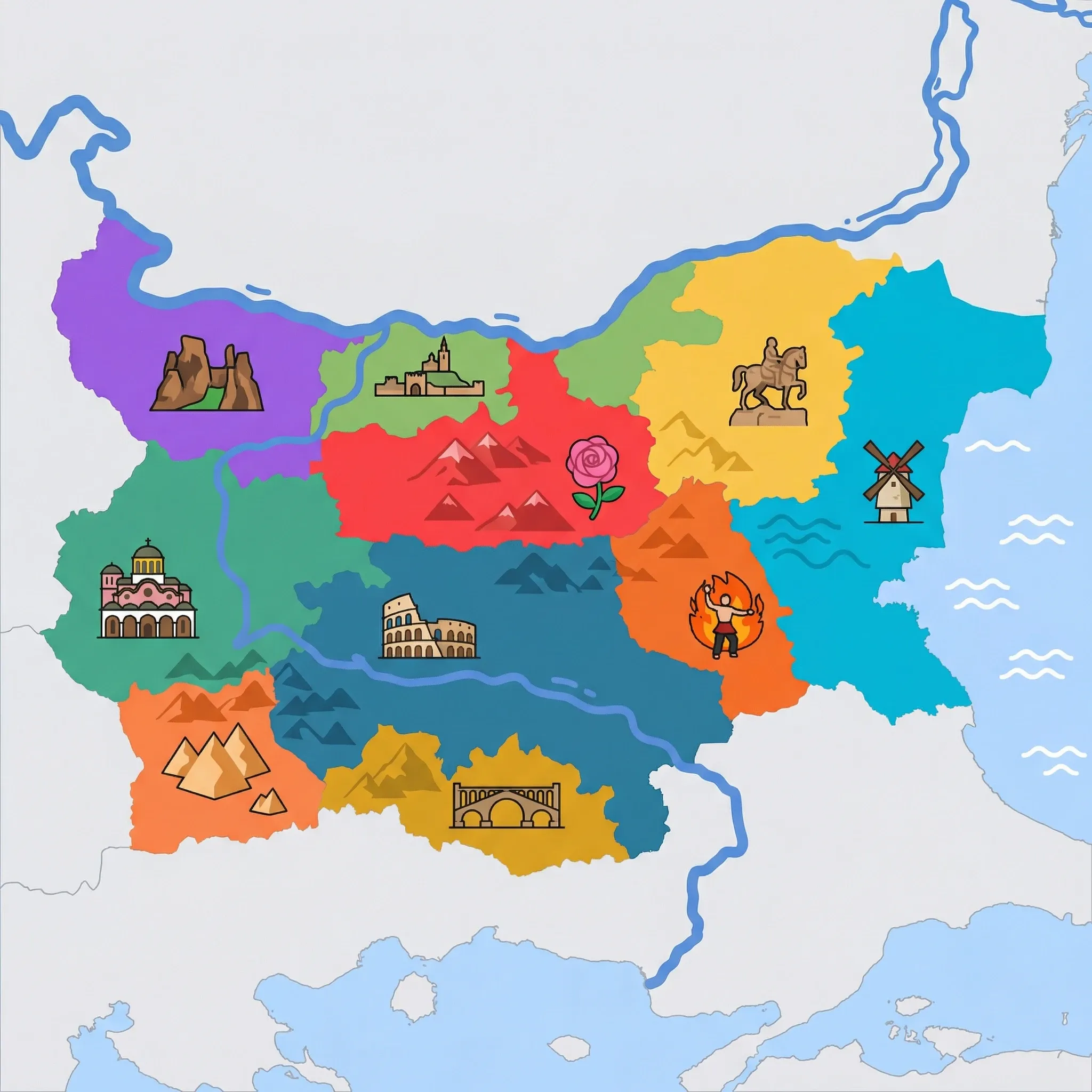
10 Regions
Black Sea Coast
Sun-soaked beaches meeting ancient ruins and endless family fun 🏖️🏰
Central Balkan Mountains & Rose Valley
Where mountain legends guard the Valley of Roses 🌹⛰️
Danubian Plain (Central North)
Medieval tsars, limestone canyons, and waterfalls 🏰🦇
Northeast Bulgaria
Where the steppe meets the sea in dramatic cliffs 🌊🦅
Northwest Bulgaria
Fantasy rock castles and Danube fortresses 🏰🏜️
Pirin & Southwest Mountains
Alpine peaks, ancient monasteries, and sunny valleys 🏔️⛷️
Plovdiv & Thracian Lowlands
Ancient history and art in Europe's oldest living city 🎭🏛️
Rhodope Mountains
The mystical mountains of Orpheus and underground rivers 🎻🌲
Sofia & Western Bulgaria
A European capital at the foot of a wild mountain 🏙️🚠
Southeast Bulgaria
Mysterious mountains, fire-walkers, and wild beaches 🌳🔥
Click on a region marker to explore details. Use the dropdown to color regions by activity suitability.

Getting There & Around
Getting There
- By Air – Sofia (SOF) is the main hub, with Varna (VAR) and Burgas (BOJ) serving the Black Sea Coast during summer.
- By Train – International connections exist from Bucharest and Istanbul, though they can be slow.
- Entry Requirements – Bulgaria is a Schengen Area member. EU/UK/US citizens can enter visa-free for short stays. Check your government website for the latest visa requirements, or use the IATA Travel Centre entry-requirements checker.
Getting Around
- Car Hire – The best way for families to explore the Sofia & Western Bulgaria region and rural mountains. Roads can be bumpy in remote areas.
- Trains – Operated by BDZ, trains are slow but scenic and very cheap. Children under 7 travel free. The narrow-gauge railway in the Pirin & Southwest Mountains is a fun adventure.
- Buses – A faster alternative to trains for inter-city travel, connecting major hubs like Plovdiv and Varna efficiently.

Packing List
Many Black Sea beaches have rocky sections or extremely hot sand in summer.
Public toilets and rest stops are frequently out of toilet paper.
Mosquitoes can be aggressive in summer, especially near the Danube and coastal wetlands.
Many small shops, guesthouses, and rural museums do not accept credit cards.
Mountain resorts like Bansko and Borovets get surprisingly cold at night, even in July.
Street lighting in smaller villages and rural guesthouse paths can be non-existent.

Activities & Best Times

Adventure & Nature
ExcellentHiking, wildlife, outdoor exploration, ecotourism
Home to two UNESCO-listed mountain ranges (Rila and Pirin) offering world-class trekking and unique conservation projects like the Belitsa Dancing Bears Park. High-altitude trails are best accessed in summer, while late autumn and winter bring heavy snow and avalanche risks to the back-country.
Offers rugged Balkan mountain trekking and unique ethnographic experiences like the Etar farm park. Peak months provide optimal trail conditions and lush landscapes, while winter brings heavy snow and limited accessibility in the high mountains.
Home to the Golden Sands Nature Park and proximity to the UNESCO-listed Srebarna Nature Reserve, offering high-quality birdwatching and hiking opportunities. May, June, and September provide the most comfortable climate for outdoor exploration away from the humid peak summer heat.

City & Cultural
Very GoodUrban tourism, museums, historical sites, architecture
Rich in UNESCO Thracian heritage and unique Bulgarian National Revival architecture in Bozhentsi and the Kazanlak region. Summer is the peak for outdoor ethnographic museums and cultural life, while winter is often too cold for comfortable walking tours.
Varna and Balchik offer a sophisticated mix of ancient history, including the Madara Rider and Roman baths, alongside elegant royal architecture. Late spring and early autumn are ideal for exploring historic sites without the congestion of the coastal holiday crowds.
The medieval capital of Veliko Tarnovo and the rock-hewn churches of Ivanovo offer world-class heritage and unique architectural history. Peak conditions occur during cultural festival seasons when temperatures are ideal for urban exploration.

Ski & Snow
Very GoodWinter sports, ski resorts, snow activities
Bansko and Borovets are premier Eastern European ski hubs with modern lift infrastructure and vibrant alpine atmospheres that rival mid-tier Alpine resorts. The core season runs from January to March, with early snow and late spring conditions providing variable shoulder opportunities.
Vitosha offers the rare luxury of a ski resort within 30 minutes of a major capital, providing solid, authentic alpine experiences for families, though it lacks the massive scale of larger European resorts. January and February offer the most reliable snow cover for high-altitude skiing.
Provides modest winter sports at Uzana and Beklemeto with a low-key, local atmosphere. Snow reliability is best in January and February, but infrastructure is limited compared to major international alpine destinations.

Sports & Active
Very GoodSport tourism, fitness activities, active recreation
Features internationally recognized paragliding in Sopot and the iconic Kom-Emine long-distance trekking trail. Peak summer provides stable thermal conditions for flying and clear mountain ridges for high-altitude activities.
Access to the EuroVelo 6 Danube Cycle Path and dedicated hiking routes in Golden Sands makes this a strong choice for active families. The shoulder seasons offer the best physical conditions for long-distance cycling and trail activities compared to the extreme cold of winter or heat of mid-summer.
Home to the major Dunav Ultra cycling route and multiple eco-trails, providing significant infrastructure for active tourists. High summer is often too hot for strenuous sport, making late spring and September the optimal windows.

Beach & Sea
Very GoodBeach resorts, marine activities: diving, snorkelling, kite surfing, wind surfing, sailing
The Black Sea Coast features internationally recognized beach resorts (Sunny Beach, Golden Sands) that attract millions of visitors annually from across Europe. With 10 documented attractions including major resort infrastructure, this deserves very_good rating by international standards, though falls short of excellent (which would require Caribbean/Maldives quality).
Features dramatic coastal cliffs at Cape Kaliakra and refined seaside gardens at Balchik Palace, though the swimming season is relatively short compared to Mediterranean benchmarks. Peak summer offers warm waters and full facility access, while shoulder months provide a quieter experience for discerning families.
Offers high-quality, 'wilder' beach experiences at Silistar and Veleka Mouth that appeal to families seeking authenticity over mass-market resorts. Seasonal peak is limited to the warm summer months when water temperatures are suitable for swimming and coastal reserves like Ropotamo are fully operational.

Educational & Exploratory
GoodLearning experiences, scientific sites, historical education
Home to specialized sites like the Museum of Roses and the Interactive Museum of Industry. May and June are peak to align with the rose harvest season and associated scientific and agricultural displays.
The Varna Aquarium and Festa Dolphinarium provide significant marine education, while the Srebarna Nature Reserve Museum offers unique ecological insights. These sites are most accessible during the main tourism season when guided programs and full exhibits are available.
Muzeiko is one of the highest-quality children's science centers in Eastern Europe, and the National Historical Museum houses world-class Thracian treasures. These indoor facilities are excellent for educational family travel during the cooler months when outdoor activities are limited.

Festivals & Seasonal
GoodEvents, celebrations, seasonal attractions
The Festival of Roses is internationally famous and represents one of Bulgaria's most distinctive cultural exports. While the narrow peak season limits it to marginal in the current notes, the international significance warrants good rating. The classification should reflect cultural importance, not just season length.
The Surva masquerade festival is UNESCO Intangible Cultural Heritage and internationally significant. While narrow in timing, its cultural importance and tourist draw warrant good rather than marginal rating.

Relaxation & Wellness
GoodSpa retreats, wellness centers, peaceful getaways
Centered on the thermal mineral springs of Pavel Banya and Shipkovo, offering authentic restorative experiences. Summer is peak for outdoor mineral beaches, while spring and autumn offer quiet retreats; winter is less appealing for family transit.
The region utilizes natural thermal springs and therapeutic muds at Tuzlata and the Roman Baths of Odessos for a historic wellness experience. Late spring and early autumn provide a tranquil atmosphere conducive to restorative travel away from the peak beach tourism rush.
Authentic thermal mineral baths in Chiflik and Shipkovo provide genuine restorative experiences in a rustic setting. These facilities are most enjoyable during the cooler months when the contrast with the thermal waters is most therapeutic.

Road Trips & Scenic
GoodScenic drives, countryside tours, route-based travel
Iconic crossings like the Shipka Pass and the scenic Sub-Balkan Rose Valley road offer spectacular vistas. Best visited in late spring for rose blooms or summer for clear mountain passes, as winter often sees closures or hazardous ice.
The Northern Black Sea coastal road and the First Bulgarian Capitals route offer scenic drives through diverse landscapes and historic plateaus. Driving conditions are optimal during the dryer, milder months of spring and autumn when visibility is high and coastal traffic is manageable.
Established routes like the Rusenski Lom Heritage Route offer scenic drives through canyons and historical sites. Roads are most accessible and scenic during the green months of spring and the golden tones of autumn.

Theme Park & Entertainment
GoodAmusement parks, family entertainment venues
Includes high-quality ethnographic complexes and aqua parks that offer immersive family entertainment. These facilities are best experienced in warm months when outdoor craft demonstrations and water-based attractions are fully operational.
Several high-quality water parks like Aquapolis and Aquamania serve the region, providing modern family entertainment. These facilities are seasonal, operating exclusively during the warm summer months with peak demand in July and August.
Regional aquatic complexes and the Ledenika amusement park provide family-oriented entertainment during the warm summer season. Most outdoor water-based attractions and amusement facilities operate on a strictly seasonal summer schedule.

Public Holidays & Calendar Next 12 months
Public holidays, festivals, cultural celebrations, and seasonal natural phenomena coming up in Bulgaria over the next 12 months.
Loading holidays and events...
Climate & Weather
Black Sea Coast
Show Details
| Month | Temp °C | Rain | Humidity |
|---|
Central Balkan Mountains & Rose Valley
Show Details
| Month | Temp °C | Rain | Humidity |
|---|
Danubian Plain (Central North)
Show Details
| Month | Temp °C | Rain | Humidity |
|---|
Northeast Bulgaria
Show Details
| Month | Temp °C | Rain | Humidity |
|---|
Northwest Bulgaria
Show Details
| Month | Temp °C | Rain | Humidity |
|---|
Pirin & Southwest Mountains
Show Details
| Month | Temp °C | Rain | Humidity |
|---|

Travel Advisory
Bulgaria is widely assessed as a safe destination with no major security threats. All major agencies advise that standard safety precautions and vigilance against petty crime are sufficient for visitors.
Safety Topics
Traveller Advice (4 groups)

General safety advice for solo female travellers applies; be cautious when walking alone at night and use reputable transportation services.

Ensure children have individual travel documents. If travelling with only one parent, carry notarized consent from the absent parent to meet potential border requirements.

Maintain standard personal security awareness and safeguard valuables in tourist-heavy areas. Ensure travel insurance is comprehensive and includes medical evacuation.

While same-sex relationships are legal, they are not always socially accepted in all regions. It is advisable to be discrete regarding public displays of affection to avoid negative attention.
Agency Summaries
Bulgaria is generally considered safe for visitors. Canadian travellers should maintain standard personal security awareness. Entry and exit are governed by Schengen area regulations.
British citizens can travel to Bulgaria with standard precautions. Key considerations include road safety, petty crime in resorts, and adhering to Schengen visa-free stay limits.
The country is a safe destination for tourists. Safety efforts should focus on avoiding petty crimes like pickpocketing in crowded areas and being alert to financial fraud at ATMs.
Bulgaria is assessed as having a low crime rate and a stable security environment. Irish citizens should ensure they have comprehensive insurance and follow basic safety routines.
No specific security concerns are currently identified for Bulgaria. New Zealanders should practice standard self-awareness and ensure they have adequate medical evacuation coverage.
Australia recommends standard safety habits in Bulgaria. Travellers should remain vigilant in crowded spaces and be aware of risks related to stray animals and occasional public demonstrations.
Information is provided for general guidance only and does not constitute travel, safety, medical, or legal advice. Conditions may change. Users are responsible for independently verifying information before travel.