

Overview
Cambodia is often defined by its past, but for visiting families, it is a country delightfully grounded in the present. Geographically, it is a bowl-shaped land dominated by the mighty Mekong River and the vast Tonle Sap lake, surrounded by mountain ranges and a short but beautiful coastline on the Gulf of Thailand. The climate is tropical and generally hot, with a wet season that turns the countryside into a lush, emerald paradise. For children, the landscape feels like a storybook: endless rice paddies dotted with sugar palms, water buffalo cooling in muddy pools, and jungles that hide ancient secrets.
The cultural vibe here is exceptionally family-oriented. Khmers are famous for their hospitality, and children are adored; don't be surprised if restaurant staff offer to entertain your toddler while you eat. While the history includes dark chapters, the spirit of the nation is resilient and optimistic. Traveling here offers a profound mix of education and adventure-kids can learn about ancient civilizations in the morning and swim in a waterfall or kayak through a floating forest in the afternoon. It is less developed than neighbouring Thailand, offering a rawer, more authentic experience, yet it possesses excellent tourism infrastructure in key hubs like Siem Reap (Angkor Wat) and Phnom Penh.
Key Attractions
No trip to Cambodia is complete without visiting the Angkor Wat complex. For families, the sheer scale of the main temple is awe-inspiring, but the real fun often lies in the surrounding sites. Bayon Temple, with its hundreds of serene stone faces looking down from the towers, fascinates children, while Ta Prohm-famous for the massive tree roots strangling the stone walls-makes them feel like true jungle explorers. Nearby, a boat trip on the Tonle Sap Lake reveals entire communities living on floating houses, complete with floating schools and pig farms, which is an eye-opening cultural lesson for young travellers.
In the northwest, the Battambang & Northwest region offers a quirky highlight: the Bamboo Train (Norry). This improvised rail vehicle-essentially a bamboo platform with a motor-whizzes through the rice fields and is guaranteed to be the most memorable train ride your kids will ever take. For a change of pace, the capital city offers the glittering Royal Palace, with its silver tiles and golden spires, and a pleasant riverside walk along Sisowath Quay. Finally, families seeking downtime should head to the Sihanoukville & Coast region, specifically to islands like Koh Rong, where shallow turquoise waters and white sands provide a perfect, safe playground away from the crowds.
Practical Advice
The best time to visit is during the dry season from November to February, when temperatures are cooler (though still warm) and humidity is manageable. April and May can be dangerously hot, often reaching 40°C (104°F). Visas are required for most nationalities; the e-Visa is the easiest option to arrange in advance, though visas on arrival are available. A crucial new requirement is the Cambodia e-Arrival Card, which must be filled out online within 7 days before arrival. Health-wise, stick to bottled water and be vigilant with mosquito repellent, as dengue fever is a risk. Medical facilities in Siem Reap and Phnom Penh are adequate for minor issues, but serious conditions usually require evacuation to Bangkok, so comprehensive travel insurance is non-negotiable.
Food & Drink
Typical meal times: Breakfast is early, often around 7:00 am to 9:00 am. Lunch is strictly observed from 12:00 pm to 2:00 pm, and many local shops will close during this time. Dinner is typically eaten between 6:30 pm and 8:30 pm.
Typical meal costs: Street food snacks cost 4,000–12,000 KHR (approx. $1–3 USD / €0.90–2.75 EUR). Local restaurant meals run 10,000–25,000 KHR (approx. $2.50–6.25 USD / €2.30–5.70 EUR), while Western dishes in tourist hubs cost 24,000–40,000 KHR (approx. $6–10 USD / €5.50–9.20 EUR).
Dietary requirements: Vegetarian options are widely available, especially in tourist areas where tofu is a common staple. However, be aware that fish sauce and oyster sauce are ubiquitous in "vegetarian" stir-fries; strict vegetarians should specify "no fish sauce." Vegan and gluten-free options are easy to find in Siem Reap and Phnom Penh but harder in rural areas.
Family-friendly dining: Cambodian food is generally mild, making it very accessible for children. Rice is served with every meal. Highchairs are becoming common in expat-friendly restaurants but are rare in local eateries. Fresh fruit shakes (check they use ice made from purified water, which is standard in reputable places) are a hit with kids.
Signature dishes:
- Fish Amok – A gentle, creamy coconut curry steamed in a banana leaf, usually made with freshwater fish. It is not spicy and has a mousseline texture kids often accept.
- Lok Lak – Stir-fried marinated beef served with rice and a lime-and-pepper dipping sauce. The meat is tender and sweet-savoury.
- Bai Sach Chrouk – Sliced pork marinated in coconut milk and garlic, grilled over charcoal and served over broken rice with pickled vegetables. The ultimate breakfast comfort food.
- Nom Banh Chok – Rice noodles topped with a fish-based green curry gravy, cucumbers, banana blossom, and edible flowers. A breakfast staple known as "Khmer noodles."
Safety
Cambodia is generally very safe for families. Violent crime against tourists is rare, but bag snatching can occur in Phnom Penh, especially from tuk-tuks-keep bags on the floor or gripped tightly. Traffic is chaotic; when crossing streets, walk slowly and predictably. Landmines remain a danger only in remote, marked border areas; tourists sticking to established paths at temples and attractions are perfectly safe. The biggest risk for families is often the heat; plan sightseeing for early mornings and enforce hydration breaks.

Cambodia is one of the most affordable destinations in Asia. A family of four can travel comfortably for 300,000–600,000 KHR (approx. $75–150 USD / €70–140 EUR) per day. Street food is incredibly cheap, often under 8,000 KHR ($2 USD), while luxury hotels are a fraction of Western prices. The biggest single expense will likely be the Angkor Pass, which is priced in USD ($37 for one day).
Age Suitability





Did you know? Cambodia welcomes approximately 2.3 million international visitors per year. Most visitors come from East Asia and the Pacific.

Explore Regions
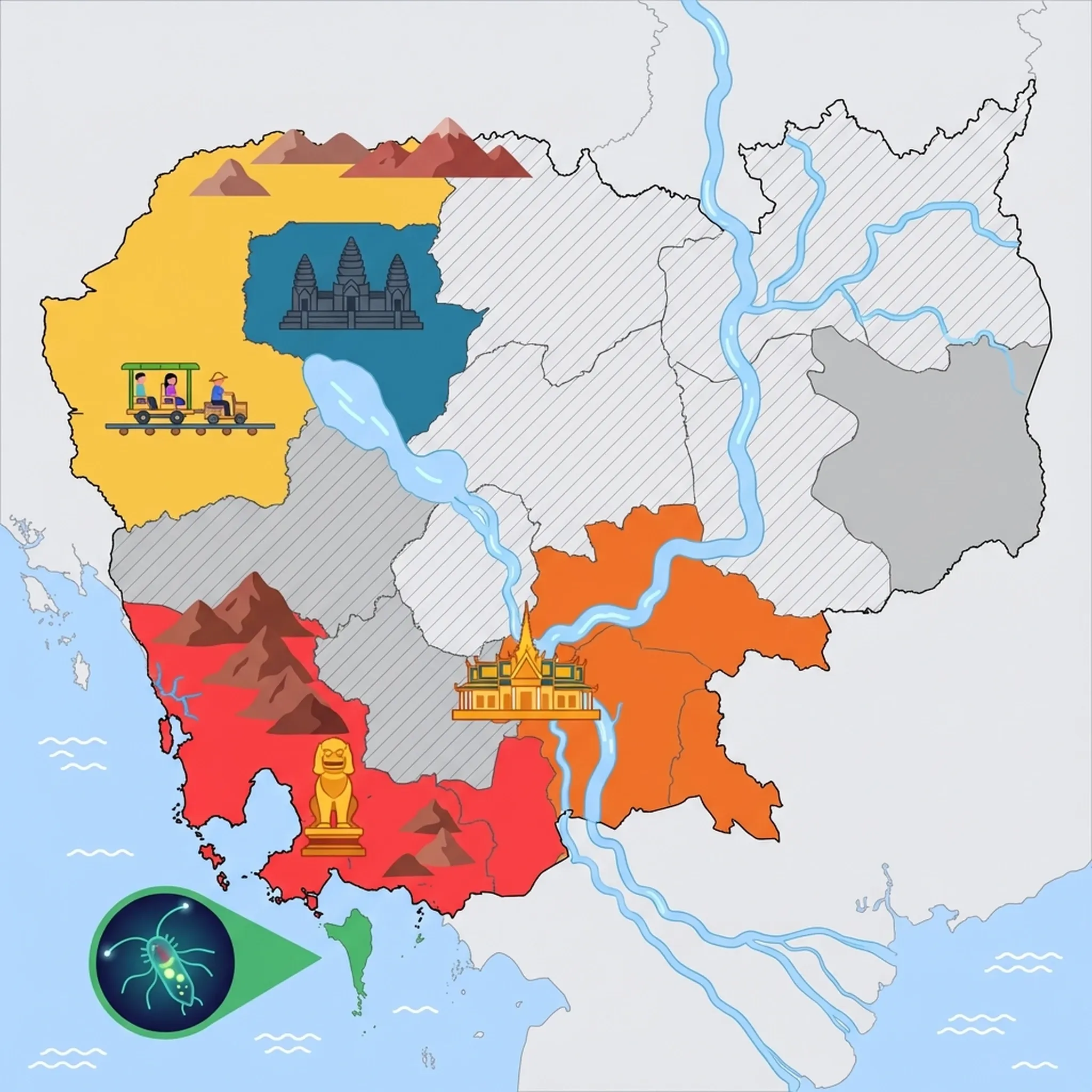
5 Regions
Battambang & Northwest
Ride the rails and watch millions of bats take flight 🦇🚂
Koh Rong Islands
White sands and glowing plankton in a car-free paradise 🏝️✨
Phnom Penh
The bustling pearl of Asia where three rivers meet 🏙️🛶
Siem Reap (Angkor Wat)
Explore jungle temples and floating villages in the Kingdom of Wonder 🏛️🌳
Sihanoukville & Coast
Misty mountains, pepper plantations, and coastal sunsets 🦀🌄
Click on a region marker to explore details. Use the dropdown to color regions by activity suitability.

Getting There & Around
Getting There
- By Air – The main gateways are Phnom Penh International Airport (PNH) and the new Siem Reap-Angkor International Airport (SAI), which serves Siem Reap (note: SAI is approx. 45-60 mins from the city).
- By Land – Buses cross from Thailand (Poipet/Aranyaprathet) and Vietnam (Bavet/Moc Bai). The Poipet crossing can be chaotic; flying is often better for families.
- Entry Requirements – Most visitors need a visa. The e-Visa (Tourist) is recommended and processes online in 3 days. Additionally, ALL travellers must complete the Cambodia e-Arrival Card within 7 days of arrival. Check your government website for the latest visa requirements, or use the IATA Travel Centre entry-requirements checker.
Getting Around
- Tuk-tuks (Remorks) – The most fun way for families to travel. The traditional trailer-style remork is spacious enough for a family of four. Always negotiate the price beforehand or use ride-hailing apps.
- Ride-Hailing Apps – PassApp and Grab are essential. They offer fixed prices for rickshaws and SUVs, eliminating the need to haggle and preventing overcharging.
- Private Drivers – Hiring a car with a driver for the day is very affordable (approx. $35–50 USD) and highly recommended for visiting distant temples like Banteay Chhmar Temple or Phnom Kulen National Park comfortably with AC.
- Buses & Vans – Companies like Giant Ibis and Vireak Buntham offer safe, air-conditioned connections between major hubs like Siem Reap and Phnom Penh.
- Boats – Ferries connect the mainland to islands like Koh Rong. Speed ferries are fast (45 mins) but can be bumpy; larger supply boats are slower but more stable.

Packing List
Old, torn, or marked US notes are frequently rejected by shops and banks; bring pristine small denominations.
You will remove your shoes constantly at temples and pagodas; laces become very frustrating.
Essential for sunrise temple walks (which start in total darkness) and navigating frequent island power cuts.
The humidity is extreme; water alone often isn't enough to prevent heat exhaustion in children.
Shoulders and knees must be covered at Angkor Wat; scarves are sometimes not accepted as sufficient cover.

Activities & Best Times

City & Cultural
ExcellentUrban tourism, museums, historical sites, architecture
Home to the world-renowned Angkor Archaeological Park, offering unparalleled UNESCO heritage sites and high-end cultural experiences. Peak months provide the most comfortable temperatures for temple exploration, while the monsoon peak in September and October presents significant flooding risks and humidity.
A vibrant capital blending Khmer heritage with colonial architecture, featuring the world-class Royal Palace and National Museum. Peak conditions occur in the cooler dry season, while heavy monsoon rains in autumn can disrupt walking tours.
Battambang is a hub of preserved French colonial architecture and home to major archaeological sites like Banteay Chhmar and Wat Banan. The cool, dry winter months are ideal for walking tours and exploring the vibrant local art scene before the extreme heat of April or the heavy monsoons of September.

Adventure & Nature
Very GoodHiking, wildlife, outdoor exploration, ecotourism
Home to world-class agritourism like the Kampot pepper farms and the misty jungles of Bokor National Park. The region is best explored during the drier months to ensure trail accessibility and comfortable temperatures for outdoor exploration.
Features unique jungle trekking, ziplining through ancient canopies, and the biodiversity of Tonle Sap lake. The dry season ensures trail accessibility and optimal wildlife viewing, whereas peak monsoon rains make jungle paths muddy and difficult for families.
Offers high-quality wildlife conservation encounters and island excursions that provide authentic rural immersion for families. Best visited in the dry season to ensure trail accessibility and comfortable wildlife viewing conditions.

Beach & Sea
Very GoodBeach resorts, marine activities: diving, snorkelling, kite surfing, wind surfing, sailing
Koh Rong is Cambodia's premier beach destination with pristine white sand bays and coral reefs (Saracen Bay) that compete internationally in Southeast Asia. It should be rated higher than Sihanoukville & Coast, which depends on these islands for beach appeal. The current equal rating fails to differentiate Cambodia's primary beach destination from the mainland gateway.
Features serene island resorts on Koh Rong and the colonial charm of Kep, offering a sophisticated alternative to the bustling mainland. Optimal conditions occur during the dry monsoon when seas are calm and visibility is highest for marine activities.
West Baray provides a freshwater 'beach' experience with local recreation facilities, though it does not meet international standards for marine or coastal tourism. Conditions are best for swimming and relaxation during the peak dry months.

Sports & Active
Very GoodSport tourism, fitness activities, active recreation
The Angkor circuits provide world-class cycling routes through historical landscapes and established wake parks for aquatic sports. Activity is best during the cooler, dry months; heavy rains in late summer can disrupt outdoor cycling and adventure park operations.
Offers quality cycling routes and adventure centers like Wake Park Cambodia, providing structured activity for active families. These facilities and trails are most reliable and enjoyable during the dry season, avoiding the washouts of the monsoon.
Features dedicated cycling routes through rural island landscapes and international-standard water parks for active families. Conditions are optimal during the cooler dry season, whereas peak monsoon rainfall can degrade rural paths.

Road Trips & Scenic
GoodScenic drives, countryside tours, route-based travel
The dramatic ascent to Bokor and the scenic coastal drive to Kep are regional highlights for scenic touring. Safe and visually rewarding travel requires the clear skies and dry roads of the November to March window.
The Small and Grand Circuits of Angkor are internationally celebrated scenic routes perfect for tuk-tuk or private car exploration. Rural driving conditions are optimal in the dry season, as unpaved roads to outlying temples can become treacherous during peak monsoon months.
Acts as a major hub for scenic national routes connecting to the Mekong Discovery Trail and the southern coast. Dry months provide the safest and most scenic driving conditions, while potential flooding in autumn can impact travel times.

Educational & Exploratory
GoodLearning experiences, scientific sites, historical education
Highly unique facilities like the APOPO Visitor Center and the Angkor Centre for Conservation of Biodiversity offer significant learning opportunities regarding history and conservation. While many exhibits are indoor or sheltered, the overall travel experience is best aligned with the dry season.
Features specialized learning-oriented sites like the Safari Aquarium which provides family-friendly insights into Mekong biodiversity. Access is best in the dry season, as outdoor components are less comfortable during the peak monsoon.

Theme Park & Entertainment
MarginalAmusement parks, family entertainment venues
Green Valley Veal Pouch provides a local-scale aquatic experience, primarily suitable as a brief diversion rather than a primary destination. Peak interest aligns with the hottest months when families seek water-based relief from the heat.
Offers regional-scale attractions like the Angkor Eye and local water parks which serve as family diversions rather than primary travel motivators. These outdoor venues are most enjoyable when the risk of heavy tropical downpours is lowest.
Local-scale water and amusement parks like Green Park provide basic family entertainment but lack the world-class infrastructure sophisticated travelers expect. These facilities are most utilized during the peak heat months of the dry season as a way to cool down.

Festivals & Seasonal
MarginalEvents, celebrations, seasonal attractions
Defined by the Angkor Wat Equinox in March and the Cambodian Water Festival (Bon Om Touk) in November. These events offer authentic cultural spectacles, though the region lacks a dense year-round international festival calendar.
Hosts the spectacular Bon Om Touk (Water Festival) in November and traditional Khmer New Year in April, providing unique cultural spectacles. Other months lack the internationally significant events required for this classification.

Public Holidays & Calendar Next 12 months
Public holidays, festivals, cultural celebrations, and seasonal natural phenomena coming up in Cambodia over the next 12 months.
Loading holidays and events...

Climate & Weather
Battambang & Northwest
Show Details
| Month | Temp °C | Rain | Humidity |
|---|
Koh Rong Islands
Show Details
| Month | Temp °C | Rain | Humidity |
|---|
Phnom Penh
Show Details
| Month | Temp °C | Rain | Humidity |
|---|
Siem Reap (Angkor Wat)
Show Details
| Month | Temp °C | Rain | Humidity |
|---|
Sihanoukville & Coast
Show Details
| Month | Temp °C | Rain | Humidity |
|---|

Travel Advisory
The majority of major travel agencies recommend exercising a high degree of caution or increased vigilance when visiting Cambodia. This assessment is driven by persistent petty and violent crime in urban areas and significant regional security risks near international land borders.
Safety Topics
Traveller Advice (3 groups)

While same-sex relationships are not illegal, there are no specific legal protections against discrimination, and public displays of affection may draw unwanted negative attention.

There have been reports of harassment and sexual assault targeting foreigners. Female travellers should avoid walking alone after dark, particularly in isolated beach areas or quiet city streets.

Travellers are advised to stay on well-used paths in rural areas to avoid unexploded landmines and to use reputable transport services to minimize the risk of theft.
Agency Summaries
New Zealanders should be more cautious than usual due to the frequency of violent crime and potential for civil unrest. All travel to the Thailand-Cambodia border is discouraged.
The U.S. government recommends heightened awareness due to crime and the presence of landmines. A high-risk warning is in effect for regions bordering Thailand due to potential armed conflict.
Canadians are urged to be very vigilant due to a rise in opportunistic street crime. Specific areas near the Thai border should be avoided entirely because of territorial disputes and military activity.
Australia advises a high level of vigilance across the country due to unpredictable security conditions and crime. Reconsider travel to border provinces affected by recent military tensions.
While general travel is permitted, the FCDO warns against visiting the land border with Thailand. Crime is a concern in tourist hubs, and visitors should be aware of lower health and safety standards.
Irish citizens are advised to be cautious of violent crime and civil unrest. The border region with Thailand is considered dangerous and should be avoided.
Information is provided for general guidance only and does not constitute travel, safety, medical, or legal advice. Conditions may change. Users are responsible for independently verifying information before travel.