
Siem Reap (Angkor Wat)
Explore jungle temples and floating villages in the Kingdom of Wonder 🏛️🌳
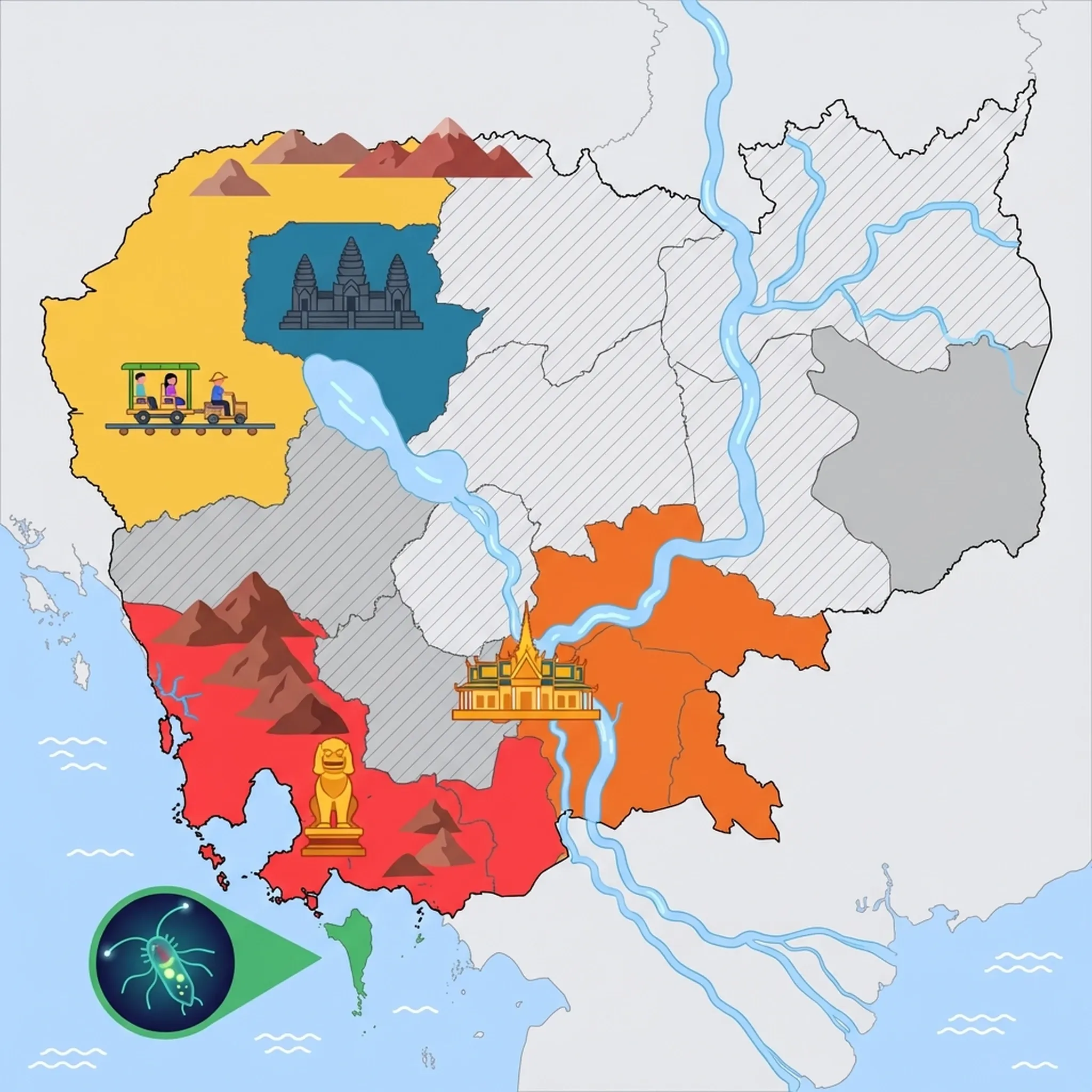
Click a region to explore
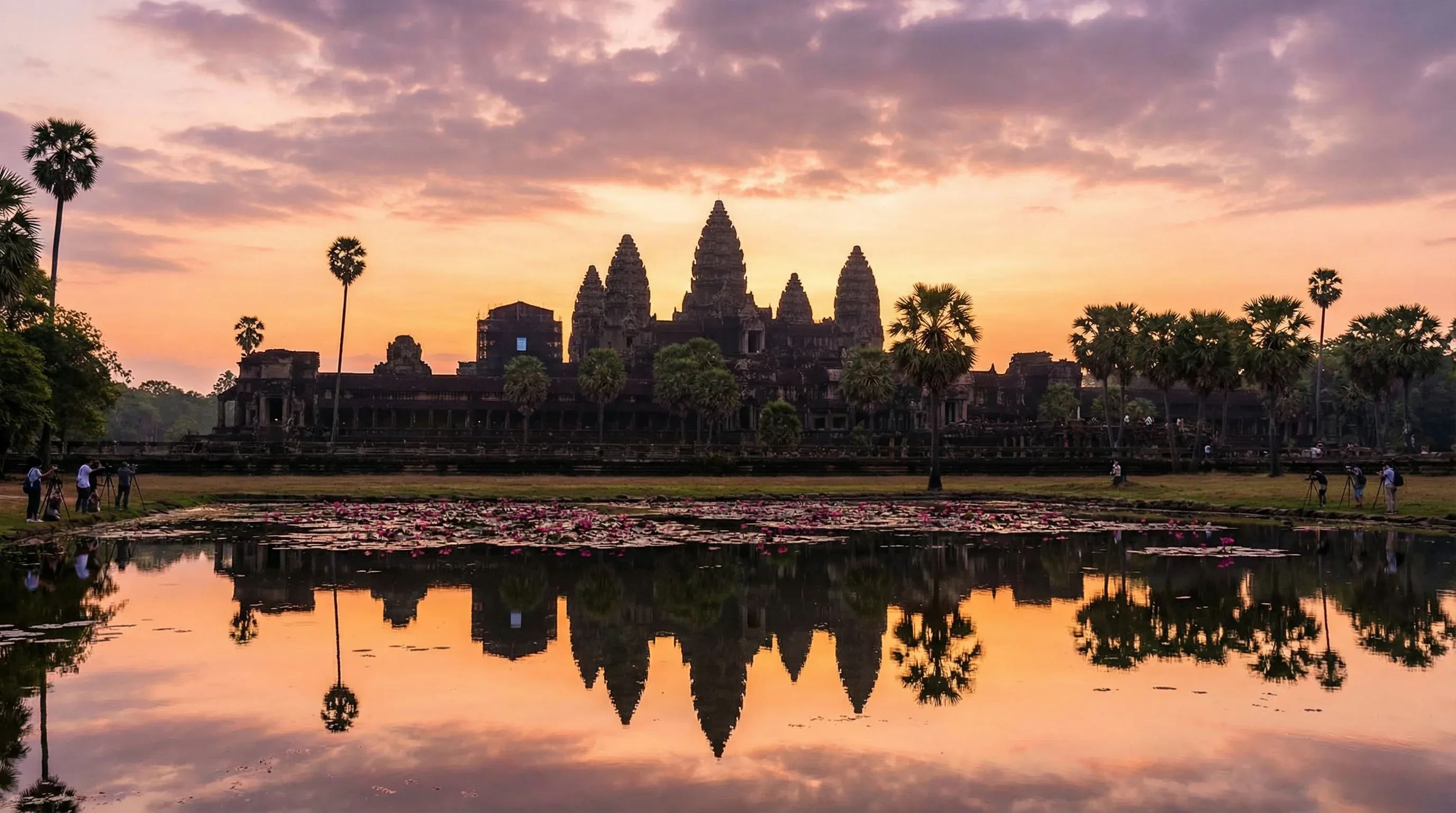
Siem Reap is the primary reason most families visit Cambodia, and it rarely disappoints. The region is dominated by the Angkor Archaeological Park, a UNESCO World Heritage site stretching over 400 square kilometers. For children, this is not a dry history lesson but an Indiana Jones-style adventure. The temples are surrounded by jungle, moats, and causeways lined with stone giants. Beyond the temples, the landscape shifts to the vast floodplain of the Tonle Sap, where communities live on stilted or floating houses, adapting their lives to the rising and falling water levels.
The town of Siem Reap has evolved into a sophisticated tourist hub that caters brilliantly to families. After a dusty morning at the ruins, you can retreat to hotels with excellent pools, visit interactive museums, or watch the Phare Circus, a high-energy acrobatic show that tells Cambodian stories. The atmosphere is safe and welcoming, with English widely spoken. It is a place where ancient grandeur meets modern comfort, allowing families to explore at their own pace without sacrificing convenience.
Key Attractions
Obviously, Angkor Wat is the headline act. To make it child-friendly, visit at sunrise to beat the heat, and focus on the bas-reliefs of churning oceans and battling demons. Just as popular with kids is Ta Prohm, famously used as a location for the 'Tomb Raider' film. Here, massive silk-cotton tree roots strangle the stone walls, creating a natural playground where nature is reclaiming history. It feels mysterious and wild.
For a break from temples, head to the Tonle Sap Lake. A boat trip to the floating villages (like Kampong Phluk) shows children a completely different way of life, where schools, police stations, and pig pens float on water. Back in town, the Angkor National Museum provides a climate-controlled environment to see the statues up close and understand the stories behind the ruins. For nature lovers, a trip to Phnom Kulen National Park offers waterfalls perfect for a cooling swim and riverbeds carved with a thousand ancient lingas.
Practical Advice
Temple fatigue is real for children. Do not try to see everything. Buy a 3-day pass but only visit for half-days (mornings), spending afternoons at the pool. The best months are December and January (coolest), but April is brutally hot. Dress codes are strictly enforced at temples: shoulders and knees must be covered for everyone over 12 (and often enforced for younger kids too).
Food & Drink
Typical meal times: Breakfast is early (from 6:00 am) to accommodate temple-goers. Lunch 12:00 pm to 2:00 pm, Dinner 6:00 pm to 9:30 pm.
Typical meal costs: Tourist restaurants average 24,000–48,000 KHR (approx. $6–12 USD / €5.50–11 EUR) per main. High-end dining is available for 80,000–160,000 KHR (approx. $20–40 USD / €18–36 EUR).
Dietary requirements: Extremely accommodating. Most restaurants have vegetarian sections and understand 'no spicy' requests for children. Western comfort food (pizza, pasta) is everywhere.
Signature dishes:
- Fish Amok – A mild, creamy coconut curry steam-cooked in banana leaves. It has a mousse-like texture that is very palatable for children.
- Lok Lak – Stir-fried marinated beef served with rice, a fried egg, and a lime-pepper dipping sauce. A safe and delicious bet for picky eaters.
- Prahok Ktis – A dip made from fermented fish, minced pork, and coconut milk, served with fresh crudités. A great way to try the famous Cambodian fermented fish flavor in a milder form.
Why this score?
Exploring the sprawling temple complexes often involves climbing steep stairs, navigating jungle-covered ruins like Ta Prohm, and cycling long circuits. Beyond the temples, the region offers adventures in the Kulen Mountains and floating villages on the Tonle Sap, though the infrastructure remains highly catered to tourists.
Why this score?
The region is well-served by specialized facilities like the Royal Angkor International Hospital, which is designed to cater to foreign tourists with high standards of care. While very reliable for most tourist needs, the most critical cases are still often evacuated to Phnom Penh or Bangkok for advanced treatment.
Why this score?
Siem Reap is a major international draw and the primary driver of Cambodia's tourism industry, hosting the UNESCO-listed Angkor Archaeological Park. The city is purpose-built for tourism with hundreds of hotels ranging from boutique stays to luxury resorts, consistently ranking as one of Asia's top cultural destinations.

Siem Reap caters to all budgets. An Angkor temple pass is a significant cost: roughly 150,000 KHR ($37 USD) for 1 day or 250,000 KHR ($62 USD) for 3 days per adult (under 12s are free). Food and accommodation offer excellent value; a luxury family suite can be found for 400,000 KHR (approx. $100 USD / €90 EUR).

Getting Here & Around
Getting Here
- Airport – The new Siem Reap-Angkor International Airport (SAI) serves the region. It is about 45–60 minutes drive from the town center.
- Bus – Connected to Phnom Penh via National Road 6. Luxury minivans are the most comfortable option for families.
- Boat – In high water season, ferries run from Battambang and Phnom Penh, crossing the Tonle Sap Lake, though safety standards vary.
Getting Around
- Remork (Tuk-tuk) – The standard way to tour the Angkor Archaeological Park. Hire a driver for the whole day (approx. $15-25 USD). It's breezy and fun for kids.
- Electric Bike – E-bikes can be rented to explore the temples silently and eco-friendlily.
- Car – Air-conditioned taxis are recommended for distant sites like Phnom Kulen National Park or Banteay Srei to escape the heat.
Nearby Airports (1 airport)
Siem Reap-Ankor International Airport
SAISiem Reap
View full flight map for Cambodia →
Official Links

Packing List
Temple tickets must be shown at every checkpoint; a lanyard keeps them accessible and prevents loss.
You will take shoes off frequently to enter active temple shrines; laces become annoying quickly.
The heat and humidity in the temple complex are draining; kids dehydrate faster than expected.
Airflow is non-existent inside the stone corridors of the temples.
Old, torn, or marked US notes are frequently rejected by shops and banks; bring pristine small denominations.
You will remove your shoes constantly at temples and pagodas; laces become very frustrating.
Essential for sunrise temple walks (which start in total darkness) and navigating frequent island power cuts.
The humidity is extreme; water alone often isn't enough to prevent heat exhaustion in children.
Shoulders and knees must be covered at Angkor Wat; scarves are sometimes not accepted as sufficient cover.

Activities & Best Times

Urban tourism, museums, historical sites, architecture
Home to the world-renowned Angkor Archaeological Park, offering unparalleled UNESCO heritage sites and high-end cultural experiences. Peak months provide the most comfortable temperatures for temple exploration, while the monsoon peak in September and October presents significant flooding risks and humidity.

Hiking, wildlife, outdoor exploration, ecotourism
Features unique jungle trekking, ziplining through ancient canopies, and the biodiversity of Tonle Sap lake. The dry season ensures trail accessibility and optimal wildlife viewing, whereas peak monsoon rains make jungle paths muddy and difficult for families.

Sport tourism, fitness activities, active recreation
The Angkor circuits provide world-class cycling routes through historical landscapes and established wake parks for aquatic sports. Activity is best during the cooler, dry months; heavy rains in late summer can disrupt outdoor cycling and adventure park operations.

Learning experiences, scientific sites, historical education
Highly unique facilities like the APOPO Visitor Center and the Angkor Centre for Conservation of Biodiversity offer significant learning opportunities regarding history and conservation. While many exhibits are indoor or sheltered, the overall travel experience is best aligned with the dry season.

Scenic drives, countryside tours, route-based travel
The Small and Grand Circuits of Angkor are internationally celebrated scenic routes perfect for tuk-tuk or private car exploration. Rural driving conditions are optimal in the dry season, as unpaved roads to outlying temples can become treacherous during peak monsoon months.

Beach resorts, marine activities: diving, snorkelling, kite surfing, wind surfing, sailing
West Baray provides a freshwater 'beach' experience with local recreation facilities, though it does not meet international standards for marine or coastal tourism. Conditions are best for swimming and relaxation during the peak dry months.

Events, celebrations, seasonal attractions
Defined by the Angkor Wat Equinox in March and the Cambodian Water Festival (Bon Om Touk) in November. These events offer authentic cultural spectacles, though the region lacks a dense year-round international festival calendar.

Amusement parks, family entertainment venues
Offers regional-scale attractions like the Angkor Eye and local water parks which serve as family diversions rather than primary travel motivators. These outdoor venues are most enjoyable when the risk of heavy tropical downpours is lowest.

Attractions (17 total)



Public Holidays & Calendar Next 12 months
Public holidays, festivals, cultural celebrations, and seasonal natural phenomena coming up in Siem Reap (Angkor Wat) over the next 12 months.
Loading holidays and events...

Travel Advisory
The majority of major travel agencies recommend exercising a high degree of caution or increased vigilance when visiting Cambodia. This assessment is driven by persistent petty and violent crime in urban areas and significant regional security risks near international land borders.
Safety Topics
Traveller Advice (3 groups)

While same-sex relationships are not illegal, there are no specific legal protections against discrimination, and public displays of affection may draw unwanted negative attention.

There have been reports of harassment and sexual assault targeting foreigners. Female travellers should avoid walking alone after dark, particularly in isolated beach areas or quiet city streets.

Travellers are advised to stay on well-used paths in rural areas to avoid unexploded landmines and to use reputable transport services to minimize the risk of theft.
Agency Summaries
New Zealanders should be more cautious than usual due to the frequency of violent crime and potential for civil unrest. All travel to the Thailand-Cambodia border is discouraged.
The U.S. government recommends heightened awareness due to crime and the presence of landmines. A high-risk warning is in effect for regions bordering Thailand due to potential armed conflict.
Canadians are urged to be very vigilant due to a rise in opportunistic street crime. Specific areas near the Thai border should be avoided entirely because of territorial disputes and military activity.
Australia advises a high level of vigilance across the country due to unpredictable security conditions and crime. Reconsider travel to border provinces affected by recent military tensions.
While general travel is permitted, the FCDO warns against visiting the land border with Thailand. Crime is a concern in tourist hubs, and visitors should be aware of lower health and safety standards.
Irish citizens are advised to be cautious of violent crime and civil unrest. The border region with Thailand is considered dangerous and should be avoided.
Information is provided for general guidance only and does not constitute travel, safety, medical, or legal advice. Conditions may change. Users are responsible for independently verifying information before travel.