

Overview
Cameroon offers families a vivid slice of the African continent, packing rainforests, savannahs, and beaches into one nation. Known as "Africa in Miniature," it is a land where you can experience the rhythms of Central Africa in a relatively compact area. While the northern and western regions currently face security challenges, the French-speaking southern and littoral regions remain open to visitors and offer rich experiences for adventurous families. The vibe here is energetic and authentic; this is not a polished "resort" destination, but a place for genuine cultural immersion.
For children, the highlight is undoubtedly the wildlife. Unlike the open savannah safaris of East Africa, Cameroon offers intimate encounters with forest giants. The sanctuary at Mefou National Park allows kids to come face-to-face with rescued gorillas and chimpanzees in a safe, educational environment. Beyond the rainforest, the Atlantic coast provides a relaxing counterpoint with warm waters and fishing villages where life moves at a gentle pace. Exploring Cameroon requires patience and a sense of adventure, but the rewards are warm smiles, incredible food, and stories that will last a lifetime.
Key Attractions
Start your journey in the capital, Yaoundé, where the Mefou National Park is an absolute must-do. Run by Ape Action Africa, this sanctuary is home to hundreds of primates rescued from the bushmeat trade. It is one of the few places in the world where families can safely see gorillas and chimps in semi-wild enclosures. Nearby, the National Museum of Cameroon offers a colorful tour through the country's history, housed in a grand former presidential palace that fascinates children with its scale and artifacts.
On the coast, the beach town of Kribi is the family holiday capital. Here, you will find the Lobé Waterfalls, a unique natural wonder where a river cascades directly into the sea-you can take a canoe ride right up to the spray. Just down the beach stands the historic Kribi Lighthouse, where you can climb for panoramic views of the Gulf of Guinea. For a deeper dive into nature, a day trip to Campo Ma'an National Park offers the chance to see forest elephants and buffalo in their natural habitat, though a guide is essential.
In the commercial hub of Douala, art-loving families should visit Doual'art, a contemporary art centre that often features interactive and outdoor installations. While the Foumban Royal Palace in the West is a cultural jewel of the Bamoun people, families must check current security reports before venturing to that region.
Practical Advice
Best time to visit: The dry season (November to February) is ideal for travel, with lower humidity and easier roads. Avoid the heavy rains of July–September.
Visas: An eVisa is mandatory for most travelers and must be arranged before departure.
Health: A Yellow Fever vaccination certificate is required for entry. Malaria prophylaxis is essential for all family members. Drink only bottled or filtered water.
Food & Drink
Typical meal times: Breakfast is usually light, taken around 7:00 am to 9:00 am. Lunch is the main meal of the day, typically served from 12:00 pm to 2:00 pm. Dinner is eaten later, generally between 7:30 pm and 9:00 pm.
Typical meal costs: Street food and local stalls are very cheap, while sit-down restaurants in cities are mid-range. A typical meal costs 2,000–6,000 XAF (approx. $3.30–10.00 USD / €3.00–9.00 EUR). High-end dining in hotels can reach 15,000–25,000 XAF (approx. $25–40 USD / €23–38 EUR).
Dietary requirements: Vegetarian options are available but limited; dishes often contain fish stock or crayfish as a base. Ndole can be made without meat upon request, but cross-contamination is possible. Peanuts and shellfish are very common ingredients, so allergy sufferers must be extremely vigilant.
Family-friendly dining: Highchairs are rare outside international hotels. Cameroonian culture is very child-friendly, and kids are welcome everywhere, but there are no specific "kids menus"-children typically eat smaller portions of adult dishes like grilled chicken and plantains.
Signature dishes:
- Poulet DG – A favorite for families, this is a "Director General" chicken stew with plantains, carrots, and green beans. It is mild, sweet, and savory.
- Ndolé – The national dish made from bitter leaves, peanuts, and spices, usually with fish or meat. It has a unique creamy, nutty flavor.
- Grilled Fish (Poisson Braisé) – Fresh fish marinated in spices and grilled over charcoal, popular on Kribi beaches and safe for kids if you ask for "no piment" (no chili).
- Puff-Puff (Beignets) – Deep-fried dough balls sold on street corners, a sugary treat children will love.
Safety
Petty crime is common in cities; keep valuables hidden and avoid walking at night. Official checkpoints are frequent-always carry your passport and vaccination card. Stick to the "green zones" (South, Littoral, Centre) and strictly avoid the borders and regions marked "Do Not Travel" by your embassy. Road safety is a major concern; hire a professional driver with a well-maintained vehicle rather than self-driving.

While local food is cheap, safe transport and comfortable accommodation suitable for families are priced at international levels. A family of four should budget around 120,000–180,000 XAF (approx. $200–300 USD / €185–275 EUR) per day for a mid-range experience with a private driver and decent hotels.
Age Suitability




Did you know? Cameroon welcomes approximately 812,000 international visitors per year. Most visitors come from Africa.
Explore Regions
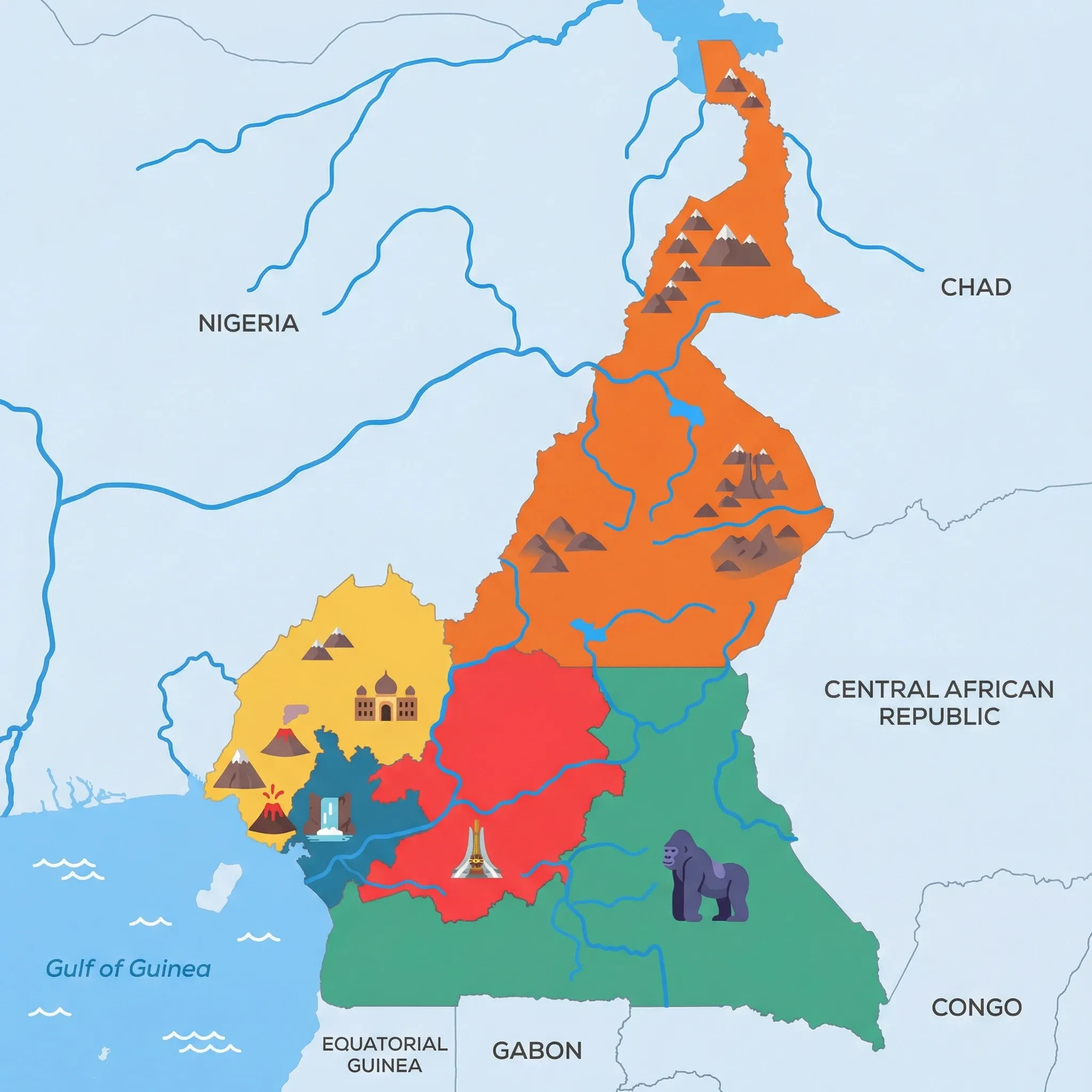
5 Regions
Douala & Littoral
The energetic gateway where urban pulses meet thundering waterfalls 🌊
Northern Cameroon
A land of lunar peaks and ancient savannah kingdoms 🦁
Southern Rainforests
Where the rainforest tumbles into the sea 🌴
Western Highlands
Misty mountains and the rhythm of royal drums 👑
Yaoundé & Centre
The city of seven hills and sanctuary for primates 🦍
Click on a region marker to explore details. Use the dropdown to color regions by activity suitability.

Getting There & Around
Getting There
- By Air – The main gateway is Yaoundé Nsimalen International Airport (NSI), serving Yaoundé & Centre. Douala International Airport (DLA) is the commercial hub and closest to Douala & Littoral. Major airlines include Air France, Brussels Airlines, and Ethiopian Airlines.
- By Land – Border crossings are generally not recommended for tourists due to safety concerns in border regions.
- Entry Requirements – Most visitors require an eVisa obtained in advance. A Yellow Fever vaccination certificate is mandatory. Check your government website for the latest visa requirements, or use the IATA Travel Centre entry-requirements checker.
Getting Around
- Car Hire – The safest and most convenient option for families. Renting a 4x4 with a professional driver is highly recommended for navigating the roads and police checkpoints.
- Inter-City Buses – VIP buses (like Touristique or Finexs) connect Douala & Littoral with Yaoundé & Centre reliably. They are comfortable and affordable but can be crowded.
- Trains – Camrail operates the Train Express between Douala and Yaoundé. It is a scenic and safe way to travel between the two major cities.
Official Links

Packing List
Mandatory for all visitors to Mefou National Park to protect the primates from human diseases.
Power cuts are frequent in all cities; essential for navigating hotels or streets at night.
Tap water is not potable anywhere; this saves buying endless plastic bottles.
English is widely spoken in the Northwest but French is dominant in key tourist areas like Kribi and Yaoundé.
You will physically not be allowed to leave the airport without showing this original document.
The XAF currency is pegged to the Euro; it is the easiest foreign currency to exchange.

Activities & Best Times

Adventure & Nature
Very GoodHiking, wildlife, outdoor exploration, ecotourism
Home to the unique Twin Lakes of Mount Manengouba and the biodiverse Douala-Edéa National Park, offering rare volcanic and rainforest landscapes. Peak dry season (December-February) is essential for navigable trails and clear views of the crater lakes, while the monsoon rains render nature expeditions difficult.
Dramatic volcanic landscapes, including Mount Oku and the Manengouba crater lakes, provide unique high-altitude wilderness experiences. Trekking is optimal in the dry season; however, the intense rainfall and fog of the wet season (Jun-Sep) make trails hazardous and obscure scenic vistas.
Home to the UNESCO-listed Dja Faunal Reserve and Campo Ma'an, the region offers world-class rainforest immersion and gorilla tracking for intrepid families. Trekking is best in the drier months; the peak rainy seasons make jungle trails nearly impassable and wildlife spotting extremely challenging.

City & Cultural
Very GoodUrban tourism, museums, historical sites, architecture
Douala serves as a significant hub for contemporary African art through institutions like Doual'art, complemented by historic colonial architecture like La Pagode. The vibrant urban culture is best explored during the drier months when street life and outdoor exhibitions are at their most active.
The region features world-class living heritage at the Royal Palace of Foumban and the Bamileke Chefferies, offering profound architectural and historical depth. The dry season (Nov-Feb) is peak for cultural exploration, as heavy highland rains from June to September hinder travel between chiefdoms.
Yaoundé serves as a regional cultural hub with the impressive National Museum and significant architectural landmarks like the Reunification Monument. The city is best explored during the drier seasons to fully appreciate the vibrant street markets and historic sites without the disruption of peak rainfall.

Beach & Sea
GoodBeach resorts, marine activities: diving, snorkelling, kite surfing, wind surfing, sailing
Offers authentic coastal escapes like Manoka Island and Yoyo Beach, characterized by dark volcanic sands and a lack of mass-market commercialization. Visiting is ideal in the dry season to ensure calm seas and sunny conditions, as heavy littoral rains significantly degrade the beach experience from June to October.
While Kribi offers pleasant beaches and the unique Lobé Waterfalls, it does not compete internationally as a beach destination. By global standards (Caribbean, Mediterranean, Southeast Asia), these are nice regional beaches but not a primary draw for international beach tourism. The waterfall feature is unique but doesn't elevate the overall beach quality to 'good' on international scale.

Road Trips & Scenic
GoodScenic drives, countryside tours, route-based travel
The Ring Road and Route des Chefferies are iconic African driving circuits offering spectacular mountain scenery and access to remote kingdoms. Travel is strictly recommended for the dry season to avoid severe road degradation and safety issues caused by the heavy highland monsoon.
The coastal drive from Douala to Kribi and the rainforest highway provide spectacular scenery through primary jungle and Atlantic vistas. Travel is significantly safer and more reliable in the dry season when unpaved access roads to parks like Campo Ma'an remain navigable.
The Mandara Mountains offer some of West Africa's most spectacular scenic drives through lunar-like landscapes. Peak months provide the best visibility and safest road conditions, whereas the rainy season poses significant transit risks on unpaved secondary routes.

Sports & Active
GoodSport tourism, fitness activities, active recreation
Features challenging hiking routes such as the Mount Nlonako and Mount Manengouba ascents, which provide high-altitude physical engagement. These activities are safest and most rewarding during the peak dry months when visibility is high and trail conditions are stable.
Challenging high-altitude cycling and trekking routes, such as the Bamenda Ring Road circuit, offer a rigorous physical experience for active families. The dry season provides the only reliable window for safe activity, with wet season rains making the terrain impassable for sports.
Hiking routes at Mount Fébé and Mount Eloundem provide active outdoor challenges for families seeking fitness. These trails are best tackled during the main dry season to avoid the slippery and hazardous conditions caused by heavy precipitation in April-May and Sept-Oct.

Theme Park & Entertainment
MarginalAmusement parks, family entertainment venues

Festivals & Seasonal
MarginalEvents, celebrations, seasonal attractions

Relaxation & Wellness
MarginalSpa retreats, wellness centers, peaceful getaways

Educational & Exploratory
MarginalLearning experiences, scientific sites, historical education

Public Holidays & Calendar Next 12 months
Public holidays, festivals, cultural celebrations, and seasonal natural phenomena coming up in Cameroon over the next 12 months.
Loading holidays and events...
Climate & Weather
Douala & Littoral
Show Details
| Month | Temp °C | Rain | Humidity |
|---|
Northern Cameroon
Show Details
| Month | Temp °C | Rain | Humidity |
|---|
Southern Rainforests
Show Details
| Month | Temp °C | Rain | Humidity |
|---|
Western Highlands
Show Details
| Month | Temp °C | Rain | Humidity |
|---|
Yaoundé & Centre
Show Details
| Month | Temp °C | Rain | Humidity |
|---|

Travel Advisory
Five out of six major agencies recommend a baseline of high caution for the country, while noting severe regional escalations where travel is discouraged or prohibited.
Safety Topics
Traveller Advice (2 groups)

Women should avoid traveling solo, particularly at night, and be aware of potential harassment. Dressing conservatively is recommended to align with local cultural norms.

Same-sex relationships are illegal and can lead to imprisonment. Societal discrimination is widespread, and travelers should avoid public displays of affection and maintain a low profile regarding their sexual orientation.
Agency Summaries
Travelers should remain extremely vigilant due to frequent violent crime and ongoing regional instability. Specific areas including the Far North, North-West, and South-West regions should be avoided entirely because of active conflict and kidnapping risks. Non-essential travel to the North and Adamaoua regions is also discouraged.
Heightened vigilance is necessary throughout the country due to civil unrest, crime, and health concerns. Certain regions are classified as Level 4 (Do Not Travel) due to severe risks of armed violence, terrorism, and kidnapping, particularly in the Far North and English-speaking Western provinces.
There are major safety concerns related to terrorism, kidnapping, and carjackings. While the overall level is 2 out of 4, visitors are strongly warned to avoid the Far North and Western regions where active conflict and piracy are prominent threats.
The UK government restricts travel to several regions including the Far North, North-West, and South-West due to terrorism and political violence. Travelers in permitted areas should be aware of a high risk of violent crime, particularly after dark, and potential spillover from neighboring conflicts.
Ireland maintains a high alert status for Cameroon, advising against all non-essential travel to northern and western regions. Citizens are warned of dangerous security conditions and the limited capacity of the embassy to provide assistance in crisis areas.
Australian citizens are advised to exercise significant caution across the country due to threats of violent crime and civil disorder. Extremist activity in border regions and the Anglophone crisis in the West pose severe risks, leading to 'Do Not Travel' warnings for those specific areas.
Information is provided for general guidance only and does not constitute travel, safety, medical, or legal advice. Conditions may change. Users are responsible for independently verifying information before travel.