

⚠️ SAFETY WARNING: Due to widespread activity by armed rebel groups, high rates of violent crime, and the threat of kidnapping, government agencies (including the USA, UK, Canada, Australia, Ireland, and New Zealand) advise travelers to avoid all travel to this country. The security situation is volatile and can deteriorate without warning. Families are strongly urged to consult their own government's official travel advisory before considering a trip, as circumstances and risk assessments vary.
Overview
For those who look beyond the travel warnings, the Central African Republic offers a window into the primordial heart of the continent. This landlocked nation is dominated by the vast Congo Basin rainforest in the south and savannahs in the north. It is a place where nature rules supreme, hosting some of Africa's most significant wildlife populations. The climate is tropical, with a wet season from May to October and a dry season from November to April, which is the only viable time for tourism.
Cultural experiences here are raw and authentic, far removed from the commercialized tourism of other African nations. The Ba'Aka people of the southwest forests maintain traditional hunter-gatherer lifestyles that have existed for millennia. However, the lack of infrastructure means travel here is an expedition rather than a holiday; families must be prepared for rough roads, limited electricity, and the need for comprehensive self-sufficiency. It is a destination that commands respect and extreme caution.
Key Attractions
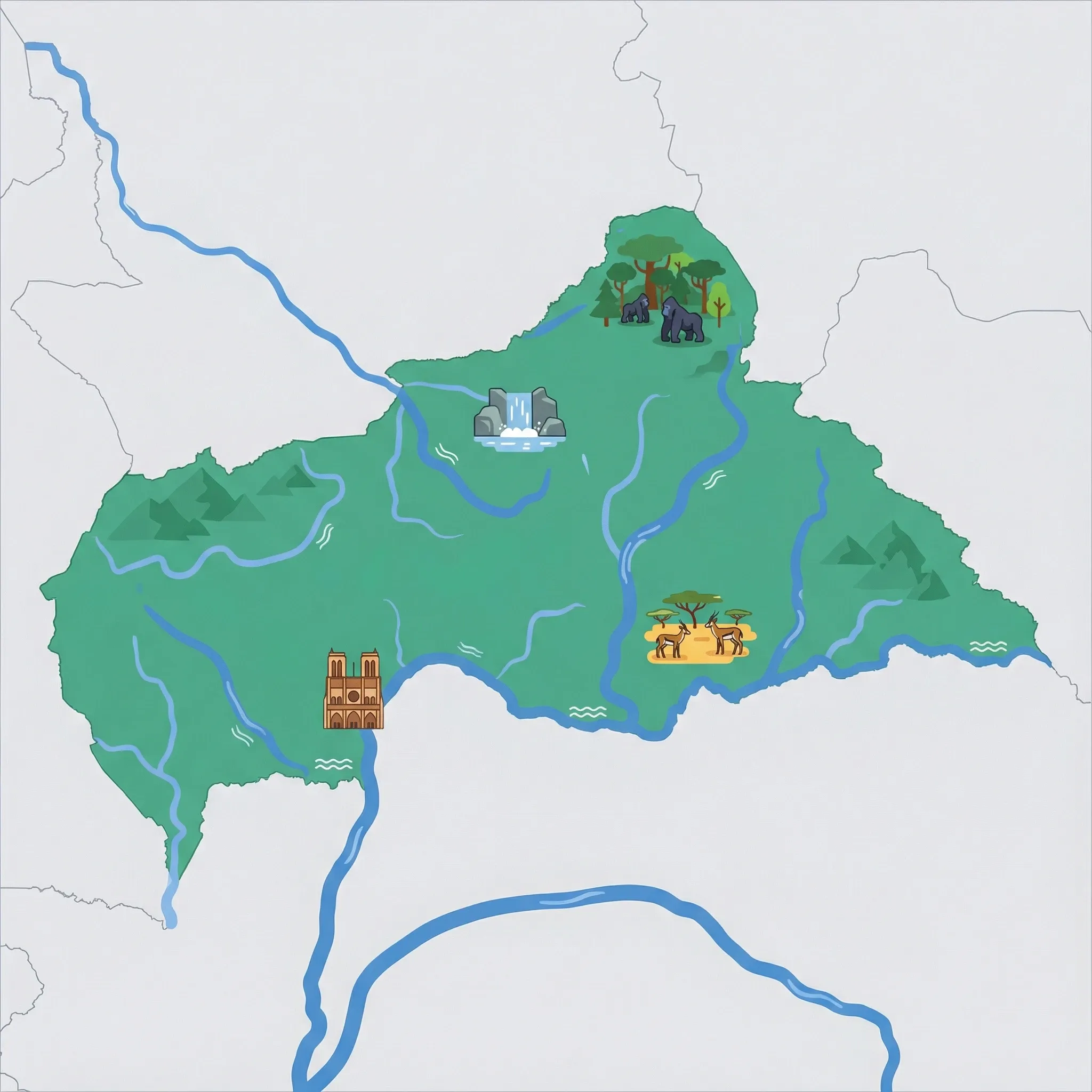
The crown jewel of the country is the Dzanga-Sangha Special Reserve in the southwest. This UNESCO World Heritage candidate is famous for the Dzanga Bai, a sandy mineral clearing where families can watch dozens of forest elephants gather to drink and socialize alongside bongo antelopes and buffalo. It is also one of the few places on earth where you can track habituated Western lowland gorillas, offering a profound wildlife encounter that rivals any in East Africa.
Near the capital, the Boali Falls offer a spectacular natural display. These immense waterfalls on the Mbari River span 250 meters wide and plunge 50 meters down, creating a thunderous roar and a permanent mist. While the hydroelectric dam upstream controls the flow, the falls are released in full force on weekends, creating a breathtaking sight. In the west, the Mégalithes de Bouar present an archaeological mystery; thousands of granite standing stones dating back to the Neolithic era suggest an ancient and sophisticated civilization once thrived here.
In the capital city of Bangui, the red-brick Notre-Dame Cathedral, Bangui stands as a prominent landmark and a center of community life. While the city requires extreme vigilance, the cathedral offers a moment of architectural calm. Visitors to the capital can also witness the bustle of the Ubangi River, the country's lifeline, where fishermen in dugout canoes ply the waters as they have for generations.
Practical Advice
Best time to visit: The dry season from December to March is crucial for accessing rural areas like Dzanga-Sangha, as dirt roads become impassable mud traps during the rains.
Visas: Almost all visitors require a visa before arrival. Requirements are strict, often demanding a letter of invitation and proof of yellow fever vaccination. Processing times can be long, so apply months in advance.
Health: A Yellow Fever vaccination certificate is mandatory for entry. Malaria is a severe risk; high-quality prophylaxis is essential for all family members. Medical facilities are severely limited, so comprehensive medical evacuation insurance is non-negotiable.
Food & Drink
Typical meal times: 12:00 pm to 2:00 pm for lunch and 7:00 pm to 9:00 pm for dinner.
Typical meal costs: 5,000–15,000 XAF (approx. $8–25 USD / €7.50–23 EUR) for a meal in a safe, expat-standard restaurant. Local street food is cheaper but high-risk for hygiene.
Dietary requirements: Vegetarian options are limited to sides like manioc and vegetables in peanut sauce. Gluten-free travelers can rely on cassava-based dishes but must communicate clearly about cross-contamination.
Family-friendly dining: Highchairs and children's menus are virtually non-existent. Families should stick to hotel restaurants or established expat venues in Bangui for safety and hygiene.
Signature dishes:
- Gozo – A thick, dough-like paste made from cassava flour, the country's primary staple, usually served with a rich sauce.
- Ngoudja – A hearty stew made from cassava leaves cooked with peanut butter and palm oil, often served with smoked fish or meat.
- Maboké – Freshwater fish (often Nile perch) spiced and steamed inside a wrapper of banana leaves.
- Kanda – Meatballs made from beef and pumpkin seeds, simmered in a spicy tomato and onion sauce.
- Chikwangue – Fermented cassava wrapped in leaves and boiled, serving as a durable bread substitute.
Safety
Travelers must maintain a low profile and avoid all political gatherings or protests. Road travel outside Bangui should only be undertaken in a convoy with professional security. The capital has a curfew that is strictly enforced; verify current hours upon arrival. Police checkpoints are frequent; always carry certified copies of your passport and visa, and remain calm and polite if stopped. Avoid walking at night under any circumstances.

While local living costs are low, safe tourism is expensive due to the need for private 4x4 transport, security, and imported supplies. A family should expect to spend 200,000–350,000 XAF (approx. $330–580 USD / €300–530 EUR) per day for secure mid-range logistics, accommodation, and food. High-end jungle lodges in Dzanga-Sangha can cost significantly more.
Age Suitability





Did you know? Central African Republic welcomes approximately 35,000 international visitors per year. Most visitors come from Africa.
Why this score?
The region offers extreme adventure through its dense, untamed rainforests and the remote Dzanga-Sangha Special Reserve, which is accessible only by arduous overland travel or chartered flights. It is a premier destination for high-intensity wildlife tracking of lowland gorillas and forest elephants, set within a challenging landscape that lacks modern amenities.
Why this score?
Medical services are virtually non-existent for tourists, as the country suffers from a severe lack of healthcare infrastructure and is frequently classified as a high-risk conflict zone. Even in the capital, Bangui, facilities are extremely basic and often lack essential supplies, making medical evacuation the only viable option for serious illness or injury.
Why this score?
With only approximately 34,600 annual arrivals, many of whom are NGO workers or business travelers, the CAR is one of the least-visited nations on Earth. Ongoing security concerns and a lack of traditional tourism infrastructure mean that international leisure travel is restricted to a very small number of niche wildlife expeditions and intrepid travelers.
While local living costs are low, safe tourism is extremely expensive due to the need for private security, 4x4 transport, and charter flights. A specialized lodge in the rainforest can cost 180,000–300,000 XAF (approx. $300–500 USD / €275–450 EUR) per night per person. Basic staples in markets are cheap, but imported goods in Bangui supermarkets are priced at a premium.

Getting There & Around
Getting There
- By Air – Bangui M'Poko International Airport (BGF) is served by Air France (from Paris), Royal Air Maroc (from Casablanca), RwandAir, and Ethiopian Airlines.
- By Land – Border crossings are generally considered dangerous and are frequently closed due to security issues. Overland travel from Cameroon is the only theoretically viable route but is high-risk.
- Entry Requirements – A visa and Yellow Fever vaccination certificate are mandatory for entry. Check your government website for the latest visa requirements, or use the IATA Travel Centre entry-requirements checker.
Getting Around
- Private 4x4 – The only safe way to move around is by hiring a private vehicle with a driver and, ideally, a security escort. Roads are often in poor condition.
- Domestic Flights – Small charter planes are the safest and most efficient way to reach remote areas like Central African Republic's southwest reserves.
- River Boat – Travel on the Ubangi River is possible but requires local expertise and safety checks before departure.

Packing List
Strictly mandatory for airport entry; you may be refused admission without the original yellow card.
Power outages are frequent even in the capital and hotels; street lighting is virtually non-existent.
International ATMs are rare and unreliable. Bring pristine Euro notes for exchange.
Essential backup as bottled water may not be available in rural areas or during shortages.
The risk is severe year-round; quality medication may be counterfeit or unavailable locally.
Internet and GPS signals are unreliable outside Bangui; a physical map is a crucial backup.

Activities & Best Times

Adventure & Nature
Very GoodHiking, wildlife, outdoor exploration, ecotourism
Home to the world-class Dzanga-Sangha Special Reserve, offering unique encounters with lowland gorillas and forest elephants in an authentic wilderness setting. Peak season aligns with the dry winter months when forest trails are most accessible and wildlife congregates at mineral-rich bais.

City & Cultural
MarginalUrban tourism, museums, historical sites, architecture
Bangui lacks the cultural infrastructure, museums, heritage sites, and international significance to warrant 'good' rating. While it has local cultural interest (markets, Ba'Aka connection), it does not meet international calibration standards for 'good' city/cultural destinations. Security concerns and limited cultural institutions support downgrade to 'marginal'.

Sports & Active
MarginalSport tourism, fitness activities, active recreation
Active exploration is centered on specialized rainforest trekking routes like the Dzanga Bai and Medicinal Plant trails. These routes are highly weather-dependent and are effectively closed during the peak rainy season due to mud and dense forest conditions.




Public Holidays & Calendar Next 12 months
Public holidays, festivals, cultural celebrations, and seasonal natural phenomena coming up in Central African Republic over the next 12 months.
Loading holidays and events...

Travel Advisory
All major global agencies maintain their highest risk rating for the Central African Republic. The consensus is that travel is extremely dangerous due to armed conflict, violent crime, and the absence of emergency support services.
Safety Topics
Traveller Advice (6 groups)

While same-sex acts are not technically illegal, public displays of affection can result in arrests for public indecency with prison sentences of up to two years. Significant social stigma exists.

Female visitors may experience harassment or verbal abuse. It is strongly advised to avoid travelling alone and to stay in well-secured accommodations.
Public infrastructure throughout the country offers almost no accessibility for those with physical or sensory disabilities. Discrimination is not legally prohibited.

Travellers should maintain a low profile, avoid all night-time movement, and ensure they have comprehensive evacuation insurance. It is recommended to keep an emergency stock of food and water.

Media professionals are considered high-risk targets for kidnapping and should operate with extreme caution, particularly in border regions and rebel-held areas.

Aid workers are frequently targeted by bandit groups seeking vehicles, communication gear, and funds. Professional security assessments are essential before venturing outside of Bangui.
Agency Summaries
Canadians are urged to stay away from the country due to extremely precarious security conditions and a high frequency of violent crimes.
Travelers should avoid this destination due to threats of civil unrest, violent crime, kidnapping, landmines, and terrorism. The government has very limited capacity to assist its citizens in emergencies.
The security landscape is considered highly dangerous with consistent threats from terrorism, abduction, and armed violence. Australians are advised to depart the country if it is safe to do so.
The FCDO recommends against any travel to the majority of the nation. For the capital, Bangui, travel should only be for essential purposes due to severe security risks and a lack of local consular aid.
Ireland maintains its highest warning level for the region due to an exceptionally dangerous security environment and a persistent risk of terrorist activity.
Due to widespread activity by armed rebel groups and high rates of violent crime, New Zealanders are advised against all travel to the country.
Information is provided for general guidance only and does not constitute travel, safety, medical, or legal advice. Conditions may change. Users are responsible for independently verifying information before travel.