

⚠️ SAFETY WARNING: Due to political volatility, high rates of violent crime, and the presence of extremist groups, government agencies (including the US, UK, Canada, Australia, and New Zealand) advise travelers to reconsider or avoid travel to Chad. The northern border regions and Lake Chad basin are particularly dangerous and often designated as 'Do Not Travel' zones. Families are strongly urged to consult their own government's official travel advisory before considering a trip, as circumstances and risk assessments vary significantly.
Overview
Chad is often described as the "Dead Heart of Africa," a moniker that belies the incredible life and beauty found within its borders. For the intrepid family, it represents one of the last great frontiers of travel. This is a destination for those who have already explored the more accessible parts of Africa and are seeking a profound, authentic wilderness experience. The country is vast, bridging the gap between the Arab-influenced north and the tropical south, offering a cultural mosaic that is as complex as it is fascinating.
Travel here is challenging and requires meticulous planning, but the rewards are unmatched. In the south, Zakouma NP has been transformed by African Parks into a sanctuary where children can see thousands of elephants, giraffes, and lions in safety. To the north, the Tibesti & Ennedi (north) region offers Martian-like landscapes of sandstone arches and ancient rock art that will captivate the imagination of any teenager. It is a place where the journey itself is the adventure, traversing dust, heat, and vast distances to find hidden oases.
Key Attractions
The crown jewel of Chadian tourism is undoubtedly Zakouma National Park. Once ravaged by poaching, it is now a safe haven and one of the best places in Central Africa to see wildlife. Families can stay in secure camps and witness the spectacle of massive elephant herds gathering at waterholes. It is an educational and inspiring example of how conservation can reverse seemingly hopeless situations.
Further north, the Ennedi Natural and Cultural Reserve is a UNESCO World Heritage site that feels like another planet. Here, families can explore towering sandstone formations and discover thousands of years of human history painted onto the rock faces. Hidden within this arid landscape is the Guelta d'Archei, a zoological miracle where Saharan crocodiles survive in a permanent waterhole, surrounded by the bleating of camels brought by nomadic herders-a scene unchanged for centuries.
For the truly dedicated, the Lakes of Ounianga offer a surreal sight: a series of 18 interconnected lakes in the middle of the hyper-arid Sahara desert. The contrast of the blue water against the golden dunes and green palm groves is a visual masterpiece. While reaching these northern attractions requires a full expedition with 4x4 convoys, the experience of camping under the unpolluted Saharan stars is a memory that will last a lifetime.
Practical Advice
The best time to visit is during the cool, dry season from November to February. Temperatures are manageable, and wildlife viewing in Zakouma is at its peak. Travel to Chad requires a visa, which often necessitates an invitation letter (typically provided by your tour operator or hotel). A Yellow Fever vaccination certificate is mandatory for entry. Medical facilities are very limited, so comprehensive travel insurance including medical evacuation is non-negotiable.
Food & Drink
Typical meal times: Lunch is the main meal, typically eaten between 12:00 pm and 2:00 pm, while dinner is served late, often from 7:30 pm to 9:00 pm.
Typical meal costs: 3,000–9,000 XAF (approx. $5–15 USD / €4.50–13.50 EUR) for a local meal; hotel dining is significantly higher at 15,000–25,000 XAF (approx. $25–40 USD / €23–38 EUR).
Dietary requirements: Vegetarian options are available but limited, often relying on okra, peanuts, and grains. Vegan and gluten-free travellers will find it difficult and should pack supplemental snacks. Nut allergies can be hard to manage as peanuts are a staple ingredient.
Family-friendly dining: Highchairs and children's menus are virtually non-existent outside of top international hotels in N'Djamena & South. Families usually eat at their lodge or camp where meals are prepared specifically for guests.
Signature dishes:
- Boule – A thick porridge made from millet or sorghum, served as the base for almost every meal and used to scoop up sauces.
- Daraba – A rich, slimy stew made from okra, tomatoes, peanut paste, and vegetables, often considered a national favourite.
- Kisra – Thin, fermented crepe-like bread made from sorghum, similar to Ethiopian injera but less sour.
- Jarret de Boeuf – Slow-cooked beef shin stew with vegetables, tender enough for children to eat easily.
- Jus de Fruit – Freshly blended fruit juices (mango, guava, papaya) that are incredibly sweet and popular with kids.
Safety
Beyond the general advisory, families must take specific precautions. Travel outside the capital N'Djamena & South should only be undertaken with a reputable tour operator using a convoy of at least two vehicles equipped with satellite phones. Avoid all travel at night due to the risk of banditry and poor road conditions. Police checkpoints are frequent; always have your passport and visa copies ready. Photography of government buildings or military personnel is strictly prohibited and can lead to detention.

While local street food is cheap, the cost of safe travel is very high. A secure family trip requires private 4x4 hire (approx. 90,000–180,000 XAF / $150–300 USD / €135–275 EUR per day), fuel, and guides. Mid-range hotels in the capital cost 90,000–150,000 XAF (approx. $150–250 USD / €135–230 EUR) per night. Expedition tours often exceed $400 USD per person per day.
Age Suitability





Did you know? Chad welcomes approximately 40,000 international visitors per year. Most visitors come from Africa.
Explore Regions
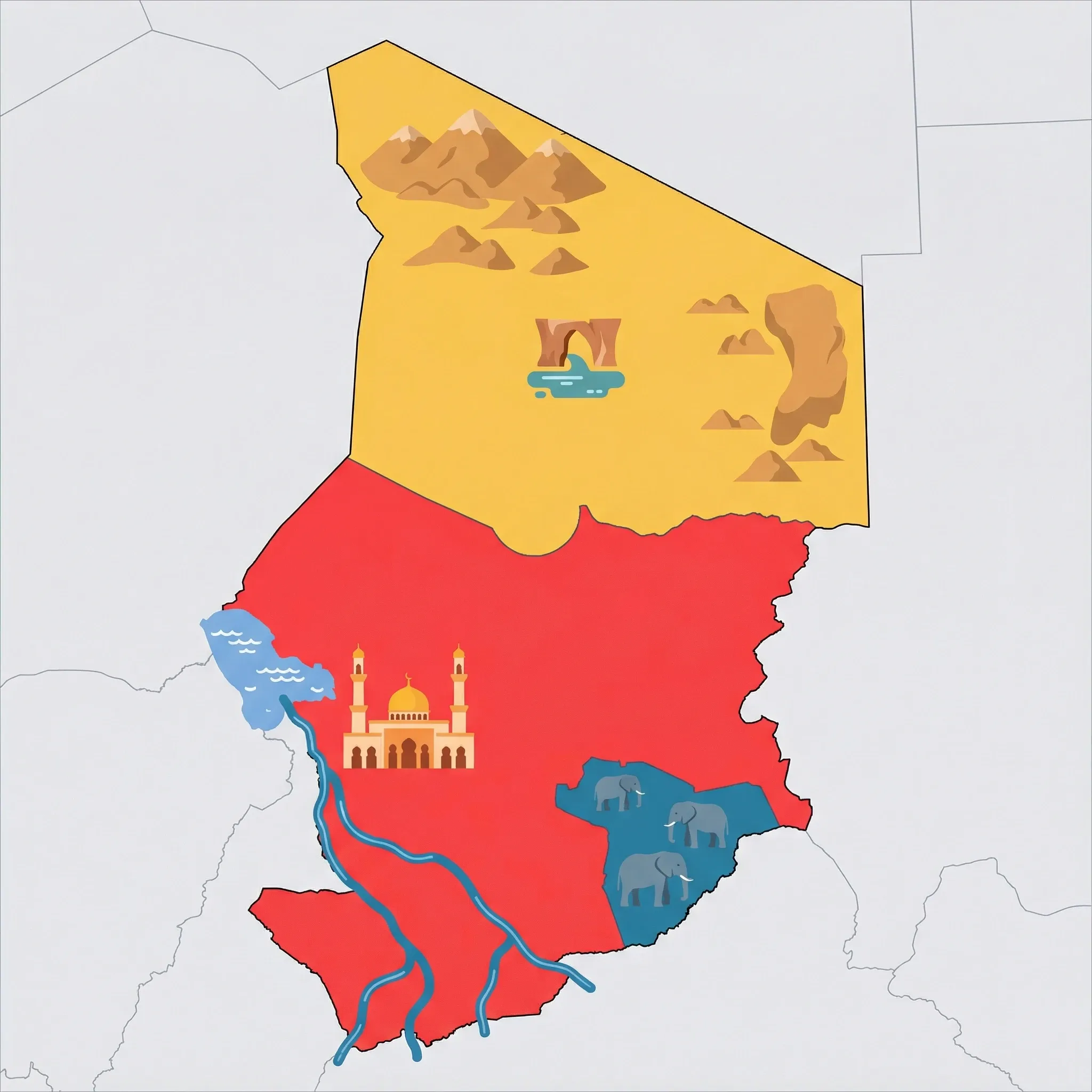
3 Regions
N'Djamena & South
The vibrant cultural gateway to the heart of the Sahel 🇹🇩
Tibesti & Ennedi (north)
A prehistoric landscape of rock arches and desert lakes 🏜️
Zakouma NP
A miraculous rebirth of African wildlife 🐘
Click on a region marker to explore details. Use the dropdown to color regions by activity suitability.

Getting There & Around
Getting There
- By Air – N'Djamena International Airport (NDJ) is the main gateway. Major carriers include Air France (from Paris), Ethiopian Airlines (from Addis Ababa), and Turkish Airlines (from Istanbul).
- Entry Requirements – Almost all visitors, including US, UK, and EU citizens, require a visa before arrival. You will also need a mandatory Yellow Fever vaccination certificate and often a Letter of Invitation (LOI) from a sponsor or tour operator. Check your government website for the latest visa requirements, or use the IATA Travel Centre entry-requirements checker.
- By Land – Border crossings with Cameroon are generally the only open and relatively safe land routes, though conditions can change rapidly. Borders with Libya, Sudan, and CAR are extremely dangerous and often closed.
Getting Around
- Car Hire – The only viable way to explore is by hiring a 4x4 with an experienced local driver. Self-driving is not recommended due to difficult terrain and security risks. Costs are high, typically starting at 90,000 XAF (approx. $150 USD / €135 EUR) per day plus fuel.
- Domestic Flights – Small charter flights are often used to reach Zakouma National Park from N'Djamena, saving days of driving on dangerous roads. These must be booked through the park or a tour operator.
- City Transport – In N'Djamena, taxis exist but are often in poor condition. Families should rely on pre-arranged transport from their hotel or tour operator rather than hailing vehicles on the street.

Packing List
Essential for protecting your face and airways from the intense Saharan dust and sand.
A physical yellow booklet is mandatory for entry; you will be refused entry without it.
Dehydration is a major risk in the 40°C+ heat; water alone is often not enough.
ATMs are unreliable and often empty. New, crisp Euro notes are the easiest currency to exchange.
GPS signals can be spotty in the desert, and electronics may fail in the extreme heat.
Water is scarce in the north; these will be your primary method of washing on expedition.

Activities & Best Times

Adventure & Nature
Very GoodHiking, wildlife, outdoor exploration, ecotourism
Zakouma National Park is internationally recognized as one of Africa's greatest wildlife conservation success stories, with world-class elephant populations and authentic wilderness safari experiences. This warrants 'very_good' rating under international calibration.
Features the world-class sandstone labyrinths of the Ennedi Massif and the unique UNESCO-listed Ounianga Lakes. Exploration is strictly seasonal, limited to cooler months to avoid extreme Saharan heat.
Zakouma National Park is a world-class destination for elephant conservation and rare wildlife viewing, though infrastructure remains exclusive and limited. Peak viewing occurs in the dry season (Dec-Mar), while heavy summer rains make the parks and river regions largely inaccessible.

City & Cultural
Very GoodUrban tourism, museums, historical sites, architecture
Home to globally significant prehistoric rock art sites and ancient cultural landscapes like Niola Doa. The profound authenticity of the Toubou nomadic culture and archaeological heritage is exceptional for sophisticated travelers.
N'Djamena lacks the density of globally significant cultural institutions or UNESCO heritage sites required for 'very_good' under international calibration standards. The National Museum alone doesn't justify this rating when compared to major African capitals.
Remote settlements like Am Timan offer highly authentic, uncommercialized market experiences for intrepid families seeking to understand local Chadian trade and culture. Access is heavily dependent on the dry season, as summer rains make the primitive road infrastructure in this region virtually impassable.

Sports & Active
GoodSport tourism, fitness activities, active recreation

Road Trips & Scenic
GoodScenic drives, countryside tours, route-based travel

Relaxation & Wellness
MarginalSpa retreats, wellness centers, peaceful getaways

Public Holidays & Calendar Next 12 months
Public holidays, festivals, cultural celebrations, and seasonal natural phenomena coming up in Chad over the next 12 months.
Loading holidays and events...
Climate & Weather
N'Djamena & South
Show Details
| Month | Temp °C | Rain | Humidity |
|---|
Tibesti & Ennedi (north)
Show Details
| Month | Temp °C | Rain | Humidity |
|---|
Zakouma NP
Show Details
| Month | Temp °C | Rain | Humidity |
|---|

Travel Advisory
Most global agencies recommend reconsidering or avoiding all non-essential travel to Chad due to persistent threats of terrorism, kidnapping, and violent crime. Extreme danger exists in border regions and northern provinces.
Safety Topics
Traveller Advice (2 groups)

All visitors should avoid moving after dark, vary their routines, and stay clear of political demonstrations or large public gatherings.

Humanitarian and aid staff are specifically targeted by kidnapping groups, especially in remote areas and the Lake Chad region.
Agency Summaries
New Zealanders are urged to avoid non-essential travel due to significant threats from terrorism and violent crime. Many regions carry the highest level of warning.
Travel is discouraged due to crime, terrorism, and kidnapping. Notably, the local government has suspended visa issuance for private US citizens, and entry for them is currently restricted.
British citizens are advised to limit travel to essential purposes only. High threats of terrorism and kidnapping exist, and the UK's ability to provide assistance is extremely limited.
Ireland advises against unnecessary travel due to the risk of political unrest and kidnapping. Border areas are considered particularly dangerous and should be avoided entirely.
Canadian authorities suggest avoiding all non-essential visits due to risks from extremist groups, violent offences, and public instability. Stricter warnings are in place for border regions and the northern provinces.
Australia recommends avoiding all travel to Chad because of the dangerous security environment, including frequent violent crime and terrorism. Consular help is severely restricted.
Information is provided for general guidance only and does not constitute travel, safety, medical, or legal advice. Conditions may change. Users are responsible for independently verifying information before travel.