

⚠️ SAFETY WARNING: Exercise increased caution in Chile due to rising property crime and theft, particularly in Santiago and Valparaíso. Pickpocketing and bag-snatching are common in tourist areas, bus terminals, and crowded metros. Keep valuables out of sight, do not hang bags on the back of chairs, and avoid walking alone downtown late at night. However, the vast majority of visits to the countryside, national parks, and remote regions remain trouble-free.
Overview
Chile is often described as a “geographical island,” isolated by the Andes mountains to the east and the Pacific Ocean to the west. For families, this distinct geography creates a living classroom where you can experience almost every climate on Earth in a single holiday. From the stargazing capitals of the north to the fairy-tale forests of the south, the country is safe, modern, and incredibly diverse. Chilean culture is deeply family-oriented; children are cherished and welcomed everywhere, often staying up late with their parents at restaurants and social gatherings.
The seasons are reversed compared to the Northern Hemisphere, making it a perfect escape from a wintry Christmas. December to February is summer, offering beach days and ideal hiking weather in The Lake District & Chiloé. While distances are vast, the domestic flight network is excellent, allowing families to hop easily between the scorched red rocks of the desert and the blue glaciers of Patagonia. Whether you are exploring the bustling streets of Santiago & Central Valley or the mystical statues of Rapa Nui (Easter Island), Chile offers a sense of adventure that is accessible and comfortable for travelers with kids.
Key Attractions
In the capital, families should head straight for Cerro San Cristóbal. This massive urban park features a historic funicular, a cable car with panoramic views of the Andes, and the national zoo. Afterward, thrill-seekers can visit Fantasilandia, the country's largest amusement park located right in the city center. Just a short drive toward the coast lies the Valparaíso & Central Coast region, where the Historic Quarter of the Seaport City of Valparaíso charms children with its colorful hillside houses and creaky wooden elevators (ascensores) that act as public transport.
For nature lovers, the Atacama Desert & Altiplano is magical. Kids will love floating effortlessly in the salt-rich Puritama Hot Springs or seeing the pink birds at Reserva Nacional Los Flamencos. Further south in the The Lake District & Chiloé, the Huilo Huilo Biological Reserve is a must-visit, famous for its volcano-shaped hotel and deer encounters. If you venture all the way to Southern Patagonia, a boat trip to Los Pingüinos Natural Monument (Magdalena Island) allows you to walk among thousands of Magellanic penguins.
Practical Advice
Best time to visit: October to April is ideal for most of the country. If visiting Patagonia, aim for December to February for the warmest weather. Sun Safety: The UV index in Chile is extremely high due to the thinner ozone layer, especially in the south and at high altitudes. High-SPF sunscreen and hats are non-negotiable for children. Health: Tap water is generally safe in Santiago and the south, but has a high mineral content that can upset sensitive stomachs. In the north (Atacama), always use bottled water.
Food & Drink
Typical meal times: Lunch (almuerzo) is the main meal, served from 1:00 pm to 3:30 pm. Dinner is late, typically 8:00 pm to 10:00 pm. Instead of a heavy dinner, many families enjoy “chilean tea time” known as once between 5:00 pm and 8:00 pm, featuring bread, avocado, tea, and cakes.
Typical meal costs: 6,000–12,000 CLP (approx. $6.50–13 USD / €6–12 EUR) for a set lunch menu (menú del día); 15,000–30,000 CLP (approx. $16–33 USD / €15–30 EUR) for a main dinner dish.
Dietary requirements: Vegetarian food is easy to find, with avocado (palta) being a national staple. Gluten-free options are available in major supermarkets (look for “sin gluten”) but cross-contamination in restaurants is a risk due to the prevalence of bread.
Family-friendly dining: Chilean restaurants are very child-friendly. Most places offer highchairs, and staff are accustomed to children dining late. Simple foods like grilled chicken, rice, and mashed potatoes are widely available for fussy eaters.
Signature dishes:
- Pastel de Choclo – A comforting corn pie filled with seasoned beef, chicken, onions, olives, and hard-boiled eggs. Sweet and savory.
- Empanada de Pino – Baked dough pockets filled with minced beef, onions, olives, and egg. A picnic staple everywhere.
- Completo Italiano – A loaded hot dog topped with chopped tomatoes, smashed avocado, and mayonnaise (colors of the Italian flag). Kids love them.
- Mote con Huesillo – A sweet summer drink/dessert made from dried peaches and husked wheat cooked in sugar and cinnamon.
- Cazuela – A hearty soup with a large piece of beef or chicken, potato, pumpkin, and corn on the cob.
Safety
While Chile is one of Latin America's safest destinations, petty crime has increased. Avoid displaying phones or cameras in downtown Santiago (especially near Plaza de Armas) and Valparaíso. Stick to official taxis or ride-share apps (Uber/Cabify) rather than hailing cars on the street. In the event of an earthquake, stay calm and follow local instructions; Chilean infrastructure is built to withstand seismic activity and locals are well-drilled.
Family Travel Notice
Chile enforces very strict border controls for minors. Parents travelling alone with children must carry notarized authorization from the other parent and an original birth certificate.

A family of four can expect to spend around 140,000–230,000 CLP (approx. $150–250 USD / €140–230 EUR) per day. This covers mid-range accommodation, a <i>menú del día</i> lunch, grocery items for snacks, and entry fees. Car rental and domestic flights will increase this budget significantly.
Age Suitability





Did you know? Chile welcomes approximately 5.2 million international visitors per year. Most visitors come from Americas.
Explore Regions
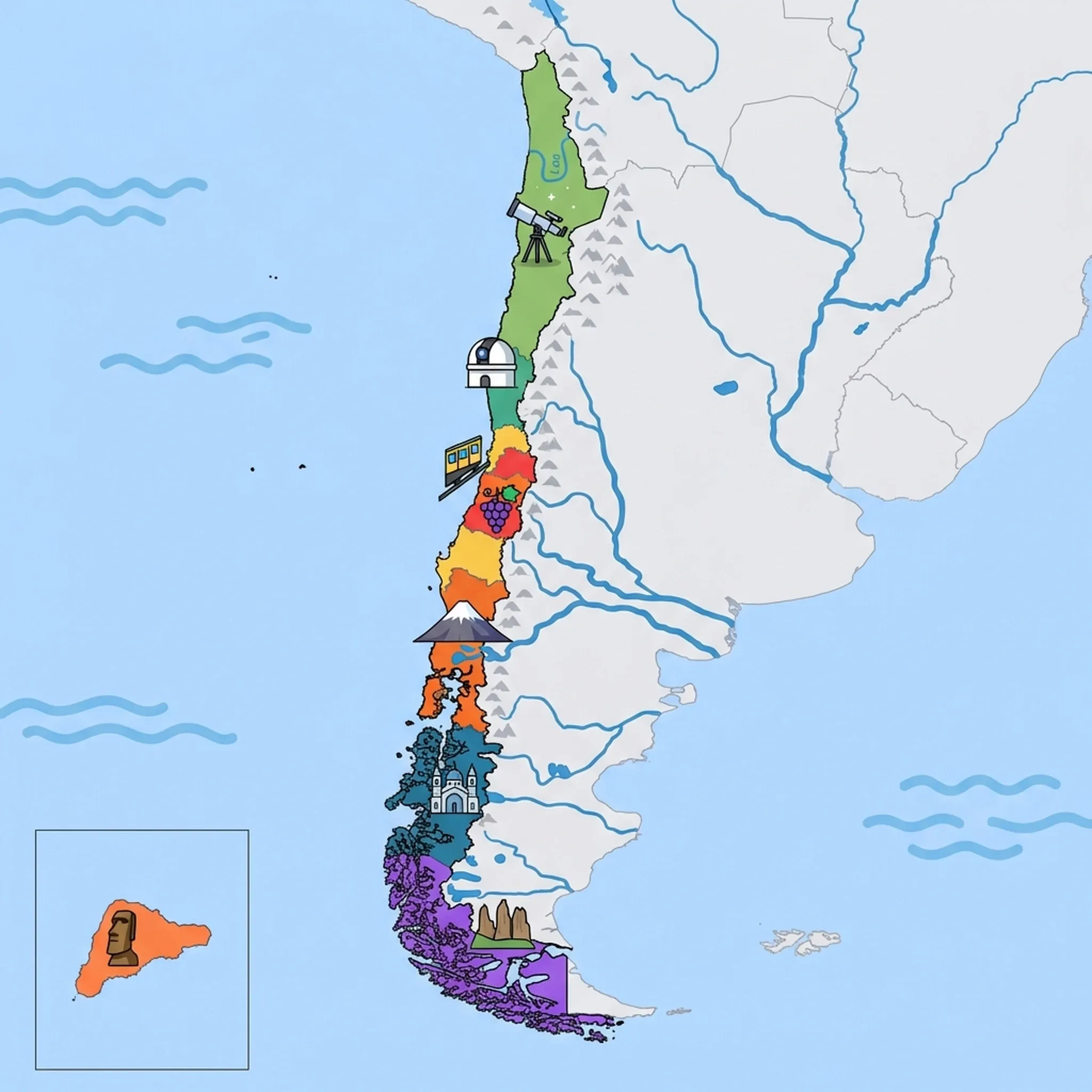
8 Regions
Atacama Desert & Altiplano
Starry skies and lunar landscapes 🌵✨
Elqui Valley & Coquimbo Coast
Where the ocean meets the stars 🐧🔭
Northern Patagonia (Carretera Austral)
Wild rivers and hanging glaciers 🌲🚙
Rapa Nui (Easter Island)
Mysterious giants in the Pacific 🗿🌺
Santiago & Central Valley
City buzz at the foot of the Andes 🏙️🏔️
Southern Patagonia
The end of the world adventure 🌬️🏔️
The Lake District & Chiloé
Volcanoes, myths, and monkey puzzles 🌋🌊
Valparaíso & Central Coast
Colourful hills and seaside fun 🎨🦀
Click on a region marker to explore details. Use the dropdown to color regions by activity suitability.

Getting There & Around
Getting There
- By Air – Santiago (SCL) is the main international gateway. Direct flights arrive from the US, Europe, and Australia. It is the hub for reaching Santiago & Central Valley.
- By Land – Long-distance buses connect from Mendoza, Argentina, crossing the spectacular Andes mountains. The crossing can close in winter due to snow.
- By Sea – Cruise ships frequently dock at Valparaíso and San Antonio, or explore the fjords of Southern Patagonia.
- Entry Requirements – Citizens of the US, UK, EU, Canada, and Australia do not need a visa for stays up to 90 days. You will receive a ’Tarjeta de Turismo’ (Tourist Card) receipt-do not lose it! Check your government website for the latest visa requirements, or use the IATA Travel Centre entry-requirements checker.
Getting Around
- Domestic Flights – The fastest way to cover Chile's length. LATAM, Sky, and JetSmart connect Santiago to the north and south. Book early for family deals.
- Car Hire – Essential for exploring The Lake District & Chiloé and parts of Patagonia at your own pace. Roads are generally good, but distances are vast.
- Buses – Comfortable and reliable “semicama” or “salon cama” buses are great for budget travel between cities. Companies like Turbus and Pullman cover most routes.
- Santiago Metro – Clean, safe, and efficient. It connects major family spots like Cerro San Cristóbal and Centro Cultural La Moneda. Avoid rush hours (8:00–9:00 am, 6:00–7:00 pm).

Packing List
The ozone layer is thinner over Chile; UV radiation is extreme even on cloudy days.
The Atacama Desert is one of the driest places on Earth and can cause nosebleeds.
Many hostels, cabins, and older hotels in remote areas lack plugs for sinks/baths.
Chile uses Type L (3 pins in a row) or Type C. Standard US/UK plugs won't fit.
Essential for the winding Andes mountain roads and boat trips in the south.
Even in summer, desert nights and Patagonian winds are freezing cold.

Activities & Best Times

Adventure & Nature
ExcellentHiking, wildlife, outdoor exploration, ecotourism
A global pinnacle for wilderness immersion, featuring iconic hanging glaciers and the unique Marble Caves in Laguna San Rafael and Cerro Castillo parks. Peak summer offers the only reliable access for families to explore these remote ecosystems before heavy winter rains and snow restrict travel.
A world-class destination for high-altitude trekking, salt flat exploration, and lunar landscapes in Moon Valley. The 'Altiplanic Winter' in January and February brings unpredictable rain and road closures, making spring and autumn the optimal times for immersion.
Home to world-class temperate rainforests, the Huilo Huilo Biological Reserve, and iconic volcanoes; it offers an authentic wilderness experience that ranks among the best globally for families.

City & Cultural
Very GoodUrban tourism, museums, historical sites, architecture
A vibrant hub featuring exceptional pre-Columbian art and sophisticated dining in historic neighborhoods. Summer offers the best atmosphere for street life, whereas winter months suffer from poor air quality and cold, rainy conditions that degrade the urban experience.
A globally unique open-air archaeological site featuring the Moai and UNESCO-listed heritage. Tourism peaks in summer when Hanga Roa's living culture is most vibrant and the weather is pleasant for exploring historic sites.
While Caleta Tortel is unique, rating the entire region 'excellent' for city/cultural based on one stilted village is internationally inflated. Very_good is more appropriate.

Sports & Active
Very GoodSport tourism, fitness activities, active recreation
Offers world-class road cycling on the Farellones switchbacks and managed adventure activities in the Maipo Valley. The dry summer climate is ideal for high-intensity activity, while winter conditions restrict most outdoor sports to lower elevations.
Renowned for world-class trekking on the Cerro Castillo circuit and iconic cycling routes along the Carretera Austral. The infrastructure is highly seasonal, with optimal trail conditions and active adventure centers operating almost exclusively from late spring through early autumn.
Strong infrastructure for niche sports like paragliding in Maitencillo and world-class cycling through the Casablanca Valley vineyards. Activity is highly seasonal, peaking when consistent winds and dry conditions support outdoor athletics.

Educational & Exploratory
GoodLearning experiences, scientific sites, historical education
The Museo Interactivo Mirador (MIM) and the Natural History Museum are destination-level facilities for curious families. While indoor attractions are technically year-round, they are best visited during the pleasant peak tourist season when city logistics are most reliable.
Significant sites like the Fonck Museum (housing an original Easter Island Moai) and the Valparaíso Natural History Museum offer strong scientific value. These indoor facilities remain accessible year-round, peaking during local and international school holiday windows.
Home to the ALMA Observatory and world-class astro-tourism centers, the region provides unique scientific engagement. The driest months offer the highest atmospheric clarity for stargazing, while summer clouds can obstruct observations.

Festivals & Seasonal
GoodEvents, celebrations, seasonal attractions
Lollapalooza Chile and Santiago a Mil are major international events. Marginal rating undervalues their significance.
Tapati Rapa Nui is described as 'world-class cultural event' in notes. Marginal rating contradicts this assessment. Should be 'good'.
Viña del Mar Song Festival is 'internationally renowned' per notes. Marginal rating is too conservative.

Relaxation & Wellness
GoodSpa retreats, wellness centers, peaceful getaways
Thermal baths like Baños Colina offer authentic Andean relaxation with dramatic high-altitude vistas. Access is optimal during the warmer months, as the high mountain passes can be dangerous or closed due to snow during the winter.
Home to high-end natural thermal complexes like Termas del Ventisquero, providing world-class relaxation in a pristine rainforest setting. While hot springs are enjoyable in cooler weather, the peak window aligns with regional transport availability and broader resort operations.
Renowned for high-quality natural hot springs like Termas Geométricas, which provide world-class restorative experiences in striking architectural and natural settings.

Road Trips & Scenic
GoodScenic drives, countryside tours, route-based travel
Iconic routes through Cajón del Maipo and the winding Paso Los Libertadores offer spectacular scenic driving. Clear skies and snow-free roads in summer provide the safest and most visually rewarding conditions for international visitors.
The scenic coastal and inland roads provide an essential and beautiful way to access the island's remote monuments. Peak months offer the best driving visibility and access to all coastal points of interest.
The Carretera Austral is one of the world's most celebrated scenic drives, offering unparalleled landscape diversity. Summer provides the safest driving conditions on predominantly unpaved roads and ensures that essential ferry connections along the route are in full operation.

Ski & Snow
GoodWinter sports, ski resorts, snow activities
Home to world-class resorts like Valle Nevado and El Colorado, offering high-altitude Andean powder and modern infrastructure. The season is strictly concentrated in winter, with the best coverage typically occurring in July and August.
The region features unique skiing opportunities on active volcanoes like Villarrica and Osorno, though infrastructure is more focused on regional rather than elite international tourism.
Offers an authentic but basic skiing experience at Centro de Ski El Fraile, catering mainly to local enthusiasts. The limited infrastructure and short season mean it lacks the world-class facilities typically sought by internationally experienced ski families.
Theme Park & Entertainment
GoodAmusement parks, family entertainment venues
Features internationally recognized concepts like KidZania and major regional parks like Fantasilandia. Peak visitation aligns with the clear weather and school holidays of the Chilean summer, while winter months see reduced operations and less pleasant conditions for outdoor parks.
Regional water parks like Aviva and Curunina offer family entertainment but are highly weather-dependent. These venues are primarily summer destinations, remaining closed or inactive during the cooler, wetter months.
The region offers limited theme park infrastructure, primarily centered on local aquatic centers in Calama. These facilities lack the international scale and novelty required to attract sophisticated global travelers beyond a brief stop.
Beach & Sea
GoodBeach resorts, marine activities: diving, snorkelling, kite surfing, wind surfing, sailing
Anakena and Ovahe provide rare, high-quality white sand beach experiences in the middle of the Pacific. Best visited during the southern summer when water and air temperatures are optimal for swimming and snorkeling.
Upscale beach enclaves like Zapallar and Reñaca provide sophisticated coastal leisure, though the Humboldt Current keeps water temperatures low. The international tourism peak is strictly limited to the hot summer months of January and February.
The Pacific coast near Antofagasta features dramatic formations like La Portada and calm waters at Hornitos. Peak southern summer offers the most comfortable conditions for coastal recreation, though the Humboldt Current keeps water temperatures cool year-round.

Public Holidays & Calendar Next 12 months
Public holidays, festivals, cultural celebrations, and seasonal natural phenomena coming up in Chile over the next 12 months.
Loading holidays and events...
Climate & Weather
Atacama Desert & Altiplano
Show Details
| Month | Temp °C | Rain | Humidity |
|---|
Elqui Valley & Coquimbo Coast
Show Details
| Month | Temp °C | Rain | Humidity |
|---|
Northern Patagonia (Carretera Austral)
Show Details
| Month | Temp °C | Rain | Humidity |
|---|
Rapa Nui (Easter Island)
Show Details
| Month | Temp °C | Rain | Humidity |
|---|
Santiago & Central Valley
Show Details
| Month | Temp °C | Rain | Humidity |
|---|
Southern Patagonia
Show Details
| Month | Temp °C | Rain | Humidity |
|---|

Travel Advisory
Four out of six major agencies recommend exercising increased caution or a high degree of vigilance. The primary concerns are civil unrest, frequent public demonstrations that may turn violent, and prevalent street crime. While the country is generally safe for travel, specific southern regions face emergencies due to wildfires.
Safety Topics
Traveller Advice (3 groups)

Chile enforces very strict border controls for minors. Parents travelling alone with children must carry notarized authorization from the other parent and an original birth certificate.

Always carry a copy of your identification and keep original documents in a secure location. Avoid all large gatherings, particularly on Friday afternoons when protests are most common in urban centers.

While Santiago is relatively safe for solo women, dressing conservatively is suggested to avoid unwanted attention. Be cautious in rural areas where solo foreign women are less common.
Agency Summaries
The U.S. government advises heightened awareness due to rising rates of violent crime and the unpredictability of large-scale public protests.
Australia recommends extra vigilance due to security threats from civil disturbances and violent criminal activity, including specialized theft tactics.
While no general travel restriction is in place, the assessment suggests a likely threat of terrorism and warns of severe environmental hazards like wildfires.
New Zealanders are warned of significant security concerns regarding theft and potential violence during urban civil unrest.
Travellers should be extremely vigilant in Chile because of persistent civil unrest, frequent demonstrations, and high levels of street crime.
Standard safety measures are recommended, though visitors must avoid all political gatherings as participation can lead to immediate deportation.
Information is provided for general guidance only and does not constitute travel, safety, medical, or legal advice. Conditions may change. Users are responsible for independently verifying information before travel.