

⚠️ SAFETY WARNING: Exercise a high degree of caution (Level 3) in Colombia due to crime. While major tourist areas like Cartagena & Caribbean Coast and Medellín & Coffee Region are generally safe for families who follow local advice, petty theft can occur. Avoid all travel to border regions and specific departments like Arauca and Cauca. Always use registered taxis or ride-share apps rather than hailing street cabs.
Colombia is a country of breathtaking contrasts, where snow-capped Andean peaks meet the turquoise Caribbean Sea and the lush Amazon rainforest. For families, it is a playground of nature and culture, known as the second most biodiverse country in the world. The warmth of the Colombian people is legendary, making children feel welcome everywhere from bustling city plazas to quiet rural villages. Whether you are exploring the historic streets of Bogotá or spotting pink dolphins in the Amazon, the sense of discovery is constant.
The country's geography is divided into distinct regions that feel like different worlds. The Andean interior offers cool, spring-like weather and green mountains, while the coasts provide tropical heat and sun. This diversity means you can wear a jacket in the morning to visit a museum and be in a swimsuit by the afternoon if you take a short flight. For adventurous families, the ecological richness provides endless educational opportunities, from coffee tours that explain the bean-to-cup process to hiking in cloud forests teeming with hummingbirds.
Key Attractions
Start your journey in the capital with a cable car ride up to Mount Monserrate for panoramic views of the city. Afterwards, descend to visit the Gold Museum, which houses the world's largest collection of pre-Hispanic gold work-a glittering experience that fascinates children. In the nearby historic district, La Candelaria offers colorful colonial streets perfect for a family walking tour. For a day of pure fun, Mundo Aventura provides thrilling rides and amusements.
Heading north to the coast, the Castillo de San Felipe de Barajas in Cartagena is a must; kids love exploring the dark tunnels of this massive fortress. Nearby, the Islas del Rosario offer calm, aquarium-clear waters ideal for snorkeling. Nature lovers should not miss Tayrona National Natural Park, where the jungle meets the sea in spectacular fashion. In the interior, the Parque del Café (Coffee Park) combines a theme park with cultural learning, while the towering wax palms of Cocora Valley look like something out of a Dr. Seuss book. Finally, Parque Explora in Medellín is a world-class interactive science museum with a huge freshwater aquarium.
Practical Advice
The best time to visit is during the dry seasons: December to March and July to August. Colombia is near the equator, so altitude determines temperature, not the season. Bogotá is high (2,600m) and can be chilly and rainy, while the coast is hot and humid. Allow time for acclimatization if flying directly into the highlands. Families must complete the "Check-Mig" form online 72 hours before travel. A Yellow Fever vaccination is required for visiting the Amazon or Tayrona Park.
Food & Drink
Typical meal times: Breakfast is eaten early, from 6:30 am to 9:00 am. Lunch is the main meal of the day, typically served from 12:00 pm to 2:00 pm. Dinner is lighter and usually eaten between 7:00 pm and 9:00 pm.
Typical meal costs: COP 25,000–60,000 (approx. $6–15 USD / €5.50–14 EUR) for a mid-range main dish. A "Corrientazo" (set lunch) can cost as little as COP 15,000–20,000 (approx. $3.50–5 USD / €3–4.50 EUR).
Dietary requirements: Vegetarian options are increasingly common in major cities like Medellín and Bogotá but can be scarce in rural areas, where rice, plantains, and eggs will be your staples. Gluten-free travelers should stick to corn-based arepas and fresh fruits, but be aware that cross-contamination is common.
Family-friendly dining: Colombia is extremely child-friendly. Restaurants almost always welcome children, though highchairs may not be available in smaller local eateries. Kids usually love the fresh fruit juices (ask for jugos naturales en agua to avoid milk) and mild soups.
Signature dishes:
- Bandeja Paisa – A massive platter featuring beans, rice, ground meat, chorizo, fried egg, plantain, arepa, and avocado. Great for sharing.
- Ajiaco – A comforting potato and chicken soup native to Bogotá, served with cream, capers, and corn on the cob.
- Arepas – Cornmeal cakes served with almost every meal; styles vary by region, from thin and crispy to thick and cheesy (Arepa de Chócolo).
- Patacones – Fried green plantains, often smashed into flat discs and served as a side or topped with cheese and hogao (tomato-onion sauce).
- Obleas – Large, thin wafers sandwiched with arequipe (caramel spread), jam, or cheese-a favorite street snack for kids.
Safety
Safety has improved significantly, but caution is still required. The golden rule in Colombia is "No dar papaya" (Don't give papaya), which means don't flash valuables or let your guard down. Stick to well-touristed areas and avoid walking alone at night, even in popular neighborhoods. Use ride-hailing apps like Uber or Cabify instead of hailing taxis on the street, as this ensures your ride is tracked. If hiking in remote areas, always go with a reputable guide. Avoid all travel to border regions with Venezuela and Ecuador.
Family Travel Notice
When visiting Medellin with minors, ensure children carry original identification documents or clear passport copies at all times to comply with local safety regulations.

Colombia offers excellent value for families. A family of four can expect to spend around COP 600,000–1,000,000 (approx. $145–245 USD / €135–225 EUR) per day, covering mid-range boutique hotels, hearty meals, and activities. Domestic flights are often very cheap, and local food is incredibly affordable, though prices in Cartagena and tourist islands can be significantly higher.
Age Suitability





Did you know? Colombia welcomes approximately 4.5 million international visitors per year. Most visitors come from South Asia.
Explore Regions
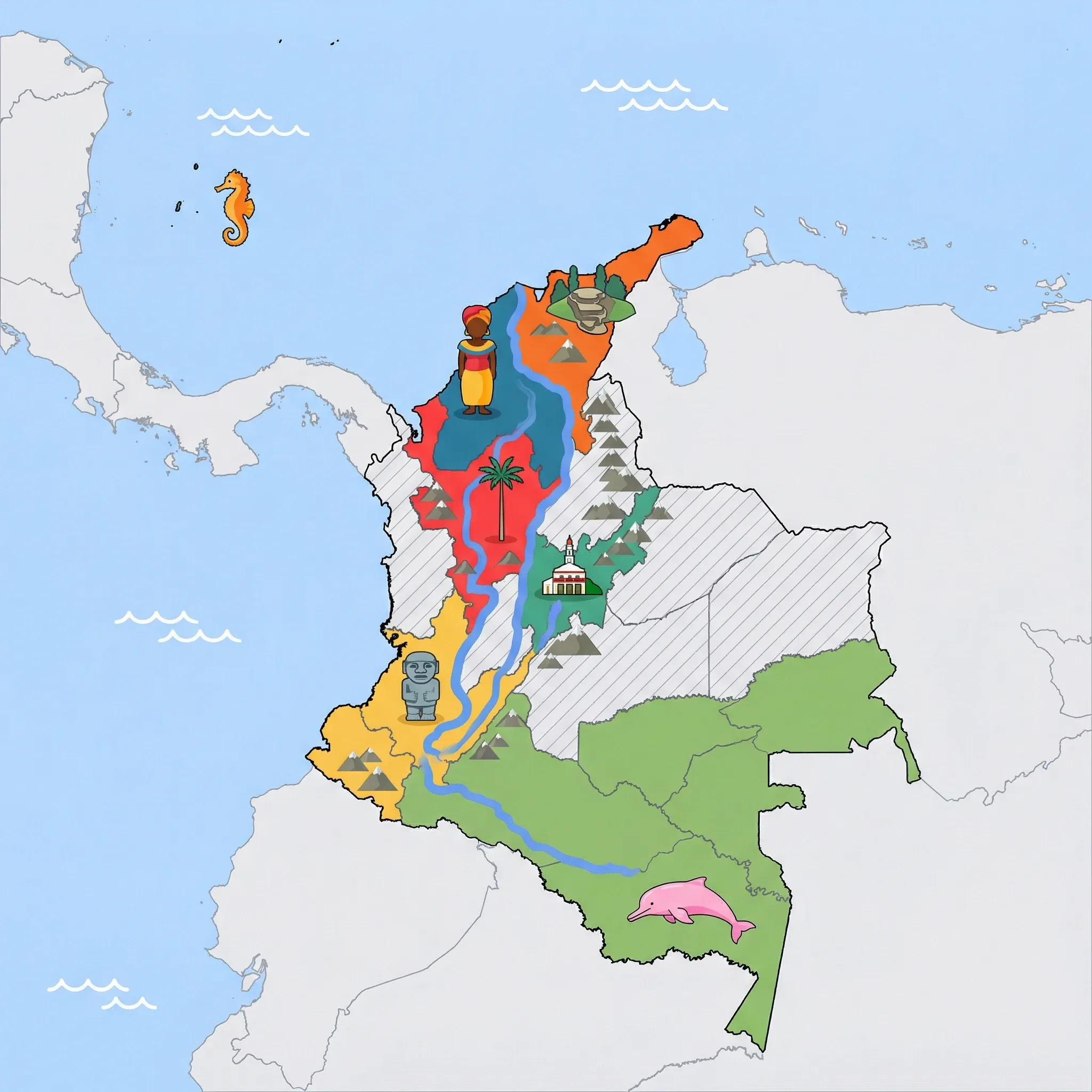
7 Regions
Amazon (Leticia)
Where the jungle comes alive with pink dolphins and monkey chatter 🐬🌿
Bogotá
A city in the clouds full of history, gold, and green parks 🚠🏙️
Cali & Southwest
The salsa capital where warm breezes and rivers meet 💃🏽☀️
Cartagena & Caribbean Coast
Pirate fortresses, cobbled streets, and Caribbean islands 🏴☠️🌴
Medellín & Coffee Region
Cable cars, coffee farms, and the City of Eternal Spring 🚠☕🌸
San Andrés & Providencia
The Sea of Seven Colors and island vibes 🏝️🐠🌊
Santa Marta & Tayrona
Where the jungle meets the sea at the foot of snowy peaks 🏔️🌴
Click on a region marker to explore details. Use the dropdown to color regions by activity suitability.

Getting There & Around
Getting There
- By Air – El Dorado International Airport (BOG) in Bogotá is the main hub, with direct flights from the US, Europe, and Latin America. José María Córdova (MDE) in Medellín and Rafael Núñez (CTG) in Cartagena also receive international flights.
- By Sea – Cruise ships frequently dock at Cartagena, allowing easy access to the Puerta del Reloj and the walled city.
- Entry Requirements – US, UK, and EU citizens do not need a visa for tourist stays up to 90 days. You must complete the "Check-Mig" form online between 72 hours and 1 hour before your flight. Check your government website for the latest visa requirements, or use the IATA Travel Centre entry-requirements checker.
Getting Around
- Domestic Flights – The most efficient way to cover long distances between regions like Bogotá and the coast. Avianca, LATAM, and Wingo offer frequent connections.
- Taxis & Ride-Apps – Uber and Cabify are widely used and safer than street taxis in major cities. In Medellín & Coffee Region, the Metro system is clean, safe, and a point of local pride.
- Buses – Inter-city buses are comfortable for shorter trips (e.g., Bogotá to Villa de Leyva) but winding mountain roads can cause motion sickness on longer routes.
Official Links

Packing List
Mandatory for entry to Amazon, Tayrona Park, and other jungle reserves; you may be denied entry without it.
Essential for boat transfers to Rosario Islands or Amazon trips where luggage often gets splashed.
Bogotá and Andean towns are high-altitude (2,600m+) and get surprisingly cold, especially at night.
Roads in the Andes are incredibly winding; essential for kids on bus transfers or car trips.
Peace of mind in crowded city centers and markets where pickpocketing can occur.

Activities & Best Times

Adventure & Nature
ExcellentHiking, wildlife, outdoor exploration, ecotourism
Offers world-class Andean landscapes like the Cocora Valley and unique coffee farm immersion that blends biodiversity with authentic heritage. Peak months align with the region's dry seasons, essential for trail accessibility and mountain visibility.
Offers world-class immersion in the high-biodiversity Amazon basin with authentic wildlife encounters, including pink river dolphins and multiple primate species. Peak tourism coincides with the drier window in July-August for trekking and the high-water period in December-January for unique flooded-forest canoe expeditions.
A world-class destination for trekking to the Lost City (Ciudad Perdida) and exploring the high-altitude biodiversity of the Sierra Nevada. The dry season (Dec-Mar) is essential for safe trail conditions and optimal wildlife viewing, as the rainy months make jungle paths dangerously muddy.

City & Cultural
ExcellentUrban tourism, museums, historical sites, architecture
A UNESCO World Heritage site featuring world-class colonial architecture and iconic fortifications that offer an authentic Caribbean-Spanish heritage experience. Peak months coincide with the dry season and major school holiday periods when the city's vibrant street life is at its most energetic.
Medellín provides a globally recognized urban transformation story alongside the preserved colonial architecture of Salento and Guatapé. The August Flower Festival and December Christmas lights are major international draws.
Cali is the global capital of Salsa, offering deep cultural immersion through dance schools and the historic San Antonio district. The atmosphere is most vibrant during the December Feria and August festivals, while heavy tropical rains in the off-season can dampen the street-life experience.

Beach & Sea
Very GoodBeach resorts, marine activities: diving, snorkelling, kite surfing, wind surfing, sailing
Rosario Islands offer crystal-clear Caribbean waters with white-sand beaches comparable to other Caribbean destinations. Rating should be 'very_good' to reflect internationally competitive beach quality.
Features iconic jungle-fringed beaches like Cabo San Juan and Playa Cristal with high biodiversity and crystalline Caribbean waters. Peak season aligns with the dry months (Dec-Mar), while October is often unsuitable due to heavy rainfall and scheduled Tayrona National Park closures.
Home to the 'Sea of Seven Colors,' the archipelago offers exceptional clarity and marine biodiversity at sites like El Acuario and Johnny Cay. Peak season aligns with the dry months (Dec-Apr) when sea conditions are calmest and visibility is at its zenith for snorkeling and diving.

Festivals & Seasonal
Very GoodEvents, celebrations, seasonal attractions
Home to world-class events like the Feria de Cali (December) and the Petronio Álvarez Pacific Music Festival (August), alongside the humpback whale migration in Bahía Málaga. These events are primary motivators for international travel to the region.
The Ibero-American Theater Festival is one of Latin America's largest cultural events. 'Marginal' undersells this - upgrade to 'good' to reflect significant international festival presence.
Anchored by the world-renowned Carnival of Barranquilla in February and the Hay Festival in January, attracting an international elite. These events are highly seasonal, making early-year visits essential for families seeking world-class cultural celebrations.

Sports & Active
Very GoodSport tourism, fitness activities, active recreation
Lago Calima provides world-class wind conditions for kitesurfing and windsurfing, while the region's mountain roads are iconic for serious cycling. Peak months offer the most consistent trade winds and dry asphalt for active sports pursuit.
A premier destination for elite cycling, featuring the legendary Alto de Letras, and high-altitude hiking in Los Nevados. Optimal conditions for these demanding activities occur during the dry months when road and trail stability is highest.
The region is a global hotspot for cycling, with the iconic Alto de Patios climb and extensive trail networks at Quebrada La Vieja. Cyclists and active families favor the dry months for safe road and trail conditions, avoiding the high precipitation periods when mountain routes become hazardous.

Theme Park & Entertainment
Very GoodAmusement parks, family entertainment venues
Home to high-quality, unique agro-parks like PANACA and the National Coffee Park, providing educational entertainment with world-class facilities. Peak periods coincide with major regional and international school holiday windows.
Major parks like Mundo Aventura and Salitre Mágico provide solid entertainment options for families, though they are regionally focused. Peak demand aligns with school holidays in December-January and mid-year, with the rainy seasons being unsuitable for primarily outdoor-based attractions.
Features established attractions like the Rodadero Sea Aquarium and Mundo Marino, which are popular with families but largely serve domestic tourism. Peak demand aligns with school holidays in January, July, and December when facilities are most active.

Educational & Exploratory
GoodLearning experiences, scientific sites, historical education
Provides high-quality learning experiences at the Oceanarium of the Rosario Islands and the Naval Museum of the Caribbean. These sites are most accessible during peak tourism months, though indoor facilities remain a viable shoulder-season option for families seeking cultural engagement.
The Cali Zoo is internationally recognized for its conservation work and immersion exhibits, paired with unique museums like the Sugar Cane Museum. These offer high-quality learning for families, best visited during holiday periods when extra programming is available.
Parque Explora is a destination-level science museum and aquarium that serves as a primary motivator for sophisticated families. Visiting is best during general peak tourism windows for the region to combine with other major activities.

Road Trips & Scenic
GoodScenic drives, countryside tours, route-based travel
Scenic drives like the Vía al Mar and the Sugar Cane Route offer dramatic landscape transitions from Andean peaks to tropical valleys. Travel is best during drier months to avoid the heavy rain and mist that can frequent mountain passes during the two rainy seasons.
Features celebrated routes like the Coffee Highway and the Reservoir Route, offering spectacular Andean vistas and well-maintained infrastructure. Drier months are preferred to avoid heavy rains and landslide-related closures in the mountains.
The scenic 'Salt Route' to Zipaquirá and the drive to the Tominé Reservoir offer well-established touring routes through the Andean highlands. Optimal driving visibility and accessibility are found in the dry months, while heavy rain in April and October can affect road safety in the mountain passes.

Relaxation & Wellness
MarginalSpa retreats, wellness centers, peaceful getaways
Centered around the unique but rustic Totumo Mud Volcano, offering a distinctive natural therapeutic experience. While authentic and memorable, the facilities lack the world-class luxury standards of international spa destinations, and accessibility is best during the dry months.
Local thermal springs in the foothills provide a rustic wellness experience for families seeking authentic relaxation. These sites are best visited during drier windows when outdoor bathing is most comfortable.
While the thermal baths in Santa Rosa de Cabal are significant, the region lacks the density of specialized high-end wellness resorts found in top-tier global spa destinations. Best visited when drier weather facilitates travel between thermal sites.

Public Holidays & Calendar Next 12 months
Public holidays, festivals, cultural celebrations, and seasonal natural phenomena coming up in Colombia over the next 12 months.
Loading holidays and events...
Climate & Weather
Amazon (Leticia)
Show Details
| Month | Temp °C | Rain | Humidity |
|---|
Bogotá
Show Details
| Month | Temp °C | Rain | Humidity |
|---|
Cali & Southwest
Show Details
| Month | Temp °C | Rain | Humidity |
|---|
Cartagena & Caribbean Coast
Show Details
| Month | Temp °C | Rain | Humidity |
|---|
Medellín & Coffee Region
Show Details
| Month | Temp °C | Rain | Humidity |
|---|
San Andrés & Providencia
Show Details
| Month | Temp °C | Rain | Humidity |
|---|

Travel Advisory
The majority of international agencies recommend exercising a high degree of caution. While tourism is active, significant risks from crime and terrorism exist, and many regions—particularly borders—are subject to severe travel restrictions.
Safety Topics
Traveller Advice (4 groups)

It is strongly recommended to avoid traveling solo or walking alone at night. Be cautious in social settings and do not accept drinks or food from strangers.

All visitors should obtain comprehensive medical insurance that includes evacuation. Complete the Check-Mig registration form within 72 hours of travel and prioritize air travel over long-distance bus journeys through rural areas.

Personnel working in the oil, mining, and energy sectors should be aware of a heightened risk of kidnapping for ransom by illegal armed groups.

When visiting Medellin with minors, ensure children carry original identification documents or clear passport copies at all times to comply with local safety regulations.
Agency Summaries
While general travel is possible, the government warns against visiting several departments and border zones. Risks include internal conflict, terrorism, and potential insurance invalidation if entering restricted areas.
High levels of caution are required nationwide due to the threat of violent crime and terrorism. Significant areas along the borders with Venezuela and Ecuador are designated as 'Do Not Travel' zones.
Travelers are urged to rethink their plans due to widespread violent crime, terrorism, and kidnapping. U.S. government personnel face severe travel restrictions, and emergency services are limited in high-risk zones.
The security situation remains volatile across many regions. Travelers should avoid large gatherings and border regions, while remaining aware of health risks such as dengue fever and yellow fever.
Heightened security concerns exist throughout the country, particularly regarding violent crime and kidnapping. Travel is safest on main routes during daylight hours, with air travel preferred between major cities.
Visitors should maintain significant vigilance due to prevalent crime. There are strict warnings to avoid all travel to border regions and specific departments where kidnapping and violence from illegal armed groups are highly likely.
Information is provided for general guidance only and does not constitute travel, safety, medical, or legal advice. Conditions may change. Users are responsible for independently verifying information before travel.