

Overview
Floating in the Mozambique Channel between Mozambique and Madagascar, the Comoros archipelago feels like a secret garden of the Indian Ocean. Often overshadowed by the luxury resorts of Seychelles or Mauritius, these islands-Grand Comore (Ngazidja), Mohéli (Mwali), and Anjouan (Ndzuwani)-offer a raw, unfiltered beauty that appeals to adventurous families. The air here is genuinely scented with ylang-ylang, cloves, and vanilla, earning them the nickname "The Perfume Islands." For children, the real magic lies in the wildlife: huge Livingston's fruit bats soar overhead, and the beaches of Mohéli are one of the few places on Earth where sea turtles nest nearly every night of the year.
Culturally, Comoros is a fascinating blend of Arab, African, and French influences. The pace of life is slow and revolves around community and faith; it is a strictly Muslim nation, so families will find a warm but conservative welcome. While the infrastructure is developing-expect bumpy roads and occasional power cuts-the payoff is an experience of nature that feels completely wild and untouched. It is not a destination for all-inclusive kids' clubs, but rather for families who want to hike up volcanoes, snorkel in pristine marine parks, and experience a way of life that hasn't changed for centuries.
Key Attractions
The absolute highlight for families is the Mohéli Marine Park (Parc National de Mohéli). This is the first protected area in the country and a world-class eco-tourism destination. Here, children can snorkel with sea turtles in shallow waters, watch them lay eggs on the beaches of Itsamia at night, and spot dolphins playing in the surf. It is widely considered one of the best places in the world for turtle encounters.
On the main island of Grande Comore, the landscape is dominated by Mount Karthala, an active volcano with one of the largest calderas in the world. Hiking to the rim is a challenging full-day adventure suitable for active teenagers, offering landscapes that look like the moon. Back in the capital, Moroni, families can wander the narrow alleys of the medina to see the Ancienne Mosquée du Vendredi (Old Friday Mosque), a beautiful coral-stone structure sitting right at the water's edge, evoking the islands' long history as a trading post.
Practical Advice
The best time to visit is the dry season from May to October, when temperatures are cooler and the humidity is manageable. French and Arabic are the official languages; English is not widely spoken, so a phrasebook is essential. Comoros is a cash economy (Euros are widely accepted alongside Comorian Francs), and ATMs can be unreliable, so bring sufficient cash. Malaria is present, so prophylaxis is highly recommended for all family members. Dress modestly off the beach-shoulders and knees should be covered when walking in towns or villages.
Safety
Comoros is generally safe for tourists, but petty crime can occur, and political demonstrations occasionally happen in Moroni. Avoid large crowds and political gatherings. Healthcare facilities are limited, especially on Mohéli and Anjouan; comprehensive travel insurance with medical evacuation cover is essential. Inter-island transport has improved with new ferries, but be cautious of small, informal speedboats (kwassa-kwassa) which can be dangerous in rough seas.
Food & Drink
Typical meal times: Lunch is usually served from 12:00 pm to 2:30 pm, and dinner from 7:00 pm to 9:30 pm. Service can be "island time" slow.
Typical meal costs: 2,500–8,000 KMF (approx. $5.50–17.50 USD / €5–16 EUR) for local dishes; 10,000–18,000 KMF (approx. $22–40 USD / €20–36 EUR) for western-style meals in hotels.
Dietary requirements: Seafood and rice are staples. Vegetarian options are generally available (vegetable curries, cassava), but vegan and gluten-free concepts are not widely understood. Nut allergies are rare but coconut is in almost everything.
Family-friendly dining: Most dining is informal. Highchairs are rare outside top hotels. Kids usually love the grilled fish, chicken skewers, and fresh tropical fruit juices.
Signature dishes:
- Langouste à la vanille – Fresh lobster cooked in a rich, creamy vanilla sauce, combining the islands' two most famous exports.
- Mkatra Foutra – A fluffy, slightly sweet yeast bread made with coconut milk, often eaten for breakfast or dipped in curry.
- Mataba – Cassava leaves stewed in coconut milk until creamy, similar to creamed spinach but with a tropical twist.
- Poulet Pilaou – A fragrant rice dish cooked with chicken and spices like cardamom, cloves, and cinnamon, similar to biryani.
- Ladu – Sweet, spiced rice balls with black pepper and cardamom, a popular treat for children.

While local markets and street food are cheap, tourism infrastructure is limited and priced higher. A family of four should budget around 80,000–120,000 KMF (approx. $175–260 USD / €160–240 EUR) per day for mid-range hotels, meals, and activities. Inter-island flights and reliable ferries add to the cost. Bring Euros in cash to exchange.
Age Suitability





Did you know? Comoros welcomes approximately 29,000 international visitors per year.

Explore Regions
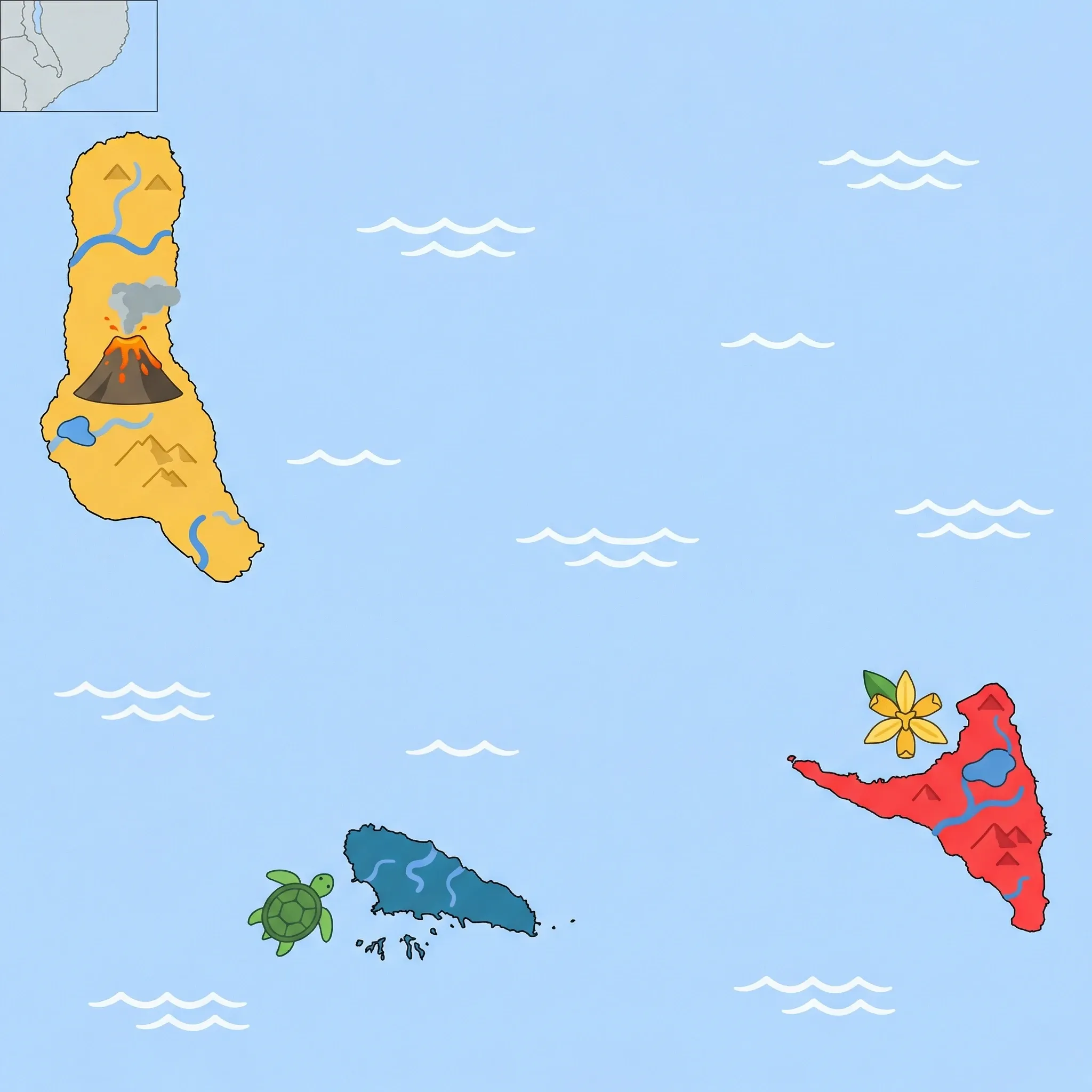
3 Regions
Anjouan
The aromatic isle of steep peaks and waterfalls 🌿⛰️
Grande Comore (Moroni, volcano)
Volcanic wonders and ancient Swahili culture 🌋🕌
Mohéli
The nature island where turtles outnumber tourists 🐢🌴
Click on a region marker to explore details. Use the dropdown to color regions by activity suitability.

Getting There & Around
Getting There
- By Air – Prince Said Ibrahim International Airport (HAH) in Moroni is the main gateway. Major connections include Ethiopian Airlines (via Addis Ababa) and Kenya Airways (via Nairobi).
- By Sea – There are no regular passenger ferries from mainland Africa or Madagascar suitable for tourists; flying is the only practical entry method.
- Entry Requirements – Visas are available on arrival for most nationalities for approx €30-50. You must have a return ticket and a hotel address. Check your government website for the latest visa requirements, or use the IATA Travel Centre entry-requirements checker.
Getting Around
- Ferries – The new Yameela ferry offers a reliable, air-conditioned link between Grande Comore and Anjouan. It is safer and more comfortable for families than the small speedboats.
- Domestic Flights – AB Aviation and other small carriers connect the three islands. Schedules can be erratic and cancellations are common, so build buffer days into your itinerary.
- Taxis – Shared taxis (bush taxis) are the main way to get around islands. They are cheap but crowded. Private taxis can be hired for day trips and are recommended for families wanting comfort.
- Car Hire – Possible on Grande Comore but expensive. Roads are often potholed and narrow; a 4x4 and a confident driver are required.

Packing List
Essential for protecting feet from sharp coral and sea urchins on wild, rocky beaches.
Power cuts are frequent on all islands; street lighting is minimal at night.
ATMs are unreliable and scarce; Euros are widely accepted at a fair fixed exchange rate.
Respectful attire is required; bikinis are only appropriate on strictly private hotel beaches.
Inter-island ferry crossings and small boat trips to marine parks can be very choppy.
English is rarely spoken outside of major hotels; basic French is crucial for communication.

Activities & Best Times

Adventure & Nature
GoodHiking, wildlife, outdoor exploration, ecotourism
Mount Ntingui and rugged landscapes offer authentic wilderness trekking, but 'very_good' overstates international significance. Limited infrastructure, access challenges, and lack of international trekking reputation mean this should be 'good' - a worthwhile destination for adventurous travelers, but not internationally outstanding.
Mohéli Marine Park and endemic wildlife are notable, but 'very_good' is not internationally calibrated for a small, underdeveloped island with minimal tourism infrastructure. 'Good' appropriately recognizes legitimate nature interest while acknowledging the limited scale and facilities.
Mount Karthala (2,361m active volcano) is a legitimate trekking destination, but 'very_good' overstates its international significance. Limited tourism infrastructure, access challenges, and lack of international recognition mean it does not compete with established volcanic trekking destinations (Kilimanjaro, Mount Bromo, etc.). 'Good' is appropriate for a notable but underdeveloped adventure destination.

Beach & Sea
GoodBeach resorts, marine activities: diving, snorkelling, kite surfing, wind surfing, sailing
Home to the Mohéli Marine Park, the region offers exceptional marine biodiversity, including humpback whales (Aug-Oct) and sea turtles. The dry season provides optimal underwater visibility, while the wet season (Jan-Mar) brings heavy rain and rougher seas.
Offers unique volcanic coastal landscapes and clear waters at locations like Trou du Prophète and Chomoni Beach; the dry season (June-October) provides the best visibility and calmest sea conditions.
While Anjouan is more mountainous than its neighbors, the Bimbini Peninsula offers secluded coastal recreation for travelers seeking quiet, authentic marine environments. Conditions for swimming and coastal exploration are optimal when the sea is calm and underwater visibility is at its peak during the mid-year dry spell.

City & Cultural
GoodUrban tourism, museums, historical sites, architecture
Mutsamudu and Domoni are authentic Swahili stone towns, but 'very_good' is not internationally calibrated. These are small settlements on a remote island with minimal tourism infrastructure, not UNESCO sites or internationally recognized cultural destinations. 'Good' appropriately recognizes their authentic character while acknowledging limited scale.
The Medina of Moroni and Friday Mosque are authentic Swahili-Islamic sites, but Moroni is a small capital (~50,000 population) with limited tourism infrastructure. 'Very_good' suggests competition with Stone Town Zanzibar, Lamu, or other established Swahili coast destinations - this is not internationally calibrated. 'Good' appropriately recognizes authentic cultural interest while acknowledging limited scale and development.
Small, authentic settlements like Nioumachoua offer a glimpse into traditional Comorian life, though infrastructure is minimal. Travel is most comfortable during the peak dry season when village festivals and community life are most accessible.

Road Trips & Scenic
GoodScenic drives, countryside tours, route-based travel
Scenic driving routes like the Mutsamudu to Moya mountain pass provide spectacular vistas of the island's jagged coastline and lush interior. Travel is recommended during the dry season when visibility is clear and the risk of rain-induced landslides on steep mountain roads is significantly reduced.
Scenic drives like the Northern Loop showcase dramatic lava flows and baobab-lined coasts; the dry season ensures safer road conditions and clear panoramic views of the island's unique topography.
Scenic coastal and mountain roads like the Trans-Mwali Highway offer dramatic views but are limited in length. The dry season is essential for safe driving conditions and clear vistas across the islets.

Sports & Active
GoodSport tourism, fitness activities, active recreation
The island features challenging, internationally recognized trekking routes to high-altitude landmarks like Lac Dzialandzé and the Ntringui summit. These specialized hiking infrastructures are most accessible and safe for active families during the dry winter period, as heavy monsoon rains make the vertical terrain impassable.
The rugged Trans-Mohéli Trek is a challenging cross-island route requiring good physical fitness. Hiking conditions are best from June to September when humidity is lower and trails are not washed out by tropical rains.
Focuses on rigorous volcanic trekking and coastal hiking along the Karthala and Bangoua Kouni routes; peak season offers the stable weather and dry terrain required for these physically demanding activities.

Educational & Exploratory
MarginalLearning experiences, scientific sites, historical education
The Maison de la Tortue and the National Park Visitor Center provide internationally significant conservation education regarding marine ecosystems. Peak visitation aligns with the turtle nesting and whale watching seasons for practical field learning.
The National Museum (CNDRS) is a significant site for scientific interest in the Coelacanth and local volcanology; visitor engagement is best during the main tourist season when regional travel is most reliable.

Public Holidays & Calendar Next 12 months
Public holidays, festivals, cultural celebrations, and seasonal natural phenomena coming up in Comoros over the next 12 months.
Loading holidays and events...
Climate & Weather
Anjouan
Show Details
| Month | Temp °C | Rain | Humidity |
|---|
Grande Comore (Moroni, volcano)
Show Details
| Month | Temp °C | Rain | Humidity |
|---|
Mohéli
Show Details
| Month | Temp °C | Rain | Humidity |
|---|

Travel Advisory
While several agencies do not issue specific warnings, major partners (USA, Canada, Ireland) classify the risk as elevated due to significant limitations in medical infrastructure and the potential for spontaneous civil unrest. Travelers should exercise a higher degree of vigilance than normal.
Safety Topics
Traveller Advice (3 groups)

Those planning to hike Mount Karthala should monitor volcanic activity through local reports and coordinate with authorities, as the volcano is active and eruptions can occur without significant notice.

Female travelers should dress conservatively in accordance with local Islamic customs. It is recommended to avoid walking alone at night, particularly on beaches or in quiet urban areas.

While legal frameworks may be ambiguous, the social climate is highly conservative and Sunni Islam is the state religion. Travelers should exercise discretion in public as same-sex relations and public displays of affection may attract negative attention or legal scrutiny.
Agency Summaries
The Australian government does not currently maintain a specific travel advisory for Comoros due to a low number of Australian travelers or a perceived lower risk level. Travelers are encouraged to consult partner agencies like Canada or the UK for security information and ensure they have comprehensive insurance.
Most visits are trouble-free, though travelers should be mindful of low-level petty crime and avoid walking alone at night. Political demonstrations can lead to road closures and disruptions. As an Islamic nation, Comoros has strict cultural and religious norms that must be respected, including dress and behavior. Healthcare facilities are basic across the islands.
Travelers should remain very vigilant due to the scarcity of emergency response services and the poor standard of medical care. While violent crime is uncommon, petty theft occurs in public spaces. Political protests can arise and may lead to unrest or traffic delays. Infrastructure issues include hazardous road conditions and safety concerns with local maritime transport.
No formal warning is in place, but travelers are advised to maintain standard security awareness. Comprehensive medical insurance that includes air evacuation is essential due to the limited local health services. Pre-travel vaccinations for common regional diseases are strongly recommended.
Visitors should exercise increased caution and stay informed about local developments. There is no resident Irish diplomatic presence, limiting emergency assistance. Safety precautions should include avoiding large gatherings and being aware of the risk of natural hazards such as cyclones or seismic activity.
Heightened vigilance is advised because of crime, potential for civil unrest, and limited health infrastructure. Petty crime is prevalent in high-traffic areas. Protests often occur in Moroni and can occasionally become violent. Medical facilities are notably inadequate, especially in rural districts, often necessitating medical evacuation for serious conditions.
Information is provided for general guidance only and does not constitute travel, safety, medical, or legal advice. Conditions may change. Users are responsible for independently verifying information before travel.