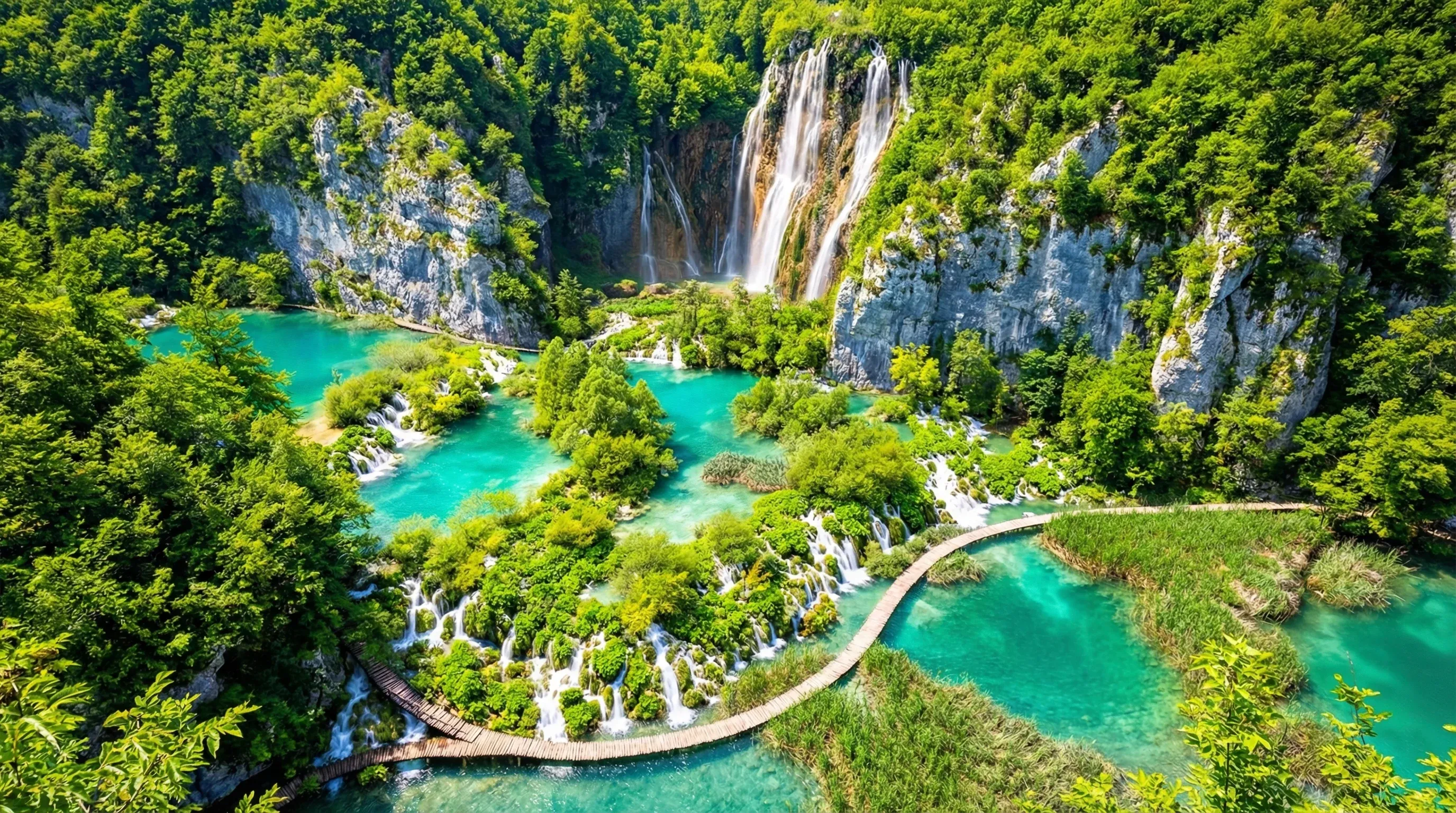

Plitvice Lakes & Central Croatia
Cascading lakes, castles, and capital cool 🏰🌲
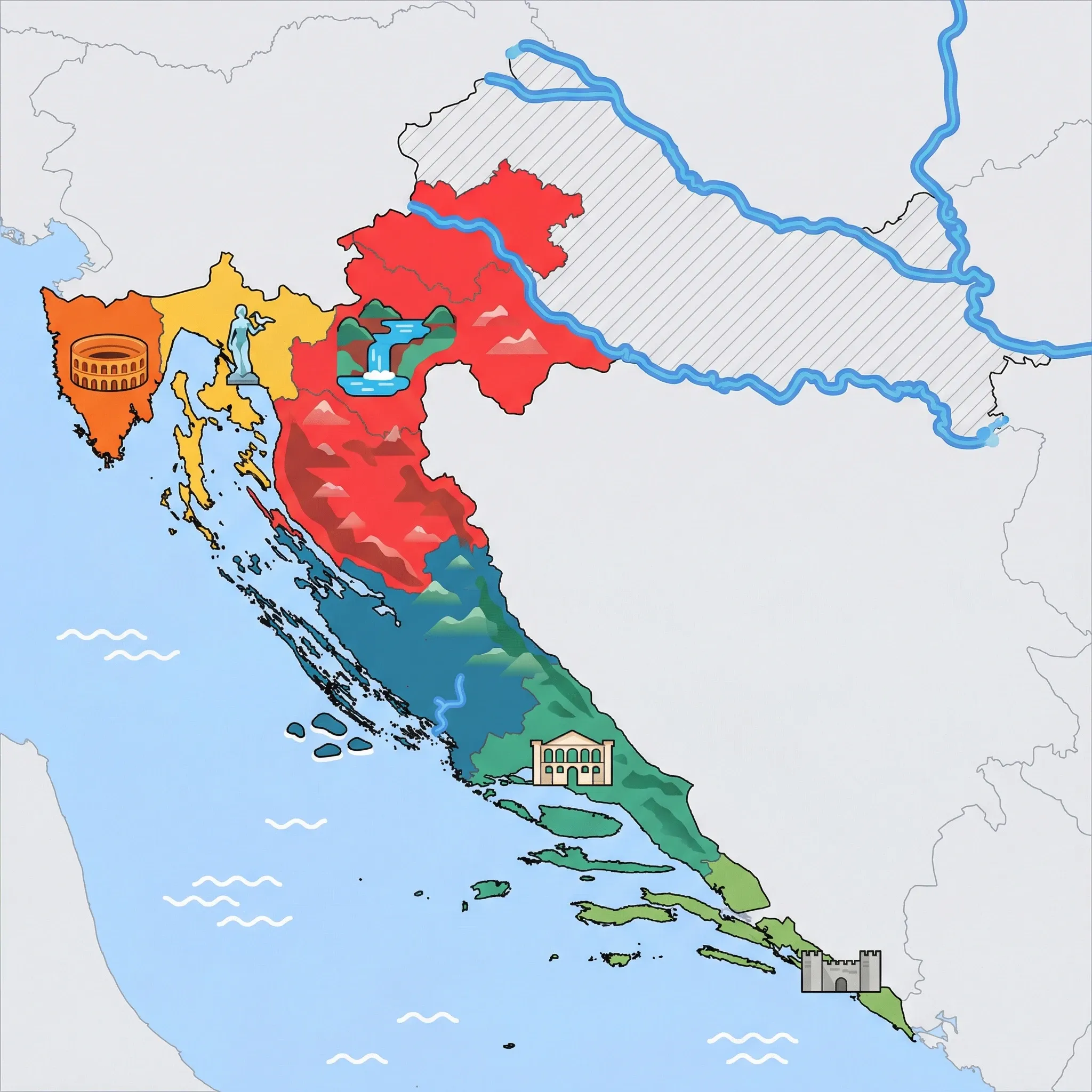
Click a region to explore
Travel Advisory: If visiting Plitvice Lakes in summer, you must book tickets weeks in advance. The park limits daily visitors, and turning up without a ticket often results in being turned away.
While most tourists stick to the coast, Central Croatia offers a lush, green, and fairytale-like alternative that is often the highlight of a trip. This region is home to Croatia's most famous natural wonder, Plitvice Lakes National Park, a UNESCO World Heritage site that looks like the setting of a fantasy movie. But beyond the lakes, the region boasts the charming capital city, Zagreb, which is surprisingly relaxed and tailored to families. The city is filled with parks, pedestrian zones, and quirky museums. North of Zagreb lies Zagorje, a region of rolling hills, thermal spas, and medieval castles that rivals the scenery of Austria or Slovenia.
The climate here is continental—warm summers but cooler nights than the coast, and snowy winters. For families, this region offers a break from the intense coastal heat. It is a place to explore science museums, ride blue trams, hike in deep forests, and explore castles where knights once roamed. It is also the culinary heartland of the country, offering hearty, comforting food that children generally love.
Key Attractions
No visit to Croatia is complete without seeing Plitvice Lakes National Park. The park consists of 16 terraced lakes joined by waterfalls that extend into a limestone canyon. Families can walk on wooden boardwalks right over the water; seeing the Plitvice Lakes Great Waterfall (Veliki Slap) is an unforgettable moment. In Zagreb, the Zagreb Zoo is located in Maksimir Park, a stunning 200-year-old landscape perfect for picnics. The city center features the shortest funicular ride in the world connecting the Lower and Upper Towns. For a day trip, Trakošćan Castle looks like a quintessential majestic fortress, complete with a lake and drawbridge, allowing kids to run around expansive grounds.
Practical Advice
Zagreb is a year-round destination, famous for its Christmas Market (Advent) which is often voted the best in Europe. Plitvice is best visited in spring or autumn when water levels are high and crowds are manageable. In Zagreb, public transport is excellent—kids love the blue trams.
Food & Drink
Typical meal times: Lunch 12:00 pm to 2:00 pm. Dinner 6:00 pm to 9:00 pm. Restaurants in Zagreb are open all day.
Typical meal costs: Significantly cheaper than the coast. A hearty lunch (gablec) can cost €8–12 (approx. $8.50–13 USD / £7–10 GBP). Dinner mains €15–20 (approx. $16–21.50 USD / £13–17 GBP).
Dietary requirements: Zagreb has a modern food scene with plenty of vegan and gluten-free specialist restaurants.
Signature dishes:
- Štrukli – A pastry filled with fresh cottage cheese and cream, which can be boiled or baked, salty or sweet. A comfort food icon.
- Turkey with Mlinci – Roast turkey served with dried flatbread (mlinci) that has been soaked in the roasting juices.
- Kotlovina – A meat and vegetable stew slow-cooked in a wide, shallow cauldron over an open fire, typical of outdoor fairs.
Why this score?
Despite its stunning natural beauty, Plitvice Lakes is highly managed with strict boardwalk paths and electric boats, offering more of a scenic walk than a rugged adventure. Zagreb is an entirely urban environment, and while the surrounding Zagorje region has hills, they are primarily used for gentle hiking and agrotourism. The physical challenge for most families is limited to walking distance rather than terrain difficulty.
Why this score?
Zagreb is the medical capital of Croatia, offering the highest level of healthcare in the country with numerous specialized university hospitals and private clinics. International patients will find the best English-speaking staff and the most advanced diagnostic equipment here. Even the rural areas near Plitvice are within a reasonable distance of these top-tier services compared to the remote islands.
Why this score?
Plitvice Lakes National Park is a global bucket-list destination, attracting over a million visitors annually from every corner of the world. Combined with Zagreb, the country's capital and primary transit hub, the region maintains a very high level of international visitor flow throughout the year. Zagreb’s growing reputation for Christmas markets and cultural museums complements the natural draw of the lakes.

Zagreb and the interior are the most budget-friendly parts of Croatia. You get high-quality accommodation for €60–90 (approx. $65–97 USD / £51–77 GBP) per night. Entry to museums is affordable, often around €5–10 (approx. $5.40–10.80 USD / £4.25–8.50 GBP). Plitvice is the exception, with high entry fees in summer.

Getting Here & Around
Getting Here
- Airports – Zagreb Airport (ZAG) is the main international entry point, connected to the city by shuttle bus (30 mins).
- Train – Zagreb is the rail hub. Trains connect to Vienna, Budapest, and Munich.
- Driving – Exploring the Master's Road (Majstorska cesta) requires a car, as does reaching rural castles like Trakošćan.
Getting Around
- Tram – Zagreb's blue trams are the best way to see the city. Rides are very cheap.
- Walking – Gornji Grad (Upper Town) is best explored on foot.
- Bus – Frequent buses run from Zagreb to Plitvice Lakes (approx 2.5 hours).
Nearby Airports (1 airport)
Zagreb Airport
ZAGZagreb
View full flight map for Croatia →
Official Links

Packing List
Plitvice involves 4-8km of walking on uneven wooden planks; flip-flops are dangerous.
The interior is greener for a reason; summer showers are common in Zagreb.
Strollers are nearly impossible to use on the stepped boardwalks of Plitvice.
Most beaches are pebbly or rocky, and sea urchins are common in the shallows.
Essential for keeping phones and wallets dry during ferry rides, boat trips, and kayaking.
Catamaran crossings between islands can be choppy; helpful for sensitive kids.
Mosquitoes can be very active in the evenings, especially near pine forests and national parks.
The Adriatic is exceptionally clear; bringing your own mask ensures kids can explore underwater anytime.

Activities & Best Times

Hiking, wildlife, outdoor exploration, ecotourism
Home to the UNESCO-listed Plitvice Lakes, this region offers world-class karst landscapes and turquoise waterfalls that are globally iconic. Peak visitation occurs from late spring through early autumn when the extensive trail network and boat routes are fully operational.

Urban tourism, museums, historical sites, architecture
Zagreb offers a sophisticated blend of Austro-Hungarian architecture and unique museums, such as the Museum of Naive Art, while Varaždin is a baroque masterpiece. Peak months reflect the best walking weather and the world-class Advent festival in December.

Sport tourism, fitness activities, active recreation
The region features high-quality infrastructure including the Amazon of Europe Bike Trail and dedicated adrenaline parks near Plitvice. Milder spring and autumn temperatures are ideal for active exploration compared to the humid summer heat.

Events, celebrations, seasonal attractions
Advent in Zagreb has won multiple 'Best Christmas Market in Europe' awards and draws significant international visitors. It is a destination-level seasonal event, not a marginal offering. This should be rated 'good'.

Spa retreats, wellness centers, peaceful getaways
The Zagorje region is an established hub for thermal wellness, with dedicated complexes like Varaždinske Toplice offering authentic restorative experiences. These facilities are a primary draw during the colder months when indoor thermal bathing is most appealing.

Scenic drives, countryside tours, route-based travel
Historic routes like the Master's Road and the Zagorje Castle Route provide scenic touring through diverse terrain and heritage sites. Spring and autumn offer the most pleasant driving conditions and clear visibility across the highland landscapes.

Amusement parks, family entertainment venues
Features several high-quality thermal water parks like Terme Tuhelj and Aquae Vivae which offer substantial family entertainment. Peak appeal coincides with summer when outdoor aquatic facilities are fully accessible and school holidays are in effect.

Learning experiences, scientific sites, historical education
The Technical Museum Nikola Tesla and Aquatika offer specialized educational engagement for families, particularly during the shoulder seasons. These sites serve as excellent supplementary activities during months with comfortable indoor/outdoor transition weather.

Winter sports, ski resorts, snow activities
Small-scale ski facilities at Sljeme and Mukinje provide basic winter sports options for local visitors, though they lack the infrastructure of major alpine resorts. The season is short and highly dependent on peak winter cold and supplementary snowmaking.

Attractions (26 total)



Public Holidays & Calendar Next 12 months
Public holidays, festivals, cultural celebrations, and seasonal natural phenomena coming up in Plitvice Lakes & Central Croatia over the next 12 months.
Loading holidays and events...

Travel Advisory
Croatia is consistently rated as a safe destination by all major international agencies. Standard personal safety awareness is recommended, as with any European destination.
Safety Topics
Traveller Advice (4 groups)

While generally safe, travelers should be aware that public displays of affection may attract unwanted attention in less metropolitan areas.

Ensure you carry a valid passport at all times and register your stay with the local police within 48 hours of arrival if your accommodation provider does not handle this for you.

Exercise caution when using taxis alone. It is recommended to use reputable ride-sharing apps, share your trip status with others, and note the taxi identification number.

Avoid off-road travel and uncultivated land in Karlovac and Lika-Senj counties due to a residual landmine risk. Always stay on marked paths and heed international warning signs in these regions.
Agency Summaries
Croatia remains a safe destination. Most visits are trouble-free, though tourists should be alert to sporadic bomb threats in public spaces and potential violence at major sporting events.
Croatia is generally safe for visitors, requiring standard safety measures similar to those in Canada. Travelers should maintain awareness of petty crime and seasonal risks.
No major travel restrictions are in place. Visitors are advised to follow local laws and be mindful of common tourist-related safety issues such as petty theft and overcharging.
Standard safety precautions are sufficient for most of the country. Specific regional risks exist in forested areas where landmines remain from past conflicts.
Travelers should use common sense and standard security measures. Entry requirements follow Schengen area protocols, and visitors must register their presence with local authorities.
Violent crime is rare, but petty crime is prevalent in high-traffic tourist zones. Environmental hazards like summer wildfires and tick-borne illnesses should be noted.
Information is provided for general guidance only and does not constitute travel, safety, medical, or legal advice. Conditions may change. Users are responsible for independently verifying information before travel.