

⚠️ SAFETY WARNING: Due to political volatility, high rates of violent crime, and armed conflict in eastern regions, government agencies (including CA, USA, UK, AU, IE, and NZ) advise travelers to avoid all travel to eastern and northeastern provinces (including North/South Kivu and Ituri) and to reconsider or avoid non-essential travel to the rest of the country, including Kinshasa. The security situation can change rapidly. Families are strongly urged to consult their own government's official travel advisory before considering a trip, as circumstances and risk assessments vary.
For the experienced, resilience-tested traveling family, the Congo River & Basin offers an adventure unlike any other on Earth. This is a land of superlatives: a country the size of Western Europe, blanketed in the world's second-largest tropical rainforest and dissected by the world's deepest river. It is not a destination for a casual holiday; infrastructure is scarce, and navigating the logistics requires patience and expert planning. However, for those who make the journey-often visiting expatriate family or on specialized eco-tours-the rewards are profound encounters with nature in its most primordial form.
The cultural energy of the DRC is as intense as its landscape. In the bustling capital of Kinshasa, the air vibrates with Ndombolo music and the streets are a living theatre of resilience and creativity. While the interior offers silence and green canopy, the cities offer a loud, vibrant, and chaotic welcome. Families visiting here will find a warmth and spirit among the Congolese people that often defies the hardships they face, offering children a powerful lesson in human strength and community.
Key Attractions
For families visiting Kinshasa, the absolute highlight is the Lola ya Bonobo Sanctuary. Located just outside the capital, this is the only sanctuary in the world for orphaned bonobos. Unlike their chimpanzee cousins, bonobos are matriarchal and peaceful, making them fascinating for children to observe. The sanctuary provides a safe, educational environment where kids can watch these "hippy apes" play in a semi-wild forest setting-a rare and touching conservation success story.
In the city center, the National Museum of the Democratic Republic of the Congo (MNRDC) is a modern, world-class facility that offers a safe and structured dive into the country's rich history. With over 400 distinct ethnic groups, the masks, musical instruments, and artifacts displayed here help families understand the immense cultural tapestry of the nation. It is spacious, air-conditioned, and one of the best museums in Central Africa.
For families with older teenagers (strictly 15+) and a high tolerance for risk, the eastern provinces-when security permits-hold the DRC's most famous treasures. Virunga National Park is Africa's oldest national park, home to the endangered mountain gorillas and the fiery Mount Nyiragongo volcano with its bubbling lava lake. Further south, Kahuzi-Biega National Park offers tracking of the Eastern Lowland Gorillas. Note: Access to these eastern parks is frequently suspended due to armed conflict; always verify current status and use heavy security convoys.
Practical Advice
When to visit: The dry seasons are the only practical times to travel, as dirt roads become impassable mud traps otherwise. For Kinshasa and the west, June to September is best. For the east, January, February, and July are preferable.
Visas & Health: Visas are expensive and notoriously difficult to obtain; you will likely need a notarized letter of invitation from a host or registered tour operator. A Yellow Fever vaccination certificate is mandatory for entry-do not forget it. Malaria prophylaxis is essential for all family members.
Food & Drink
Typical meal times: 12:00 pm to 2:30 pm for lunch, and 7:00 pm to 9:30 pm for dinner.
Typical meal costs: 30,000–85,000 CDF (approx. $10–30 USD / €9–28 EUR) for a main dish in a safe, mid-range restaurant in Kinshasa. High-end hotel dining can easily double this.
Dietary requirements: Vegetarian options are available but limited (often beans, cassava leaves, or plantains). Peanuts (moambe) and chili are common ingredients. Gluten-free travelers can rely on rice and fufu (usually maize/cassava based), but cross-contamination is a risk.
Family-friendly dining: In Kinshasa, expatriate-focused restaurants and hotel buffets are the safest bet for families, offering highchairs and familiar western dishes alongside local cuisine. Street food is generally not recommended for children due to hygiene risks.
Signature dishes:
- Poulet à la Moambé – Considered the national dish, this is chicken slow-cooked in a rich, creamy sauce made from palm nut pulp, often served with rice or fufu.
- Liboke – Fish (often river catfish) marinated with spices and chili, wrapped in banana leaves, and steamed or grilled over charcoal.
- Fufu – A thick, dough-like staple made from boiled cassava and maize flour, used to scoop up sauces and stews.
- Chikwangue – A fermented cassava bread wrapped in leaves, with a dense, chewy texture that keeps well in the heat.
- Mikate – Deep-fried dough balls (similar to doughnuts), a popular snack that children usually love, often dipped in peanut butter or sugar.
Safety
Safety is the primary concern here. In Kinshasa, avoid all travel after dark. Car doors should be locked at all times. "Express kidnappings" (being forced to withdraw cash) are a risk, so never use street taxis-hire a private driver through your hotel or a reputable contact. Photography in public can draw aggressive attention from police; ask permission or avoid taking photos of government buildings entirely. In the east, travel should only be undertaken with professional security setups. Always carry a color photocopy of your passport and visa, leaving the originals in a hotel safe if possible.

Travel in the DRC is surprisingly expensive due to the need for private logistics and security. A family can expect to spend over 850,000–1,400,000 CDF (approx. $300–500 USD / €275–460 EUR) per day. Secure mid-range hotels in Kinshasa start around $150 USD per night, and a 4x4 rental with a driver—essential for safety—can cost $150–250 USD daily.
Age Suitability





Did you know? Democratic Republic of the Congo welcomes approximately 382,000 international visitors per year. Most visitors come from Africa.
Explore Regions
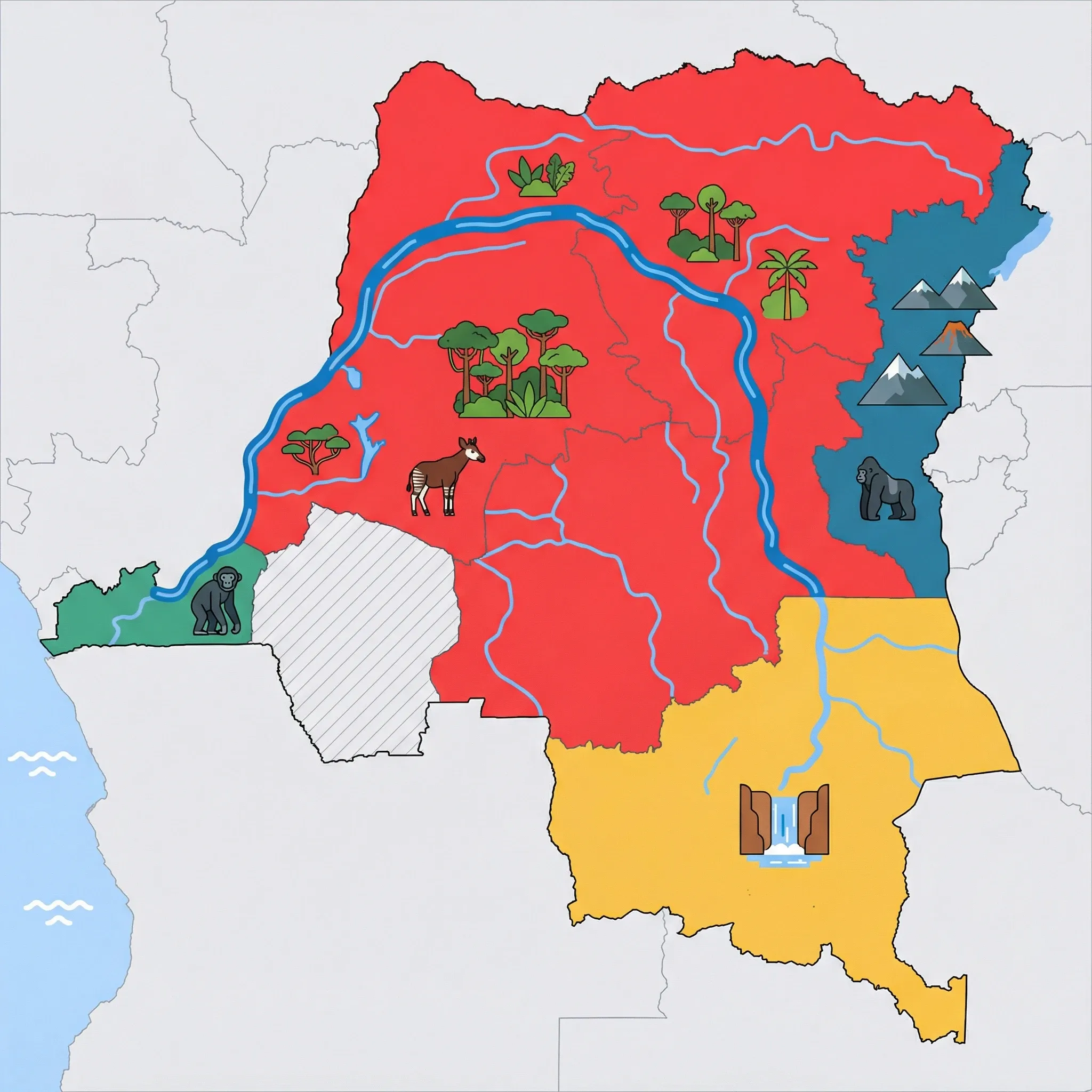
4 Regions
Congo River & Basin
Journey into the green heart of Africa 🌿🛶
Katanga & South
Savannahs, waterfalls, and mineral wealth 💎🦁
Kinshasa
The electric capital of rumba and river views 🎶🏙️
Virunga & Eastern DRC (gorillas)
Africa's most dramatic and dangerous wilderness 🦍🌋
Click on a region marker to explore details. Use the dropdown to color regions by activity suitability.

Getting There & Around
Getting There
- By Air – N'Djili International Airport (FIH) in Kinshasa is the main gateway, served by major carriers like Air France, Brussels Airlines, and Ethiopian Airlines.
- By Sea/River – Ferries connect Kinshasa with Brazzaville (Republic of Congo) across the river. It is a short but often bureaucratic and chaotic crossing.
- Entry Requirements – A visa is required for almost all visitors and must be obtained before arrival; it often costs over $100 USD. You must also present a valid Yellow Fever vaccination certificate to enter. Check your government website for the latest visa requirements, or use the IATA Travel Centre entry-requirements checker.
Getting Around
- Domestic Flights – The only viable way to cross the vast country. Kinshasa to Goma or Lubumbashi is a 2–4 hour flight. Warning: Most local airlines (like CAA) are banned from EU/UK airspace due to safety records. Families should weigh this risk carefully.
- Private Driver – Essential for all movements within cities. Self-driving is not recommended due to chaotic traffic, police harassment, and poor road conditions. Hire a vehicle with a trusted driver through your hotel.
- River Ferries – Crossing the Congo River between Kinshasa and Brazzaville is possible by ferry, but the "Canot Rapide" (speedboat) is a safer and faster option than the public barge.

Packing List
Local merchants and banks refuse dollar bills with even tiny tears, marks, or dates older than 2013.
You will be physically denied entry at the airport without this original yellow booklet.
Power cuts are frequent even in cities; street lighting is non-existent in many areas.
English is rarely spoken outside top hotels; basic French is essential for daily interactions.
Malaria is a severe risk throughout the country; medication is much harder to find locally.
To keep phones charged during long travel days or frequent hotel blackouts.

Activities & Best Times

Adventure & Nature
ExcellentHiking, wildlife, outdoor exploration, ecotourism
A globally unique destination for mountain gorilla encounters and trekking active volcanoes like Nyiragongo. The experience is highly authentic and immersive, with peak accessibility occurring during the drier months when forest trails are manageable.
Home to the spectacular Lofoi Falls and the vast Upemba and Kundelungu National Parks, the region offers raw, authentic wilderness immersion. Peak visitation occurs during the May-September dry season when park tracks are navigable and wildlife is easier to spot near water sources.
The region features the world-unique Lola ya Bonobo sanctuary and the expansive N'sele Valley, providing rare wildlife encounters and wilderness access close to the capital. The dry season from June to August is optimal for trail accessibility and wildlife viewing, while extreme humidity and heavy rains from October to May impede exploration.

City & Cultural
Very GoodUrban tourism, museums, historical sites, architecture
Kinshasa boasts a world-class National Museum and a vibrant contemporary art scene centered in Gombe and Texaf Bilembo. Travelers should visit during the cooler, drier months of June to August to navigate the intense urban environment and heritage sites comfortably.
Features unique heritage sites such as the Wagenia Fishermen's traditional cataracts fishing and the historic Yangambi Research Station. Travel is most rewarding during the shorter dry season (Dec-Feb) when urban navigation and river transport are reliable; heavy equatorial rains in the off-season months significantly disrupt local infrastructure and outdoor cultural demonstrations.
Lubumbashi serves as a cultural hub with significant Belgian colonial architecture and a well-regarded national museum. The dry winter months provide the most comfortable conditions for exploring the city's street life, markets, and botanical gardens without the heavy tropical downpours of the wet season.

Educational & Exploratory
GoodLearning experiences, scientific sites, historical education
Provides access to globally significant scientific facilities like the Epulu Research Station for Okapi conservation and the Jardin Botanique d'Eala. These sites offer profound insights into tropical ecology and conservation history, with the drier months providing the necessary road and river access to reach these remote research outposts.
The Lwiro Natural Science Research Center provides a significant, destination-level educational opportunity for families interested in conservation. Travel to the center is heavily weather-dependent, making the drier peak months the only recommended time for international visitors.

Sports & Active
GoodSport tourism, fitness activities, active recreation
Features world-class high-altitude trekking infrastructure on the Rwenzori and Virunga massifs. Conditions are best for these physically demanding climbs during the dry seasons to ensure safety and visibility on technical slopes.
The region features world-class hiking terrain, specifically the challenging trails leading to the Lofoi Falls and within the national park interiors. Peak conditions occur in the dry season when trails are safe, firm, and offer high visibility for trekkers.
Dedicated infrastructure at the Nsele Valley and Ma Vallee supports organized hiking and mountain biking trails that appeal to active families. These activities are most viable when trails are dry and firm, avoiding the mud and oppressive heat of the peak rainy seasons.

Road Trips & Scenic
GoodScenic drives, countryside tours, route-based travel
Scenic routes like the Matadi Road and the drive to Zongo Falls offer dramatic landscapes and views of the Congo River's power. These journeys require the dry season's stable road conditions and high visibility, as tropical downpours can make rural navigation hazardous.
The Copperbelt Mining Heritage and Kundelungu Plateau routes offer unique industrial and natural landscapes for experienced 4x4 travelers. Driving is only recommended during the core dry months (June-August) when unpaved roads are stable and free from seasonal flooding or mud.

Relaxation & Wellness
MarginalSpa retreats, wellness centers, peaceful getaways
Theme Park & Entertainment
MarginalAmusement parks, family entertainment venues

Public Holidays & Calendar Next 12 months
Public holidays, festivals, cultural celebrations, and seasonal natural phenomena coming up in Democratic Republic of the Congo over the next 12 months.
Loading holidays and events...

Climate & Weather
Congo River & Basin
Show Details
| Month | Temp °C | Rain | Humidity |
|---|
Katanga & South
Show Details
| Month | Temp °C | Rain | Humidity |
|---|
Kinshasa
Show Details
| Month | Temp °C | Rain | Humidity |
|---|
Virunga & Eastern DRC (gorillas)
Show Details
| Month | Temp °C | Rain | Humidity |
|---|

Travel Advisory
Due to a split in agency assessments between 'Reconsider Travel' and 'Do Not Travel', the higher severity level of L3 is applied. Most agencies cite extreme risks from armed conflict, kidnapping, and terrorism.
Safety Topics
Traveller Advice (4 groups)

While same-sex relations are not explicitly criminalized under national law, social stigma and discrimination are high, and same-sex couples are legally barred from adopting children.

Ensure you have comprehensive travel insurance that includes emergency medical evacuation by air. Most standard policies may exclude coverage for the DRC due to its security status.

High risks of sexual violence and harassment exist. Women are advised to maintain a low profile, dress conservatively, and avoid travelling alone, particularly after dark.

Humanitarian workers are frequently targeted by armed groups and violent mobs. Personnel should operate with extreme caution and specialized security protocols.
Agency Summaries
Canadians are advised to avoid non-essential travel to the Democratic Republic of the Congo due to a very fragile security environment, significant crime rates, and frequent civil disturbances. Regional advisories suggest avoiding all travel to most eastern and northeastern provinces.
Ireland maintains a 'Do Not Travel' advisory for the DRC, emphasizing the high risk of violence and conflict, especially in eastern provinces where fighting between government and rebel forces has escalated.
The U.S. government recommends reconsidering travel to the DRC because of prevalent crime and civil unrest. Some regions, particularly in the east, carry a much higher risk due to active armed conflict and terrorism.
British authorities advise against all but essential travel to the country as a whole, with stricter 'no travel' warnings for specific areas in the east and north. Recent updates highlight insecurity at Bangoka International Airport in Kisangani.
New Zealand advises its citizens not to travel to the DRC due to the unstable security situation, ongoing armed conflict, and high risk of terrorism and violent crime.
Australia advises against all travel to the DRC due to the volatile security climate and the significant threat of kidnapping, terrorism, and violent conflict throughout the country.
Information is provided for general guidance only and does not constitute travel, safety, medical, or legal advice. Conditions may change. Users are responsible for independently verifying information before travel.