

Overview
Denmark is widely considered one of the easiest and most welcoming destinations in the world for families. The country's geography is remarkably flat, making it perfect for cycling holidays and stroller walks, while the distances between attractions are short. The culture revolves around the concept of hygge-a feeling of cozy contentment and well-being-which translates into child-friendly cafés, relaxed public spaces, and a society that genuinely values work-life balance and family time. Whether you are exploring the vibrant streets of Greater Copenhagen or the rolling dunes of the West Coast & Wadden Sea, you will find high chairs, changing tables, and children's menus are the standard, not the exception.
Beyond the practical ease, Denmark offers a rich tapestry of experiences that spark children's imaginations. This is the land of Vikings, ancient castles, and Hans Christian Andersen's fairy tales. From the rocky cliffs of Bornholm to the historic towns of Central & East Jutland, the country is packed with interactive museums and outdoor adventures designed specifically for young explorers. The atmosphere is safe and laid-back, allowing parents to relax while kids burn off energy in clean, well-designed playgrounds found in almost every town.
Key Attractions
Denmark's attractions are world-class, often combining learning with pure fun. In Central & East Jutland, families can step back in time at Den Gamle By (The Old Town), an open-air museum where history comes alive with actors in period costume. For thrill-seekers, Djurs Sommerland offers Scandinavia's biggest summerland with eight themed lands. Animal lovers should not miss Givskud Zoo (Zootopia), where you can drive your own car on safari among lions and giraffes, or the historic Copenhagen Zoo in the capital.
On the island of Funen & South Funen Archipelago, Egeskov Castle is a must-visit; it is often voted the best castle in Europe for families due to its massive play forest, mazes, and vintage car exhibitions. Nature-loving families will be awestruck by Camp Adventure in South Zealand, featuring a spiraling forest tower that offers panoramic views over the canopy. For a maritime experience, the Fisheries and Maritime Museum in Esbjerg lets kids get up close with seals and explore the UNESCO-listed Wadden Sea ecosystem. Finally, the dramatic Hammershus Castle Ruins on Bornholm offer an unforgettable setting for a family hike.
Practical Advice
The best time to visit is summer (June to August) when the days are long and the weather is mild. Winters are dark and cozy but require warm clothing. Denmark is extremely safe, and English is spoken fluently by almost everyone. Strollers (called barnevogn) are welcome everywhere, including on buses and trains. Tap water is among the cleanest in the world and safe to drink.
Food & Drink
Typical meal times: Danes eat earlier than many other Europeans. Lunch is typically served from 12:00 pm to 1:00 pm, and dinner restaurants are busiest between 6:00 pm and 7:30 pm.
Typical meal costs: Lunch cafes: 85–130 DKK (approx. $12–19 USD / €11–17 EUR). Mid-range dinner: 180–300 DKK (approx. $26–43 USD / €24–40 EUR). Fast food/Hot dog: 35–60 DKK (approx. $5–9 USD / €5–8 EUR).
Dietary requirements: Vegetarian, vegan, and gluten-free options are widely available in cities and supermarkets. Danes are very allergy-aware; just ask staff who are usually fluent in English and happy to help.
Family-friendly dining: Children are welcome in almost all restaurants. Most places offer high chairs and a children's menu (børnemenu), often featuring fish fillet or meatballs. Many cafes have a play corner or a box of toys.
Signature dishes:
- Smørrebrød – Open-faced rye bread sandwiches piled high with toppings like cold cuts, fish, or pâté. A lunch staple.
- Frikadeller – Danish pork meatballs, usually served with potatoes and gravy. A guaranteed hit with children.
- Rød Pølse – Bright red hot dogs served at street stands (pølsevogn) with remoulade, fried onions, and pickles.
- Stegt Flæsk – The national dish of crispy pork belly served with parsley sauce and potatoes.
- Koldskål – A sweet, cold buttermilk soup served with crunchy vanilla biscuits (kammerjunkere), popular in summer.

Denmark is expensive. A family of four should budget around 2,000–3,000 DKK (approx. $290–435 USD / €265–400 EUR) per day for accommodation, meals, and activities. To save money, use public transport (kids often travel free), buy lunch at bakeries or supermarkets, and look for 'family tickets' at museums.
Age Suitability

Did you know? Denmark welcomes approximately 14.2 million international visitors per year. Most visitors come from Europe.
Explore Regions
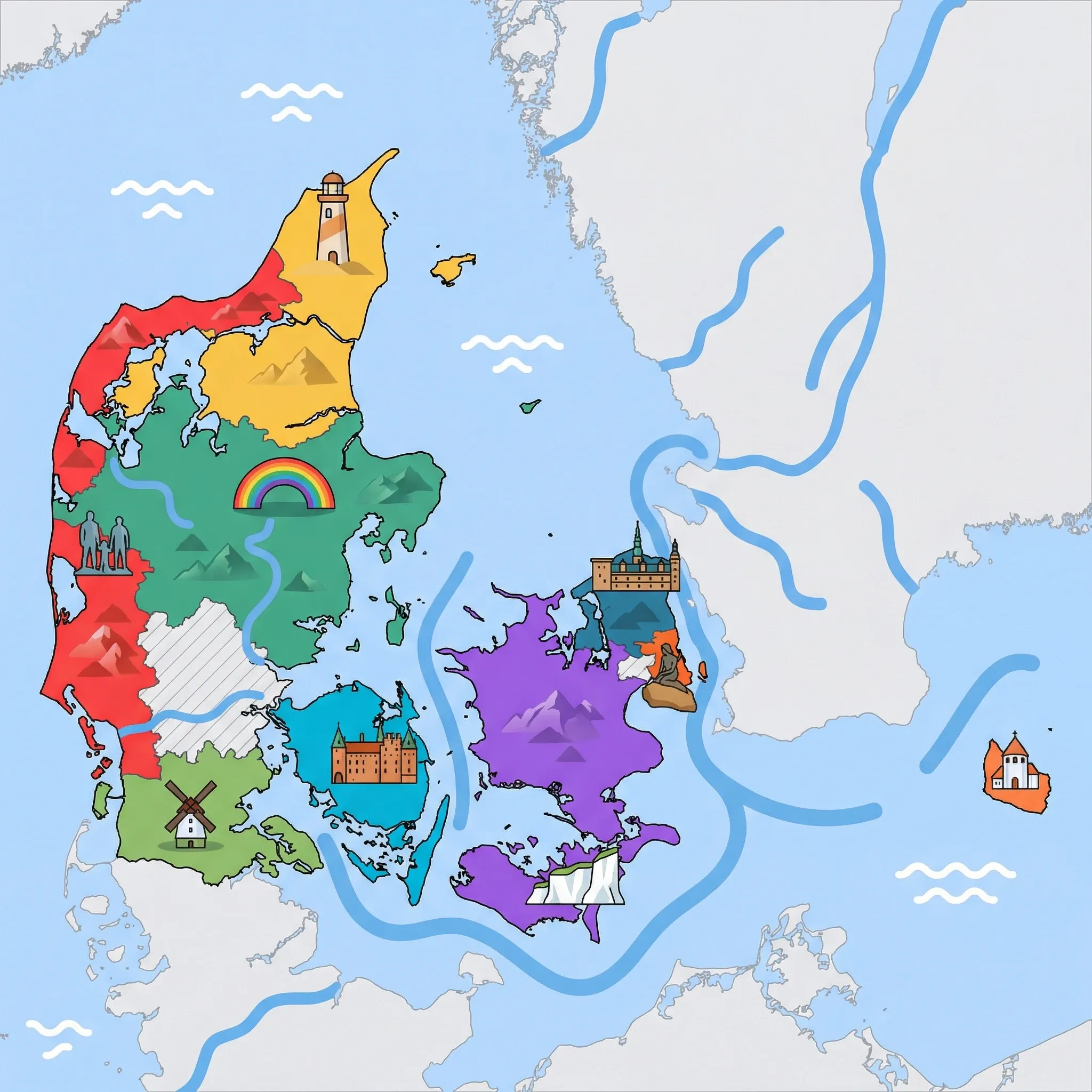
9 Regions
Bornholm
Denmark's rocky sunshine island ☀️🌊
Central & East Jutland (Midt- & Østjylland)
Home of LEGO and the happiest city 🇩🇰🧱
Funen & South Funen Archipelago (Fyn & Sydfynske Øhav)
The fairytale island of H.C. Andersen 🏰🦢
Greater Copenhagen (Storkøbenhavn)
The cool, swim-able, bike-able capital 🧜♀️🚲
North Jutland (Nordjylland)
Where two seas meet at the top of Denmark 🌊👆
North Zealand (Nordsjælland)
Royal castles and the Danish Riviera 👑🏖️
South Jutland (Sønderjylland)
Historic borderlands and epic cake tables 🇩🇰🇩🇪🍰
South Zealand, Lolland-Falster & Møn (Sydsjælland, Lolland-Falster & Møn)
White cliffs, wild safari, and island fun 🦁🧗♂️
West Coast & Wadden Sea (Vestkysten & Vadehavet)
Viking lands and the UNESCO Wadden Sea 🛶🌊
Click on a region marker to explore details. Use the dropdown to color regions by activity suitability.

Getting There & Around
Getting There
- By Air – Copenhagen Airport (CPH) is the main international hub, located just 15 minutes by metro from the city center. Billund Airport (BLL) in Central & East Jutland is convenient for Legoland and the west coast.
- By Train – Direct trains run from Hamburg (Germany) to Copenhagen and Aarhus. The journey from Hamburg to Copenhagen takes about 4.5 hours.
- By Sea – Ferries connect Denmark to Norway, Sweden, and Germany. The Scandlines ferry from Puttgarden (Germany) to Rødby is a popular route for drivers.
- Entry Requirements – Denmark is part of the Schengen Area. US, UK, and Canadian citizens do not need a visa for short tourist stays (up to 90 days). Check your government website for the latest visa requirements, or use the IATA Travel Centre entry-requirements checker.
Getting Around
- Trains – DSB trains are clean, punctual, and spacious. Two children under 12 travel free with a paying adult. InterCity trains connect major hubs like Greater Copenhagen and Central & East Jutland efficiently.
- Car Hire – Essential for exploring rural areas, the West Coast & Wadden Sea, or hopping between islands. Roads are excellent, but always watch for cyclists.
- Bicycles – The Danish way of life. You can rent cargo bikes (Christiania bikes) in cities to transport young children safely in the front bucket.
- Public Transport – Copenhagen has a driverless Metro that runs 24/7. Buses are stroller-friendly with dedicated spaces for prams.

Packing List
Ticks (skovflåt) are common in Danish forests and tall grass; quick removal is important.
Summer days are very long with sunrise as early as 4:00 am, which can disrupt kids' sleep.
Essential for playgrounds and forest walks; Danish kids wear these over clothes to play outside in wet weather.
Many Danish beaches have pebbles, and harbor bath ladders can be slippery or have sharp barnacles.
Denmark is flat and often breezy, even on sunny summer days, so a windbreaker is more useful than a heavy coat.

Activities & Best Times

Adventure & Nature
ExcellentHiking, wildlife, outdoor exploration, ecotourism
Home to the Wadden Sea UNESCO World Heritage site, offering world-class tidal ecosystems, seal safaris, and unique mudflat trekking. Peak season aligns with mild weather and critical bird migration periods.
Features the UNESCO-listed Par Force Hunting Landscape and Gribskov forest, offering authentic immersion in ancient woodlands and coastal trails. The peak season provides long daylight hours for exploring diverse ecosystems, while the winter months see significant closures and reduced accessibility for nature-based attractions.
Home to Thy National Park and the dramatic Råbjerg Mile migrating dunes, offering a raw, wilderness feel rare in Denmark. Best visited from late spring to early autumn to navigate the coastal trails and observe migratory bird patterns.

City & Cultural
ExcellentUrban tourism, museums, historical sites, architecture
Home to world-class landmarks including the UNESCO-listed Kronborg Castle and the Louisiana Museum of Modern Art, which is globally recognized for its architecture and collection. The region offers a high-end, authentic cultural experience that peaks in the summer but remains attractive in December for traditional Danish Christmas markets.
A world-class cultural hub featuring impeccably preserved royal palaces, a vibrant culinary scene, and a unique 'hygge' atmosphere. Peak travel occurs during the bright summer months and the festive Christmas season, while the dark mid-winter months offer a more subdued experience.
Aarhus is a sophisticated cultural hub featuring the iconic ARoS museum and a vibrant culinary scene. Shoulder months offer better access to galleries without the peak summer crowds, while winter is often too dark for optimal urban exploration.

Sports & Active
Very GoodSport tourism, fitness activities, active recreation
Boasts purpose-built infrastructure for cycling through the UNESCO Par Force landscape and elite sailing facilities along the coast. The active season is constrained by weather, with the best infrastructure availability and competition schedules occurring between late spring and early autumn.
A global leader in urban cycling infrastructure with world-class routes like the Amarminoen and unique facilities like Urban Ranger Camp. Peak conditions coincide with the mild, dry summer window, while winter weather significantly hampers outdoor sporting activities.
Klitmøller, known as 'Cold Hawaii,' is a premier European hub for windsurfing and surfing. The region also offers excellent infrastructure for long-distance cycling and hiking along the ancient Hærvejen route.
Theme Park & Entertainment
Very GoodAmusement parks, family entertainment venues
Home to Tivoli Gardens, a global benchmark for authentic and aesthetic amusement parks, and Bakken, the world's oldest park. These parks operate seasonally, with major peaks during summer and specialized openings for Halloween and Christmas.
Features the global flagship LEGOLAND Billund and the massive Djurs Sommerland. While Lalandia offers indoor water parks, the primary theme park season is tied to school holidays and the temperate summer window.
Features Bakken (Dyrehavsbakken), the world's oldest amusement park, providing a unique and authentic historical entertainment experience. The parks operate seasonally, typically opening in April and closing in September, which strictly dictates the peak and shoulder windows for international families.
Beach & Sea
GoodBeach resorts, marine activities: diving, snorkelling, kite surfing, wind surfing, sailing
Known as the 'Danish Riviera', this region offers high-quality sandy beaches like Hornbæk with a sophisticated atmosphere, though the swimming season is brief due to northern water temperatures. Peak visitation aligns with the warmest sea temperatures in mid-summer, while shoulder months are ideal for brisk coastal walks and sailing.
Copenhagen offers a unique and high-quality urban beach culture at Amager Strandpark and innovative harbor baths. The season is strictly limited to the brief summer window when water temperatures become tolerable for swimming.
Renowned for the unique 'Skagen light' and the meeting of the Skagerrak and Kattegat seas at Grenen. The season is short due to Northern latitudes, with swimmable water temperatures only in July and August.

Educational & Exploratory
GoodLearning experiences, scientific sites, historical education
Features internationally significant facilities like Den Blå Planet and Experimentarium, which are primary draws for families. While these are indoor attractions, peak visitation follows the international and local school holiday calendar.
The Nordsøen Oceanarium is a major destination-level facility for marine biology education. While indoors, the experience is best coupled with the broader region's natural sites during the primary travel season.
Highly specialized facilities like the Kattegatcentret and Randers Tropical Zoo offer world-class biological education. These are best experienced in conjunction with broader regional travel during the warmer, more accessible months.
Road Trips & Scenic
GoodScenic drives, countryside tours, route-based travel
The scenic 'Strandvejen' coastal road and the Marguerite Route offer exceptional driving experiences past historic mansions and sea views. Peak months provide the best visibility and lush greenery, while winter conditions and shorter days significantly detract from the scenic touring experience.
The Strandvejen coastal drive provides a sophisticated scenic route through affluent seaside suburbs and beech forests. Best driven in summer for the coastal views and garden blooms; winter visibility and short days make it less appealing.
The West Coast Route offers iconic driving vistas of the North Sea and dramatic lighthouses like Rubjerg Knude. Travel is most rewarding in summer when daylight lasts until 10 PM and rural heritage sites are fully open.

Festivals & Seasonal
MarginalEvents, celebrations, seasonal attractions
The Shakespeare Festival at Kronborg is an internationally significant event that draws sophisticated travelers specifically in August. Outside of this and the traditional Christmas 'Hygge' period in December, the region lacks high-profile events that serve as primary international travel motivators.
Features major events like the Copenhagen Jazz Festival and Distortion, alongside iconic Christmas markets. These specific events drive international interest during June, July, and December.
Centered on the Aalborg Carnival in May—the largest in Northern Europe—and the Rebild Festival in July. These specific events provide an authentic, high-energy cultural experience for international visitors.

Ski & Snow
MarginalWinter sports, ski resorts, snow activities
While CopenHill offers year-round dry-slope skiing, the region only offers a traditional snow experience at small centers like Hedeland during rare consistent cold snaps in mid-winter. Not a primary ski destination for international families.
The island has a small local ski facility at Slettebakke, though snow coverage is inconsistent and not comparable to alpine destinations. It serves as a curiosity for winter visitors during rare periods of heavy Baltic snowfall.

Relaxation & Wellness
MarginalSpa retreats, wellness centers, peaceful getaways

Public Holidays & Calendar Next 12 months
Public holidays, festivals, cultural celebrations, and seasonal natural phenomena coming up in Denmark over the next 12 months.
Loading holidays and events...
Climate & Weather
Bornholm
Show Details
| Month | Temp °C | Rain | Humidity |
|---|
Central & East Jutland (Midt- & Østjylland)
Show Details
| Month | Temp °C | Rain | Humidity |
|---|
Funen & South Funen Archipelago (Fyn & Sydfynske Øhav)
Show Details
| Month | Temp °C | Rain | Humidity |
|---|
Greater Copenhagen (Storkøbenhavn)
Show Details
| Month | Temp °C | Rain | Humidity |
|---|
North Jutland (Nordjylland)
Show Details
| Month | Temp °C | Rain | Humidity |
|---|
North Zealand (Nordsjælland)
Show Details
| Month | Temp °C | Rain | Humidity |
|---|

Travel Advisory
The majority of international agencies suggest that standard safety measures are sufficient for travel to Denmark. However, travelers should be aware of elevated security warnings from North American agencies regarding terrorism and localized gang activity.
Safety Topics
Traveller Advice (4 groups)

Maintain awareness in crowded areas and on public transportation to prevent falling victim to petty theft. Always carry travel documents when crossing internal European borders.

Those visiting remote areas in Greenland or the Faroe Islands must prepare for extreme weather conditions and recognize that medical and rescue infrastructure is extremely limited.

The social climate is highly progressive and the country is consistently ranked as one of the safest and most welcoming destinations for the community.

Female visitors should follow standard safety protocols, particularly when traveling alone at night in large metropolitan areas like Copenhagen.
Agency Summaries
No specific travel restrictions are in place, though visitors are encouraged to review security guidelines and prepare for standard European travel risks.
General safety risks are considered low, though visitors are advised to avoid protests and keep an eye on personal belongings in transit hubs.
Visitors should maintain standard safety awareness and ensure they have valid identification for movement within the Schengen area.
The safety environment is stable, though petty crime remains a factor in popular tourist areas and travelers should stay informed about the local terror threat level.
Officials recommend a heightened state of vigilance due to the threat of terrorist activities and incidents of gang-related violence in specific urban districts.
Travelers should remain alert to their surroundings because of persistent plans by extremist groups to target public and tourist locations.
Information is provided for general guidance only and does not constitute travel, safety, medical, or legal advice. Conditions may change. Users are responsible for independently verifying information before travel.