

Key Attractions
The crown jewel is undoubtedly the Galápagos Islands. Here, the Charles Darwin Research Station offers kids a chance to see giant tortoises up close and learn about conservation. For active families, snorkeling around Kicker Rock (León Dormido) or hiking the Sierra Negra Volcano provides unforgettable encounters with wildlife that has no fear of humans. On the mainland, the Avenue of Volcanoes is spectacular. Cotopaxi National Park allows families to walk near an active volcano, while the Pailon del Diablo waterfall in Baños offers a thrilling (but safe) descent to a roaring cascade. In the capital, the Historic Center of Quito is a UNESCO treasure where you can climb the Basilica del Voto Nacional towers. Just north of the city, Ciudad Mitad del Mundo is a must-do photo op where kids can jump between the northern and southern hemispheres.Practical Advice
Ecuador uses the US Dollar, making payments simple for many travellers. The high altitude in Quito (2,850m) can affect children, so plan a slow first day or head directly to lower elevations. The best time to visit the highlands and Galápagos is June to September, though the Amazon is year-round. Pack for all four seasons-the weather can change instantly.Food & Drink
Typical meal times: Lunch (almuerzo) is the main meal, served from 12:00 pm to 3:00 pm. Dinner is often lighter and served from 6:30 pm to 9:00 pm.
Typical meal costs: $3.50–5.00 (approx. €3.20–4.60 EUR / £2.70–3.90 GBP) for a set lunch (almuerzo); $10–25 (approx. €9–23 EUR / £8–19 GBP) for a mid-range dinner main.
Dietary requirements: Vegetarian options are increasingly common in cities, with rice, beans, eggs, and avocado being staples. In remote areas, verify that soups are not made with meat stock. Gluten-free travelers can rely on corn-based dishes (mote, humitas) and plantains, but cross-contamination is a risk.
Family-friendly dining: Children are welcome everywhere. Most restaurants offer highchairs and are happy to serve plain rice, chicken, or mild soups. Fresh fruit juices (jugos) are ubiquitous and loved by kids-ask for them with bottled water.
Signature dishes:
- Locro de Papa – A creamy, hearty potato soup served with cheese and avocado. It is mild, comforting, and perfect for kids in the chilly highlands.
- Encebollado – The national fish soup made with albacore tuna, yuca, and pickled onions. Usually eaten for breakfast or lunch.
- Bolón de Verde – Green plantain dumplings stuffed with cheese or pork crackling (chicharrón), a filling and delicious breakfast favourite.
- Llapingachos – Fried potato patties stuffed with cheese, often served with peanut sauce, eggs, and chorizo.
- Mote Pillo – Hominy corn scrambled with eggs and onions, a soft and savoury dish that is very toddler-friendly.
Safety
While the internal conflict warning sounds alarming, tourism in established zones generally continues normally. Stick to official tourist transport and avoiding walking alone at night, especially in large cities like Guayaquil and Quito. Trust local advice from your hotel regarding safe neighbourhoods. In the Galápagos, safety issues are virtually non-existent, but strict rules regarding wildlife must be followed.Family Travel Notice
Minors who are dual nationals or have resident status may require notarized consent from both parents to exit the country. Ensure all documentation is legalized via apostille where necessary.

Mainland Ecuador is very affordable, but the Galápagos Islands are expensive. A family of four on the mainland might spend $100–150 (approx. €90–140 EUR / £80–115 GBP) per day, while a Galápagos trip can easily exceed $600–800 (approx. €550–740 EUR / £470–630 GBP) per day including tours. Almuerzos (set lunches) are a bargain everywhere.
Age Suitability






Explore Regions
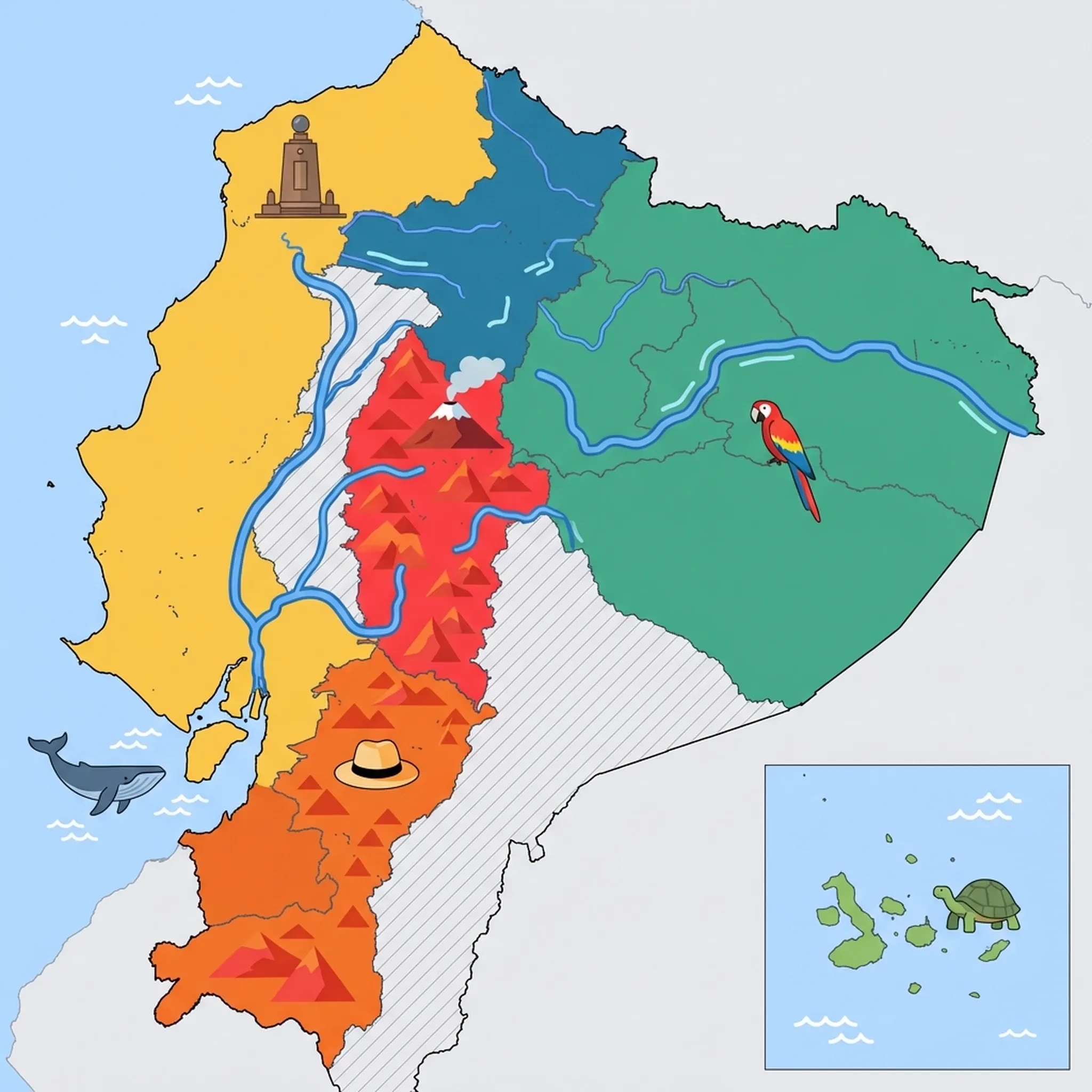
6 Regions
Amazon (Coca, Tena)
A living classroom of wildlife and jungle adventure 🐒🌿
Avenue of Volcanoes
A road trip through the land of giants 🏔️🌋
Cuenca & Southern Highlands
Colonial charm and ancient Incan secrets 👒🏛️
Galápagos Islands
The ultimate wildlife playground 🐢🦁
Guayaquil & Coast
Sun, seafood, and riverfront breezes 🦀🏖️
Quito & Northern Highlands
A capital in the clouds and the middle of the world ☁️🌎
Click on a region marker to explore details. Use the dropdown to color regions by activity suitability.

Getting There & Around
Getting There
- By Air – The main gateways are Mariscal Sucre International Airport (UIO) in Quito and José Joaquín de Olmedo (GYE) in Guayaquil. Direct flights arrive from the US, Spain, and Panama.
- By Land – Borders with Colombia (Rumichaca) and Peru (Huaquillas/Macará) are open, but crossing by land is currently discouraged due to safety concerns in border regions.
- Galápagos Entry – Flights to the islands depart only from Quito or Guayaquil. A $20 Transit Control Card and a $200 National Park entrance fee (payable in cash) are required.
- Entry Requirements – Most nationalities (US, UK, EU, Canada) do not need a visa for stays up to 90 days. Check your government website for the latest visa requirements, or use the IATA Travel Centre entry-requirements checker.
Getting Around
- Domestic Flights – The most efficient way to travel between major regions, especially to the Galápagos Islands (from Quito or Guayaquil) and the Amazon (Coca, Tena).
- Private Drivers – Highly recommended for families on the mainland. It is affordable ($80–120/day) and offers flexibility for stops at sights like Cotopaxi National Park or Ciudad Mitad del Mundo.
- Buses – Interprovincial buses are cheap and frequent, but safety varies. For families, higher-end 'executive' services are safer and more comfortable.
- Taxis/Rideshare – Uber and Cabify work well in Quito and Guayaquil and are safer than hailing street taxis.
Official Links

Packing List
Many shops and taxis cannot change $20 bills; small change is essential for daily purchases.
Mandatory in the Galápagos to protect marine life; regular sunscreen is often restricted.
Essential for 'wet landings' from boats in Galápagos and walking on sharp volcanic rock.
Boat travel between islands can be choppy; vital for kids even if they don't usually get seasick.
Protects electronics during Amazon canoe trips and Galápagos pangas (dinghy rides).

Activities & Best Times

Adventure & Nature
ExcellentHiking, wildlife, outdoor exploration, ecotourism
Yasuní National Park is a global biodiversity hotspot with world-class eco-lodges that provide sophisticated families with authentic, high-standard wilderness encounters. Peak visitation occurs during international school holidays, though the immersive jungle experience is available year-round despite tropical rainfall.
A globally unique archipelago offering unparalleled wildlife encounters and volcanic trekking; peak months reflect the main international family travel windows and key wildlife activity. September is often considered off-peak as some cruise vessels undergo maintenance and the cool, misty weather is at its peak.
Home to iconic peaks like Cotopaxi and Chimborazo, offering world-class trekking and crater lake exploration. The dry season from June to September provides the best visibility for volcano photography and mountain safety.

City & Cultural
ExcellentUrban tourism, museums, historical sites, architecture
As a UNESCO World Heritage city with exceptionally preserved colonial architecture and the major Ingapirca ruins nearby, it offers authentic world-class culture. Peak visitation occurs during the dry northern summer and November's Independence festivities, while the heavy rains of March and April can disrupt urban exploration.
Home to the first UNESCO World Heritage site, Quito offers an authentic colonial atmosphere and world-class heritage sites. While mostly a year-round destination, the heavy rains of March and April can hinder explorations of the steep historic streets.
Rich in unique heritage sites like the Wall of Tears and Post Office Bay that tell the islands' human history alongside iconic natural landmarks. These sites are best visited during drier, cooler periods or peak holiday windows, while September sees the lowest tourism infrastructure activity.

Road Trips & Scenic
Very GoodScenic drives, countryside tours, route-based travel
The Pan-American Highway offers one of the world's most spectacular scenic drives through the 'Avenue of the Volcanoes'. Clear skies in the Andean summer are essential for viewing the majestic peaks along the route.
The Avenue of the Volcanoes and Lake Route offer spectacular driving routes with views of the Andes. Peak visibility is critical for these scenic drives, occurring between June and September before the heaviest cloud cover arrives.
The descent from the Andes to the Amazon via the 'Gateway Route' or the Loreto Road offers dramatic scenic transitions through cloud forests and tropical basins. Driving conditions are most reliable during the drier months to avoid the frequent landslides associated with the heavy April-June rains.

Sports & Active
Very GoodSport tourism, fitness activities, active recreation
Tena is a premier international destination for whitewater kayaking and rafting, supported by professional outfitters and world-class river runs. The activity is best from November to February when river levels are consistent and safe, avoiding the extreme flood risks of the mid-year peak rainy season.
Features exceptional hiking routes on Sierra Negra and unique formations like Las Grietas for active exploration. Peak months offer the most comfortable temperatures for strenuous hiking, whereas the February to April period can be excessively hot and humid.
Provides exceptional high-altitude mountain biking trails and world-recognized hiking circuits like the Quilotoa Loop. Optimal trail conditions and safety are found during the June to September dry season.

Educational & Exploratory
GoodLearning experiences, scientific sites, historical education
Includes unique scientific attractions such as the Intiñan Solar Museum on the equator and interactive science centers for families. Visitation peaks during major school holiday periods when weather is driest for outdoor interactive exhibits.
Home to the world-renowned Charles Darwin Research Station and high-quality interpretation centers that provide essential context for the islands' biodiversity. Visits are optimal during peak travel seasons when guided programs are most frequent.
Features internationally significant archaeological sites like Ingapirca and the Pumapungo complex, alongside specialized natural history museums. These facilities are primary motivators for families seeking historical learning, best visited when weather allows for clear exploration of outdoor excavation sites.

Festivals & Seasonal
GoodEvents, celebrations, seasonal attractions
Inti Raymi is a globally significant indigenous sun festival with substantial international visitor interest. The classification notes acknowledge 'culturally significant events' but the marginal rating understates the importance of these festivals in Ecuador's cultural tourism offer.
The Mama Negra festival in Latacunga is a major cultural event drawing international visitors in September and November. Other months lack major internationally-significant festivals.
The humpback whale migration is a world-class seasonal event that defines the region's tourism calendar between June and September. Outside of this period and specific civic holidays, there are few festivals that attract international attention.

Relaxation & Wellness
GoodSpa retreats, wellness centers, peaceful getaways
Famous for natural volcanic thermal springs in Papallacta and Chachimbiro, providing high-quality restorative experiences. The baths are particularly appealing during the cooler, drier months of the year.
The volcanic thermal baths in the Baños de Cuenca district, such as Piedra de Agua, provide a genuine and restorative wellness experience. While thermal pools are usable year-round, the peak dry season and the year-end holidays represent the most comfortable times for international family travel.
Famous for natural thermal baths in Baños de Agua Santa fueled by volcanic activity. The experience is most enjoyable during the cooler, drier months, while heavy rains can affect the outdoor spring experience.

Theme Park & Entertainment
GoodAmusement parks, family entertainment venues
Baños serves as a regional hub for family-oriented adventure parks and the famous 'Swing at the End of the World'. Visitation peaks during international school holidays and drier windows.
Vulqano Park provides standard amusement facilities for children with the added uniqueness of a high-altitude setting near the Telefériqo. It serves as a secondary attraction best visited during the local and international holiday windows.
Local attractions like the Jumandy Caves and regional water parks provide family-oriented recreation, though they are modest in scale and facilities compared to international theme park benchmarks. They are best visited during the primary travel seasons to ensure full facility availability.

Beach & Sea
GoodBeach resorts, marine activities: diving, snorkelling, kite surfing, wind surfing, sailing
Offers iconic coastal areas like Tortuga Bay with unique marine life; peak months align with the warm season when water visibility and temperatures are highest for snorkeling. The off-season sees cooler, choppier waters and the 'garúa' mist which reduces clarity.
The region features iconic coastal spots like Los Frailes and Montañita, though they lack the high-end luxury infrastructure of global beach capitals. Peak season occurs during the sunny, tropical months when water temperatures are highest, while the dry season brings grey skies and cooler waters.
River beaches like Misahuallí offer a unique freshwater alternative with native capuchin monkeys, though they lack the infrastructure and water clarity of international marine resorts. These areas are best visited when river levels are lower and sandbars are exposed, typically from December to February.

Public Holidays & Calendar Next 12 months
Public holidays, festivals, cultural celebrations, and seasonal natural phenomena coming up in Ecuador over the next 12 months.
Loading holidays and events...
Climate & Weather
Amazon (Coca, Tena)
Show Details
| Month | Temp °C | Rain | Humidity |
|---|
Avenue of Volcanoes
Show Details
| Month | Temp °C | Rain | Humidity |
|---|
Cuenca & Southern Highlands
Show Details
| Month | Temp °C | Rain | Humidity |
|---|
Galápagos Islands
Show Details
| Month | Temp °C | Rain | Humidity |
|---|
Guayaquil & Coast
Show Details
| Month | Temp °C | Rain | Humidity |
|---|
Quito & Northern Highlands
Show Details
| Month | Temp °C | Rain | Humidity |
|---|

Travel Advisory
Most major agencies advise exercising a high degree of caution or increased vigilance country-wide due to crime and civil unrest, despite extreme danger in specific border and coastal regions.
Safety Topics
Traveller Advice (4 groups)

Hikers and climbers should monitor volcanic activity alerts for Cotopaxi and Sangay. Use only reputable guides and ensure your insurance covers high-altitude search and rescue.

Female travellers should exercise extreme vigilance, particularly in tourist hubs like Montañita, due to reports of harassment and sexual assault. Avoid solo travel and moving alone after dark.

Minors who are dual nationals or have resident status may require notarized consent from both parents to exit the country. Ensure all documentation is legalized via apostille where necessary.

While legal protections exist, social attitudes can be conservative outside of major urban centres. Public displays of affection may attract unwanted attention or hostility in rural areas.
Agency Summaries
Due to serious security threats and a state of internal armed conflict, only essential travel is advised. Consular assistance is very limited in many parts of the country.
Heightened security concerns stem from violent crime and civil unrest. Travellers are advised to avoid certain neighbourhoods in Guayaquil and all areas within 20km of the border with Colombia.
General caution is advised across the country because of criminal activity and civil unrest. Higher risk levels apply to parts of Guayaquil and El Oro, while border provinces like Carchi and Esmeraldas are designated as Level 4 (Do Not Travel).
Travellers should be extremely vigilant due to pervasive crime and potential civil instability. Elevated risks, including a recommendation to avoid all travel, exist within 20km of the Colombian border in Carchi, Esmeraldas, and Sucumbíos provinces.
High levels of violent crime and internal armed conflict require significant security awareness. Specific regions, including Guayaquil and the northern border, carry higher risk ratings of 'Reconsider your need to travel' or 'Do not travel'.
Authorities recommend against all but essential travel to coastal provinces and areas near the Colombian border. Visitors should monitor the status of the ongoing nationwide state of emergency and observe local curfews.
Information is provided for general guidance only and does not constitute travel, safety, medical, or legal advice. Conditions may change. Users are responsible for independently verifying information before travel.