

⚠️ SAFETY WARNING: Due to political volatility, limited consular support, and landmine risks in border regions, government agencies (including the US, UK, CA, AU, and NZ) advise travelers to reconsider travel (L2) or avoid non-essential travel to Eritrea. Strict travel permits are required outside the capital, and land borders are closed. Families are strongly urged to consult their own government's official travel advisory before considering a trip, as circumstances and risk assessments vary.
Overview
Eritrea is one of the most enigmatic and least-visited countries in Africa, often described as a "North Korea of Africa" by media but experienced by visitors as a welcoming, safe, and architectural marvel frozen in time. For families, it is not a typical holiday destination-there are no resorts, ATMs, or reliable internet access. However, for those with a deep interest in history and architecture, Asmara offers a safe, walkable, and fascinating open-air museum where vintage Fiat cars roll past Futurist buildings and children play in clean, palm-lined streets. The Italian colonial legacy is palpable, from the macchiatos served in retro cafes to the pizza that rivals Naples.
Beyond the capital, the landscape transforms dramatically. The journey from the cool highlands to the steamy Red Sea coast is one of the world's most spectacular drives, winding down 2,000 meters in just over 100 kilometers. While travel requires government permits and a hired driver, the reward is untouched archaeological sites like Qohaito Archaeological Site and the crumbling Ottoman charm of Massawa. It is a challenging destination that demands preparation, but it rewards patient families with a glimpse into a world that modern tourism has largely forgotten.
Key Attractions
The capital is the undisputed highlight, home to the UNESCO-listed Asmara Historic Perimeter. Families can spend days just walking the safe streets, spotting architectural oddities like the Fiat Tagliero Building, a service station designed to look like an aeroplane. A visit to the National Museum of Eritrea provides essential context to the country's long struggle for independence and its ancient history.
Venturing out of the capital (permit required), the Southern Highlands offer accessible history. The Qohaito Archaeological Site sits on a high plateau with breathtaking views into canyons and ruins that date back to the Aksumite empire-a great spot for adventurous kids to explore ancient rock art and pillars. toward the coast, the port city of Massawa offers a completely different vibe with its coral-block buildings and access to the ancient Adulis Archaeological Site, once a major port of the ancient world.
Practical Advice
Best time to visit: October to March is ideal, with pleasant temperatures in the highlands (20°C/68°F) and bearable heat on the coast. The rainy season is June to September.
Visas & Permits: Visas must be arranged in advance via an embassy. Crucially, travel outside Asmara requires a separate permit, which takes 24 hours to process once you arrive. You cannot travel freely between cities.
Money & Internet: There are NO ATMs in Eritrea. You must bring all cash (USD or EUR) with you and declare it upon arrival. Internet is dial-up speed, available only in a few cafes, and mobile data does not exist for tourists.
Food & Drink
Typical meal times: 12:00 pm to 2:30 pm for lunch, and 7:00 pm to 9:30 pm for dinner.
Typical meal costs: 150–350 ERN (approx. $10–23 USD / €9–21 EUR). Prices can vary wildly depending on whether you access the official or parallel currency markets, but tourists should stick to official legal exchanges.
Dietary requirements: Excellent for vegetarians and vegans. Due to Orthodox fasting traditions, "fasting food" (vegan) is widely available on Wednesdays and Fridays and during lent, consisting of spicy lentils, vegetables, and injera.
Family-friendly dining: Italian cuisine is ubiquitous. If your children struggle with spicy local stews, high-quality pasta, pizza, and gelato are available in almost every restaurant in Asmara.
Signature dishes:
- Zigni – A spicy beef stew slow-cooked in berbere spices, served atop a large flatbread called injera.
- Injera – The sour, fermented flatbread that serves as both plate and utensil for almost every meal.
- Frittata – Scrambled eggs with onions, peppers, and tomatoes, a popular breakfast dish with Italian roots.
- Capretto – Roast goat meat, often served with rice or pasta, a festive dish found in better restaurants.
- Shiro – A smooth, spiced chickpea flour stew that is the staple comfort food for many families.
Safety
Eritrea is paradoxically one of the safest countries in Africa regarding street crime-muggings and theft are extremely rare, and you can walk Asmara's streets at night with children safely. However, the political safety is the primary concern. Avoid all border areas (25km buffer zones) due to unmarked minefields and military tensions. Photography of government buildings, military personnel, or police is strictly prohibited and can lead to detention and device confiscation. Always carry your passport and travel permits, as checkpoints are frequent. Medical facilities are very basic; comprehensive evacuation insurance is non-negotiable.

While local food is affordable, the lack of a functional banking system and the fixed official exchange rate (1 USD = 15 ERN) make Eritrea relatively expensive for tourists. A mid-range hotel costs 1,200–2,250 ERN (approx. $80–150 USD / €75–140 EUR) per night. Car hire with a driver—essential for travel outside the capital—costs around 2,250–3,000 ERN (approx. $150–200 USD / €140–185 EUR) per day.
Age Suitability




Explore Regions
3 Regions
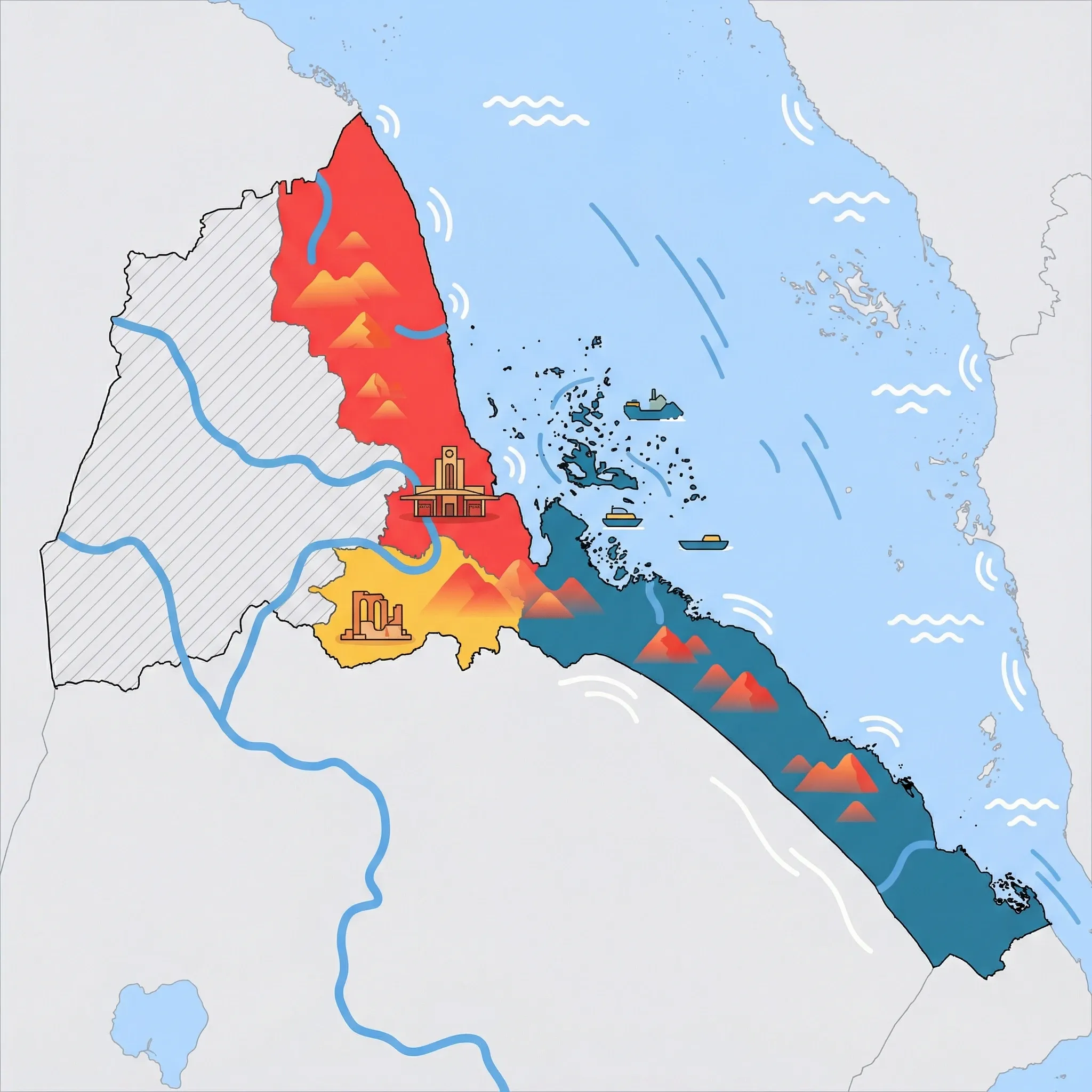
Asmara
Africa's Art Deco jewel in the clouds ☕🏛️
Massawa & Coast
Ancient port cities and untouched Red Sea islands 🐢⚓
Southern Highlands
Canyons, ancient pillars, and the roots of civilization 🏛️⛰️
Click on a region marker to explore details. Use the dropdown to color regions by activity suitability.

Getting There & Around
Getting There
- By Air – Asmara International Airport (ASM) is the only entry point. Major connections include Ethiopian Airlines (via Addis Ababa), FlyDubai (via Dubai), Turkish Airlines (via Istanbul), and EgyptAir (via Cairo).
- Border Controls – Land borders with Ethiopia, Sudan, and Djibouti are closed to tourists. Entry is exclusively by air.
- Entry Requirements – Visas are required for nearly all nationals and must be obtained from an Eritrean embassy in advance. You must complete a currency declaration form upon arrival; keep this safe as you may need to show it and your exchange receipts upon exit. Check your government website for the latest visa requirements, or use the IATA Travel Centre entry-requirements checker.
Getting Around
- Car Hire – The only practical way for families to explore regions like the Southern Highlands. You must hire a car with a driver; self-drive is virtually impossible for tourists. Costs are high but include the driver's expertise in navigating checkpoints.
- Travel Permits – Mandatory for any travel more than 25km outside Asmara. Your hotel or tour operator must assist you in applying for these at the Ministry of Tourism. Processing takes at least 24 hours.
- City Transport – In Asmara, red taxis are abundant and cheap. Local buses are extremely overcrowded and not recommended for families with luggage or small children.

Packing List
Power cuts are frequent and street lighting is dim or non-existent in many areas.
ATMs do not exist. Bring more cash than you need; notes must be post-2009 and pristine.
Internet is virtually non-existent (no mobile data), so Google Maps will not work.
To keep devices charged during long blackouts or travel days.
With no Wi-Fi or streaming, bring downloaded movies, books, and games for kids.
Diapers, wipes, and feminine hygiene products are expensive and hard to find.

Activities & Best Times

Adventure & Nature
Very GoodHiking, wildlife, outdoor exploration, ecotourism
The Qohaito Plateau and Mount Soira offer dramatic escarpment views and unique high-altitude rift landscapes that are highly authentic and uncommercialized. Peak visitation follows the rains from September when the landscape is lush and visibility for the 'Grand Canyon' vistas is at its best.
While the Green Belt and escarpments are notable, 'very_good' suggests internationally outstanding nature tourism. With only urban attractions currently in the database and limited wilderness infrastructure, 'good' is more appropriate unless major nature reserves/parks are added.
Features the diverse ecosystems of the Dahlak Marine National Park and the lush 'Green Belt' of Semienawi Bahri. These wilderness areas are best explored during the cooler winter months when wildlife visibility is high and trekking conditions are safe.

City & Cultural
Very GoodUrban tourism, museums, historical sites, architecture
Asmara is a UNESCO World Heritage site celebrated for its exceptionally preserved Italian Modernist architecture and sophisticated café culture. Peak season provides dry, sunny weather ideal for architectural walks, while the heavy rainfall in July and August can disrupt outdoor heritage exploration.
Massawa's Coral City offers a unique blend of Ottoman and Italian colonial architecture, alongside the significant archaeological site of Adulis. The intense humidity and heat of the summer months make cultural walking tours unsuitable outside the winter window.
The region features significant Aksumite archaeological sites at Qohaito and Metera, providing a deep sense of ancient history. These open-air sites are best explored during the dry season when dirt access roads are stable and the highland sun is tempered by cool breezes.

Road Trips & Scenic
GoodScenic drives, countryside tours, route-based travel
The descent from Asmara to Massawa is one of the world's most dramatic scenic drives, descending over 2,000 meters through diverse climate zones. Clear winter skies ensure spectacular views of the escarpments, whereas July and August bring heavy fog and hazardous driving conditions.
The Asmara-Massawa road is attributed to both Asmara and Massawa regions. Road trip classifications should be assigned to one primary region. Since Asmara is the origin point, Massawa should have 'marginal' rating (destination of the route, not the route itself).
The scenic highway from Asmara to Senafe is a masterpiece of engineering offering spectacular mountain views, though tourism infrastructure remains basic. Driving is safest and most visually rewarding in the dry months to avoid potential landslides and heavy mountain mists during the July-August rains.

Sports & Active
GoodSport tourism, fitness activities, active recreation
Eritrea's national passion for cycling provides world-class high-altitude training routes and challenging mountain trails for experienced cyclists. The temperate dry season offers perfect conditions for long-distance riding, avoiding the slippery roads and intense downpours of the summer months.
The region is an exceptional destination for high-altitude cycling and trekking, with the Adi Keyh to Senafe route being particularly notable for experienced riders. The winter months provide the most stable, cool temperatures necessary for strenuous physical activity at elevations exceeding 2,400 meters.
The road cycling route between Asmara and Massawa is internationally recognized among enthusiasts for its extreme elevation change. Due to the high physical exertion required, this route is only recommended for international visitors during the peak cool season.

Beach & Sea
GoodBeach resorts, marine activities: diving, snorkelling, kite surfing, wind surfing, sailing

Educational & Exploratory
MarginalLearning experiences, scientific sites, historical education

Relaxation & Wellness
MarginalSpa retreats, wellness centers, peaceful getaways

Public Holidays & Calendar Next 12 months
Public holidays, festivals, cultural celebrations, and seasonal natural phenomena coming up in Eritrea over the next 12 months.
Loading holidays and events...
Climate & Weather
Asmara
Show Details
| Month | Temp °C | Rain | Humidity |
|---|
Massawa & Coast
Show Details
| Month | Temp °C | Rain | Humidity |
|---|
Southern Highlands
Show Details
| Month | Temp °C | Rain | Humidity |
|---|

Travel Advisory
A majority of international agencies advise avoiding non-essential travel to Eritrea due to unstable regional security, the risk of arbitrary detention, mandatory internal travel permits, and significant landmine hazards in border regions.
Safety Topics
Traveller Advice (3 groups)

Same-sex sexual activity is illegal and generally not accepted in society; travellers should exercise extreme discretion.

Female travellers are encouraged to dress conservatively and remain aware of local cultural sensitivities, especially when visiting rural or religious sites.

Travellers should always carry copies of their passport and visa, as original documents should be kept secure. Dual nationals should be aware that they are treated as local citizens by authorities and may be subject to national service obligations.
Agency Summaries
Travellers are advised to avoid non-essential travel to the country due to ongoing regional tensions and the risk of conflict with neighbouring nations. Extreme caution is urged near all border regions where a total travel ban is in effect.
The government warns against all travel to areas within 25km of any land border due to high tensions with Ethiopia. Consular support is severely restricted throughout the country, and travel permits are mandatory for movement outside Asmara.
Increased vigilance is necessary due to the threat of wrongful detention, the presence of unmarked minefields, and the extremely limited ability of the government to provide emergency assistance to citizens outside the capital.
The security environment is unpredictable and can deteriorate rapidly. Travellers should avoid non-essential trips and be aware of high risks involving landmines and armed banditry in rural and coastal areas.
The general recommendation is to reconsider the necessity of travel because of the risk of violent crime and potential armed conflict. A 'Do Not Travel' warning is in place for all border zones.
Serious and life-threatening risks, including extensive landmines and limited consular assistance, warrant avoiding non-essential visits. Travel within 25km of borders is strictly advised against.
Information is provided for general guidance only and does not constitute travel, safety, medical, or legal advice. Conditions may change. Users are responsible for independently verifying information before travel.