

⚠️ SAFETY WARNING: Due to ongoing civil conflict, the risk of kidnapping, and potential for civil unrest, government agencies (including CA, USA, UK, AU, IE, NZ) advise travelers to reconsider travel to Ethiopia. Specific regions, particularly Amhara, Tigray, and border areas, are subject to "Do Not Travel" warnings due to active military operations and armed clashes. The security situation can change rapidly. Families are strongly urged to consult their own government's official travel advisory before considering a trip, as circumstances and risk assessments vary.
Overview
Ethiopia stands apart from the rest of Africa-and indeed the world-with its own unique alphabet, calendar, and timekeeping system. For adventurous families, it offers a journey into a civilization that traces its roots back to the dawn of humanity. The landscape is dominated by the massive Ethiopian Highlands, often called the "Roof of Africa," which provide a cool, spring-like climate that defies the country's equatorial location. In the bustling capital, Addis Ababa, children can stand face-to-face with humanity's ancestor, "Lucy," and experience the warmth of a traditional coffee ceremony.
Culturally, the country is a mosaic of ancient Christianity, Islam, and indigenous traditions. The vibe is one of profound pride and hospitality, though the infrastructure can be challenging for those used to Western comforts. Travel here is an expedition rather than a vacation; it requires patience and resilience but rewards families with sights found nowhere else on Earth, from the castles of Gondar to the surreal landscapes of the Rift Valley. While safety concerns currently limit access to some northern regions, the country's enduring spirit remains a powerful draw for those who can visit safely.
Key Attractions
The crown jewel of the country is undoubtedly the Rock-Hewn Churches of Lalibela. Often described as the "Eighth Wonder of the World," these eleven medieval monolithic churches were carved down into the volcanic rock rather than built up. Walking through the dark tunnels and trenches connecting them is an Indiana Jones-style adventure that captivates children and adults alike. Nearby in the region, Fasil Ghebbi (the Royal Enclosure) in Gondar offers a fairytale experience with its 17th-century stone castles and banquet halls that look more like Camelot than East Africa.
For nature-loving families, the Simien Mountains National Park offers some of the most spectacular scenery on the continent. Known for its jagged peaks and deep valleys, it is home to the gelada monkey-the "bleeding heart baboon"-which is unique to these highlands and often grazes in large, peaceful troops that are fascinating to watch. In the capital, the National Museum of Ethiopia provides essential context for the trip, housing the famous fossilized hominid "Lucy" (Dinkinesh), which helps children understand the deep history of human evolution.
Further south, the Omo Valley & South offers a completely different experience, focusing on the diverse tribal cultures of the region. While this area requires sensitive and responsible tourism, it provides a window into traditional ways of life that have persisted for centuries. Families can also visit Lake Chamo near Arba Minch to see massive Nile crocodiles and hippos on a boat safari, a thrilling wildlife encounter that rivals any in Africa.
Practical Advice
Best time to visit: The dry season from October to May is ideal for trekking and sightseeing. The rainy season (June to September) can make rural roads impassable.
Health & Altitude: Addis Ababa sits at 2,355m (7,726ft), so take it easy on arrival to acclimatize. Malaria prophylaxis is recommended for lowlands (like the Omo Valley) but is generally not needed for the high-altitude historic circuit-consult a travel doctor.
Visas: Most nationalities require a visa, which is best obtained online (e-visa) before departure to avoid queues.
Food & Drink
Typical meal times: Lunch is usually 12:30 pm to 2:00 pm, and dinner is served from 7:00 pm to 9:00 pm.
Typical meal costs: 400–1,200 ETB (approx. $3.50–10.00 USD / €3.20–9.50 EUR) for a local meal; 2,000–4,500 ETB (approx. $17–38 USD / €16–35 EUR) for a mid-range restaurant dinner.
Dietary requirements: Ethiopia is a paradise for vegetarians and vegans due to the Orthodox fasting traditions. On "fasting days" (Wednesdays and Fridays), almost every restaurant serves bayenetu, a delicious vegan platter of lentils, split peas, and greens.
Family-friendly dining: Ethiopian dining is communal and fun for kids. You eat with your right hand using injera (spongy flatbread) to scoop up stews from a shared platter. It’s a messy, tactile experience children usually love. Highchairs are rare outside top hotels.
Signature dishes:
- Doro Wat – A rich, spicy chicken stew slowly cooked with berbere spice and topped with hard-boiled eggs; considered the national dish.
- Injera – The sour, fermented flatbread made from teff flour that serves as both plate and utensil for almost every meal.
- Shiro Tegamino – A smooth, spiced chickpea or broad bean flour stew, often served bubbling hot in a clay pot.
- Tibs – Sautéed meat (beef or lamb) chunks seasoned with garlic and rosemary, a non-spicy favorite that is safe for picky eaters.
- Buna (Coffee) – Not just a drink but a ceremony. Popcorn is traditionally served alongside fresh coffee, a treat kids enjoy even if they don't drink the coffee.
Safety
Beyond the conflict warnings, petty theft (pickpocketing) is common in Addis Ababa, particularly around Meskel Square and the Mercato. Keep valuables hidden and avoid walking at night. Road safety is a major risk; vehicles are often poorly maintained and livestock frequently blocks highways. Avoid all overland travel after dark. Be aware that photography of government buildings, police, or military installations is strictly prohibited and can lead to detention.

Daily costs are generally low, but organized tours and reliable private transport increase the budget significantly. A family of four can expect to spend around 12,000–20,000 ETB (approx. $100–170 USD / €95–160 EUR) per day for mid-range hotels, meals, and driver hire. Entry fees for historic sites are higher for foreigners but still reasonable.
Age Suitability





Did you know? Ethiopia welcomes approximately 536,000 international visitors per year. Most visitors come from Africa.

Explore Regions
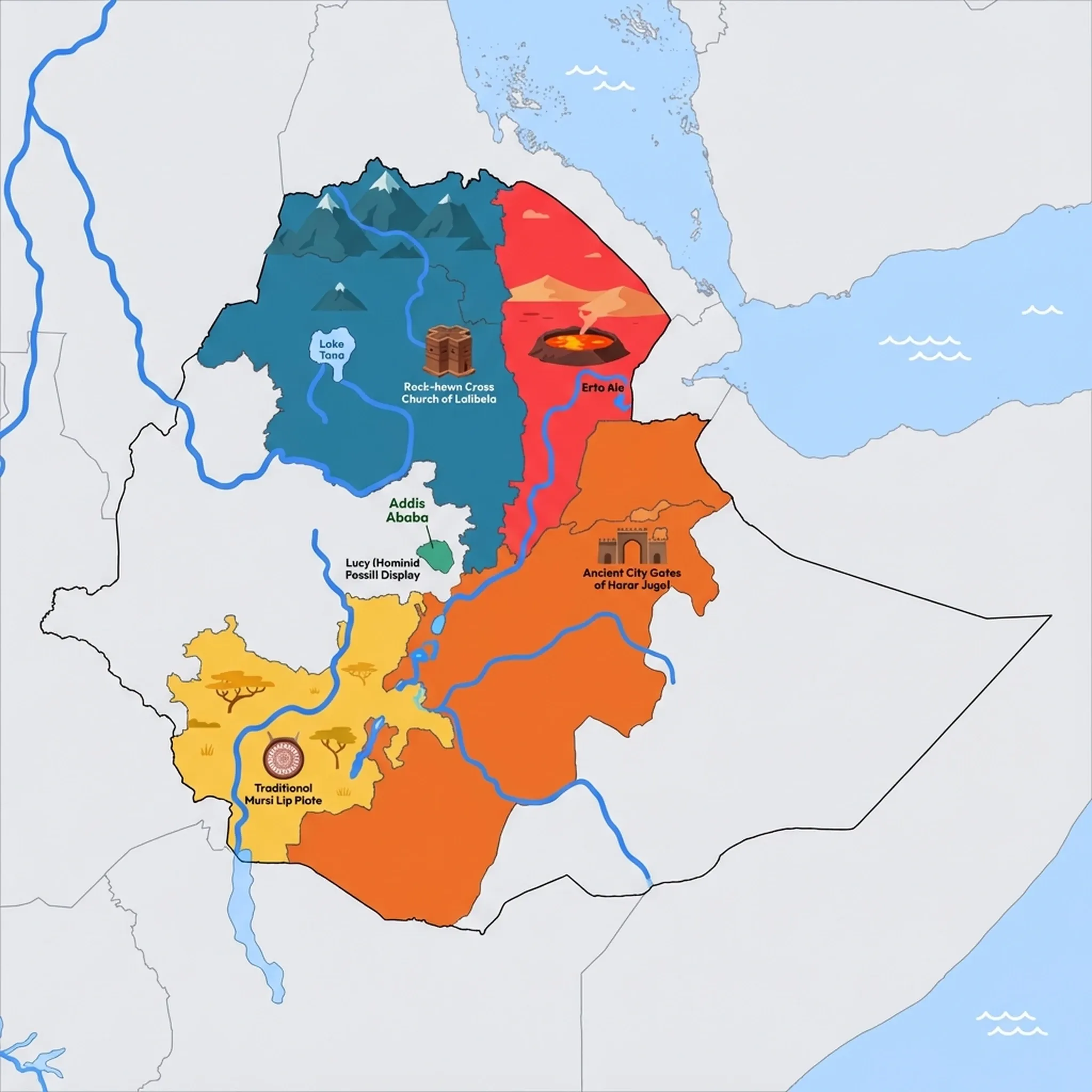
5 Regions
Addis Ababa
The beating heart of the highlands where humanity began ☕️
Danakil Depression & Afar
An alien world of fire, salt, and neon colors 🌋
Eastern Ethiopia (Harar)
Where wild hyenas roam the colorful walled city 🕌
Northern Historic Circuit (Lalibela, Gondar, Axum, Simien Mountains)
Castles in the clouds and ancient legends 🏰
Omo Valley & South
Ancient traditions in the Great Rift Valley 🐊
Click on a region marker to explore details. Use the dropdown to color regions by activity suitability.

Getting There & Around
Getting There
- By Air – Bole International Airport (ADD) in Addis Ababa is one of Africa's major hubs, with Ethiopian Airlines connecting directly to Europe, the USA, and Asia.
- Entry Requirements – Visitors must obtain a visa. An e-visa is available for most nationalities and is the most reliable method. Check your government website for the latest visa requirements, or use the IATA Travel Centre entry-requirements checker.
- By Land – Border crossings with Sudan, Eritrea, and Somalia are generally closed to tourists or extremely dangerous due to conflict. Arriving by air is the only recommended route for families.
Getting Around
- Domestic Flights – The safest and most efficient way to travel between the Northern Historic Circuit sites. Ethiopian Airlines offers an extensive network and discounts if you arrived on their international flight.
- Private Driver – Essential for exploring regions like the Omo Valley & South. Self-driving is not recommended for families due to hazardous road conditions and navigation difficulties.
- Taxis/Ride-Hailing – In Addis Ababa, use the "Ride" or "Feres" apps (local versions of Uber) for safe, tracked journeys. Avoid unmetered blue taxis unless you are confident negotiating prices in Amharic.

Packing List
Power cuts are frequent even in hotels; essential for navigating rooms or streets after dark.
You must remove shoes at all churches; stone floors in Lalibela and other sites are cold and uneven.
Required for modesty in churches; white cotton (Netela) is preferred but any modest covering works.
Budget accommodation carpets and mattresses can sometimes host fleas; a barrier helps peace of mind.
ATMs can be unreliable or empty; clean, post-2013 USD bills are essential for emergencies and some fees.
Altitude sickness and stomach bugs are common; these help recovery in remote areas with limited pharmacy access.

Activities & Best Times

Adventure & Nature
ExcellentHiking, wildlife, outdoor exploration, ecotourism
Features the world-renowned Simien Mountains and Lake Tana, offering unique endemic wildlife like Gelada baboons and spectacular escarpments. The dry months from October to March provide the clear vistas and stable conditions necessary for high-altitude trekking and wildlife spotting.
Features iconic wilderness areas like Nechisar and Mago National Parks, offering unique wildlife encounters and dramatic Rift Valley landscapes. Peak visitation occurs in the drier windows of June-August and December-February when roads are navigable and wildlife is easier to spot.
Entoto Natural Park and the Menagesha Suba Forest provide high-altitude hiking and unique endemic birdwatching near the city. Peak visitation follows the dry season from October to May, while heavy Kiremt rains in July and August make mountain trails muddy and difficult.

City & Cultural
ExcellentUrban tourism, museums, historical sites, architecture
Home to unparalleled UNESCO World Heritage sites including the rock-hewn churches of Lalibela and the castles of Gondar. Dry season is peak for cultural exploration as it ensures comfortable walking conditions and full access to outdoor religious and architectural monuments.
Home to the UNESCO-listed paleoanthropological sites of the Awash Valley and the unique nomadic culture of the Afar people. The cultural identity of the salt caravans is authentic and world-class, though the brutal climate makes it inaccessible for half the year.
Home to multiple UNESCO World Heritage sites and the globally unique tribal cultures of the Lower Omo Valley, providing an exceptionally authentic experience. Heavy rains in April and May create significant access challenges to remote villages, making the dry seasons the only viable time for high-quality cultural immersion.

Educational & Exploratory
Very GoodLearning experiences, scientific sites, historical education
Multiple UNESCO World Heritage sites (Lalibela, Gondar, Axum), Simien Mountains Visitor Center, and Lake Tana monasteries make this an outstanding educational destination. World-class heritage sites are inherently educational.
Ethiopian National Museum (Lucy fossil, human evolution exhibits), National Museum of Ethiopia, and Ethnological Museum make this a strong educational destination by African standards. 'Marginal' significantly underrates these institutions.
The South Omo Museum and Konso Cultural Centre offer important ethnographic insights, though they function best as supplements to broader regional exploration. Access follows general regional patterns, with peak months offering the most reliable entry during dry conditions.

Relaxation & Wellness
GoodSpa retreats, wellness centers, peaceful getaways
Features extraordinary natural hot springs like Alalobad and hypersaline baths at Lake Afdera, though amenities are basic and lack high-end spa infrastructure. Relaxation is only viable during the peak Ethiopian winter when ambient air temperatures are tolerable.
The historic Filwoha Hot Springs offer a traditional thermal experience within the city, though it lacks the infrastructure of a modern global spa resort. The baths remain functional year-round, serving as a restorative stop regardless of the exterior weather.
Erer Gota offers historic thermal springs, though international-standard wellness infrastructure remains limited. The cooler dry months provide the most comfortable environment for visiting natural hot spring sites.

Road Trips & Scenic
GoodScenic drives, countryside tours, route-based travel
The Southern Ethiopia Cultural Route and Great Rift Valley Scenic Drive provide spectacular vistas and cultural stops, but require robust 4x4 vehicles. Road travel is highly seasonal; the 'black cotton' soil becomes dangerously impassable during the peak rains of April and May.
The city is a gateway to the spectacular Blue Nile Gorge and Rift Valley scenic drives, offering dramatic highland vistas. Visibility and road conditions are excellent in the dry season, but mountain fog and heavy rain during July and August present significant driving hazards.
The Northern Historic Circuit is one of Africa's most iconic scenic drives, highlighted by the dramatic Limalimo Pass. Best experienced in the dry season when roads are safest and visibility of the highland scenery is optimal for sophisticated travelers.

Sports & Active
GoodSport tourism, fitness activities, active recreation
Centred on the physically demanding Erta Ale volcano trek and geological walks through the Dallol hydrothermal field. These routes require high fitness levels and are only safe during the cooler months to prevent heat-related medical emergencies.
The Dorze Highlands and Konso landscapes offer significant trekking routes that combine physical challenge with living heritage. Optimal conditions for hiking are during the dry months when trails are stable and the heat is moderated by higher altitudes.
Entoto Natural Park provides dedicated high-altitude cycling and hiking routes that are popular with professional athletes and active families. Peak conditions occur in the dry, temperate months, while the extreme precipitation of July and August hinders outdoor training.

Festivals & Seasonal
GoodEvents, celebrations, seasonal attractions
UNESCO-recognized Meskel and Timkat festivals with hundreds of thousands of participants warrant 'good' rating. These are nationally significant events with international tourist draw.
Hosts the world-famous Timkat (Epiphany) and Genna (Christmas) festivals in January, providing deep authentic immersion into Ethiopian Orthodox traditions. While these are bucket-list events, the primary international draw is concentrated heavily in this single month.

Theme Park & Entertainment
MarginalAmusement parks, family entertainment venues

Public Holidays & Calendar Next 12 months
Public holidays, festivals, cultural celebrations, and seasonal natural phenomena coming up in Ethiopia over the next 12 months.
Loading holidays and events...

Climate & Weather
Addis Ababa
Show Details
| Month | Temp °C | Rain | Humidity |
|---|
Danakil Depression & Afar
Show Details
| Month | Temp °C | Rain | Humidity |
|---|
Eastern Ethiopia (Harar)
Show Details
| Month | Temp °C | Rain | Humidity |
|---|
Northern Historic Circuit (Lalibela, Gondar, Axum, Simien Mountains)
Show Details
| Month | Temp °C | Rain | Humidity |
|---|
Omo Valley & South
Show Details
| Month | Temp °C | Rain | Humidity |
|---|

Travel Advisory
International consensus is split between caution and recommending the avoidance of non-essential trips. While urban centers like Addis Ababa offer more stability, the presence of active conflict in multiple regions and a high risk of civil unrest justify a significant warning.
Safety Topics
Traveller Advice (4 groups)

Media professionals require specific government accreditation to operate. There is a documented risk of detention for those reporting on sensitive security or political matters.

Same-sex sexual activity is criminalized and can result in significant prison terms. Public displays of affection are culturally inappropriate and may lead to harassment or legal issues.

Women traveling alone may face persistent harassment. It is safer to travel in groups and follow local standards of modest dress to minimize unwanted attention.

Aid workers face elevated risks of kidnapping and being caught in crossfire in border regions and areas with active insurgencies.
Agency Summaries
The Australian government warns that the safety landscape is volatile and could decline rapidly. Citizens are encouraged to evaluate if their travel is essential, particularly given the risks of armed conflict and civil disturbances in various provinces.
Ireland recommends a heightened sense of vigilance for anyone visiting. There are significant warnings against travel to most areas outside the capital due to active fighting between local militias and national forces.
British officials highlight severe security risks in several regions, including Tigray and Amhara, where travel is strongly discouraged. Although some tourist hubs are open, the overall environment is impacted by the threat of terrorism and ongoing political tension.
New Zealanders are advised to stay highly alert and avoid any large gatherings or protests, as these can quickly become violent. Travel outside urban centers should be planned with extreme care.
American citizens are urged to rethink visits to the country because of potential for civil unrest, armed clashes, and kidnapping in peripheral zones. Consular aid is severely limited outside of the capital, and communications can be disrupted without notice.
Canadian authorities advise against all trips that are not absolutely necessary due to widespread violence, internal conflict, and criminal threats. While the capital city is somewhat more stable, travelers there must still maintain an extremely high level of alertness.
Information is provided for general guidance only and does not constitute travel, safety, medical, or legal advice. Conditions may change. Users are responsible for independently verifying information before travel.