

Overview
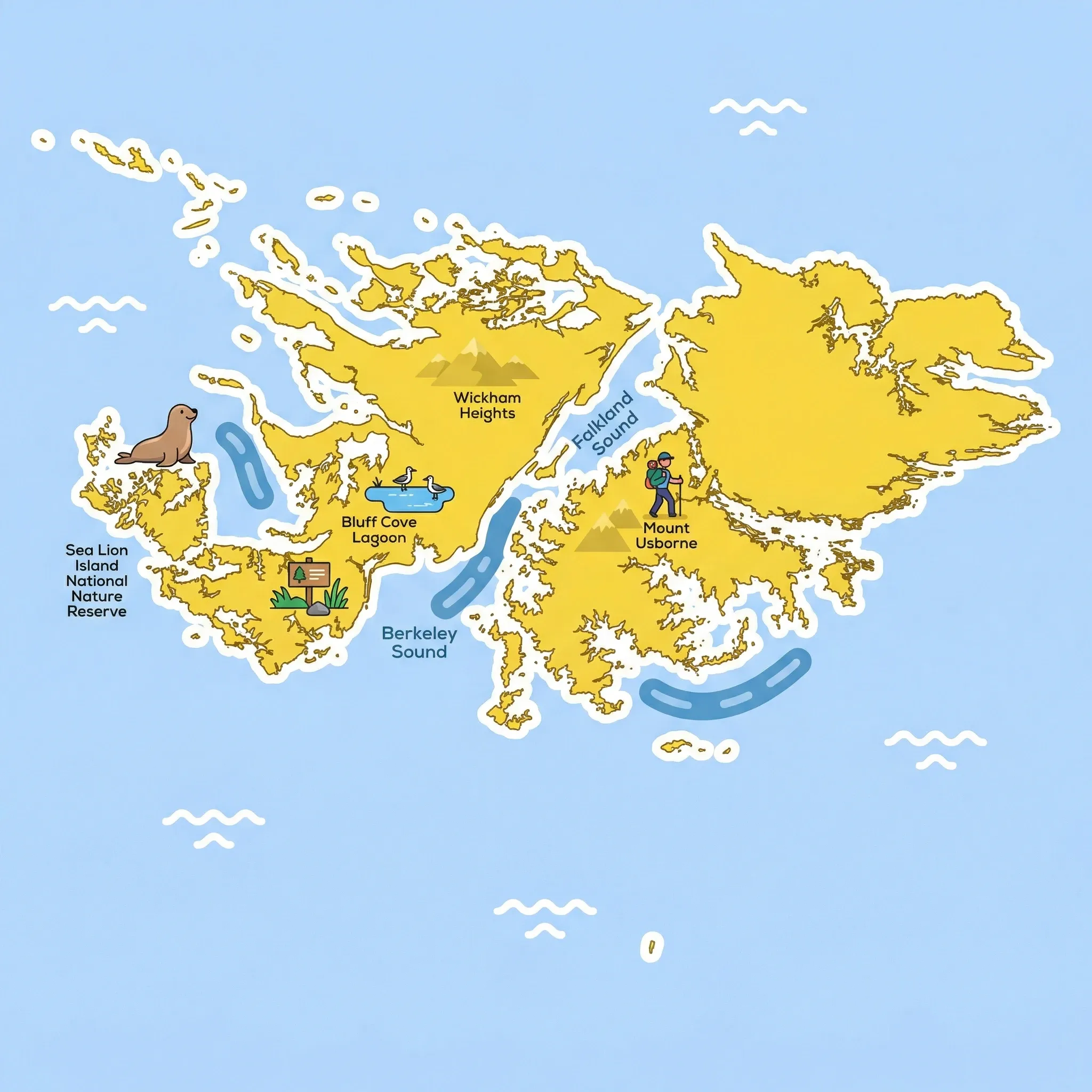
The Falkland Islands are a remote archipelago in the South Atlantic, comprised of two main islands-East and West Falkland-and over 700 smaller ones. For families, this is not a typical beach holiday; it is an immersive wildlife expedition in a place that feels like a cross between the Scottish Highlands and a National Geographic documentary. The climate is cool and windy, but the landscape is stunningly raw, featuring craggy coastlines, white sand beaches, and rolling tussock grass plains.
Culturally, the islands are distinctly British, with red phone boxes, pubs serving fish and chips, and a community spirit that is incredibly welcoming to visitors. The local way of life, known as "Camp" (the countryside outside the capital, Stanley), revolves around sheep farming and conservation. Families will find a safe environment with virtually no crime, where children can run free and learn about nature firsthand. The wildlife here is unafraid of humans, offering unparalleled opportunities to see five species of penguins, seals, and albatrosses in their natural habitat.
Key Attractions
A visit to Volunteer Point is the highlight of any family trip. Accessible by a thrilling 4x4 off-road adventure, this white sand beach is home to the largest accessible colony of King Penguins in the world. Children will be mesmerised by the sight of these regal birds and their fluffy brown chicks, often just a few meters away. It is a photographer's dream and a memory that will last a lifetime.
For a complete immersion in nature, a stay on Sea Lion Island is essential. As the most southerly inhabited island, it teems with wildlife, including thundering elephant seals, sea lions, and gentoo penguins. The lodge here is comfortable and family-friendly, allowing you to step out the door and be surrounded by animals. It is one of the few places where you can safely watch killer whales (orcas) patrolling the coast from the shore.
Back in the capital, the Falkland Islands Museum & National Trust provides crucial context. It offers fascinating exhibits on the 1982 conflict, maritime history, and the islands' unique social heritage. The museum is interactive and engaging for older children, helping them understand the human story behind this remote outpost. Nearby, the historic dockyards and whalebone arch are perfect for a short family walk.
Practical Advice
The best time to visit is between October and March (summer), with peak wildlife viewing in December and January. English is the official language. A valid passport is required, and while many Western nationalities do not need a visa, regulations can change, so checking is essential. Medical facilities in Stanley are good (UK standard), but travel insurance including medical evacuation is mandatory. Internet can be slow and expensive, making this a great place for a digital detox.
Food & Drink
Typical meal times: Lunch is usually served from 12:00 pm to 1:30 pm, and dinner from 6:30 pm to 8:30 pm. "Smoko" is a traditional mid-morning tea break often involving homemade cakes.
Typical meal costs: £15–30 (approx. $19–38 USD / €18–35 EUR) for a main course in a pub or restaurant. Snacks and light lunches cost around £8–15 (approx. $10–19 USD / €9–18 EUR).
Dietary requirements: Vegetarian options are available in Stanley and most lodges, though the local diet is meat-heavy. Gluten-free supplies can be limited in remote areas, so it is wise to bring specific snacks if you have severe intolerances.
Family-friendly dining: Most establishments are informal and welcoming to children. Highchairs are generally available in Stanley, and portions are generous. The traditional "smoko" (cakes and tea) is a hit with kids.
Signature dishes:
- Falklands Lamb – Renowned for its delicate flavour due to the sheep grazing on coastal tussock grass and heath.
- Falklands Calamari – Freshly caught squid (Loligo), often served lightly battered or flash-fried; a local staple.
- Toothfish – Also known as Chilean Sea Bass, this deep-sea fish is rich, oily, and sustainably harvested in local waters.
- Smoko cakes – Homemade scones, teaberry buns, or biscuits served during the traditional mid-morning break.
- Diddle-dee jam – A tart, red berry preserve unique to the islands, usually served with toast or meats.

The Falklands is a high-cost destination due to its remoteness. A family can expect to pay £150–250 (approx. $190–315 USD / €175–290 EUR) per night for lodge accommodation with meals. Internal flights and 4x4 tours are also significant expenses. Supermarket food is imported and pricier than in the UK.
Age Suitability





Why this score?
The islands offer a significant level of adventure, characterized by rugged coastal terrain, unpredictable South Atlantic weather, and a lack of paved roads outside the main settlements. Traveling to 'The Camp' or outer islands like Sea Lion or Saunders often requires specialized 4x4 vehicles or small FIGAS Islander aircraft. The isolation and reliance on self-sufficiency in remote farm settlements provide a truly off-the-beaten-path experience for families.
Why this score?
Medical services are centered at the King Edward VII Memorial Hospital in Stanley, which provides high-quality primary and secondary care following British standards. However, facilities for complex surgeries or specialist treatments are limited, necessitating expensive emergency medevacs to Chile or the UK. In the remote outer islands, medical access is extremely limited and depends entirely on weather-dependent air transport.
Why this score?
While a bucket-list destination for wildlife photographers and birders, the islands receive relatively few land-based visitors due to their remote location and high travel costs. Most tourists arrive via expedition cruise ships for brief day trips to sites like Volunteer Point or West Point Island rather than staying for extended periods. The tourism infrastructure is well-developed but remains niche and small-scale compared to mainstream global destinations.
The Falkland Islands is an expensive destination due to its remoteness and reliance on imports. The currency is the Falkland Islands Pound (FKP), which is pegged 1:1 with the British Pound (GBP); UK notes and coins circulate freely. Accommodation in tourist lodges typically costs £130–180 (approx. $165–230 USD / €150–210 EUR) per person per night, often including full board. Supermarket prices are roughly 20–50% higher than in the UK.

Getting There & Around
Getting There
- By Air (via Chile) – LATAM operates a weekly Saturday flight from Santiago (SCL) via Punta Arenas (PUQ) to Mount Pleasant (MPN). This is the most common route for international tourists.
- By Air (via UK) – The RAF Airbridge flies twice weekly from Brize Norton, Oxfordshire, via Ascension Island. Seats for civilians are limited and expensive, but it is a direct link for UK residents.
- By Sea – Many families arrive via cruise ships which dock in Stanley for the day. While convenient, this limits you to day trips and misses the experience of staying in "Camp" (the countryside).
- Entry Requirements – Comprehensive travel insurance covers medical evacuation is mandatory for entry. Check your government website for the latest visa requirements, or use the IATA Travel Centre entry-requirements checker.
Getting Around
- FIGAS (Air Taxi) – The Falkland Islands Government Air Service operates red Islander planes that act as taxis between islands. It is a thrilling experience for kids, offering low-altitude views of whales and coastlines. Schedules are announced the day before. Note: There is a strict 20kg luggage limit per person.
- 4x4 Taxis/Hire – Essential for reaching places like Volunteer Point. Most roads outside Stanley are gravel tracks. Hire cars are expensive and require confident off-road driving skills; hiring a driver with a vehicle is often safer and more relaxing for families.
- Walking – Stanley is small and easily explored on foot. It is the only place with paved roads suitable for standard pushchairs.
Official Links

Packing List
Customary to remove outdoor boots when entering lodges to keep them mud-free.
Internal flights are on small planes and off-road driving is very bumpy.
The ozone layer is thin here; UV levels are surprisingly high despite the cold.
Essential for sitting on damp ground to watch penguins without getting wet.
Cards work in Stanley, but remote settlements often rely on cash (FKP or GBP).

Activities & Best Times

Adventure & Nature
Very GoodHiking, wildlife, outdoor exploration, ecotourism
A premier destination for intimate wildlife encounters with King Penguins and elephant seals across rugged, remote island ecosystems. Peak months offer the best weather for trekking Mount Usborne and visiting remote farm settlements like Port Howard.

City & Cultural
GoodUrban tourism, museums, historical sites, architecture
Stanley is a small town of ~2,100 people. While it offers unique British-overseas atmosphere and 1982 War museums, it lacks the scale and globally significant cultural institutions required for 'very_good' rating under international calibration. Rating should be 'good' - cultural interest exists but not internationally outstanding.

Sports & Active
GoodSport tourism, fitness activities, active recreation
Features internationally recognized hiking routes across challenging terrain such as Mount Tumbledown and Mount Maria. The season is strictly limited to the austral summer to avoid dangerous gales and ensure safe visibility for mountain activities.

Beach & Sea
MarginalBeach resorts, marine activities: diving, snorkelling, kite surfing, wind surfing, sailing
While the Falklands has pristine beaches, the sub-Antarctic water temperatures (4-9°C year-round) make swimming and typical beach activities impractical. Beaches are scenic for walking but not suitable for beach holidays by international standards. This should be rated 'marginal' - beaches exist but conditions are suboptimal for the activity.

Road Trips & Scenic
MarginalScenic drives, countryside tours, route-based travel
Rugged scenic drives like the Darwin Road offer stark South Atlantic vistas but require reliable vehicles and favorable conditions. Driving is only recommended in the summer months when daylight is long and the unpaved tracks are most passable.




Public Holidays & Calendar Next 12 months
Public holidays, festivals, cultural celebrations, and seasonal natural phenomena coming up in Falkland Islands over the next 12 months.
Loading holidays and events...

Travel Advisory
The Falkland Islands are considered a very safe destination where travelers should follow the same security measures they would at home.
Safety Topics
Traveller Advice (5 groups)

Guidance is available for those with mobility issues, though infrastructure outside Stanley may be limited or rugged.

Hikers and trekkers should avoid solo expeditions in remote areas. It is recommended to hire local guides, carry appropriate gear for rapid weather changes, and ensure insurance covers helicopter extraction and search-and-rescue operations.

Standard legal protections and social norms typical of British territories apply; travelers can refer to general guides for LGBTQ+ safety abroad.

Visitors should respect the local 'countryside code' when observing wildlife, keeping at least 6 meters from animals and avoiding blocking their path to the sea. Ensure all travel documents and evidence of funds are ready for inspection upon arrival.

General safety guidelines for female travelers apply, though the territory is noted for having extremely low crime rates and a safe environment for solo travel.
Agency Summaries
There is no separate advisory for the Falkland Islands. New Zealanders should follow general safety guidelines for British Overseas Territories.
Ireland does not maintain a dedicated advisory page for this territory; visitors should follow standard international safety practices.
As a British Overseas Territory, the Falkland Islands are stable. Advice focuses on environmental hazards, unexploded ordnance, and specific entry requirements like medical insurance.
The Falkland Islands are generally safe. Travelers should maintain standard safety awareness and be aware of remaining unexploded ordnance from previous conflicts.
Standard travel precautions are recommended for visitors to the territory, which is assessed as having a low risk level for safety and security.
No specific stand-alone advisory is published for the Falkland Islands, but the territory is generally considered low-risk and falls under standard safety baseline guidance.
Information is provided for general guidance only and does not constitute travel, safety, medical, or legal advice. Conditions may change. Users are responsible for independently verifying information before travel.