

Overview
Fiji is more than just a beach destination; it is a welcoming archipelago where family comes first. The moment you arrive, the warmth of the local "Bula!" greeting sets the tone for a holiday defined by hospitality and relaxation. Geographically, the country is centred around the main island of Viti Levu & Western Islands, home to the international airport in Nadi and the bustling capital, Suva. For families, this region offers a convenient mix of high-end resorts, cultural sites, and accessible nature. Further afield, the Outer Islands offer secluded paradise experiences, while Vanua Levu & Taveuni provide lush, rugged landscapes for adventurous older children.
The cultural vibration of Fiji is a unique blend of indigenous Fijian, Indo-Fijian, and colonial influences. Children are treated like royalty here; it is common for hotel staff to remember your child's name and engage them in games. The climate is tropical and warm year-round, though the wet season (November to April) brings higher humidity. whether you are snorkelling in calm lagoons, visiting a traditional village, or exploring the rainforest, Fiji offers a safe and gentle introduction to the South Pacific for travellers of all ages.
Key Attractions
Start your cultural journey in Nadi at the Sri Siva Subramaniya Temple. As the largest Hindu temple in the Southern Hemisphere, its towering Dravidian architecture and explosion of colours will captivate children. It is a working religious site, so it offers a respectful way to introduce kids to new customs-remember to cover up before entering. On the other side of the island in Suva, the Fiji Museum is a treasure trove of history. Kids are often fascinated by the massive Drua (double-hulled canoe) and the slightly spooky exhibits of cannibal forks, which tell the story of the island's fierce past in a curated environment.
For active families, a trip to Colo-i-Suva Forest Park is unmissable. Located just outside Suva, this lush rainforest offers walking trails that are manageable for energetic children and lead to natural swimming holes. Swinging on a rope into the cool, fresh water is a highlight that rivals any resort pool. For a deep dive into colonial history, a visit to Levuka Historical Port Town on Ovalau Island is a step back in time. As Fiji's first capital and a UNESCO World Heritage site, its Wild West-style wooden storefronts and the 199 steps up Mission Hill offer a unique educational excursion for older kids.
Practical Advice
The best time to visit is during the dry season from May to October, when temperatures are milder and rainfall is lower. "Fiji Time" is a real concept-service can be slower than you are used to, so patience is key. Mosquito-borne illnesses like dengue fever exist, so rigorous use of repellent is essential day and night. Tap water is generally safe in major hotels, but bottled water is recommended elsewhere. Visa-free entry is available for many nations, but always check requirements.
Food & Drink
Typical meal times: Lunch is typically served from 12:00 pm to 2:00 pm, and dinner from 6:00 pm to 9:00 pm. Resorts often offer all-day dining.
Typical meal costs: Local casual dining costs FJD $15–30 (approx. $6.50–13 USD / €6–12 EUR), while resort meals are significantly higher at FJD $60–120 (approx. $26–53 USD / €24–48 EUR). High-end dining can exceed FJD $150 (approx. $66 USD / €60 EUR).
Dietary requirements: Vegetarian and vegan options are widely available and delicious, largely due to the significant Indo-Fijian population. Gluten-free options are common in resorts but may be harder to find in remote local eateries.
Family-friendly dining: Fijians love children, and highchairs are standard in resorts and most cafes. Kids' menus are ubiquitous, featuring both Western staples and milder local dishes.
Signature dishes:
- Kokoda – A refreshing raw fish salad cured in lemon juice and coconut cream, often served in a coconut shell. It is mild and creamy, making it a great seafood introduction for kids.
- Lovo – A traditional feast cooked in an underground earth oven. The smoky flavour of the chicken, fish, and root vegetables is unique and delicious.
- Rourou – Taro leaves cooked in coconut milk, similar to creamed spinach but richer.
- Cassava Chips – Fried tapioca root, a starchy and addictive alternative to french fries that children usually love.

Resort stays drive costs up, with a family of four spending FJD 800–1,500 (approx. $350–660 USD / €320–600 EUR) per day. However, dining at local cafes and using public transport can drop costs significantly. A local meal costs FJD 15–30 (approx. $6.50–13 USD / €6–12 EUR).
Age Suitability





Did you know? Fiji welcomes approximately 929,000 international visitors per year. Most visitors come from East Asia and the Pacific.

Explore Regions
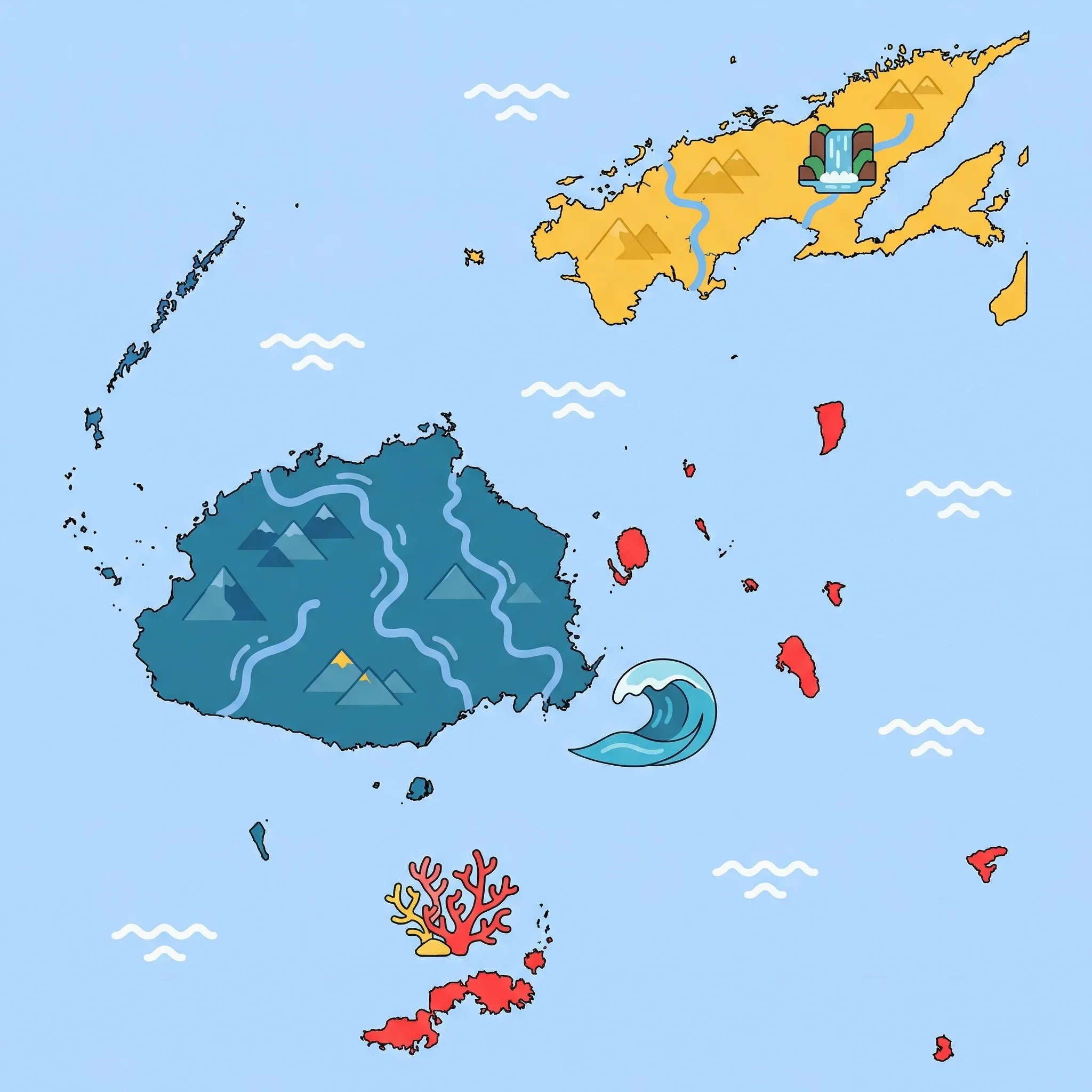
3 Regions
Outer Islands
Untouched reefs and authentic island culture 🏝️🇫🇯
Vanua Levu & Taveuni
Waterfalls, rainforests, and the soft coral capital 🌺🌿
Viti Levu & Western Islands (Nadi, Mamanuca, Yasawa)
The ultimate family holiday mix: culture, coast, and coral 🏖️🐚
Click on a region marker to explore details. Use the dropdown to color regions by activity suitability.

Getting There & Around
Getting There
- By Air – Nadi International Airport (NAN) is the main gateway, receiving direct flights from Australia, New Zealand, the US, and Asia. It serves Viti Levu & Western Islands directly. Nausori Airport (SUV) near Suva handles mostly domestic and some regional traffic.
- By Sea – Cruise ships frequently dock at Lautoka and Suva. Yachts can enter via cleared ports of entry including Levuka and Savusavu.
- Entry Requirements – Many nationalities (including US, UK, EU, AU, NZ) are visa-exempt for stays up to 4 months. You must have a return ticket and proof of funds. Check your government website for the latest visa requirements, or use the IATA Travel Centre entry-requirements checker.
Getting Around
- Buses – The most affordable way to travel Viti Levu. Open-air buses are a fun adventure for kids. The 'Express' buses running the Queens Highway are air-conditioned and reliable.
- Taxis – Plentiful in Nadi and Suva. Look for number plates starting with 'LT' or 'LH' which are metered. Always negotiate the fare for long distances before setting off.
- Ferries – Essential for reaching the Outer Islands. The Yasawa Flyer and Malolo Cat are reliable, comfortable catamarans serving the island resorts.
- Domestic Flights – Fiji Link connects Nadi to Suva, Vanua Levu & Taveuni, and other islands. It is the fastest way to travel but more expensive than ferries.
Official Links

Packing List
Essential for protecting feet from sharp coral and stonefish on beaches and in waterfall pools.
Required for covering knees and shoulders when visiting villages or temples; serves as a versatile towel.
The tropical sun is intense; these protect kids better than sunscreen during long water sessions.
Boat transfers are frequent and often wet; keeps electronics and change of clothes dry.
Strictly necessary to protect Fiji's delicate marine ecosystems; can be expensive or hard to find locally.
Mosquitoes are active day and night, and dengue fever is a risk in tropical areas.

Activities & Best Times

Adventure & Nature
ExcellentHiking, wildlife, outdoor exploration, ecotourism
Known as Fiji's 'Garden Island,' Taveuni offers world-class immersion in Bouma National Heritage Park and Waisali Rainforest, featuring iconic waterfalls and rare birdlife. The dry season is essential for trekking and exploring rainforest reserves as heavy summer rains make trails muddy and difficult to navigate.
Intrepid families will find authentic wilderness immersion through rugged volcanic trekking on Kadavu and exploration of remote marine reserves. Peak months offer the most stable conditions for hiking trails like Nabukelevu, whereas the humid wet season from December to March makes jungle trekking difficult and potentially hazardous.
Extensive natural attractions including the Sigatoka River Safari and Sawa-i-Lau Caves provide authentic immersion in Fiji's volcanic and riverine ecosystems. The cooler dry season is essential for trekking and river adventures to avoid heavy monsoon rains and high humidity.

Beach & Sea
ExcellentBeach resorts, marine activities: diving, snorkelling, kite surfing, wind surfing, sailing
The Mamanuca and Yasawa islands, Blue Lagoon, and Natadola Beach are internationally famous beach destinations that consistently rank among the world's best beaches. The region competes directly with Maldives and Caribbean destinations in terms of water clarity, sand quality, and marine environments. The current 'good' rating significantly undervalues Fiji's global reputation as a premier beach destination.
The region features world-class marine environments like the Great Astrolabe Reef and Fulaga Lagoon, offering exceptional diving and snorkeling in pristine, non-commercialized settings. The peak season runs from May to October when dry weather ensures optimal underwater visibility and calm seas, while the December to March cyclone season brings significant rain and wind.
Home to the world-renowned Rainbow Reef and Waitabu Marine Park, the region offers exceptional diving and snorkeling with high marine biodiversity. Peak conditions occur during the cooler dry season when underwater visibility is at its best, while the wet summer months can see increased swell and lower clarity.

Sports & Active
Very GoodSport tourism, fitness activities, active recreation
Steep hiking trails to Des Voeux Peak and the natural rock waterslides at Waitavala provide rigorous physical activity within stunning natural environments. Activity is centered in the drier months to ensure safe footing on trails and manageable water levels for canyoning and slides.
Purpose-built infrastructure like EcoTrax cycling and major hiking routes such as the Mt Batilamu Track cater to active travelers. These facilities are best utilized during the peak dry months to avoid trail washouts and the physical strain of high-summer tropical heat.

City & Cultural
GoodUrban tourism, museums, historical sites, architecture
While Levuka is a significant UNESCO heritage site, a single historic port town does not justify 'very_good' rating. The scale and density of cultural offerings is insufficient compared to international standards. 'good' appropriately reflects a noteworthy heritage site without overstating the region's cultural tourism depth.
Suva and Nadi offer significant cultural depth through the Fiji Museum and the Garden of the Sleeping Giant, showcasing Pacific heritage and botanical diversity. While cultural sites are accessible year-round, the dry season provides the most comfortable conditions for exploring urban markets and heritage gardens.
Yachting culture and marina infrastructure do not constitute cultural heritage tourism. There are no museums, UNESCO sites, or significant cultural institutions mentioned. This classification appears to confuse lifestyle amenities with cultural tourism offerings.

Road Trips & Scenic
GoodScenic drives, countryside tours, route-based travel
The Queens Road (Coral Coast) and Kings Road (Sun Coast) offer well-regarded scenic drives through diverse coastal and rural landscapes. Traveling during the dry season ensures safer road conditions and clear vistas of the Pacific coastline and the Nausori Highlands.
The Hibiscus Highway and Taveuni's coastal drive offer spectacular Pacific vistas and access to remote rural villages. Driving is most reliable during the dry season to avoid road washouts and ensure clear, scenic views of the coastline and mountain interiors.

Relaxation & Wellness
MarginalSpa retreats, wellness centers, peaceful getaways
The Tifajek Mud Pool & Hot Spring provides a unique, authentic natural wellness experience rooted in local geothermal features. While the region has many hotel spas, this specific facility represents the primary dedicated wellness draw for those seeking restorative natural baths.
The natural hot springs in Savusavu and Vunimoli offer an authentic, albeit rustic, wellness experience for travelers seeking thermal treatments. These are best visited during the cooler months when the thermal waters provide a pleasant contrast to the air temperature, whereas the humid summer makes them less appealing.

Theme Park & Entertainment
MarginalAmusement parks, family entertainment venues

Public Holidays & Calendar Next 12 months
Public holidays, festivals, cultural celebrations, and seasonal natural phenomena coming up in Fiji over the next 12 months.
Loading holidays and events...

Climate & Weather
Outer Islands
Show Details
| Month | Temp °C | Rain | Humidity |
|---|
Vanua Levu & Taveuni
Show Details
| Month | Temp °C | Rain | Humidity |
|---|
Viti Levu & Western Islands (Nadi, Mamanuca, Yasawa)
Show Details
| Month | Temp °C | Rain | Humidity |
|---|

Travel Advisory
All six major agencies agree that Fiji is safe for travel with standard safety awareness. No country-wide elevated warnings are in place, though travelers should remain vigilant regarding petty crime and seasonal weather events.
Safety Topics
Traveller Advice (3 groups)

Female visitors should be cautious when walking alone, particularly in downtown Suva and other urban centers at night. Incidents of harassment and sexual assault have been reported.

Those participating in water sports like scuba diving should verify the current status of the country's limited hyperbaric chambers and ensure their insurance covers medical evacuation.

While same-sex relationships are legal, they are not universally accepted by the local population. It is recommended to avoid public displays of affection, especially in rural or traditional village settings.
Agency Summaries
Visitors should maintain standard safety awareness. While generally safe, urban centers like Suva and Nadi see frequent petty crimes like theft and bag-snatching. Female travelers should be particularly cautious of harassment.
Standard security awareness is required. Visitors should watch out for theft and assault, particularly in poorly lit urban areas after dark. Financial fraud and seasonal cyclones are the primary non-security risks.
Most visits are trouble-free, but travelers should be aware of local safety and health risks. Petty theft occurs in cities. Road conditions are often poor, and maritime safety standards vary.
Irish citizens should follow standard safety measures. Be aware of the tropical climate's impact on travel, including cyclone risks. Consular support is provided via the embassy in Canberra.
Travelers should follow standard safety protocols. Increased vigilance is recommended in specific areas like Colo-I-Suva Forest Park due to trail-side robberies. Avoid resisting robbery attempts and be careful at night.
Fiji is currently under a green advisory level. Travelers are encouraged to be mindful of opportunistic crime in urban areas. Significant health updates include a recently declared HIV outbreak and risks of mosquito-borne viruses.
Information is provided for general guidance only and does not constitute travel, safety, medical, or legal advice. Conditions may change. Users are responsible for independently verifying information before travel.