

Overview
France is often called l'Hexagone due to its six-sided shape, and within these borders lies an incredible variety of experiences for families. To the north, the dramatic coastlines of Normandy and Brittany offer rugged beauty and ancient legends. The center is dominated by the lush Loire Valley, a real-life storybook land of renaissance castles. To the east, the Lyon, Rhône Valley & French Alps region provides Europe's best mountain playgrounds, while the south dazzles with Mediterranean charm.
For families, the French lifestyle-art de vivre-is a major draw. Life moves at a civilized pace here. You can spend mornings exploring world-class museums that actively cater to children with workshops and treasure hunts, and afternoons relaxing in manicured public parks where toy boats float in fountains. While the French value etiquette, they also cherish family time, making it a welcoming destination where children are expected to dine, explore, and appreciate beauty alongside their parents.
Key Attractions
No trip is complete without visiting Paris & Île-de-France. While the Eiffel Tower is the icon, families often find the Arc de Triomphe offers a more engaging climb with equally stunning views. For a break from monuments, the Aquarium de Paris provides a magical underwater escape right in the city center. Just outside the capital, history comes alive at the Château de Fontainebleau, a sprawling palace that served as a residence for French monarchs for centuries.
Venture into the Loire Valley to see the jaw-dropping Château de Chambord, with its double-helix staircase designed by Da Vinci, or the graceful Château de Chenonceau bridging the Cher river. In the southwest, the Château de Castelnaud is a favorite for kids, featuring a museum of medieval warfare with real catapults. Nature lovers should head to the Provence & Côte d'Azur region to see the Arènes d'Arles, a Roman amphitheater still in use, or the wild horses of the Camargue Regional Nature Park.
For dramatic landscapes, the Cliffs of Étretat in Normandy offer breathtaking coastal walks, while the Carnac Stones in Brittany present a prehistoric mystery to rival Stonehenge. In the high mountains, a cable car ride to the Aiguille du Midi offers an unforgettable close-up of Mont Blanc that will leave older children awestruck.
Practical Advice
Best time to visit: Spring (April–June) and Autumn (September–October) offer the best balance of pleasant weather and thinner crowds. July and August are hot and crowded, especially on the coast. Winter is magical in Paris and essential for skiing in the Alps.
Visas: France is part of the Schengen Area. US, Canadian, Australian, and UK citizens generally do not need a visa for short stays (up to 90 days), but always check current ETIAS requirements before travel.
Health: Pharmacies in France are excellent and marked by a flashing green cross. Pharmacists are highly trained and can offer medical advice for minor ailments. Public hospitals are world-class.
Food & Drink
Typical meal times: Lunch is strictly served from 12:00 pm to 2:00 pm. Restaurants often close the kitchen promptly at 2:00 pm. Dinner usually begins at 7:30 pm or 8:00 pm. Finding hot food between 2:30 pm and 7:00 pm can be difficult outside of tourist hubs or "service continu" brasseries.
Typical meal costs: Lunch menus (formule midi) are great value at €18–28 (approx. $20–30 USD / £15–24 GBP). Dinner is pricier, around €30–50 (approx. $32–54 USD / £25–42 GBP) per person. Kid's menus are usually €10–15 (approx. $11–16 USD / £8–13 GBP).
Dietary requirements: Vegetarian options are becoming standard in cities, though harder to find in traditional rural bouchons. Vegan options are growing but not ubiquitous. Allergies are taken seriously; strictly inform the waiter: "Je suis allergique à..."
Family-friendly dining: Most bistros welcome children, often providing a menu enfant (steak haché or fish with fries). Highchairs are common but not guaranteed in tiny venues. Do not expect crayons and activity packs everywhere; French children are generally expected to sit and eat.
Signature dishes:
- Galettes Bretonnes – Savory buckwheat crêpes from Brittany, often filled with ham, cheese, and egg (a "complète").
- Steak Frites – A simple steak served with fries, a staple beloved by children and adults alike.
- Croque-Monsieur – The ultimate grilled ham and cheese sandwich, topped with béchamel sauce.
- Cassoulet – A hearty slow-cooked casserole containing meat (pork sausages, goose, duck) and white beans.
- Macarons – Colorful, meringue-based sandwich cookies that make for a perfect treat.
Family Travel Notice
Minors traveling alone or with only one parent may need specific written authorization and documentation to exit or enter the country, according to local regulations.

A family of four can expect to spend around €280–400 (approx. $300–430 USD / £240–340 GBP) per day. This includes mid-range accommodation, meals, and entry fees. Paris is significantly more expensive than rural regions. Lunch 'formules' offer the best value for dining out.
Age Suitability





Did you know? France welcomes approximately 48.4 million international visitors per year. Most visitors come from Europe.
Explore Regions
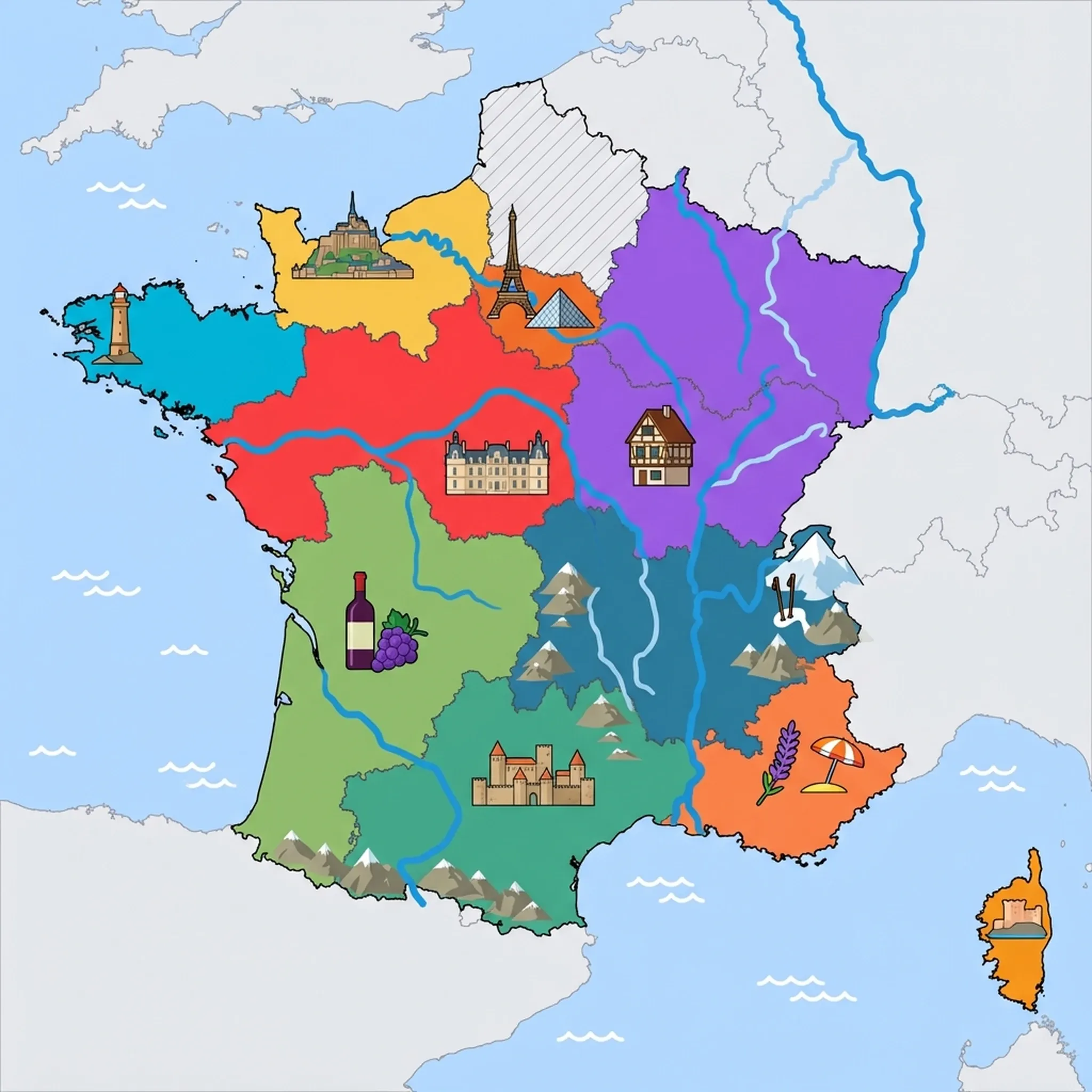
10 Regions
Bordeaux & Southwest France
Surf huge dunes, explore ancient caves, and taste the good life 🌊🍷
Brittany
Where pirate forts meet pink granite coasts 🏴☠️🥞
Burgundy, Champagne & Alsace
Real-life fairy tales, medieval building sites, and festive markets 🏰🥨
Corsica
Wild mountains rising from turquoise seas ⛰️🏝️
Loire Valley
Kings, queens, and Da Vinci's flying machines 👑🚲
Lyon, Rhône Valley & French Alps
Snowy peaks, crystal lakes, and the world's best food 🏔️🧀
Normandy
D-Day beaches, medieval abbeys, and creamy camembert 🐮⚔️
Occitanie & The Pyrenees
Medieval knights, Roman gladiators, and rocket ships 🚀🛡️
Paris & Île-de-France
The City of Light, magic, and monuments ✨🗼
Provence & Côte d'Azur
Lavender fields, Roman ruins, and the glittering blue sea ☀️🌿
Click on a region marker to explore details. Use the dropdown to color regions by activity suitability.

Getting There & Around
Getting There
- By Air – Paris Charles de Gaulle (CDG) and Orly (ORY) are the main international hubs. Nice (NCE) serves the Provence & Côte d'Azur region.
- By Train – The Eurostar connects London St Pancras to Paris Gare du Nord in just over 2 hours. TGV Lyria connects to Switzerland, and Thalys to Belgium/Netherlands.
- By Sea – Ferries connect UK ports (Dover, Portsmouth, Plymouth) to Calais, Caen, and St-Malo in Brittany.
- Entry Requirements – Check your government website for the latest visa requirements, or use the IATA Travel Centre entry-requirements checker.
Getting Around
- Trains – The SNCF network is excellent. High-speed TGV trains connect major cities like Paris, Lyon, and Bordeaux in hours. Booking early saves money.
- Car Hire – Essential for exploring rural areas like the Loire Valley or Normandy. French motorways (autoroutes) are fast but have frequent tolls.
- Metro – Paris has a dense, efficient metro system. Children under 4 travel free; ages 4-9 get 50% off carnets (books of tickets).

Packing List
Loose swim shorts are banned in most public pools for hygiene; men/boys must wear tight trunks.
Rarely provided in French hotels; pack your own if you are used to washing with them.
Supermarkets do not provide free bags and often charge for sturdy ones; keep a tote handy.
Strictly required to prove age for free/discounted entry at museums and on transport.

Activities & Best Times

Adventure & Nature
ExcellentHiking, wildlife, outdoor exploration, ecotourism
The French Alps and Ardèche Gorges provide world-class natural immersion with 18 supporting attractions including wildlife parks and the iconic Chamonix massif. Peak months offer accessible high-altitude trails, while transitional seasons provide spring blooms and autumn colors before winter snow limits access.
Home to the unique ecosystem of Mont Saint-Michel Bay and the spectacular Alabaster Coast, the region provides world-class natural landscapes for exploration. Peak visitation occurs during late spring and summer when trails are dry and wildlife centers like Cerza Safari Park are most active.
Home to the Pyrenees National Park and Gorges du Tarn, offering world-class trekking, canyoning, and wildlife encounters in the Parc Animalier des Pyrénées. High altitude trails and canyoning parks are most accessible and vibrant during the warm summer window.

City & Cultural
ExcellentUrban tourism, museums, historical sites, architecture
A world-renowned UNESCO World Heritage site famous for its concentration of Renaissance châteaux and historic cities like Tours and Orléans. Peak season offers long days and full access to heritage sites, while the winter off-season is often grey and several smaller sites may have reduced hours.
Lyon is a UNESCO World Heritage site and a global capital of gastronomy with a rich array of fine art museums and historic landmarks. The spring and autumn months provide the most comfortable climate for urban exploration, avoiding the extreme heat and local closures of August.
Normandy is a cultural powerhouse featuring the UNESCO-listed Mont Saint-Michel, Monet's gardens at Giverny, and profound WWII heritage sites. While summer offers peak accessibility, December is a notable shoulder month for traditional Christmas markets in historic cities like Rouen.

Educational & Exploratory
Very GoodLearning experiences, scientific sites, historical education
The region features internationally significant educational facilities, most notably La Cité de la Mer and the comprehensive WWII museum complexes. These sites offer deep historical and scientific engagement that is best experienced during the main tourism season when all exhibits and guided tours are available.
Toulouse is a global aerospace hub featuring the Cité de l'Espace, a top-tier scientific discovery center, while Tautavel offers significant prehistoric education. These indoor-centric facilities are world-class travel motivators, though peak visiting aligns with broader school travel seasons.
Hosts world-leading science centers and specialized museums that serve as standalone educational draws for sophisticated families. Ideal for spring and autumn school windows; less focused during the peak summer tourist rush or the coldest winter months.

Sports & Active
Very GoodSport tourism, fitness activities, active recreation
Home to the 'La Loire à Vélo', an internationally recognized cycle route with excellent infrastructure that is a primary draw for active families. Optimal cycling conditions prevail from late spring through early autumn; winter rainfall and cold make the infrastructure significantly less appealing.
The region features world-class sports infrastructure, including the Tour du Mont Blanc hiking circuit and the ViaRhôna cycling route. These facilities are best utilized during the summer months when high-altitude paths and riverside routes are in peak condition.
Boasts significant infrastructure for active tourism, including the Véloscénie cycling route and the GR 21 hiking trail along the Alabaster Coast. The active season is concentrated in the sunnier months to ensure safe conditions for coastal hiking and long-distance cycling.

Theme Park & Entertainment
Very GoodAmusement parks, family entertainment venues
With major international-standard venues like Walibi Rhône-Alpes and Le Pal, the region offers high-quality family entertainment. Peak visitation aligns with the summer school holiday period when all aquatic and outdoor attractions are fully operational.
The Halle de la Machine in Toulouse provides a uniquely sophisticated, artistic entertainment experience unlike any traditional theme park. Coastal water parks like Aqualand drive summer peaks, while the more mechanical and historical parks operate primarily in the warmer half of the year.
Futuroscope stands as a globally unique, high-tech educational theme park that appeals specifically to sophisticated families. Primary operations and water park availability peak during the summer months.

Festivals & Seasonal
GoodEvents, celebrations, seasonal attractions
International Garden Festival at Chaumont-sur-Loire is described as 'a major global event' in the notes. The Loire Valley also hosts numerous wine festivals and summer châteaux events. Rating should be 'good' not 'marginal'.
Lyon Festival of Lights is already in the database as a major international event. December tourism peak is significant. The 'marginal' rating contradicts the presence of a major festival attraction.
D-Day Festival (June) is an internationally significant commemoration drawing global visitors. Deauville American Film Festival has international recognition. These are destination-level events.

Road Trips & Scenic
GoodScenic drives, countryside tours, route-based travel
Celebrated scenic routes including the Loire Wine Route and the Route of the Troglodytes offer authentic rural French exploration. Driving is most scenic when vineyards are in leaf and autumn colors appear in October; winter landscapes are comparatively stark and less rewarding.
Renowned scenic routes like the Route des Grandes Alpes and Route Napoléon offer some of Europe's most spectacular mountain driving. High passes are typically only accessible and safe from early June through September due to snow closures.
Established routes like the Cider Route and the D-Day Landing Beaches provide exceptional thematic driving experiences through authentic rural landscapes. Optimal conditions occur from late spring through early autumn, ensuring clear visibility of the coastal cliffs and blooming countryside.

Relaxation & Wellness
GoodSpa retreats, wellness centers, peaceful getaways
Historically significant spa towns like Aix-les-Bains and Saint-Gervais Mont-Blanc provide authentic thermal bath experiences. Transitional months offer pleasant weather for wellness tourism without the overcrowding or intense heat of mid-summer.
A historic thermal bath region with authentic open-air sulfur springs like Bains de Dorres. The experience is best in autumn when the crisp mountain air provides a perfect contrast to the hot thermal waters, away from the summer heat.
Historically significant thermal towns like Gréoux-les-Bains offer sophisticated wellness retreats in a traditional setting. Peak months align with pleasant weather for outdoor relaxation, while winter months see reduced facility operations.

Ski & Snow
GoodWinter sports, ski resorts, snow activities
Home to premier resorts like Chamonix, Val Thorens, and Courchevel, the region offers elite infrastructure and reliable snow coverage. Despite its global reputation, the classification is calibrated to its core winter season, with April providing late-season spring conditions.
Major resorts like Grand Tourmalet and Font-Romeu offer solid Pyrenean ski infrastructure and authentic mountain atmosphere. The season is shorter and the altitude generally lower than the Northern Alps, making mid-winter the only reliable period for premium snow conditions.
Southern Alps resorts like Serre Chevalier offer high-altitude skiing with high sunshine hours. The season is strictly limited to winter and early spring, with no snow coverage available during the rest of the year.

Beach & Sea
GoodBeach resorts, marine activities: diving, snorkelling, kite surfing, wind surfing, sailing
Normandy offers iconic coastal scenery like the Étretat cliffs and historic D-Day beaches, though the English Channel waters remain brisk even in summer. High season is limited to the warmest summer months when water activities and coastal resorts are fully operational.
The Languedoc coast offers vast sandy stretches like Espiguette and scenic rocky coves in Paulilles. While high quality, it is less exclusive than the neighboring Côte d'Azur, with swimming conditions optimal only during the core summer months.
The French Riviera provides iconic coastal experiences and world-class beach clubs in destinations like Saint-Tropez and Nice. Optimal conditions occur in summer when sea temperatures are warm, while winter months are unsuitable for swimming or marine activities.

Public Holidays & Calendar Next 12 months
Public holidays, festivals, cultural celebrations, and seasonal natural phenomena coming up in France over the next 12 months.
Loading holidays and events...
Climate & Weather
Bordeaux & Southwest France
Show Details
| Month | Temp °C | Rain | Humidity |
|---|
Brittany
Show Details
| Month | Temp °C | Rain | Humidity |
|---|
Burgundy, Champagne & Alsace
Show Details
| Month | Temp °C | Rain | Humidity |
|---|
Corsica
Show Details
| Month | Temp °C | Rain | Humidity |
|---|
Loire Valley
Show Details
| Month | Temp °C | Rain | Humidity |
|---|
Lyon, Rhône Valley & French Alps
Show Details
| Month | Temp °C | Rain | Humidity |
|---|

Travel Advisory
The majority of international agencies advise travelers to exercise increased caution. This assessment is primarily driven by a persistent and high threat of terrorism, as well as frequent civil unrest and strikes that can impact travel logistics.
Safety Topics
Traveller Advice (3 groups)

Minors traveling alone or with only one parent may need specific written authorization and documentation to exit or enter the country, according to local regulations.

Exercise caution when walking alone after dark and be vigilant in nightlife venues. There have been reports of drink spiking and the use of sedative drugs in bars and clubs.

Ensure you carry valid photo identification at all times, as this is a legal requirement. Monitor local media for updates on strikes or protests that may affect public transportation or access to major sites.
Agency Summaries
Safety concerns are more significant than typically found in New Zealand. Key risks include the highest level of terrorism alerts, frequent civil unrest, and common petty theft in tourist areas.
Travelers should maintain a high level of vigilance due to a consistent threat of terrorist activity. The national security alert system is currently at an elevated level. Petty crime and residential break-ins are also reported frequently.
Visitors should be aware that terrorist attacks are considered very likely. Significant travel disruption may arise from frequent industrial actions and protests across the country.
Increased awareness is recommended because of potential terrorism and civil disturbances. Public demonstrations and industrial strikes occur regularly and can disrupt transportation services.
Vigilance is advised regarding personal security and potential terror threats. Travelers must carry valid photographic identification at all times and follow instructions from local law enforcement.
Exercise heightened caution due to the risk of terrorism. Be mindful of serious street crimes, including violent theft and assault, especially in major urban centers during peak travel seasons.
Information is provided for general guidance only and does not constitute travel, safety, medical, or legal advice. Conditions may change. Users are responsible for independently verifying information before travel.