

Overview
French Guiana is a destination of startling contrasts that captures the imagination of children and adults alike. As an Overseas Department of France nestled on the northeast coast of South America, it offers the unique experience of exploring the Amazon rainforest while using the Euro and speaking French. The vibe here is a fascinating mix of Creole vibrancy, Amerindian tradition, and European infrastructure. For families, this means you can embark on genuine jungle adventures-riding motorized canoes down river and sleeping in hammock camps-while still enjoying reliable healthcare and familiar food standards.
The country is covered almost entirely by dense tropical rainforest, broken only by the major rivers and the coastal strip where most of the population lives. The capital, Cayenne, buzzes with colorful markets and colonial architecture, while the town of Kourou looks towards the stars as the home of the European Space Agency. Whether you are watching leatherback turtles lay eggs on the beach (in season), learning about the history of the penal colonies, or hiking through the canopy, French Guiana offers an educational and thrilling family holiday off the beaten track.
Key Attractions
A trip to French Guiana must include a visit to the Guiana Space Centre (CSG) in Kourou. It is one of the world's most active spaceports, and families can take free guided bus tours to see the massive launch pads and control centres-a guaranteed hit for budding astronauts. Nearby, the famous Îles du Salut (Salvation Islands) offer a haunting mix of history and nature; while the parents explore the ruins of the penal colony, children can spot friendly monkeys and agoutis roaming freely among the coconut palms.
For a deep dive into nature, the Interior Rainforest offers accessible adventure. A boat trip to the Kaw-Roura Marshland Nature Reserve is unmissable; gliding through the wetlands on a pirogue offers the chance to see caimans, colorful birds, and water buffalo. In the west, the historic Camp de la Transportation in Saint-Laurent-du-Maroni provides a powerful history lesson about the "Papillon" era, with guided tours often adapted for younger audiences. Finally, a journey up the Maroni River introduces families to the diverse cultures of the river peoples, including the Bushinengue and Amerindian communities.
Practical Advice
The best time to visit is during the dry season (August to December), as the tropical rains can be intense. Health is a priority: A Yellow Fever vaccination certificate is mandatory for entry for everyone over 1 year old-you will be refused entry without it. Malaria prophylaxis is generally recommended for inland jungle trips but check with a travel doctor. French is the official language, so a phrasebook is helpful, though many people in the tourism industry speak some English. Families should book car hire well in advance as public transport is limited.
Food & Drink
Typical meal times: 12:00 pm to 2:00 pm for lunch and 7:30 pm to 9:30 pm for dinner. Many restaurants close strictly between shifts.
Typical meal costs: €15–25 (approx. $16–27 USD / £13–21 GBP) for a casual lunch; €40–60 (approx. $43–65 USD / £34–50 GBP) for a nice dinner. Prices are comparable to mainland France or slightly higher due to imports.
Dietary requirements: Vegetarian options are available but not ubiquitous; you will often find sides of rice, beans, and plantains. Gluten-free awareness is growing in Cayenne but limited elsewhere. French pharmacies are excellent for specific baby food needs.
Family-friendly dining: The atmosphere is relaxed and children are welcome everywhere. "Snacks" (casual eateries) and food trucks (camions bars) are great for quick, affordable meals like sandwiches and crepes that kids love.
Signature dishes:
- Bouillon d'Awara – A thick, rich stew made from the pulp of the awara palm fruit, smoked chicken, fish, and vegetables, traditionally eaten at Easter but found year-round.
- Colombo – A mild, thick curry (chicken or pork) influenced by Indian immigrants, served with rice and familiar to those who have visited the French Caribbean.
- Fricassée – Hearty stews made with wild game (like paca) or domestic meats, often served with beans and rice.
- Pimentade – A tomato-based fish court-bouillon seasoned with lemon and peppers (can be spicy, so ask first for kids).
Safety
French Guiana is generally safe for tourists, but petty crime can occur in Cayenne and Saint-Laurent-du-Maroni. Families should avoid walking in unlit or deserted areas of the cities at night. When swimming, stick to designated beaches as ocean currents can be strong and some river areas have caimans (though attacks are extremely rare). Always use repellent to protect against mosquito-borne illnesses like Dengue.
Family Travel Notice
Parents traveling with minors should be aware of specific legal protocols regarding child custody and may need to consult legal counsel for property or residency-related stays.

French Guiana is an expensive destination, with prices comparable to or higher than mainland France. A family of four should budget around €250–350 (approx. $270–380 USD / £210–295 GBP) per day for car rental, mid-range accommodation, and meals. Supermarket items are pricey due to imports. Tours to the jungle or islands will add significantly to this daily cost.
Age Suitability




Did you know? French Guiana welcomes approximately 86,000 international visitors per year. Most visitors come from Europe.

Explore Regions
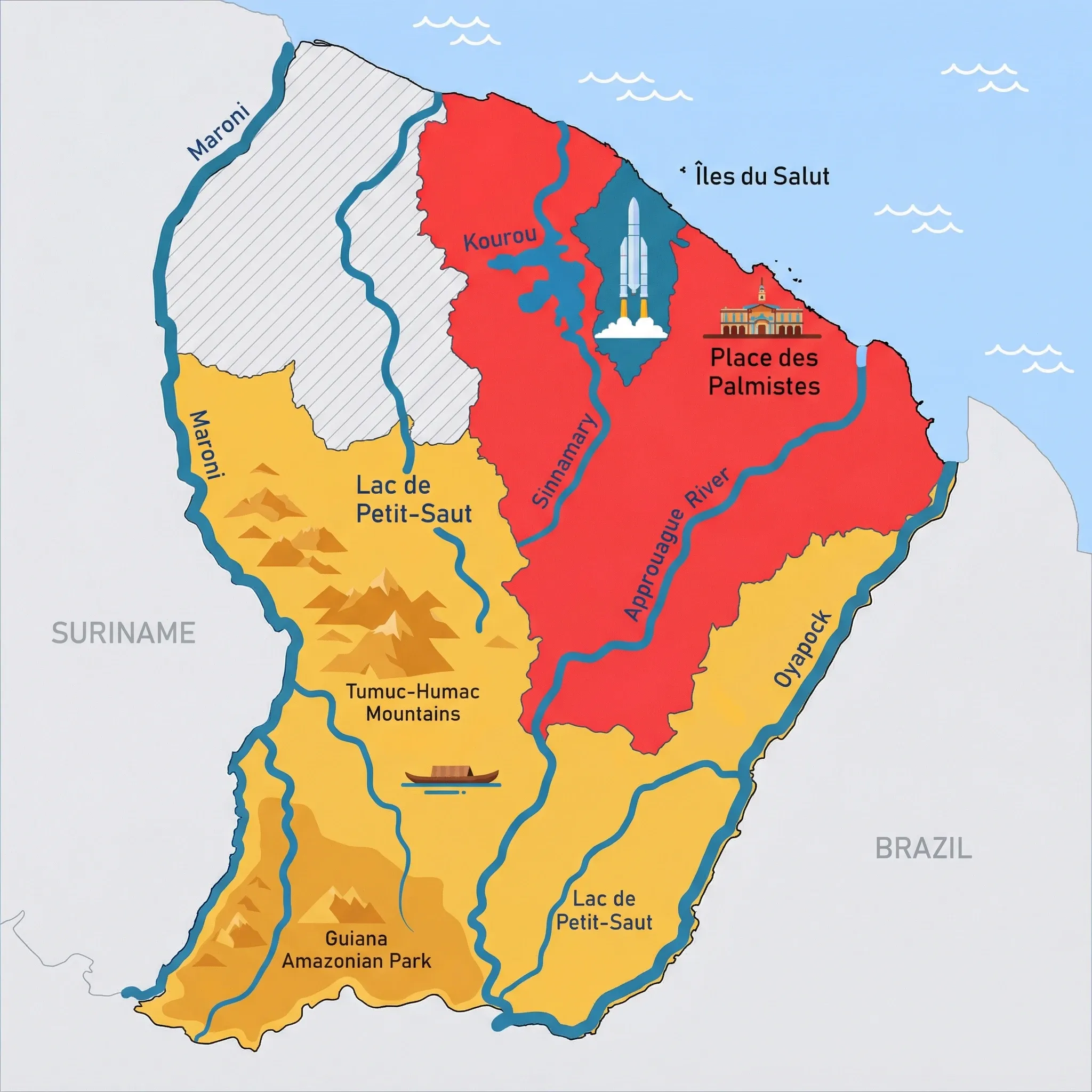
3 Regions
Cayenne
A colorful collision of Parisian style and Amazonian spirit 🐆
Interior Rainforest
Deep jungle, mighty rivers, and living history 🌳
Kourou (Space Centre)
Where rockets launch from the rainforest edge 🛰️
Click on a region marker to explore details. Use the dropdown to color regions by activity suitability.

Getting There & Around
Getting There
- By Air – The main gateway is Cayenne–Félix Éboué Airport (CAY), which receives daily direct flights from Paris (Orly) via Air France and Air Caraïbes. There are also connections from the French Caribbean (Martinique, Guadeloupe) and Brazil (Belém).
- By Land – You can enter from Suriname via the ferry at Saint-Laurent-du-Maroni or from Brazil via the bridge at Saint-Georges-de-l'Oyapock.
- Entry Requirements – As a French Overseas Department, it is part of the EU (but not Schengen). EU citizens need a passport or ID card. US, UK, and Canadian citizens do not need a visa for stays under 90 days. Crucially, a Yellow Fever vaccination certificate is mandatory for all travelers over 1 year old. Check your government website for the latest visa requirements, or use the IATA Travel Centre entry-requirements checker.
Getting Around
- Car Hire – The most practical option for families. International agencies are available at the airport and in Cayenne. Driving is on the right, and roads like the RN1 and RN2 are generally good, though rural tracks require 4x4s.
- Pirogues (Canoes) – Essential for exploring the Interior Rainforest and river networks like the Maroni River. These motorized canoes act as water taxis and are an adventure in themselves.
- Domestic Flights – Air Guyane connects the coast to remote interior villages like Saül, which is the gateway to the Parc Amazonien de Guyane - Saül Sector.

Packing List
Absolutely mandatory for entry. You will be denied boarding or entry without the original physical booklet.
Essential for keeping cameras and spare clothes dry during pirogue (canoe) trips and sudden tropical downpours.
Useful for night walks to spot caimans or turtles, and for navigating eco-lodges or carbets which often have limited electricity.
Amazonian rain is intense and soaks through standard light jackets instantly; a full poncho covers your backpack too.
Humidity is very high, so regular cotton towels never dry. Quick-dry antibacterial towels are essential.

Activities & Best Times

Educational & Exploratory
ExcellentLearning experiences, scientific sites, historical education
The Guiana Space Centre is one of only a handful of operational spaceports globally and Europe's primary launch facility. This is a world-class, internationally unique educational attraction that warrants the highest rating. Families can witness actual rocket launches - this is an exceptional educational destination by any global standard.
As the capital with the Musée Alexandre-Franconie and proximity to the Space Centre, this should be rated 'good' not 'marginal'. The museum provides deep historical insight into the complex colonial and penal history, and the capital offers educational infrastructure.
Home to specialized facilities like the Le Planeur Bleu insect museum, which provides niche scientific engagement for families interested in tropical biology. While authentic, these educational stops are typically secondary to nature-based exploration.

Adventure & Nature
Very GoodHiking, wildlife, outdoor exploration, ecotourism
Features exceptional Amazonian biodiversity and unique hiking trails like the Montagne des Singes and island loops. Visitation is best during the dry season (August to November) to avoid extremely muddy trails and heavy tropical downpours that can impact forest accessibility.
Cayenne offers immediate access to primary jungle via trails like Vidal and the Grand Matoury reserve, providing authentic wildlife encounters for families. The dry season from August to November is essential for trail accessibility and optimal wildlife spotting.
Offers exceptional immersion in primary Amazonian rainforest, particularly in the remote Saül sector and the Kaw-Roura marshes, which provide world-class birdwatching and caiman spotting. The peak dry season from August to November is essential for navigating jungle trails and accessing remote eco-lodges safely.

City & Cultural
Very GoodUrban tourism, museums, historical sites, architecture
A compelling mix of dark tourism history at the Devil's Island penal colony and living indigenous culture at Saramaca Village. The drier months of August through November offer the most comfortable conditions for exploring these heritage sites on foot.
A unique blend of French administration and Amazonian Creole culture, centered on the historic Place des Palmistes and Fort Cépérou. Peak times include the vibrant Carnival season and the driest months for comfortable exploration of the city's markets and botanical gardens.
This is a rainforest region, not a city destination. Camp de la Transportation is a remote historic penal colony site, not an urban cultural experience. The 'good' rating misapplies the city_cultural category to wilderness heritage sites. Should be 'marginal' at best.

Sports & Active
Very GoodSport tourism, fitness activities, active recreation
Provides high-quality active experiences including the multi-day Molokoï trekking trail and world-class canopy adventures at Camp Canopée. These activities require stable weather for safety and comfort, making the drier second half of the year the only recommended time for active families.
Dedicated outdoor infrastructure like the Camp Canopée adventure center and established trekking routes provide quality active experiences. Peak activity is centered in the dry season when humidity is slightly lower and terrain is stable for climbing and hiking.
Robust coastal and jungle trail networks provide excellent opportunities for family hiking and trail running in tropical environments. The heavy rainfall between April and June can make trails hazardous and uncomfortably humid for active sports.

Road Trips & Scenic
GoodScenic drives, countryside tours, route-based travel
Scenic drives like the Route des Plages offer beautiful coastal views and access to the peninsula's diverse environments. The dry season ensures safe, clear driving conditions and the best visibility for the Atlantic vistas.
The Route de l'Espace offers a distinctive scenic drive through the tropical landscape surrounding the spaceport. Driving conditions and visibility are significantly better during the drier months from August to November.
While RN1/RN2 routes exist, calling rainforest corridors 'good' road trip destinations overstates accessibility and road conditions. These are functional transport routes through jungle, not scenic leisure drives with amenities.

Festivals & Seasonal
GoodEvents, celebrations, seasonal attractions

Beach & Sea
MarginalBeach resorts, marine activities: diving, snorkelling, kite surfing, wind surfing, sailing
While the Îles du Salut offer coastal access, they are primarily rocky historic sites (former penal colony) rather than beach resort islands. The 'good' rating overstates the beach quality compared to Caribbean standards. Atlantic waters here are not ideal for swimming.
Beaches like Remire-Montjoly offer Atlantic recreation, though waters are often silty due to river runoff; peak months provide the driest conditions for coastal visits. High rainfall and seasonal sediment from the Amazon make the water quality less consistent than Caribbean benchmarks.

Public Holidays & Calendar Next 12 months
Public holidays, festivals, cultural celebrations, and seasonal natural phenomena coming up in French Guiana over the next 12 months.
Loading holidays and events...
Climate & Weather
Cayenne
Show Details
| Month | Temp °C | Rain | Humidity |
|---|
Interior Rainforest
Show Details
| Month | Temp °C | Rain | Humidity |
|---|
Kourou (Space Centre)
Show Details
| Month | Temp °C | Rain | Humidity |
|---|

Travel Advisory
All six major agencies agree that French Guiana is a low-risk destination where standard safety precautions are sufficient. No significant security threats or travel restrictions are currently reported.
Safety Topics
Traveller Advice (5 groups)

Parents traveling with minors should be aware of specific legal protocols regarding child custody and may need to consult legal counsel for property or residency-related stays.

Travelers requiring specific accessibility infrastructure should research facilities in advance, as conditions in the territory may differ from mainland France.

Solo female travelers should be cautious after dark and are advised against walking alone in isolated or poorly lit areas to minimize the risk of harassment or petty crime.

Those exploring the Amazon interior or engaging in diving should use well-established tour operators and verify safety equipment, such as oxygen availability and access to hyperbaric chambers.

While French laws apply, travelers should review general safety guidance for sexual and gender minorities before visiting.
Agency Summaries
New Zealand does not maintain a specific warning for French Guiana but emphasizes the necessity of comprehensive travel and medical insurance, including provisions for emergency air evacuation.
The UK provides standard safety guidance for French Guiana, noting low overall crime but highlighting specific robbery risks in parts of Cayenne after dark. Driving follows French laws, and medical preparations are essential.
The U.S. Department of State classifies French Guiana at the lowest risk level. Travelers are encouraged to maintain standard safety awareness, particularly in urban centers and when exploring remote jungle areas.
As an overseas department of France, French Guiana is part of the EU, and Irish citizens enjoy visa-free entry. Travelers should follow local authority guidance and stay informed via local news.
Australia advises travelers to use standard safety measures. Guidance focuses on administrative requirements and the lack of a resident embassy, with consular services provided via the High Commission in Trinidad and Tobago.
French Guiana is generally considered safe, with risk levels comparable to Canada. Visitors should remain vigilant against petty crime in cities and exercise caution regarding property investments and legal disputes.
Information is provided for general guidance only and does not constitute travel, safety, medical, or legal advice. Conditions may change. Users are responsible for independently verifying information before travel.