

Overview
French Polynesia is often painted as a honeymooner's exclusive, but for families, it is a vast, safe, and magical aquatic playground. Spread across an area as large as Europe, its 118 islands offer a mix of high volcanic peaks and low-lying coral atolls. For children, the islands are a real-life geography lesson and a natural theme park combined. The culture is incredibly welcoming to little ones; Polynesians cherish family (fetii), and children are often greeted with flowers and smiles wherever they go. The calm, warm lagoons of Tahiti & Moorea provide some of the safest swimming conditions on the planet, free from strong currents and dangerous waves, making them perfect for young swimmers building confidence.
Beyond the beaches, the islands offer a unique blend of French sophistication and Polynesian tradition. You can buy fresh baguettes and croissants in the morning before heading out to watch a traditional dance performance or explore ancient stone temples. The pace of life is slow and governed by the sun, which suits family rhythms perfectly. While the Marquesas Islands offer wilder adventures for families with older teens, the Society Islands and Tuamotus remain the most accessible and facility-rich regions for those traveling with younger children.
Key Attractions
Start your journey in Tahiti & Moorea, the most accessible islands. A visit to the Museum of Tahiti and the Islands (Te Fare Iamanaha) is essential for grounding children in the local mythology and history before you explore. Nearby, the Point Venus Lighthouse sits on a expansive black sand beach that is a favorite for local families; the absence of coral here makes it excellent for splashing around without worry. On Moorea, the lagoon is the main star, but a 4x4 trip inland can reveal pineapple plantations and ancient sites.
For the iconic postcard experience, head to the Leeward Islands. Bora Bora isn't just for couples; a boat tour around Mount Otemanu allows kids to snorkel in waist-deep water while sharks and rays glide harmlessly nearby-an unforgettable confidence booster. For a deeper cultural dive, the Taputapuatea Marae on Raiatea is a UNESCO World Heritage site where families can walk among ancient stone structures and learn about the voyagers who navigated the Pacific by the stars.
If you venture to the Tuamotu Atolls, the Blue Lagoon (Le Lagon Bleu) in Rangiroa is a natural nursery within the main lagoon. It acts as a giant, shallow swimming pool teeming with friendly marine life, safe enough for toddlers to wade in. For adventurous families heading to the remote Marquesas Islands, the towering The Spires of Ua Pou and the trek to Vaipo Waterfall offer Jurassic Park-style landscapes that will captivate energetic teenagers.
Practical Advice
The best time to visit is during the dry season (May to October), when temperatures are pleasant and humidity is lower. The sun is extremely strong, so UV protective clothing is better than sunscreen alone. Coral cuts can become infected quickly in the tropics, so immediate cleaning with lime (often available on boats) or antiseptic is key. Tap water is generally safe in Papeete and major resorts, but bottled water is recommended elsewhere. Mosquitoes can carry Dengue fever, so repellent is a must, especially at dawn and dusk.
Food & Drink
Typical meal times: Breakfast is early (6:30 am to 9:00 am). Lunch is served from 11:30 am to 1:30 pm, and dinner typically runs from 6:30 pm to 9:00 pm. On Sunday mornings, families often gather for a massive early brunch at the local market.
Typical meal costs: 1,800–3,500 XPF (approx. $16–32 USD / €15–30 EUR) for lunch; 3,500–6,500 XPF (approx. $32–60 USD / €30–55 EUR) for dinner. Food trucks (Roulottes) offer cheaper meals around 1,500–2,200 XPF ($14–20 USD / €12–18 EUR).
Dietary requirements: Vegetarian options are available in hotels and tourist areas but less common in local snacks. Gluten-free awareness is growing in high-end resorts (due to French influence) but can be tricky in remote islands. Fish and coconut are staples.
Family-friendly dining: The "Roulottes" (food trucks) in Papeete (Place Vai'ete) are fantastic for families-casual, open-air, and offering everything from steak and fries to Chinese food and crepes. Highchairs are standard in resorts but rare in small local eateries.
Signature dishes:
- Poisson Cru – The national dish of raw tuna marinated in lime juice and coconut milk with veggies. Mild, creamy, and surprisingly kid-friendly.
- Firi Firi – Tahitian coconut milk donuts, usually shaped like a figure-8 and eaten for breakfast.
- Poulet Fafa – Chicken stewed with taro leaves (similar to spinach) and coconut milk. Soft comfort food for picky eaters.
- Po'e – A sweet, pudding-like fruit dessert made from banana, papaya, or pumpkin mixed with starch and coconut cream.
- Mahi Mahi with Vanilla Sauce – Grilled fish served with a savory sauce made from local Taha'a vanilla.
Family Travel Notice
Tahiti and Moorea are often recommended as the most suitable islands for families due to better infrastructure and facilities.

French Polynesia is a premium destination. A family of four should budget 45,000–70,000 XPF (approx. $410–640 USD / €380–590 EUR) per day for mid-range accommodation, car hire, and meals. Dining out is comparable to Paris or New York prices. You can save significantly by eating at 'Roulottes' (food trucks) where meals cost 1,500–2,500 XPF ($14–23 USD / €12–21 EUR), and by booking family pensions (guesthouses) instead of resort overwater bungalows.
Age Suitability




Did you know? French Polynesia welcomes approximately 219,000 international visitors per year. Most visitors come from Americas.
Explore Regions
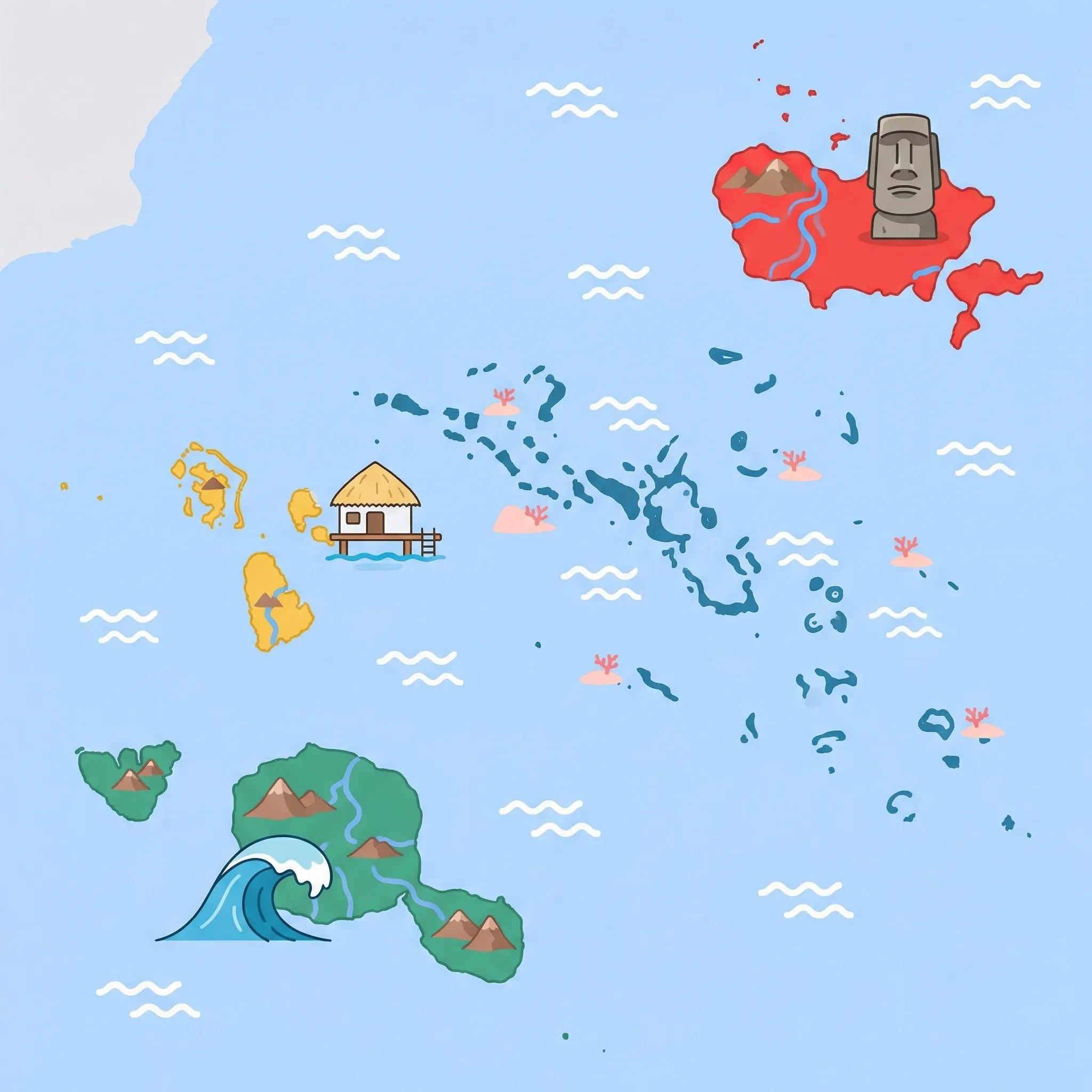
4 Regions
Leeward Islands (Bora Bora, Huahine, Raiatea)
Where legendary lagoons meet ancient legends 🌺🛶
Marquesas Islands
Raw, wild, and untamed beauty 🐴🗿
Tahiti & Moorea
The gateway to paradise ⛰️🏙️🦈
Tuamotu Atolls (Rangiroa, Fakarava)
The infinite aquarium 🐠🐡🦀
Click on a region marker to explore details. Use the dropdown to color regions by activity suitability.

Getting There & Around
Getting There
- By Air – Faa'a International Airport (PPT) in Tahiti is the only international gateway. Direct flights arrive from Los Angeles, San Francisco, Seattle, Auckland, and Tokyo. Major carriers include Air Tahiti Nui, French Bee, and United.
- By Sea – Cruise ships frequently dock in Papeete and Moorea, serving as a popular way for families to see multiple islands without unpacking.
- Entry Requirements – US, Canadian, EU, and ANZ citizens generally do not need a visa for short tourist stays (up to 90 days). Your passport must be valid for at least 3 months beyond your date of departure. Check your government website for the latest visa requirements, or use the IATA Travel Centre entry-requirements checker.
Getting Around
- Domestic Flights – Air Tahiti connects 47 islands. It is the fastest way to reach the Leeward Islands and Tuamotu Atolls. Multi-island air passes are the most economical option for families island-hopping.
- Ferries – High-speed catamarans (Aremiti and Terevau) connect Tahiti and Moorea in 30–45 minutes. It is a scenic, reliable, and affordable trip. Children pay reduced fares (approx. 50%).
- Car Hire – Essential for exploring the main islands like Tahiti, Moorea, and Raiatea. Driving is on the right-hand side. Roads are generally good but can be narrow.
- Public Transport – The 'Tere Tahiti' bus network on Tahiti is modern and affordable, but schedules can be infrequent outside Papeete. On smaller islands, public transport is non-existent.

Packing List
Essential for all ages due to sharp coral and stonefish in the lagoons. Flip-flops are not sufficient for water entry.
The sun is far stronger here than in Europe or the US. Sunscreen washes off; UV shirts protect kids during long snorkel sessions.
Boat transfers and dinghy landings are common. Keeps phones and spare clothes dry when splashing across lagoons.
Rental gear often leaks on small faces. Having a well-fitted set ensures your child's first shark/ray encounter is fun, not salty.
Strictly encouraged to protect the reefs. Local options are expensive, so bring a supply of zinc-based or reef-safe cream.

Activities & Best Times

Adventure & Nature
ExcellentHiking, wildlife, outdoor exploration, ecotourism
Boasts dramatic volcanic topography, lush interior valleys like Papenoo, and legendary hiking trails such as Mount Aorai. The dry season is essential for safety on mountain ridges and for clear views of the island's unique peaks.
An exceptional destination for wilderness immersion featuring the towering Vaipo Waterfall and the iconic Spires of Ua Pou. Travel is best during the drier season to ensure trail accessibility and safety on steep, volcanic terrain that becomes hazardous during heavy rains (Jan-Mar).
Home to world-class marine biodiversity in the Fakarava UNESCO Biosphere Reserve and the massive Rangiroa lagoon, featuring unique wildlife experiences at Tiputa and Garuae Passes. The dry season provides the most comfortable conditions for boat-based wilderness immersion and visits to remote pearl and wine farms.

Beach & Sea
ExcellentBeach resorts, marine activities: diving, snorkelling, kite surfing, wind surfing, sailing
The Tuamotu atolls are world-renowned for pristine lagoons like the Blue Lagoon and exceptional snorkeling/diving conditions. Fakarava is a UNESCO Biosphere Reserve with exceptional marine biodiversity. These are globally premier beach and lagoon destinations and should be rated 'excellent'.
Bora Bora is globally iconic for its lagoon and beaches. Matira Beach consistently ranks in 'world's best beaches' lists. The Bora Bora Lagoon is internationally synonymous with paradise-quality beach experiences. Rating this as merely 'good' is a severe calibration error - this should be 'excellent'.
Tahiti and Moorea offer world-class beaches (Temae Beach, Plage de Toaroto), crystal-clear lagoons, and iconic overwater bungalow resorts. This is one of the world's premier beach destinations and should be rated accordingly. The current 'good' rating severely undervalues the region's global beach reputation.

City & Cultural
Very GoodUrban tourism, museums, historical sites, architecture
The region offers profound Polynesian heritage through world-class archaeological sites like Te Iipona and Kamuihei, which feature some of the largest tikis in the Pacific. Peak season aligns with dry conditions necessary for exploring these open-air heritage sites and historic valley settlements.
Features the UNESCO-listed Taputapuatea Marae, a site of immense historical significance for Polynesian heritage. The clear-sky months offer the best conditions for exploring these open-air archaeological sites and traditional Maeva village structures.
While the region has authentic Polynesian heritage and significant historic sites, 'excellent' city/cultural ratings should be reserved for destinations with globally significant cultural institution density (Paris, Rome, Kyoto). Tahiti's offerings, while substantial, don't reach this threshold internationally.

Educational & Exploratory
GoodLearning experiences, scientific sites, historical education
Home to high-quality scientific facilities like the Fare Natura Ecomuseum and Coral Gardeners, providing sophisticated families with deep insights into marine biology. These experiences are best paired with the dry season when lagoon conditions are optimal for conservation-focused activities.
Niche educational appeal centered on the Enana culture and marine history at Musée Enana and the Hane Sea Museum. These facilities provide specialized context for the region's unique isolation and evolution, though they are secondary to the natural attractions.

Road Trips & Scenic
GoodScenic drives, countryside tours, route-based travel
Features spectacular, high-altitude driving routes such as the Taiohae to Hatiheu drive, offering some of the most dramatic coastal vistas in the Pacific. Reliable road conditions are critical on these steep, winding paths, making the drier months from August to November the peak window.
Dedicated circle-island roads on Bora Bora, Huahine, and Raiatea provide scenic driving routes with world-class lagoon views. Driving conditions are most reliable during the dry season, avoiding the heavy downpours and potential road debris of the cyclone season.
While scenic coastal roads exist, Tahiti and Moorea are relatively small islands with limited road networks (circle roads of ~50-60km each). Compared to true road trip destinations with extensive highway systems, this should be downgraded to 'marginal'.

Sports & Active
GoodSport tourism, fitness activities, active recreation
The atolls offer unique cycling routes across narrow strips of land between lagoon and ocean, particularly in Rangiroa and Fakarava. The mid-year months offer consistent trade winds and lower temperatures, making outdoor physical activity significantly more enjoyable for families.
Renowned for challenging mountain trails and organized cycling routes around the islands' perimeters. The cooler, drier trade-wind season provides the most comfortable and safe environment for high-exertion activities.
Provides high-quality active infrastructure including mountain trekking routes and adventure parks like Tiki Parc Moorea. The lower humidity and reduced rainfall from May to October create ideal conditions for physically demanding outdoor sports.

Festivals & Seasonal
GoodEvents, celebrations, seasonal attractions
The Hawaiki Nui Va'a outrigger canoe race is described in the notes as 'internationally significant.' This is the world's premier outrigger canoe race, attracting elite teams from across the Pacific. 'Marginal' contradicts the attraction's international status.
The Heiva i Tahiti festival in July is the premier cultural celebration of Polynesia, attracting international visitors and featuring traditional dance, music, and sports. The notes describe it as 'internationally significant,' which contradicts the 'marginal' rating. Should be 'good' minimum.

Public Holidays & Calendar Next 12 months
Public holidays, festivals, cultural celebrations, and seasonal natural phenomena coming up in French Polynesia over the next 12 months.
Loading holidays and events...
Climate & Weather
Leeward Islands (Bora Bora, Huahine, Raiatea)
Show Details
| Month | Temp °C | Rain | Humidity |
|---|
Marquesas Islands
Show Details
| Month | Temp °C | Rain | Humidity |
|---|
Tahiti & Moorea
Show Details
| Month | Temp °C | Rain | Humidity |
|---|
Tuamotu Atolls (Rangiroa, Fakarava)
Show Details
| Month | Temp °C | Rain | Humidity |
|---|

Travel Advisory
All major agencies agree that French Polynesia is a safe destination requiring only standard safety and security awareness. There are no significant nationwide threats.
Safety Topics
Traveller Advice (5 groups)

Review general guidance for sexual and gender minorities to ensure awareness of local cultural attitudes, though French law applies.

Female travellers should follow standard safety protocols and dress conservatively when visiting religious sites or attending church services.

Tahiti and Moorea are often recommended as the most suitable islands for families due to better infrastructure and facilities.

Ensure water sports and diving are conducted with reputable, insured companies. Wear protective reef shoes to avoid injuries from coral or stonefish.

Maintain standard vigilance against petty crime and ensure you have valid travel insurance that covers medical evacuation from remote islands.
Agency Summaries
Travellers should maintain a standard level of safety awareness as they would in Canada. There are no major security concerns, although occasional demonstrations occur and should be avoided.
No specific travel restrictions are in place. Visitors are advised to follow routine safety protocols and be aware of health entry requirements and local legal differences.
French Polynesia is considered a safe destination with low crime rates. Standard safety measures are sufficient for visitors, though awareness of local traffic and environmental hazards is recommended.
The overall security situation is stable. Visitors should stay informed about weather-related risks and follow standard personal safety practices, particularly in crowded areas.
There is no specific travel advisory for French Polynesia, indicating a low risk level. Travellers are encouraged to have comprehensive insurance and take standard precautions.
Irish citizens are advised to exercise a standard degree of caution and be mindful of their surroundings and personal belongings while travelling.
Information is provided for general guidance only and does not constitute travel, safety, medical, or legal advice. Conditions may change. Users are responsible for independently verifying information before travel.