
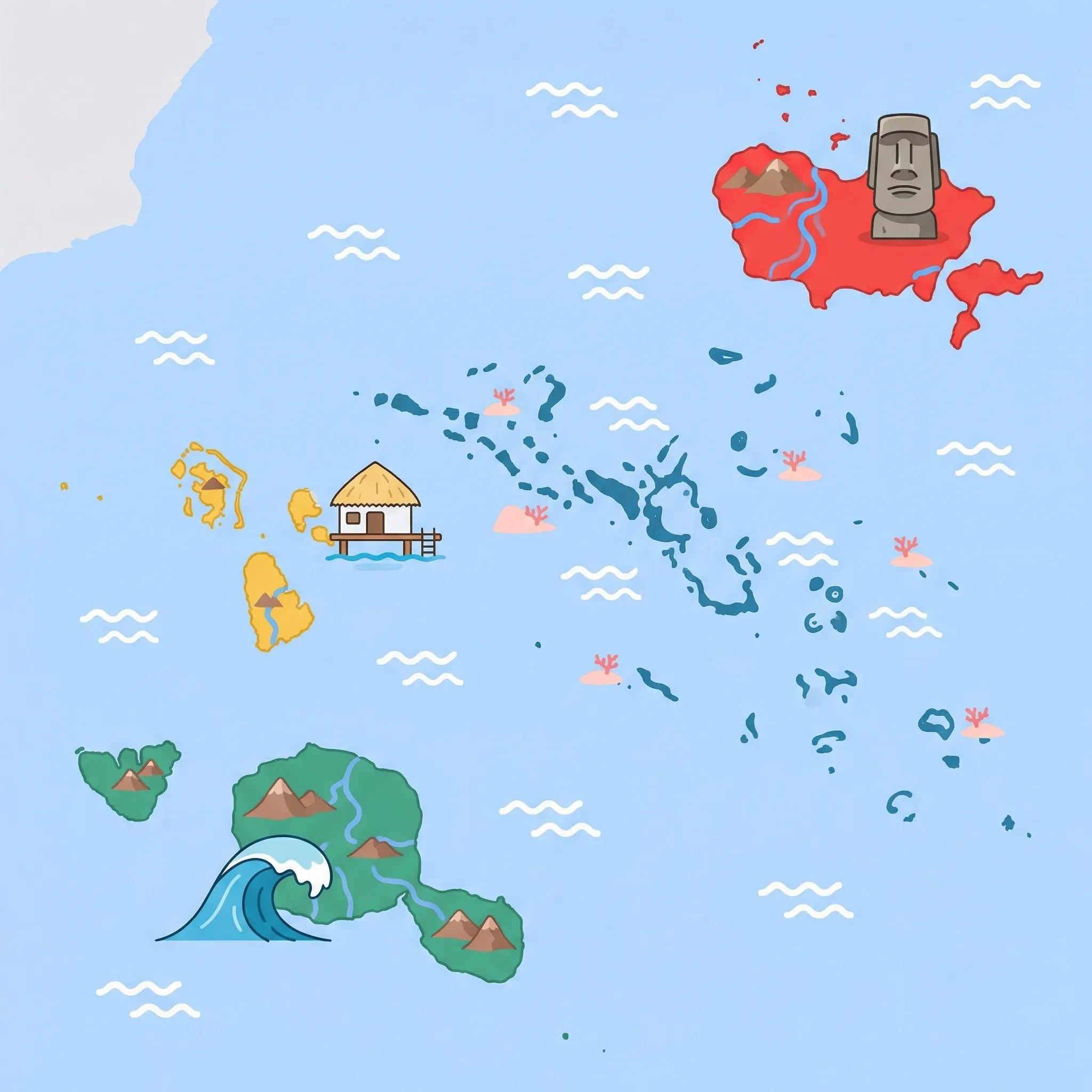
Click a region to explore
Overview
Important Travel Context: The Marquesas are extremely remote and lack the protective coral lagoons found elsewhere in French Polynesia. Swimming is mostly done in deep bays or hotel pools, not calm turquoise shallows. The ocean here is darker and wilder.
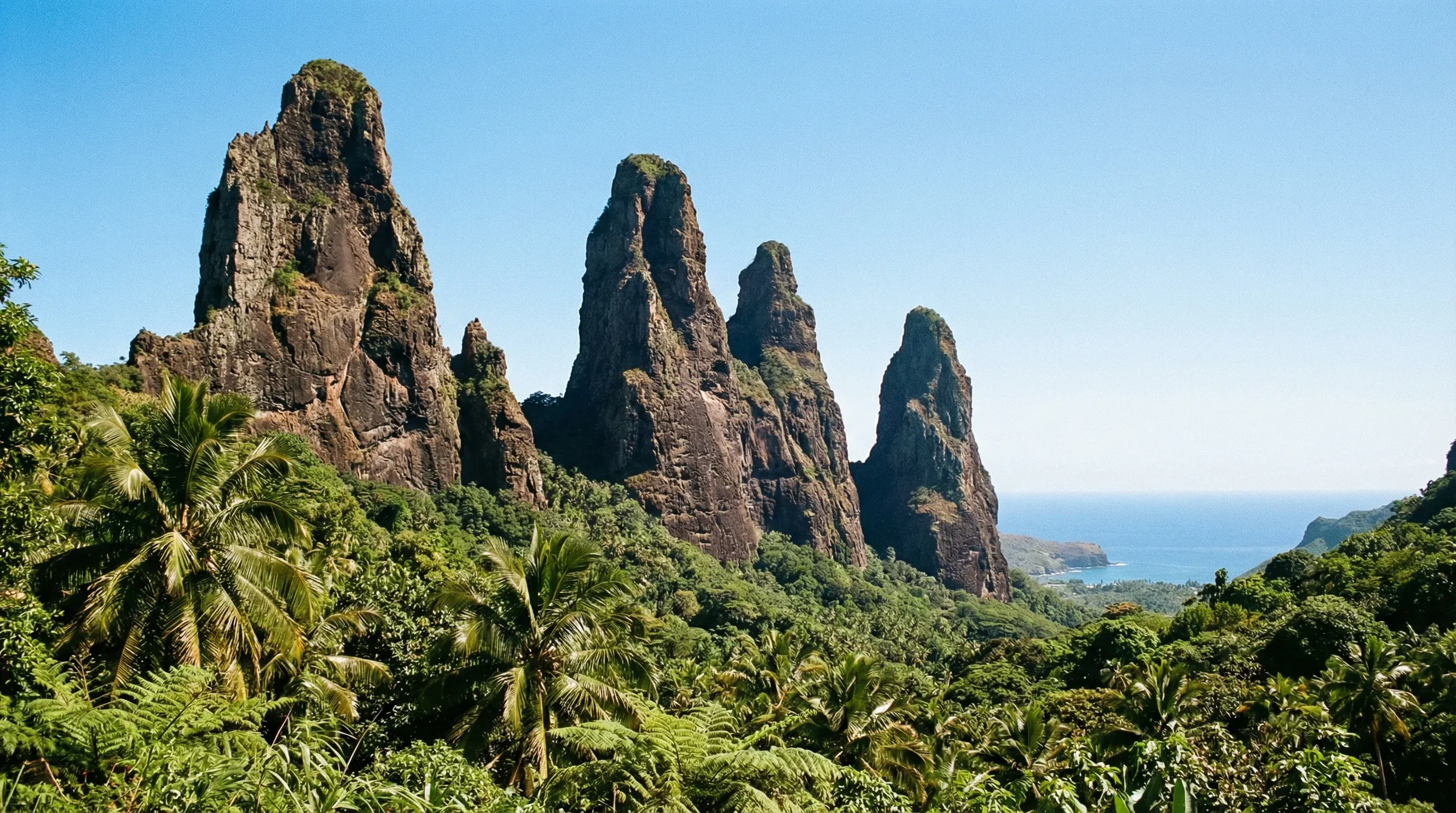
The Marquesas (Henua Enana) feel like the edge of the world. For families with older children or teens who crave adventure over lounging, this is a destination of mythical proportions. The landscape is dramatic—towering basalt spires pierce the clouds, and wild horses roam the plateaus. This region is culturally distinct from Tahiti; the dialect is different, the haka is danced with ferocity, and the art of wood carving and tattooing is world-famous. It is a place that feels alive and untamed, resembling Hawaii fifty years ago or a lost prehistoric world.
There are no overwater bungalows here. Instead, families stay in charming lodges nestled in the hills or sail aboard the cargo-cruiser Aranui. The focus is on the land: hiking into deep valleys to find ancient stone tikis hidden in banyan trees, horseback riding across windswept ridges, and 4x4 safaris that navigate steep mountain roads. The isolation fosters a unique hospitality; the Marquesans are incredibly welcoming and eager to share their distinct culture. It provides a profound lesson in geography and isolation for children, showing them a way of life that is self-sufficient and deeply connected to the rugged nature surrounding it.
Key Attractions
On Nuku Hiva, the Vaipo Waterfall is a must-see. It is one of the tallest waterfalls in Polynesia, cascading over 350 meters down a jungle cliff. Accessing it involves a boat ride and a hike through the Hakaui Valley, an adventure that feels like true exploration. On the island of Hiva Oa, families can visit the Espace Culturel Paul Gauguin. While the original paintings are in Europe, this museum offers excellent reproductions and tells the story of the artist's final years here, alongside a replica of his "Maison du Jouir." It provides a colorful, accessible art history lesson for kids. On Ua Pou, the skyline is dominated by The Spires of Ua Pou, incredible basalt columns that look like a castle from a fantasy novel. Seeing these clouds-piercing pinnacles from the village of Hakahau is an unforgettable sight.
Practical Advice
The climate is subtropical but slightly cooler than Tahiti; pack light rain gear as showers are frequent and keep the islands lush. The most critical advice for this region is regarding insects: "Nono" flies (biting midges) are common on beaches. They are small but leave itchy bites. Families must pack strong repellent and wear long trousers when hiking or near the shore. Cash is king here; ATMs are scarce outside the main villages of Taiohae and Atuona.
Food & Drink
Typical meal times: Early to bed, early to rise. Lunch 11:30 am to 1:30 pm. Dinner 6:30 pm to 8:30 pm. Many places close early on Sundays.
Typical meal costs: Slightly cheaper than Bora Bora but logistics add cost. Meals cost 2,500–4,500 XPF (approx. $23–41 USD / €21–38 EUR). Portions are often large and hearty.
Dietary requirements: Vegetarian options are limited compared to the Society Islands. The diet is heavy on meat and root vegetables. Inform your host in advance if you have specific needs.
Signature dishes:
- Kaaku – A staple paste made from breadfruit (uru) pounded with coconut milk, often served with meat.
- Goat Curry – Wild goats are hunted in the mountains; the meat is slow-cooked in curry spices and coconut milk.
- Lobster – The rocky coastlines (without reefs) are rich in spiny lobster, often grilled simply over wood fires.
Why this score?
This is a truly rugged frontier with vertical volcanic cliffs, no protective reefs, and vast tracts of jungle accessible only by 4x4 or horseback. The lack of standard tourist infrastructure and the physical demands of navigating the 'Land of Men' make it a significant adventure for any traveler.
Why this score?
Medical facilities are extremely limited, consisting mostly of small government-run dispensaries or infirmaries with restricted equipment. Specialist care is non-existent on the islands, and the extreme distance from Tahiti makes emergency response times very long and logistically complex.
Why this score?
Located nearly 1,000 miles from Tahiti, the Marquesas receive only a tiny fraction of the country's already modest visitor numbers. Most tourists arrive via the Aranui cargo-cruise ship or expensive, infrequent domestic flights, making it a niche destination for dedicated explorers.

While accommodation can be slightly cheaper than Bora Bora's luxury resorts, the cost of getting here (flights are pricey) and the necessity of hiring guided 4x4 transport daily balances it out. A family pension stay with half-board costs around 20,000–35,000 XPF (approx. $180–320 USD / €165–295 EUR) per night. Guided excursions cost 8,000–12,000 XPF (approx. $73–110 USD / €67–100 EUR) per person.
Family Travel Notice
Tahiti and Moorea are often recommended as the most suitable islands for families due to better infrastructure and facilities.

Getting Here & Around
Getting Here
- Airports – Nuku Hiva (NHV) and Hiva Oa (AUQ) are reached via a 3.5-hour flight from Tahiti (PPT). The flight is long and expensive, often stopping in the Tuamotus.
- Ship – The Aranui 5 is a cargo-passenger ship that supplies the islands. It is a legendary way to visit, acting as a lifeline for the region. It stops at major sites like The Spires of Ua Pou.
Getting Around
- 4x4 with Driver – Essential. The roads are steep, winding, and often unpaved. Renting a car without a local driver is not recommended for tourists. Drivers double as guides.
- Walking – Within the small villages like Taiohae, walking is safe and easy, but distances between valleys are too great for walking.
- Horseback – A very popular and traditional mode of transport in the Marquesas, with tours available for all skill levels.
Nearby Airports (4 airports)
Atuona
AUQAtuona
Nuku Hiva
NHVNuku Hiva
Ua Huka Airport
UAHUa Huka
Ua Pou Airport
UAPUa Pou, Marquesas Island
View full flight map for French Polynesia →
Official Links

Packing List
Crucial for 'Nonos' (biting sandflies). Normal herbal repellents do not work here.
Sudden tropical downpours are common in the high mountains.
Terrain is rugged, rocky, and muddy; flip-flops are useless for excursions.
ATMs are very rare; artisans and small guides only accept cash.
Essential for all ages due to sharp coral and stonefish in the lagoons. Flip-flops are not sufficient for water entry.
The sun is far stronger here than in Europe or the US. Sunscreen washes off; UV shirts protect kids during long snorkel sessions.
Boat transfers and dinghy landings are common. Keeps phones and spare clothes dry when splashing across lagoons.
Rental gear often leaks on small faces. Having a well-fitted set ensures your child's first shark/ray encounter is fun, not salty.
Strictly encouraged to protect the reefs. Local options are expensive, so bring a supply of zinc-based or reef-safe cream.

Activities & Best Times

Hiking, wildlife, outdoor exploration, ecotourism
An exceptional destination for wilderness immersion featuring the towering Vaipo Waterfall and the iconic Spires of Ua Pou. Travel is best during the drier season to ensure trail accessibility and safety on steep, volcanic terrain that becomes hazardous during heavy rains (Jan-Mar).

Urban tourism, museums, historical sites, architecture
The region offers profound Polynesian heritage through world-class archaeological sites like Te Iipona and Kamuihei, which feature some of the largest tikis in the Pacific. Peak season aligns with dry conditions necessary for exploring these open-air heritage sites and historic valley settlements.

Beach resorts, marine activities: diving, snorkelling, kite surfing, wind surfing, sailing
While lacking the classic coral lagoons of the Society Islands, the Marquesas offer dramatic volcanic bays like Anaho and Hanavave with a rugged, wild beauty. The drier months from August to November provide the best visibility and calmer sea conditions for boat access to these remote shores.

Scenic drives, countryside tours, route-based travel
Features spectacular, high-altitude driving routes such as the Taiohae to Hatiheu drive, offering some of the most dramatic coastal vistas in the Pacific. Reliable road conditions are critical on these steep, winding paths, making the drier months from August to November the peak window.

Learning experiences, scientific sites, historical education
Niche educational appeal centered on the Enana culture and marine history at Musée Enana and the Hane Sea Museum. These facilities provide specialized context for the region's unique isolation and evolution, though they are secondary to the natural attractions.

Sport tourism, fitness activities, active recreation
Primarily focused on rigorous trekking and legendary horse-riding routes through deep valleys and over mountain passes. While physically demanding, the lack of modern sporting infrastructure limits the rating to marginal for specialized sport tourists.




Public Holidays & Calendar Next 12 months
Public holidays, festivals, cultural celebrations, and seasonal natural phenomena coming up in Marquesas Islands over the next 12 months.
Loading holidays and events...

Travel Advisory
All major agencies agree that French Polynesia is a safe destination requiring only standard safety and security awareness. There are no significant nationwide threats.
Safety Topics
Traveller Advice (5 groups)

Review general guidance for sexual and gender minorities to ensure awareness of local cultural attitudes, though French law applies.

Female travellers should follow standard safety protocols and dress conservatively when visiting religious sites or attending church services.

Tahiti and Moorea are often recommended as the most suitable islands for families due to better infrastructure and facilities.

Ensure water sports and diving are conducted with reputable, insured companies. Wear protective reef shoes to avoid injuries from coral or stonefish.

Maintain standard vigilance against petty crime and ensure you have valid travel insurance that covers medical evacuation from remote islands.
Agency Summaries
Travellers should maintain a standard level of safety awareness as they would in Canada. There are no major security concerns, although occasional demonstrations occur and should be avoided.
No specific travel restrictions are in place. Visitors are advised to follow routine safety protocols and be aware of health entry requirements and local legal differences.
French Polynesia is considered a safe destination with low crime rates. Standard safety measures are sufficient for visitors, though awareness of local traffic and environmental hazards is recommended.
The overall security situation is stable. Visitors should stay informed about weather-related risks and follow standard personal safety practices, particularly in crowded areas.
There is no specific travel advisory for French Polynesia, indicating a low risk level. Travellers are encouraged to have comprehensive insurance and take standard precautions.
Irish citizens are advised to exercise a standard degree of caution and be mindful of their surroundings and personal belongings while travelling.
Information is provided for general guidance only and does not constitute travel, safety, medical, or legal advice. Conditions may change. Users are responsible for independently verifying information before travel.