
Click a region to explore
Overview
Safety Warning: The "passes" (channels where the ocean meets the lagoon) have extremely strong currents during tidal changes. Always snorkel with a guide and listen to safety briefings carefully. Never let children swim in the passes unaccompanied.
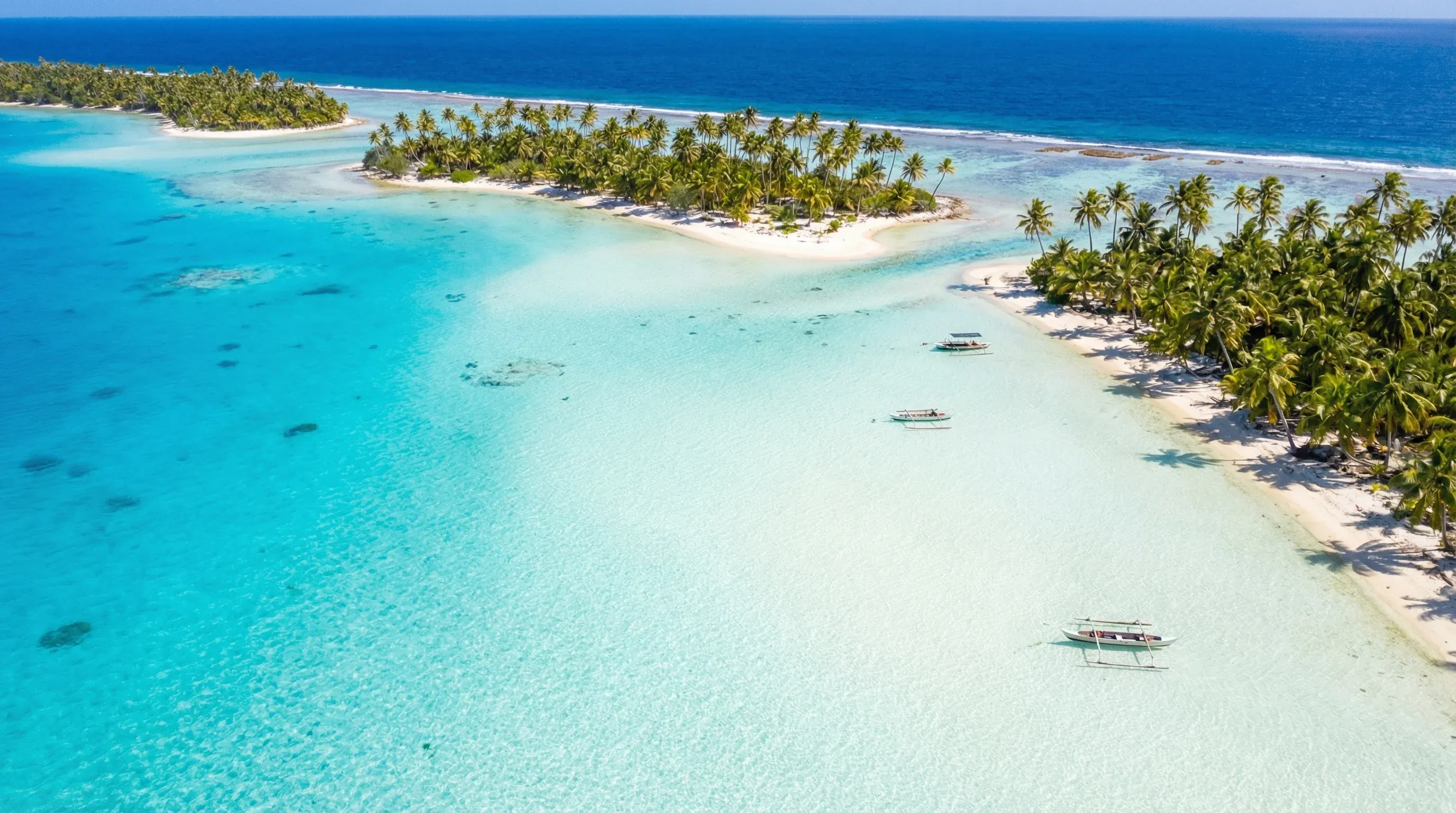
The Tuamotu Archipelago is geographically unique; these are atolls—sunken volcanoes where only the surrounding coral reef remains above water. There are no mountains, no rivers, and no valleys. It is a flat world of blindingly white sand, coconut palms, and the most spectacular water colors on the planet. For families, this is a destination focused almost entirely on the ocean. If your family loves water, this is heaven. If you need hiking or shopping, this is not the place. The pace of life here is incredibly slow and peaceful. The locals live in harmony with the tides, and the silence is broken only by the sound of waves and wind in the fronds.
Rangiroa is the most famous atoll, with a lagoon so large the entire island of Tahiti could fit inside it. It is renowned for "shooting the pass," where you drift-snorkel in the current watching sharks and dolphins below you. Fakarava is a UNESCO Biosphere Reserve, offering pristine pink sand beaches and untouched coral gardens. These islands are less commercial than Bora Bora; the accommodation is often in family-run pensions where you eat dinner with the hosts, providing a warm, communal experience for children.
Key Attractions
In Rangiroa, the absolute highlight for families is a day trip to the Blue Lagoon (Le Lagon Bleu). It is a "lagoon within a lagoon"—a circle of motus (islets) creating a shallow, swimming-pool-like area of water that is impossibly bright blue. Small blacktip sharks (harmless) school here, and children can walk among them in knee-deep water. It looks like a postcard come to life. Another key experience is visiting the "Aquarium" near the Tiputa Pass, a sheltered coral garden teeming with thousands of butterflyfish, surgeonfish, and parrotfish, accessible even to novice snorkelers.
Practical Advice
Fresh water is a precious resource on atolls (mostly rainwater collection), so families should be mindful of usage. The internet can be slow or non-existent. Medical facilities are basic (infirmaries), with serious cases evacuated to Tahiti. Pack absolutely everything you need (diapers, specific meds, batteries) as shops are small and supply ships can be delayed.
Food & Drink
Typical meal times: Regulated by the sun. Breakfast 7:00 am. Lunch 12:00 pm. Dinner is often communal in guesthouses at 7:00 pm sharp.
Typical meal costs: Expensive due to freight. Restaurant meals 2,500–4,000 XPF (approx. $23–36 USD / €21–33 EUR). Full board in pensions is the best value option.
Dietary requirements: Challenging for strict vegans or picky eaters. The diet is heavily fish-based. Vegetables are imported and expensive. Inform hosts in advance.
Signature dishes:
- Korori – Pearl meat (the adductor muscle of the pearl oyster), usually served as a carpaccio with lime. A local delicacy.
- Lagoon Fish – Parrotfish or Grouper, grilled simply. Note: Some lagoon fish can carry ciguatera; always ask locals what is safe to eat.
- Pain Coco – Coconut bread, often baked fresh for breakfast in the pensions.
Why this score?
The adventure here is water-based, involving drift diving through high-current passes and exploring remote, uninhabited motus. Living on a low-lying coral atoll with limited resources and extreme exposure to the elements provides a high sense of isolation and ruggedness.
Why this score?
Medical infrastructure is nearly non-existent outside of basic first-aid clinics meant for the local population. While some diving operations have emergency oxygen and protocols, any serious illness or injury necessitates a complex air transfer to Tahiti.
Why this score?
These atolls are specialized destinations primarily attracting world-class divers and luxury yacht enthusiasts. Outside of the main hubs of Rangiroa and Fakarava, the islands see very few international visitors due to their isolation and limited land-based attractions.

Accommodation is generally cheaper than the Society Islands (mostly guesthouses rather than 5-star resorts), but food and activities are pricey due to remoteness. A family pension with half-board (breakfast + dinner) is the standard model, costing 25,000–40,000 XPF (approx. $230–365 USD / €210–335 EUR) per night for a family unit. Excursions like the Blue Lagoon cost approx 10,000 XPF (approx. $90 USD / €84 EUR) per person.
Family Travel Notice
Tahiti and Moorea are often recommended as the most suitable islands for families due to better infrastructure and facilities.

Getting Here & Around
Getting Here
- Airports – Rangiroa (RGI) and Fakarava (FAV) are connected by daily flights from Tahiti (PPT). Flight time is approx 1 hour. The view of the atolls from the air is spectacular.
- Connections – There are direct flights between Bora Bora and Rangiroa, allowing you to combine the two regions without returning to Tahiti.
Getting Around
- Bicycle – The atolls are completely flat. Many pensions provide free bikes (often with child seats), which are the best way to get around the single main road.
- Boat – Essential for excursions. To see the Blue Lagoon, you must book a boat tour operator.
- Walking – Distances can be deceivingly long in the heat, but villages are compact.
Nearby Airports (16 airports)
Anaa Airport
AAAAnaa
Ahe Airport
AHEAhe
Arutua Airport
AXRArutua
Fangatau Airport
FGUFangatau, Tuamoto Island
Kauehi Airport
KHZKauehi
Kaukura Atoll Airport
KKRKaukura Atoll
Katiu Airport
KXUKatiu
Makemo Airport
MKPMakemo
Nukutavake Airport
NUKNukutavake, Tuamoto Island
Puka Puka Airport
PKPPuka Puka
Rangiroa Airport
RGIRangiroa
Aratika-Nord Airport
RKAAratika
Tikehau Atoll
TIHTikehau Atoll
Takume Airport
TJNTakume
Takapoto Airport
TKPTakapoto
Vahitahi Airport
VHZVahitahi
View full flight map for French Polynesia →
Official Links

Packing List
You are on the equator with no shade and fragile coral reefs. Massive quantities needed.
Boat rides are wet; keeps cameras and clothes dry during lagoon crossings.
The scenery underwater is better than above water; you will regret not having one.
Coral cuts and swimmer's ear are common; pharmacies are limited.
Essential for all ages due to sharp coral and stonefish in the lagoons. Flip-flops are not sufficient for water entry.
The sun is far stronger here than in Europe or the US. Sunscreen washes off; UV shirts protect kids during long snorkel sessions.
Rental gear often leaks on small faces. Having a well-fitted set ensures your child's first shark/ray encounter is fun, not salty.
Strictly encouraged to protect the reefs. Local options are expensive, so bring a supply of zinc-based or reef-safe cream.

Activities & Best Times
Beach resorts, marine activities: diving, snorkelling, kite surfing, wind surfing, sailing
The Tuamotu atolls are world-renowned for pristine lagoons like the Blue Lagoon and exceptional snorkeling/diving conditions. Fakarava is a UNESCO Biosphere Reserve with exceptional marine biodiversity. These are globally premier beach and lagoon destinations and should be rated 'excellent'.

Hiking, wildlife, outdoor exploration, ecotourism
Home to world-class marine biodiversity in the Fakarava UNESCO Biosphere Reserve and the massive Rangiroa lagoon, featuring unique wildlife experiences at Tiputa and Garuae Passes. The dry season provides the most comfortable conditions for boat-based wilderness immersion and visits to remote pearl and wine farms.

Sport tourism, fitness activities, active recreation
The atolls offer unique cycling routes across narrow strips of land between lagoon and ocean, particularly in Rangiroa and Fakarava. The mid-year months offer consistent trade winds and lower temperatures, making outdoor physical activity significantly more enjoyable for families.

Urban tourism, museums, historical sites, architecture
While the Tetamanu Church and pearl farms offer cultural interest, the sparse atoll settlements lack the depth of cultural attractions to warrant 'good.' The church is significant regionally but not internationally. Should be 'marginal'.




Public Holidays & Calendar Next 12 months
Public holidays, festivals, cultural celebrations, and seasonal natural phenomena coming up in Tuamotu Atolls (Rangiroa, Fakarava) over the next 12 months.
Loading holidays and events...

Travel Advisory
All major agencies agree that French Polynesia is a safe destination requiring only standard safety and security awareness. There are no significant nationwide threats.
Safety Topics
Traveller Advice (5 groups)

Review general guidance for sexual and gender minorities to ensure awareness of local cultural attitudes, though French law applies.

Female travellers should follow standard safety protocols and dress conservatively when visiting religious sites or attending church services.

Tahiti and Moorea are often recommended as the most suitable islands for families due to better infrastructure and facilities.

Ensure water sports and diving are conducted with reputable, insured companies. Wear protective reef shoes to avoid injuries from coral or stonefish.

Maintain standard vigilance against petty crime and ensure you have valid travel insurance that covers medical evacuation from remote islands.
Agency Summaries
Travellers should maintain a standard level of safety awareness as they would in Canada. There are no major security concerns, although occasional demonstrations occur and should be avoided.
No specific travel restrictions are in place. Visitors are advised to follow routine safety protocols and be aware of health entry requirements and local legal differences.
French Polynesia is considered a safe destination with low crime rates. Standard safety measures are sufficient for visitors, though awareness of local traffic and environmental hazards is recommended.
The overall security situation is stable. Visitors should stay informed about weather-related risks and follow standard personal safety practices, particularly in crowded areas.
There is no specific travel advisory for French Polynesia, indicating a low risk level. Travellers are encouraged to have comprehensive insurance and take standard precautions.
Irish citizens are advised to exercise a standard degree of caution and be mindful of their surroundings and personal belongings while travelling.
Information is provided for general guidance only and does not constitute travel, safety, medical, or legal advice. Conditions may change. Users are responsible for independently verifying information before travel.