

French Southern Territories
French Southern and Antarctic Lands
Terres australes et antarctiques françaises
⚠️ SAFETY WARNING: Travel to the French Southern Territories involves extreme isolation. There are no hospitals, airstrips (for commercial use), or hotels. Medical evacuation can take days or weeks depending on weather. Visitors must be in good health, and this destination is best suited for families with teenagers or adult children, rather than young toddlers.
Overview
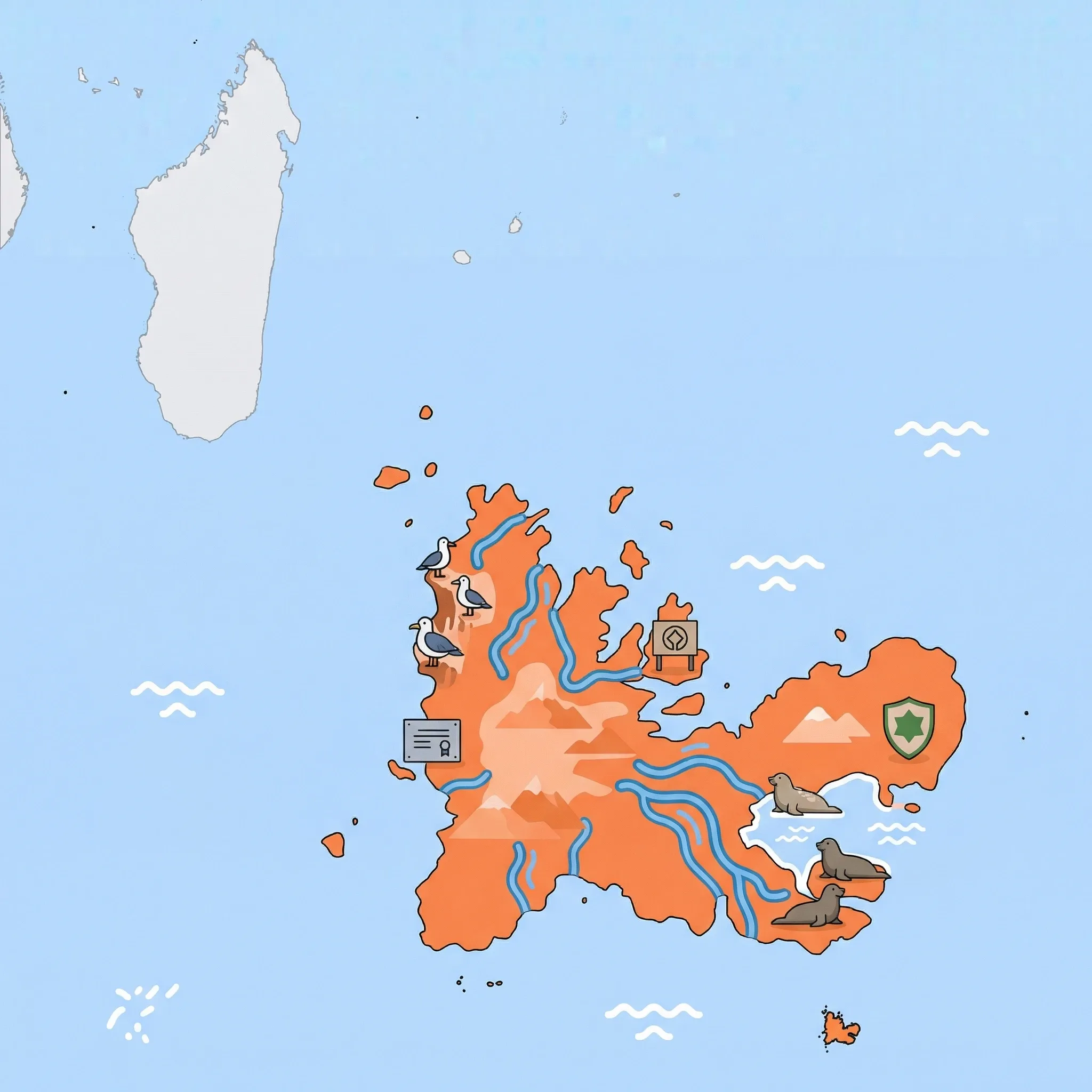
The French Southern & Antarctic Lands are not a country in the traditional sense, but a collection of remote islands scattered across the southern Indian Ocean, plus a slice of Antarctica. For families who have "seen it all," this is the ultimate frontier. The territory consists primarily of the Crozet Islands, the Kerguelen Islands (often called the Desolation Islands), and the Saint-Paul and Amsterdam Islands. These volcanic specks of land are battered by the winds of the Roaring Forties and Furious Fifties, creating dramatic, treeless landscapes that feel prehistoric. There is no permanent civilian population here-only rotating teams of scientists, military personnel, and conservationists living on research bases.
For a family expedition, the appeal lies entirely in the wildlife and raw nature. Imagine standing on a black sand beach surrounded by 200,000 King Penguins, their calls drowning out the sound of the surf. Children can witness the brutal but fascinating hierarchy of elephant seal colonies, watch orcas patrolling the coast, and see the world's largest seabirds nesting in the tussock grass. It is a living biology lesson on a massive scale. While the logistics are challenging and the cost is high, the experience of visiting one of the least-disturbed ecosystems on the planet is incomparable. Access is generally via luxury expedition cruises or the supply ship Marion Dufresne, making the journey itself part of the adventure.
Key Attractions
The Crozet Islands are arguably the crown jewel for wildlife watchers. The beaches here, particularly in the Baie du Marin, hold some of the largest King Penguin colonies in the world. Families can observe the fuzzy brown chicks in the "crèches" and watch the sleek adults return from the sea. It is an overwhelming sensory experience of sight, sound, and smell that defines the sub-Antarctic.
Further south lies the Kerguelen Archipelago, a massive island group dominated by the cook Ice Cap. The landscape is rugged and forbidding, carved by glaciers and dotted with fjords. Highlights include the Arch of Kerguelen, a stunning natural rock formation, and the historic Port-aux-Français research station. Here, visitors can see the introduced reindeer (a quirk of history) and the Commerson's dolphins playing in the kelp forests. The sheer isolation of Kerguelen gives it a mythical status among travelers.
To the north, the islands of Saint-Paul and Amsterdam offer a slightly milder climate. Amsterdam Island is famous for its cliffs-the Entrecasteaux cliffs are among the highest in the world-and its population of Amsterdam Albatrosses, one of the rarest birds on Earth. Exploring these islands feels like visiting a lost world, where nature is still entirely in charge and humans are just temporary guests.
Practical Advice
Best time to visit: The austral summer (November to March) is the only feasible time for tourism. Temperatures range from 2°C to 10°C (35°F–50°F), though wind chill makes it feel colder.
Visa basics: These territories are not part of the Schengen Area. A specific authorization from the TAAF administration is required, which is almost always handled by your cruise operator. Valid passports are essential.
Family logistics: There are no shops, pharmacies, or bathrooms ashore. All landings are by zodiac boat, requiring a reasonable level of fitness and mobility. Seasickness is a major consideration; the Southern Ocean is notoriously rough. Most operators have a minimum age limit (often 8–12 years).
Food & Drink
Dining in the French Southern & Antarctic Lands is strictly ship-based or, on rare occasions, inside a base mess hall.
Typical meal times:
Breakfast is typically 7:00 am to 8:30 am, Lunch 12:00 pm to 1:30 pm, and Dinner 7:30 pm to 9:00 pm, scheduled around shore landings.
Typical meal costs:
All food is included in the expedition price. If buying snacks/souvenirs at a base canteen (which uses the Euro): €5–15 (approx. $5.50–16 USD / £4–13 GBP).
Dietary requirements:
Expedition ships (especially French ones like Ponant) are excellent at catering to vegetarians, gluten-free, and allergies, provided you notify them in advance. Base food is hearty French canteen style (meat, potatoes, cheese, bread) and less flexible.
Family-friendly dining:
Ships offer familiar western foods (pasta, chicken, fruits). There are no "kids menus" at research bases, but the fresh French bread and pastries are universally loved.
Signature dishes:
While there is no indigenous cuisine, the "Base Life" food culture is unique:
- Pain Maison – Freshly baked French baguettes and bread made daily on the bases or ships-a comforting staple in the cold climate.
- Langouste (Rock Lobster) – Found in the waters around Saint-Paul and Amsterdam islands, this is a luxury treat occasionally served on supply ships or special base dinners.
- Kerguelen Cabbage – A native plant historically eaten by sailors to prevent scurvy, though now strictly protected and not for consumption-but famous in local lore.
- French Cheese Platter – Even in the most remote place on Earth, a proper meal ends with a selection of cheeses imported from mainland France.
Safety
Safety is paramount. The primary risks are weather and isolation. Sudden storms can strand shore parties. Visitors must strictly follow the expedition leader's instructions. Never approach wildlife too closely (keep 5-10 meters distance), as fur seals can be aggressive. Hypothermia is a risk even in summer; waterproof and windproof layers are non-negotiable. There is no crime, but the environment is unforgiving.

Visiting these territories is exclusively a high-end expedition experience. There are no budget options. A berth on a tourist cruise or the supply ship typically costs €9,000–20,000 (approx. $9,800–21,800 USD / £7,800–17,500 GBP) per person for a 2-3 week voyage. All expenses (accommodation, food, landings) are included in this upfront price.
Age Suitability




Why this score?
This is a true expedition territory characterized by extreme sub-Antarctic weather, the 'Furious Fifties' sea conditions, and a total lack of tourism infrastructure like hotels or roads. Visitors must navigate rugged volcanic terrain and interact with massive wildlife colonies in an environment where humans are strictly guests in a pristine wilderness.
Why this score?
There are no public hospitals or commercial medical services in the territory, with only small infirmaries available at scientific stations for emergency staff use. A serious medical emergency requires a complex sea evacuation to Réunion or Australia, a journey that can take more than a week depending on the ship's location and weather.
Why this score?
This territory is among the least-visited places on Earth, with no permanent residents and access restricted to a few berths on the Marion Dufresne supply ship each year. Most visitors are scientists or military personnel, and total annual tourist numbers rarely exceed 200, making it a niche expedition destination rather than a standard tourist region.
This is one of the most exclusive travel experiences on Earth. A berth on the supply ship rotation typically costs between €9,000–17,000 (approx. $9,700–18,300 USD / £7,700–14,500 GBP) per person depending on the cabin class. This fee covers all transport, accommodation, food, and guiding for the month-long voyage. There are no opportunities to spend money on the islands themselves, aside from a small 'postal gérant' shop selling stamps and philatelic souvenirs.

Getting There & Around
Getting There
- By Sea (Expedition Cruise) – The most common way for tourists to visit is aboard a specialized ice-strengthened expedition ship (e.g., Ponant). These voyages typically depart from South Africa, Mauritius, or Réunion Island and last 14–21 days.
- By Sea (Supply Ship) – The French research vessel Marion Dufresne conducts 4 rotations per year from Réunion Island to French Southern & Antarctic Lands. It traditionally accepted a small number of tourists (approx. 12 per trip), though this program is periodically suspended. It is a working vessel, not a cruise ship.
- Entry Requirements – Access is strictly controlled. Tourists must be part of an organized expedition that handles the TAAF permits. Check your government website for the latest visa requirements, or use the IATA Travel Centre entry-requirements checker.
Getting Around
- By Zodiac – All transfers from the ship to the islands are done via Zodiac (inflatable rubber boats). This requires stepping from a gangway into a moving boat in potentially choppy water-life jackets are mandatory.
- On Foot – Once ashore, travel is exclusively by walking. There are no tourist buses or cars. Terrain can be muddy, rocky, and steep.
- Helicopter – On the supply ship Marion Dufresne, ship-to-shore transport for logistics is sometimes done by helicopter, but this is rarely available for tourists unless specified in a luxury package.

Packing List
The Southern Ocean (Roaring Forties) produces some of the roughest seas on the planet; standard pills may not be enough.
Zodiac landings are wet, and you will likely be sitting in guano or mud while observing penguins.
Horizontal rain and wind gusts over 100km/h can make it impossible to keep your eyes open without protection.
Salt spray is constant on zodiacs; a simple backpack will soak through and ruin electronics instantly.
Essential for spotting albatrosses at sea and observing seal behavior from the required safety distance.

Activities & Best Times

Adventure & Nature
GoodHiking, wildlife, outdoor exploration, ecotourism
Upgrade from 'marginal' to 'good' - while access is extremely restricted and expensive (expedition cruises only, ~$10k-30k), the region offers genuinely world-class wilderness and wildlife experiences for those who can reach it. UNESCO World Heritage Site status, largest king penguin colonies globally, and pristine sub-Antarctic ecosystems make this a bucket-list destination for serious nature travelers. 'Marginal' incorrectly suggests poor quality; the barrier is accessibility, not experience.


Public Holidays & Calendar Next 12 months
Public holidays, festivals, cultural celebrations, and seasonal natural phenomena coming up in French Southern Territories over the next 12 months.
Loading holidays and events...

Travel Advisory
Travel to the French Southern Territories requires elevated caution. While the risk of crime or unrest is negligible due to the lack of a permanent population, the extreme environmental hazards, lack of medical facilities, and the requirement for specialized permits create a complex safety environment. Most agencies maintain this level based on the governing state's security profile and regional environmental risks.
Safety Topics
Traveller Advice (3 groups)
Scientific and research staff should adhere to strict TAAF (French Southern and Antarctic Lands) protocols regarding environmental impact and station safety. Emergency plans must be coordinated with the French Polar Institute.

These territories are extremely isolated and rugged. Visitors must be in excellent physical health to manage landings in rough seas and trekking over icy or volcanic terrain. Specialized polar gear and professional guides are essential.

Tourism is strictly limited and generally restricted to guided cruises on specific research supply vessels. Advance permits from the TAAF administration in Réunion are mandatory for any landing.
Agency Summaries
Travellers should remain highly vigilant while visiting French territories due to a persistent threat of extremist activity across French jurisdictions. Although the Southern Territories are extremely remote, the national security level for the governing state remains elevated.
Vigilance is advised across all French territories. For remote polar and sub-antarctic regions, the lack of consular support and the treacherous nature of the terrain and weather represent significant safety considerations.
While standard safety awareness is generally sufficient, travellers should note that laws and logistics in French overseas territories differ from the mainland. Thorough research into transport and environmental permits is required.
Increased vigilance is recommended primarily due to the extreme and volatile environmental conditions and the severe lack of emergency infrastructure. Consular assistance is not available within the territory, and travellers must be entirely self-sufficient.
No specific travel restrictions are in place for the French Southern Territories, though the general safety profile follows that of the French Republic. Visitors should be aware of stringent environmental laws and the logistical challenges of reaching these remote islands.
A heightened level of security awareness is maintained for French territories. For the Southern Lands, safety concerns are predominantly environmental, involving unpredictable weather and limited access to help.
Information is provided for general guidance only and does not constitute travel, safety, medical, or legal advice. Conditions may change. Users are responsible for independently verifying information before travel.