

⚠️ SAFETY WARNING: Governments currently advise against all travel to the breakaway regions of Abkhazia and South Ossetia due to military presence, unexploded ordnance, and lack of consular support. Additionally, political demonstrations can occur in central Tbilisi; visitors should exercise caution, avoid large gatherings, and monitor local media. The rest of the country remains open and generally safe for tourism, but staying informed is essential.
Overview
Situated at the cultural crossroads of Europe and Asia, Georgia offers families a rich tapestry of experiences that blend rugged adventure with deep-rooted tradition. The landscape shifts dramatically from the semi-desert hills of the southeast to the snow-capped peaks of the Kazbegi & Greater Caucasus range, giving children the sense of exploring several different worlds in a single trip. Georgian culture is famously hospitable-the concept of the supra (feast) is central to daily life, and families are often treated with special warmth. While English is widely spoken in tourist hubs, the unique Georgian alphabet and language add a layer of mystery that young explorers will love decoding.
For active families, the country is a paradise. You can hike to glaciers in the morning and swim in the Black Sea by the afternoon. The cities are equally engaging, mixing futuristic architecture with winding old-town streets that feel like movie sets. Whether you are wandering the cobbled alleys of Tbilisi or marveling at the defensive towers of Svaneti, the sense of history is palpable but accessible. The pace of life is relaxed, costs are reasonable, and the food-arguably the world's most kid-friendly cuisine-will ensure no one goes hungry.
Key Attractions
Start your journey in the capital, where Mtatsminda Park offers a retro theme park experience atop the highest point in the city, reachable by a funicular railway. Just below, the National Botanical Garden of Georgia features a waterfall right in the city center, perfect for a cooling splash. Kids will be fascinated by the futuristic The Bridge of Peace, which lights up at night, and the historic Abanotubani district, where sulfur bath domes rise from the ground like strange brick bubbles.
Head north into the mountains to witness the iconic Gergeti Trinity Church, perched dramatically under the towering Mount Kazbek; local jeeps can drive families right up to the doorstep for an unforgettable view. In the east, the Kakheti wine region isn't just for adults-the Sighnaghi Historic Town is a fully walled hilltop citadel where children can walk the ramparts and imagine defending the valley. For a change of pace, the Batumi & Black Sea Coast offers seaside fun, including the world-class Batumi Dolphinarium and the mesmerizing kinetic Ali and Nino Statue which slowly merges two massive steel figures.
Practical Advice
The best times to visit are late spring (May-June) and early autumn (September-October), when the weather is warm but not scorching, and the mountains are accessible. Summer in Tbilisi can be intensely hot. Getting around is an adventure in itself; while the railway connects major cities comfortably, shorter trips often rely on marshrutkas (minibuses). For families, hiring a private driver or using apps like Bolt is highly recommended for safety and comfort. Public toilets can be scarce in rural areas, so plan stops at restaurants or petrol stations.
Food & Drink
Typical meal times: Lunch is usually eaten late, from 1:00 pm to 3:00 pm. Dinner is a lingering affair, typically starting between 8:00 pm and 9:00 pm.
Typical meal costs: 40–80 GEL (approx. $15–30 USD / €14–28 EUR) for a mid-range family meal. Fine dining in Tbilisi can cost 100–200 GEL (approx. $37–75 USD / €35–70 EUR).
Dietary requirements: Vegetarians will thrive here, as many dishes rely on walnuts, aubergines, beans, and cheese. Vegan options are common in the form of pkhali (vegetable pâtés) and bean stews, though always check if butter or cheese is used. Gluten-free is difficult due to the ubiquity of bread.
Family-friendly dining: Georgian food is naturally kid-friendly, focusing on bread, cheese, and dumplings. Restaurants are very welcoming to children, though highchairs are not guaranteed in smaller, traditional venues.
Signature dishes:
- Khachapuri – The national cheese bread. The Adjaruli version is boat-shaped, filled with melted cheese, butter, and an egg-kids love mixing it together.
- Khinkali – Giant soup dumplings eaten with your hands. It is a fun challenge to bite a small hole, drink the broth, and eat the rest without spilling.
- Pkhali – Colorful vegetable pâtés (spinach, beetroot, or bean) blended with walnut paste and pomegranate seeds, served as a starter.
- Churchkhela – A traditional candle-shaped candy made of grape must and nuts, often called "Georgian Snickers."
- Lobio – A thick, savory bean stew served in a clay pot, often with cornbread (mchadi) for dipping.
Safety
Beyond the specific regional warnings, Georgia is statistically very safe regarding violent crime. However, traffic can be chaotic, and pedestrian crossings are not always respected by drivers-hold hands firmly near roads. Stray dogs are common; most are tagged, vaccinated, and friendly, but instruct children not to pet them. In mountainous areas, weather changes rapidly, so always carry warm layers. Avoid political demonstrations in Tbilisi if they occur.

Georgia offers exceptional value for families. A family of four can travel comfortably for 400–600 GEL (approx. $150–225 USD / €140–210 EUR) per day, covering mid-range accommodation, generous meals, and private transport. While prices in Tbilisi have risen, they remain significantly lower than in Western Europe.
Age Suitability





Did you know? Georgia welcomes approximately 5.1 million international visitors per year. Most visitors come from Europe.
Explore Regions
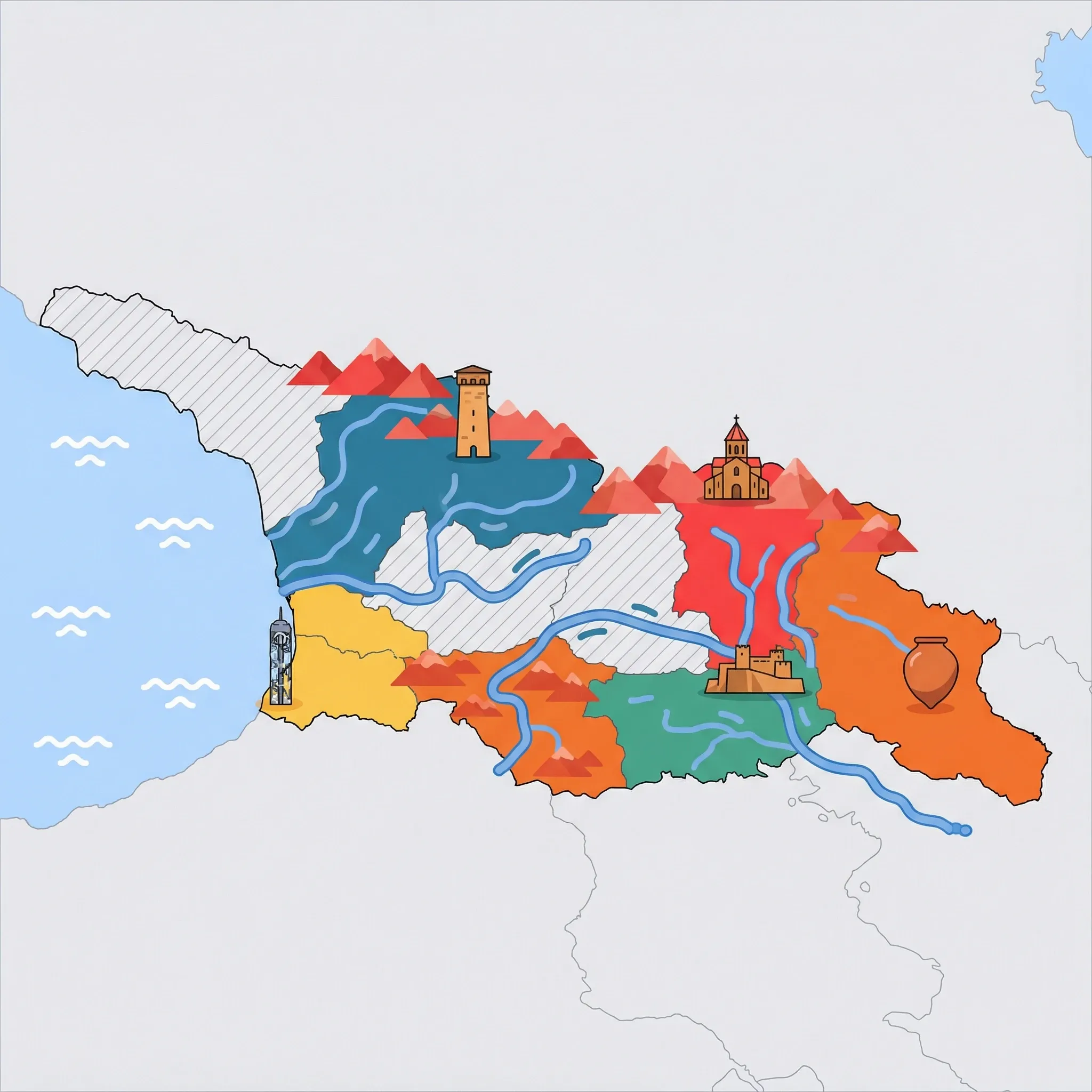
5 Regions
Batumi & Black Sea Coast
Subtropical vibes, pebble beaches, and endless family entertainment 🐬🌴
Kakheti (wine region)
Ancient castles, rolling vineyards, and the best food in Georgia 🍇🏰
Kazbegi & Greater Caucasus
Touching the clouds on the roof of Europe 🏔️🦅
Svaneti
Where medieval towers meet the wildest peaks 🏔️🏰
Tbilisi
A city of balconies, cable cars, and warm embraces 🎡🚠
Click on a region marker to explore details. Use the dropdown to color regions by activity suitability.

Getting There & Around
Getting There
- By Air – Tbilisi International Airport (TBS) is the main hub. Kutaisi International Airport (KUT) is a major base for low-cost European carriers and is a 3-4 hour drive from the capital. Batumi International Airport (BUS) serves the Batumi & Black Sea Coast.
- By Train – An overnight sleeper train connects Baku (Azerbaijan) and Yerevan (Armenia) to Tbilisi, though land borders with Azerbaijan may be subject to closures (check current status).
- Entry Requirements – Citizens of the US, UK, EU, and many other nations can enter visa-free for up to 1 year. Check your government website for the latest visa requirements, or use the IATA Travel Centre entry-requirements checker.
Getting Around
- Private Drivers – The most stress-free option for families. Apps like Bolt work in major cities, while services like GoTrip allow you to book vetted drivers for intercity travel at fixed prices, often cheaper than renting a car.
- Trains – The Georgian Railway operates modern, double-decker Stadler trains connecting Tbilisi to the Batumi & Black Sea Coast in about 5 hours. It is comfortable, scenic, and very safe for children.
- Marshrutkas – These ubiquitous minibuses go everywhere but can be cramped, driven aggressively, and confusing for non-Georgian speakers. Generally not recommended for families with young children or luggage.
- Cable Cars – In Tbilisi and mountainous regions like Chiatura, cable cars are a functional form of public transport, offering cheap and spectacular rides.

Packing List
Women must cover their heads to enter Orthodox churches; useful to keep one in your bag.
Essential for cleaning sticky hands after eating Khinkali (dumplings) the traditional way.
Even 'light' walks in Kazbegi or paved streets in Old Tbilisi can be steep, uneven, or muddy.
Street lighting in rural guesthouses and some historic city streets can be dim or inconsistent.
Some stricter monasteries require women to wear skirts (not trousers); wraps are often provided but own is better.
The local diet is very heavy on dough, cheese, and meat, which can be tough on sensitive stomachs.

Activities & Best Times

Adventure & Nature
ExcellentHiking, wildlife, outdoor exploration, ecotourism
Offers world-class alpine wilderness and authentic immersion in the Greater Caucasus, featuring iconic multi-day treks between UNESCO-listed medieval villages. Peak conditions occur in high summer when high mountain passes are clear of snow and wildflowers are in full bloom.
Offers world-class mountain scenery and high-altitude trekking including the iconic Mount Kazbek and Juta valley. Best explored in summer when high passes are snow-free; winter conditions make most trails dangerous or inaccessible for families.
Home to the unique Colchic Rainforests (UNESCO Heritage) in Mtirala National Park, offering lush biodiversity and temperate jungle experiences rare in this part of the world. Summer provides optimal trail conditions, while the region's exceptionally high winter and autumn rainfall makes mountain exploration difficult during the off-season.

City & Cultural
ExcellentUrban tourism, museums, historical sites, architecture
A historic crossroads of Europe and Asia featuring the Narikala Fortress and world-class fine art museums. Peak visits occur during the mild spring and autumn months when the city's street life and outdoor cafes are most vibrant.
Home to the culturally iconic Gergeti Trinity Church and Ananuri Fortress, representing the soul of Georgian highland heritage. Peak visitation occurs during warmer months when these historic sites are easiest to reach and enjoy on foot.
The unique Svan architecture and defensive towers of Ushguli and Mestia provide an authentic encounter with a living medieval culture and ancient traditions. Summer months ensure access to the most remote heritage sites that are frequently isolated by heavy winter snowfall.

Road Trips & Scenic
Very GoodScenic drives, countryside tours, route-based travel
The Georgian Military Highway is one of the world's most iconic mountain roads with exceptional historical and scenic significance. This elevation creates better differentiation from other Georgian road trip regions and aligns with international recognition of this route.
The drive from Zugdidi into Upper Svaneti follows the dramatic Enguri Gorge and is one of the world's most scenic mountain ascents. Optimal road safety and visibility for navigating high-altitude dirt roads are found in late summer, while winter brings significant risks of ice and landslides.
The Trans-Adjarian Highway and Machakhela Valley offer dramatic, rugged drives through the Lesser Caucasus mountains with authentic rural encounters. Access to high passes like Goderdzi is strictly seasonal, with heavy snow blocking routes from late autumn through mid-spring.

Sports & Active
Very GoodSport tourism, fitness activities, active recreation
Features internationally recognized trekking routes like the path to Ushguli and technical mountain infrastructure at Hatsvali. Peak season aligns with the summer window when trails are dry and safe for experienced hikers and mountain bikers seeking vertical challenges.
Offers significant infrastructure for urban hiking, cycling, and adventure parks like the Narikala Zipline. Peak months provide optimal weather for outdoor exertion, while winter months are less suitable due to cold and potential ice.
Offers established hiking and cycling infrastructure within national parks that cater to active families seeking rugged but organized routes. High-mountain trails are only fully accessible during the snow-free summer window, while lower trails remain viable in late spring and early autumn.

Relaxation & Wellness
GoodSpa retreats, wellness centers, peaceful getaways
Famous for its ancient, authentic sulfur bath district (Abanotubani) which offers a unique thermal experience in historic structures. These facilities are most appealing during the cooler months, providing a cozy contrast to the winter chill.
Unique wellness offerings include the therapeutic mud of Akhtala and traditional thermal baths, providing an authentic alternative to standard spa resorts. These facilities are most comfortable during the milder seasons when outdoor transit between pools and treatment areas is pleasant.

Theme Park & Entertainment
GoodAmusement parks, family entertainment venues

Educational & Exploratory
MarginalLearning experiences, scientific sites, historical education
The Kazbegi National Park Visitor Center offers localized insights into the region's unique biodiversity. It serves as a notable supplementary educational stop during the peak summer tourism season.
The Enguri Discovery Centre provides a focused look at massive Soviet-era hydroelectric engineering amidst the region's natural splendor. It is a niche attraction best visited during the main summer tourist season as a transit stop into the high mountains.

Ski & Snow
MarginalWinter sports, ski resorts, snow activities
Gudauri provides significant ski infrastructure with modern lifts and a long season. While a major regional hub, it is rated marginal for international families due to the limited number of distinct resorts in the immediate vicinity.
Goderdzi offers impressive snow depths and 'cat-skiing' potential for adventurous families, though infrastructure remains in early development stages. The season is reliable in mid-winter, but the resort's remote location and limited amenities place it below established European alpine standards.

Beach & Sea
MarginalBeach resorts, marine activities: diving, snorkelling, kite surfing, wind surfing, sailing
While popular regionally, the pebble beaches and variable water quality are modest compared to global benchmarks. The swimming season is relatively short, centered on the high summer months when Black Sea water temperatures become comfortable for families.
While landlocked, Ilia Lake offers a localized freshwater beach experience for families seeking summer recreation. It serves as a cooling retreat during the peak summer heat but lacks the scale and biodiversity of international maritime destinations.

Public Holidays & Calendar Next 12 months
Public holidays, festivals, cultural celebrations, and seasonal natural phenomena coming up in Georgia over the next 12 months.
Loading holidays and events...

Climate & Weather
Batumi & Black Sea Coast
Show Details
| Month | Temp °C | Rain | Humidity |
|---|
Kakheti (wine region)
Show Details
| Month | Temp °C | Rain | Humidity |
|---|
Kazbegi & Greater Caucasus
Show Details
| Month | Temp °C | Rain | Humidity |
|---|
Svaneti
Show Details
| Month | Temp °C | Rain | Humidity |
|---|
Tbilisi
Show Details
| Month | Temp °C | Rain | Humidity |
|---|

Travel Advisory
Five out of six major agencies classify Georgia's overall risk as the lowest level, recommending standard safety awareness. While serious regional warnings exist for the breakaway territories of Abkhazia and South Ossetia, the country is generally considered stable for tourism.
Safety Topics
Traveller Advice (3 groups)

While same-sex acts are legal, social attitudes can be conservative. Members of the LGBTQ+ community may face discrimination or harassment in public settings.

As of early 2026, all visitors are required to have valid health and accident insurance with a minimum coverage of 33,000 GEL. Proof of insurance may be requested upon entry.

Female visitors should exercise caution, particularly when traveling alone at night. Instances of harassment and sexual assault have been reported; avoid isolated areas and use reputable taxi applications instead of hailing cabs on the street.
Agency Summaries
Most of Georgia is safe for travel with standard vigilance. Australian travelers are advised to completely avoid South Ossetia and Abkhazia because of high risks involving terrorism and unexploded ordnance.
While general travel is permitted, the authorities warn against visiting breakaway regions and areas near their administrative boundaries. Travelers are alerted to potential drink spiking in bars and the ongoing risk of political protests in the capital.
Standard safety measures are recommended for the majority of the country. A strict 'Do Not Travel' advisory is in effect for South Ossetia and Abkhazia due to the presence of Russian troops, landmines, and a lack of available emergency services.
Heightened vigilance is advised across the country due to civil unrest and the potential for crime targeting foreigners. Extreme danger exists in the separatist regions where the government has no control.
Visitors should maintain standard safety awareness throughout the country. However, travel is strongly discouraged to regions bordering Russia and the separatist territories of Abkhazia and South Ossetia due to military activity, landmines, and the risk of detention.
Travelers should observe standard safety protocols. It is important to avoid the occupied territories and be mindful of new mandatory health insurance requirements that came into effect recently.
Information is provided for general guidance only and does not constitute travel, safety, medical, or legal advice. Conditions may change. Users are responsible for independently verifying information before travel.