
Overview
Germany is widely regarded as one of the most family-friendly destinations in Europe. Its landscape shifts dramatically from the wind-swept beaches of the north to the snow-capped Alps of the south, with vast woodlands like the legendary Black Forest in between. For families, this means a huge variety of experiences in a single trip: you can be building sandcastles on Binz Beach one day and hiking through dragon-filled gorges the next. The country’s infrastructure is superb, with spacious family compartments on trains, clean public facilities, and a culture that genuinely welcomes children.
Culturally, Germany balances modern efficiency with deep-rooted traditions. While cities like Berlin and Munich offer cutting-edge science museums and urban parks, rural areas feel timeless, dotted with timber-framed houses and medieval fortresses. Parents will appreciate the safety, walkability, and high standard of food hygiene, while kids will love the abundance of adventure parks, zoos, and the novelty of eating giant pretzels and bratwurst. It is a destination where history is accessible, nature is celebrated, and fun is taken very seriously.
Key Attractions
For thrill-seekers, Europa-Park in Baden-Württemberg is an absolute must; it is often voted the world's best theme park and features European-themed lands with rides for all ages. If you prefer natural wonders, the Berchtesgaden National Park in the Alps offers stunning emerald lakes and accessible hiking trails. In the north, families can relax at Binz Beach on the island of Rügen, known for its white sands and historic resort architecture.
Germany is famous for its castles, and Burg Eltz in the Rhineland & Mosel region is arguably the most magical, hidden deep within a forest and looking exactly like a knight's fortress should. In the capital, the Berlin TV Tower provides an unforgettable 360-degree view of the city. For a hands-on history lesson, the Black Forest Open Air Museum Vogtsbauernhof allows children to explore thatched farmhouses and see traditional crafts in action. Animal lovers should head to Hellabrunn Zoo in Munich, the world's first geo-zoo where animals live in spacious naturalistic enclosures.
Practical Advice
Germany is a year-round destination, but May to September offers the best weather for outdoor activities. December is magical for its Christmas markets, though days are short and cold. The public transport network is excellent; consider the "Deutschland-Ticket" for regional travel or a German Rail Pass for families. Tipping is modest (5–10% rounded up). Pharmacies ("Apotheke") are widely available and easily identified by a red 'A' symbol.
Food & Drink
Typical meal times: Lunch is the main meal, typically served from 11:30 am to 2:00 pm. Dinner is lighter and eaten between 6:00 pm and 8:00 pm, though restaurants in cities stay open later.
Typical meal costs: Main dishes in standard restaurants cost €12–25 (approx. $13–27 USD / £10–21 GBP). A quick street food lunch (Döner or Wurst) costs €6–9 (approx. $6.50–10 USD / £5–7.50 GBP).
Dietary requirements: Germany is exceptionally vegan and vegetarian-friendly, especially in cities. Allergens are strictly labelled on menus by law (look for the footnotes or ask for the "Allergenkarte"). Gluten-free options are common in supermarkets ("dm", "Rossmann") but can be limited in traditional rustic restaurants.
Family-friendly dining: Most traditional "Gasthaus" restaurants offer a "Kindermenü" (children's menu) with smaller portions of schnitzel or pasta. Highchairs ("Hochstuhl") are standard. Bakeries are everywhere and perfect for affordable, kid-friendly snacks.
Signature dishes:
- Schnitzel – Breaded and fried pork or veal cutlet, usually served with fries or potato salad; a guaranteed hit with kids.
- Käsespätzle – Soft egg noodles covered in melted cheese and roasted onions, effectively the German version of mac 'n' cheese.
- Currywurst – Steamed and fried pork sausage sliced and seasoned with curry ketchup, a beloved street food classic.
- Brezel (Pretzel) – Large, soft, twisted salty bread, perfect for a mid-morning snack ("Brotzeit").
- Kartoffelpuffer – Fried potato pancakes, often served with apple sauce as a sweet-savoury treat.

A family of four can expect to spend around €300–450 (approx. $325–490 USD / £250–375 GBP) per day including mid-range accommodation, meals, and activities. While street food and supermarkets are affordable, trains and entry fees for major attractions like <a data-attraction-id="3949">Europa-Park</a> can be significant expenses.
Age Suitability

Did you know? Germany welcomes approximately 37.4 million international visitors per year. Most visitors come from Europe.
Explore Regions
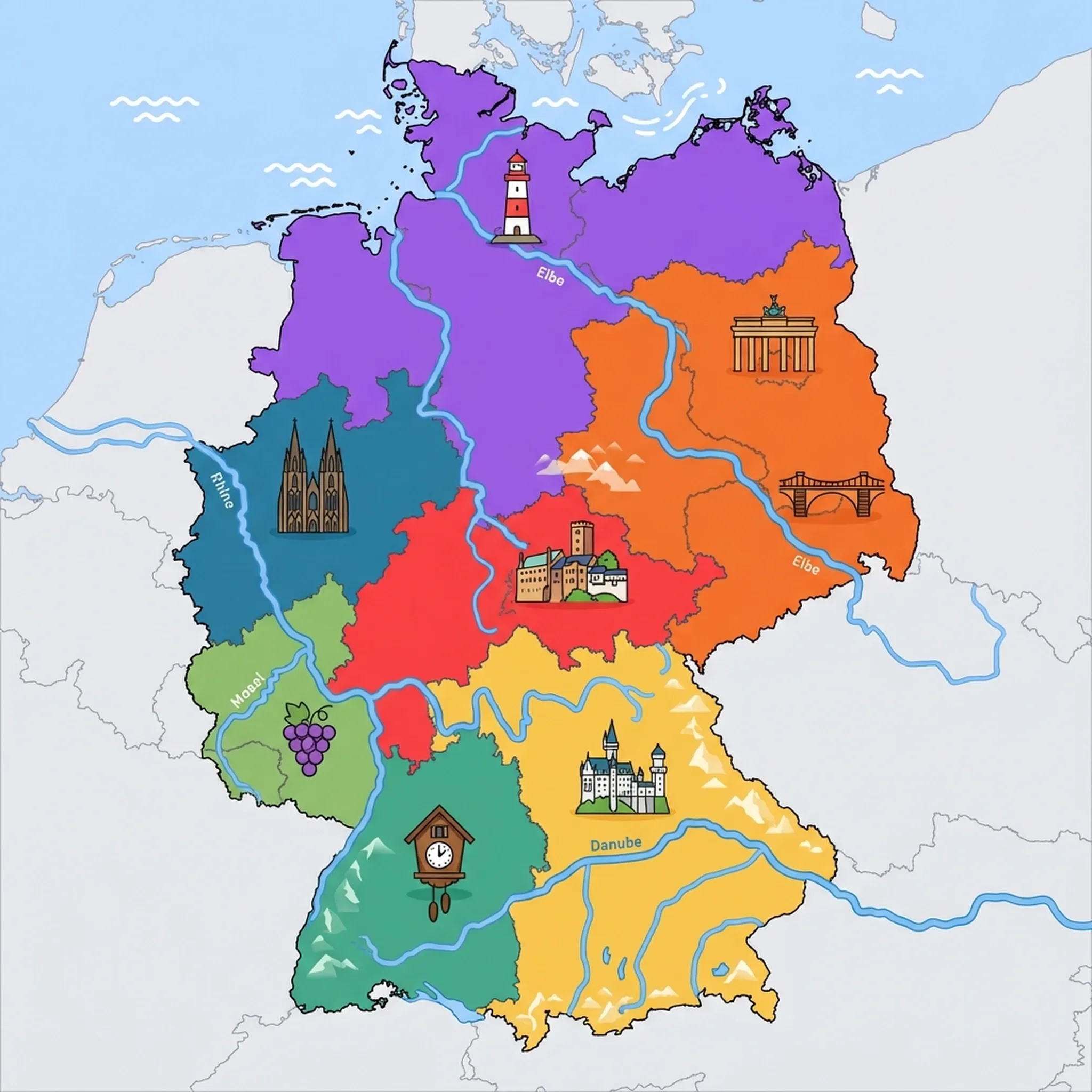
8 Regions
Baden-Württemberg
Where cuckoo clocks, rollercoasters, and sunny vineyards meet 🌲🎢☀️
Bavaria
Lederhosen, Lego, and Alpine adventures 🏔️🥨🏰
Berlin
History, street art, and the world's best playgrounds 🐻🎨🏙️
Central Germany
Where fairytales began and forests never end 🌲📚🧙♀️
Hamburg & North Coast
Where the ocean meets the city ⚓🏖️🛳️
North Rhine-Westphalia
Urban buzz, river views, and endless fun 🏙️🚂🌊
Rhineland & Mosel
Castles, rivers, and Romans 🍇🏰🛥️
Saxony & Eastern Germany
Sandstone peaks, steam trains, and baroque beauty 🚂⛰️🏛️
Click on a region marker to explore details. Use the dropdown to color regions by activity suitability.

Getting There & Around
Getting There
- By Air – Frankfurt (FRA) and Munich (MUC) are the primary international hubs, with extensive connections to Bavaria and central regions. Berlin Brandenburg (BER) serves the east.
- By Train – High-speed trains connect Germany to all neighbours. The Eurostar runs from London to Cologne/Frankfurt (via Brussels). Nightjets (sleeper trains) are a fun family option from countries like Austria or Italy.
- Entry Requirements – Germany is part of the Schengen Area. Check your government website for the latest visa requirements, or use the IATA Travel Centre entry-requirements checker.
Getting Around
- Trains – Berlin, Munich, and other hubs are linked by the high-speed ICE network. It is fast and comfortable; look for the "Kleinkindabteil" (toddler compartment) or family zones when booking. Children under 14 travel free with parents/grandparents on long-distance DB trains if added to the ticket.
- Car Hire – Recommended for exploring rural regions like the Black Forest or Rhineland & Mosel. German Autobahns are efficient, but stay in the right lane unless overtaking. Child seats are mandatory for children under 1.50m or 12 years.
- City Transport – Major cities have excellent U-Bahn (metro) and S-Bahn (suburban train) systems. Strollers are easily accommodated.

Packing List
Public toilets (Sanifair) and supermarket trolleys often require €0.50, €1, or €2 coins.
Supermarkets and shops charge for plastic bags; locals always carry their own totes.
Ticks are common in German forests (Black Forest, Bavaria) and can carry Lyme disease.
Standard gear for German kids; essential for damp playgrounds and forest walks.
Many small bakeries, ice cream shops, and rural 'Gasthaus' restaurants still do not accept cards.

Activities & Best Times

Adventure & Nature
ExcellentHiking, wildlife, outdoor exploration, ecotourism
With 15 major attractions including the Alpine peaks and sophisticated wildlife parks, the region offers world-class immersion in natural landscapes. Peak season aligns with optimal hiking weather and full accessibility of mountain trails and wildlife centers.
Home to the Harz Mountains and Thuringian Forest, the region offers world-class hiking and high-quality wildlife parks like Sababurg. Peak season provides optimal trail conditions and lush landscapes, while winter transitions the focus away from general nature immersion.
With numerous adventure parks and large-scale open-air museums like Kommern and Irrland, the region provides excellent outdoor family exploration. These experiences are highly seasonal, with peak conditions from May to September and general closures or poor conditions during the cold winter months.

City & Cultural
ExcellentUrban tourism, museums, historical sites, architecture
Berlin is a premier global capital for history and contemporary culture, featuring UNESCO-listed Museum Island and iconic landmarks like the Brandenburg Gate. Peak visitation occurs during the warm summer months and the festive December period, while the early year is often too cold and grey for optimal urban exploration.
Home to iconic landmarks like Nymphenburg Palace and Marienplatz, Bavaria offers a high-density of authentic heritage experiences. Peak tourism occurs during the warm summer months and again in December for the world-renowned Christmas market tradition.
Heidelberg and Freiburg are world-class cultural hubs with authentic historic quarters that appeal to sophisticated international travelers. Summer provides optimal conditions for exploring urban landmarks, while December is a peak period for the region's globally recognized Christmas market culture.

Theme Park & Entertainment
Very GoodAmusement parks, family entertainment venues
Home to Phantasialand, one of the world's highest-rated theme parks, the region offers internationally recognized family entertainment. Summer is the primary peak, while the highly acclaimed Wintertraum event in December provides a quality shoulder-season experience.
Home to the massive Tropical Islands indoor resort and the historic Filmpark Babelsberg, Berlin provides high-quality, internationally recognized family entertainment. Peak periods align with summer holidays and the October half-term, though indoor facilities like Tropical Islands and Legoland provide year-round alternatives.
Features internationally recognized venues like Legoland Deutschland and Therme Erding, providing high-standard infrastructure for families. The seasonal window is dictated by the operational dates of outdoor parks, though water parks remain a year-round draw.

Sports & Active
GoodSport tourism, fitness activities, active recreation
The region features high-quality sports infrastructure, including specialized indoor ski facilities and major outdoor activity hubs. Activity levels peak during the warmer months, though indoor facilities like Alpenpark Neuss provide international appeal even in the shoulder seasons.
Strong infrastructure for active families, including innovative urban climbing parks like MountMitte and extensive forest high-ropes courses. Participation is highly seasonal, peaking during the dry, mild months from May through September when outdoor facilities are fully operational.
Organized infrastructure such as the Jochen Schweizer Arena and Alpsee Bergwelt supports high-energy sport tourism. Peak conditions are found in summer when alpine adventure centers are fully operational and weather is stable for outdoor activities.

Educational & Exploratory
MarginalLearning experiences, scientific sites, historical education
Aquazoo and Sea Life centers are nice additions but don't constitute a destination-level educational tourism draw. Downgrade to marginal.
Having Sea Life Munich and some historic sites doesn't constitute a destination for educational tourism. This is marginal - nice to have but not a primary draw.
While quality facilities exist, they don't elevate the region to 'good' for educational tourism by international standards.

Beach & Sea
MarginalBeach resorts, marine activities: diving, snorkelling, kite surfing, wind surfing, sailing
Alpine lakeside facilities are not beach/sea destinations. Chiemsee and similar lakes are freshwater recreational areas, not comparable to coastal beach tourism.
While lacking a coastline, the region's high-quality lake districts (like the New Leipzig Lake District) provide solid swimming and sailing facilities for families. It is rated conservatively as it lacks the marine biodiversity and scale of international sea-based destinations.
While lacking a coastline, the volcanic maars of the Eifel provide unique freshwater swimming and lakeside recreation for families. The season is narrow, with suitable water temperatures and facilities only available during the peak of summer.

Public Holidays & Calendar Next 12 months
Public holidays, festivals, cultural celebrations, and seasonal natural phenomena coming up in Germany over the next 12 months.
Loading holidays and events...
Climate & Weather
Baden-Württemberg
Show Details
| Month | Temp °C | Rain | Humidity |
|---|
Bavaria
Show Details
| Month | Temp °C | Rain | Humidity |
|---|
Berlin
Show Details
| Month | Temp °C | Rain | Humidity |
|---|
Central Germany
Show Details
| Month | Temp °C | Rain | Humidity |
|---|
Hamburg & North Coast
Show Details
| Month | Temp °C | Rain | Humidity |
|---|
North Rhine-Westphalia
Show Details
| Month | Temp °C | Rain | Humidity |
|---|

Travel Advisory
While several agencies recommend standard precautions, others have elevated their status to a caution level due to consistent terrorism risks and temporary border controls. A tie between levels resulted in the more cautious assessment.
Safety Topics
Traveller Advice (4 groups)

Germany is considered one of the safer destinations globally for LGBTQIA+ visitors, frequently appearing in top-tier safety indices for this demographic.

Visitors should always carry a form of government-issued photo identification and be prepared for potential delays at land borders due to temporary security checks.
Consult dedicated accessibility resources for major cities as infrastructure varies, particularly in historic areas or older public transport segments.
Individuals participating in winter sports in mountainous regions should monitor avalanche reports closely and ensure their travel insurance specifically covers high-risk mountain activities.
Agency Summaries
An increased level of caution is advised due to security concerns related to terrorism. Visitors should expect a visible security presence in major cities.
Travellers should remain highly vigilant due to a persistent threat of terrorist attacks throughout the country, targeting public spaces and transportation hubs.
General travel is considered safe, though visitors are advised to maintain standard safety awareness and be alert to the possibility of terrorism in public areas.
Standard safety measures are recommended. Travellers should be aware of temporary border controls and ensure they carry valid identification at all times.
No travel restrictions are in place, though there is an ongoing likelihood of terrorist activity. Security measures and entry requirements have been updated recently.
Heightened vigilance is recommended because of the threat posed by terrorist organizations and individuals who may target tourist locations and major events without warning.
Information is provided for general guidance only and does not constitute travel, safety, medical, or legal advice. Conditions may change. Users are responsible for independently verifying information before travel.