
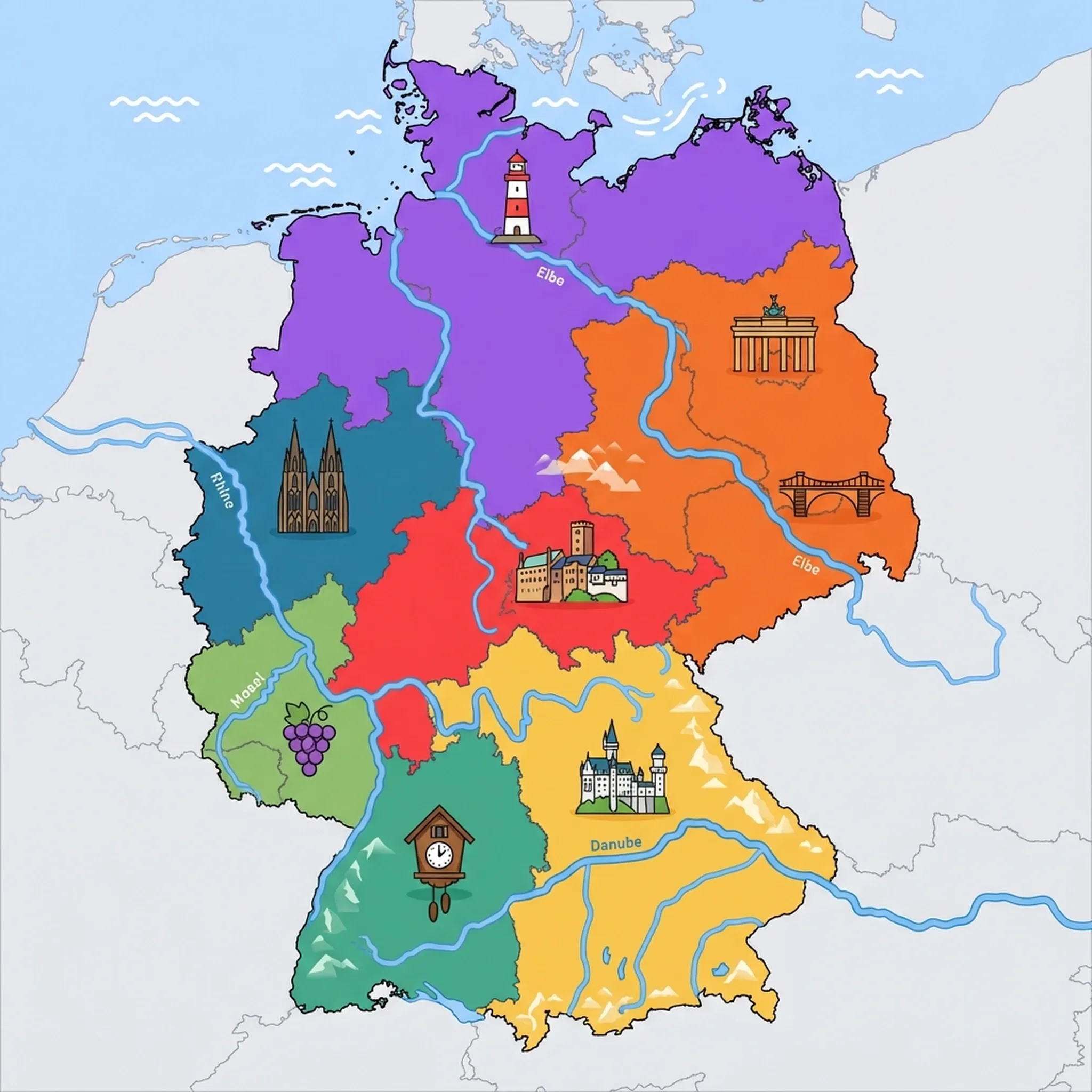
Click a region to explore
Overview
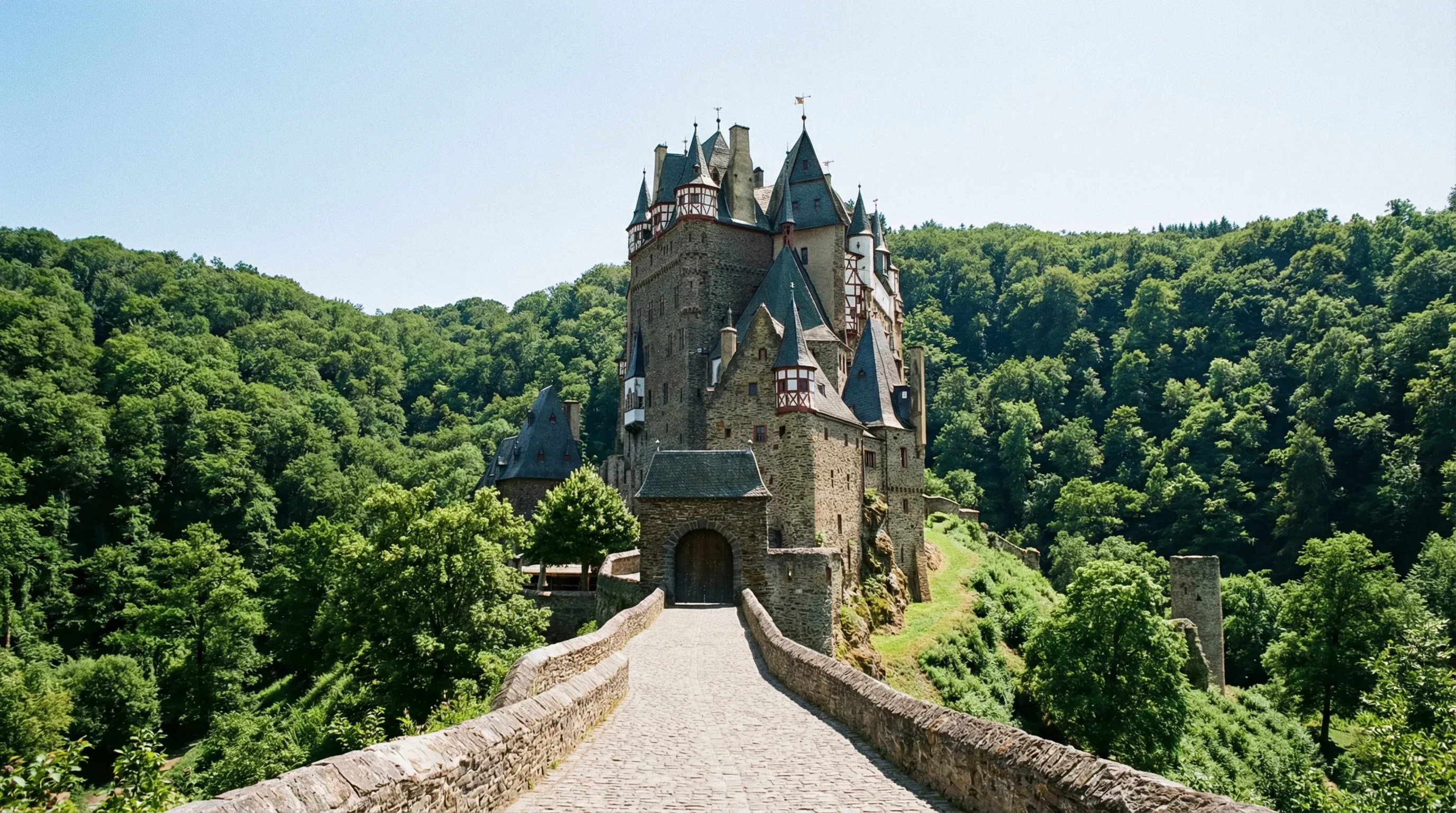
The Rhineland and Mosel region is the Germany of romantic paintings. Here, two mighty rivers—the Rhine and the Mosel—carve their way through slate mountains, creating dramatic valleys lined with terraced vineyards and crowned with castles at nearly every bend. For families, it is a region of exploration. The castles here aren't just museums; many are ruins perfect for scrambling over, or preserved fortresses like Burg Eltz that feel entirely untouched by time. The pace of life is slower here, dictated by the flow of the river.
Beyond the riverbanks, the volcanic Eifel region offers a wilder landscape with crater lakes (Maars) suitable for swimming and mysterious forests. The region also boasts deep Roman roots, especially in Trier (Germany's oldest city), where kids can walk through massive city gates and explore underground bath tunnels. It is an ideal destination for families who enjoy hiking, cycling, and history, but want to do it at a relaxed pace with plenty of stops for ice cream and boat rides.
Key Attractions
The absolute must-see is Burg Eltz. Unlike many castles that were destroyed and rebuilt, Eltz has stood intact for 850 years. The hike through the forest to reach it builds anticipation, and the treasury inside is dazzling. For a different kind of thrill, the Geierlay Suspension Bridge in the Hunsrück offers a wobbly walk 100 meters above the valley floor—free to cross and very Instagrammable.
In Koblenz, where the rivers meet at the Deutsches Eck, you can take a cable car across the Rhine up to the massive Ehrenbreitstein Fortress. It is a great adventure with playgrounds and expansive views. Nature lovers should head to the Eifel National Park or visit Eifelpark Gondorf, a nature and leisure park with bears, wolves, and rides tailored for younger kids. The legendary Loreley Rock offers a steep hike and a visitor center explaining the myths of the river sirens.
Practical Advice
The Mosel Valley is very popular in late summer/autumn for the wine harvest (Weinfests). While beautiful, accommodation books up months in advance. Many castles close or have reduced hours in winter (Nov-March).
Food & Drink
Typical meal times: Lunch 12:00 pm–2:00 pm. In wine villages, 'Straußwirtschaften' (seasonal wine taverns) open in the evenings and serve simple, hearty food.
Typical meal costs: Moderate to affordable. A family dinner costs €50–90 (approx. $55–95 USD / £40–75 GBP). Wine is cheaper than water here!
Dietary requirements: Traditional food is rustic. Vegetarians can rely on 'Flammkuchen' (tarte flambée) which often comes in veggie versions.
Signature dishes:
- Saumagen – The signature dish of the Palatinate. A stomach casing stuffed with pork, potatoes, and carrots, sliced and fried. It sounds daunting but tastes like a delicious spiced hash brown sausage.
- Flammkuchen – Very thin crispy dough topped with crème fraîche, onions, and bacon. The German answer to pizza, perfect for sharing.
- Zwiebelkuchen – Savory onion cake with bacon and caraway seeds, traditionally eaten in autumn with 'Federweißer' (new wine).
Why this score?
The steep vineyard slopes and the Hunsrück hills provide some opportunities for strenuous hiking and high-altitude views from the Geierlay bridge. However, the region's tourism model focuses heavily on river cruises, wine tasting, and historical tours, which are low-intensity. The 'adventure' is found in exploring medieval ruins and steep paths rather than navigating wild terrain.
Why this score?
Cities like Mainz, Koblenz, and Trier offer very good healthcare with modern hospitals that are accessible to foreigners. While perhaps lacking the 'mega-hub' status of Berlin or Munich, the medical infrastructure is robust and reliable. English is widely spoken in hospitals, and the region is well-integrated into Germany's efficient emergency response network.
Why this score?
The Middle Rhine Valley is a UNESCO World Heritage site famous for its river cruises and high concentration of castles, drawing a consistent flow of international tourists. The Mosel valley is equally renowned for its scenic vineyards and Roman history in Trier. While it is a staple of European tour itineraries, its visitor volume is generally lower and more seasonal than Berlin or Munich.

Accommodation in the popular river towns (Cochem, Bernkastel-Kues) can be pricey in summer (€120–160 / $130–175 USD per night), but stay a few kilometers inland and prices drop significantly. Dining is good value. Many activities like hiking the <a data-attraction-id="4078">Loreley Rock</a> or walking the <a data-attraction-id="4073">Deutsches Eck</a> are free.

Getting Here & Around
Getting Here
- Airports – Frankfurt (FRA) is the closest major hub (1 hour away). Frankfurt-Hahn (HHN) is a budget airport located directly in the Hunsrück region, though transport connections are limited to buses.
- Train – The scenic Rhine Valley line is one of Europe's most beautiful train rides, running right along the river bank past castles.
- Driving – Essential for accessing the side valleys and the Eifel. The B9 road along the Rhine is scenic but slow.
Getting Around
- Boat – The 'KD' line boats are practically public transport here. You can hop on and off at different towns (e.g., Bacharach or St. Goar).
- Cycling – The Mosel Cycle Path is famous for being flat and separate from the road, winding along the river loops. It is perfect for families.
- Train – Regional trains connect the river towns, but the Eifel region is harder to reach without a car.
Nearby Airports (2 airports)
Frankfurt Hahn
HHNHahn
Saarbrucken
SCNSaarbruecken
View full flight map for Germany →

Packing List
The slate soil in vineyards reflects heat; valleys can get surprisingly hot and stuffy.
Paths to castles like Burg Eltz can be steep and slippery; poles help with child carriers.
Near the river banks and in the Eifel forests, mosquitoes can be a nuisance in summer.
You will likely want to bring bottles of local Riesling home; padded bags prevent breakage.
Public toilets (Sanifair) and supermarket trolleys often require €0.50, €1, or €2 coins.
Supermarkets and shops charge for plastic bags; locals always carry their own totes.
Ticks are common in German forests (Black Forest, Bavaria) and can carry Lyme disease.
Standard gear for German kids; essential for damp playgrounds and forest walks.
Many small bakeries, ice cream shops, and rural 'Gasthaus' restaurants still do not accept cards.

Activities & Best Times

Urban tourism, museums, historical sites, architecture
Home to UNESCO-listed Roman monuments in Trier and world-renowned medieval castles like Burg Eltz, this region offers authentic, world-class cultural heritage. Peak season aligns with full accessibility of historical sites and Rhine cruise operations, while December serves as a strong shoulder period for traditional Christmas markets.

Hiking, wildlife, outdoor exploration, ecotourism
The unique volcanic landscapes of the Eifel and the rugged Hunsrück forests provide high-quality hiking and immersion in rare geological ecosystems. Peak visitation occurs from late spring through early autumn when trails are optimal and the region's major wildlife and nature parks are fully operational.

Sport tourism, fitness activities, active recreation
Features specialized infrastructure such as the Geierlay suspension bridge and multiple high-rope adventure forests that cater to active families seeking organized outdoor challenges. These facilities are primarily accessible during the warmer, drier months, with limited utility during the damp winter season.
Amusement parks, family entertainment venues
The notes incorrectly claim Phantasialand is in this region (it's in North Rhine-Westphalia). Without a major international theme park within its boundaries, this region should be rated 'good' based on regional facilities.

Beach resorts, marine activities: diving, snorkelling, kite surfing, wind surfing, sailing
While lacking a coastline, the volcanic maars of the Eifel provide unique freshwater swimming and lakeside recreation for families. The season is narrow, with suitable water temperatures and facilities only available during the peak of summer.

Learning experiences, scientific sites, historical education
Provides quality regional educational facilities like SEA LIFE and specialized aquariums, though it lacks the globally unique scientific institutions typical of top-tier educational destinations. Visitation is strongest during the summer school holidays when family-oriented programming is at its peak.

Attractions (37 total)



Public Holidays & Calendar Next 12 months
Public holidays, festivals, cultural celebrations, and seasonal natural phenomena coming up in Rhineland & Mosel over the next 12 months.
Loading holidays and events...

Travel Advisory
While several agencies recommend standard precautions, others have elevated their status to a caution level due to consistent terrorism risks and temporary border controls. A tie between levels resulted in the more cautious assessment.
Safety Topics
Traveller Advice (4 groups)

Germany is considered one of the safer destinations globally for LGBTQIA+ visitors, frequently appearing in top-tier safety indices for this demographic.

Visitors should always carry a form of government-issued photo identification and be prepared for potential delays at land borders due to temporary security checks.
Consult dedicated accessibility resources for major cities as infrastructure varies, particularly in historic areas or older public transport segments.
Individuals participating in winter sports in mountainous regions should monitor avalanche reports closely and ensure their travel insurance specifically covers high-risk mountain activities.
Agency Summaries
An increased level of caution is advised due to security concerns related to terrorism. Visitors should expect a visible security presence in major cities.
Travellers should remain highly vigilant due to a persistent threat of terrorist attacks throughout the country, targeting public spaces and transportation hubs.
General travel is considered safe, though visitors are advised to maintain standard safety awareness and be alert to the possibility of terrorism in public areas.
Standard safety measures are recommended. Travellers should be aware of temporary border controls and ensure they carry valid identification at all times.
No travel restrictions are in place, though there is an ongoing likelihood of terrorist activity. Security measures and entry requirements have been updated recently.
Heightened vigilance is recommended because of the threat posed by terrorist organizations and individuals who may target tourist locations and major events without warning.
Information is provided for general guidance only and does not constitute travel, safety, medical, or legal advice. Conditions may change. Users are responsible for independently verifying information before travel.