

Overview
Ghana is often celebrated as the most accessible and family-friendly destination in West Africa. Situated on the Gulf of Guinea, it spans a diverse landscape ranging from the golden surf beaches of Accra & Greater Accra to the lush rainforests of the central belt and the dry savannah of Northern Ghana. For families, the country offers a unique blend of education and adventure. It is an English-speaking nation with a deep sense of peace and democratic stability, making it less daunting for first-time visitors to the continent than many of its neighbors.
The cultural heartbeat of the country is evident in its festivals, fabric markets, and the ubiquitous Akwaaba (welcome) that greets you everywhere. Children will be fascinated by the vibrant street life, the storytelling traditions of the Ashanti kingdom in Kumasi, and the chance to see wildlife up close without the barriers of a vehicle. While the heat and humidity can be intense, and logistics require patience, the warmth of the Ghanaian people makes the journey incredibly rewarding for families seeking a meaningful cultural connection.
Key Attractions
For an unforgettable family adventure, head north to Mole National Park. Unlike many African safaris where you are confined to a jeep, Mole offers walking safaris where families can safely approach elephants on foot under the guidance of armed rangers-a thrilling experience for older children. Nearby, the ancient Larabanga Mosque offers a glimpse into the region's Sahelian architectural history.
In the south, the Cape Coast & Central Region is a mandatory stop. Kakum National Park is a highlight, featuring a canopy walkway suspended 30 meters above the rainforest floor that is secure enough for children and offers bird's-eye views of the jungle. For a sobering but essential history lesson, a guided tour of Cape Coast Castle reveals the realities of the trans-Atlantic slave trade; guides are skilled at tailoring the narrative for younger audiences.
Back in the capital, Kwame Nkrumah Memorial Park & Mausoleum provides a peaceful space to learn about Ghana's independence. Families can cool off at Labadi Beach, known for its lively atmosphere, drumming, and horseback rides, or venture east to the Volta Region to hike to the spectacular Wli Waterfalls, the highest in West Africa.
Practical Advice
Best time to visit: The dry season (November to March) is ideal for spotting wildlife and enjoying beaches. December is festive but busy. The "Harmattan" winds in January can bring dust haze. Health: A Yellow Fever vaccination certificate is mandatory for entry. Malaria prophylaxis is highly recommended for all family members. Logistics: Power outages ("dumsor") can occur; pack power banks. Traffic in Accra is heavy; allow extra time for travel.
Food & Drink
Typical meal times: Breakfast is eaten early, from 6:30 am to 9:00 am. Lunch is the main meal, served from 12:00 pm to 2:00 pm. Dinner is typically eaten from 6:00 pm to 9:00 pm.
Typical meal costs: Street food or local "chop bars" cost GHS 30–70 (approx. $2–4.50 USD / €1.80–4.20 EUR). Mid-range restaurant meals cost GHS 150–300 (approx. $9.50–19 USD / €9–18 EUR) per person. High-end dining in Accra can exceed GHS 450 (approx. $29 USD / €27 EUR).
Dietary requirements: Vegetarian options are plentiful as many local stews are plant-based by default (like Red Red), though verify they haven't been cooked with fish stock or crayfish powder. Peanuts (groundnuts) are a major ingredient in soups and snacks, so those with nut allergies must be extremely cautious.
Family-friendly dining: Ghanaians love children, and restaurants are welcoming. Fried plantains and mild rice dishes are safe bets for fussy eaters. Highchairs are available in modern restaurants in Accra but rare in rural areas.
Signature dishes:
- Jollof Rice – A spicy, one-pot tomato and rice dish. Ghanaians fiercely defend theirs as the best in West Africa (over Nigeria's).
- Red Red – A mild, kid-friendly stew made from black-eyed peas and red palm oil, served with fried plantains.
- Kelewele – Spicy fried plantain cubes seasoned with ginger and chili, a popular street snack for older kids who like a kick.
- Waakye – A breakfast dish of rice and beans cooked with millet leaves, served with spaghetti, shito (hot sauce), and egg.
- Banku and Tilapia – Fermented corn and cassava dough served with grilled fish; the sour taste of Banku is a unique local flavor to try.
Safety
Ghana is generally one of the safest countries in Africa for tourists, but petty crime exists. Avoid walking alone at night in unlit areas and keep valuables hidden in crowded markets like Makola. Use Uber or Bolt in Accra rather than hailing random taxis to ensure trackable rides. Be cautious of ocean currents at beaches like Labadi Beach; only swim where lifeguards are present. Avoid political demonstrations. As noted, strict caution is advised near the northern borders; however, Mole National Park remains safe to visit, preferably by flying into Tamale rather than driving the full distance.

While street food is cheap, a comfortable family trip is mid-range due to accommodation and tour costs. Expect to spend GHS 2,300–3,800 (approx. $150–250 USD / €140–230 EUR) per day for a family of four, covering mid-range hotels, private transport, and meals. Western-style supermarkets and imported goods in Accra are expensive.
Age Suitability





Did you know? Ghana welcomes approximately 915,000 international visitors per year. Most visitors come from Africa.
Explore Regions
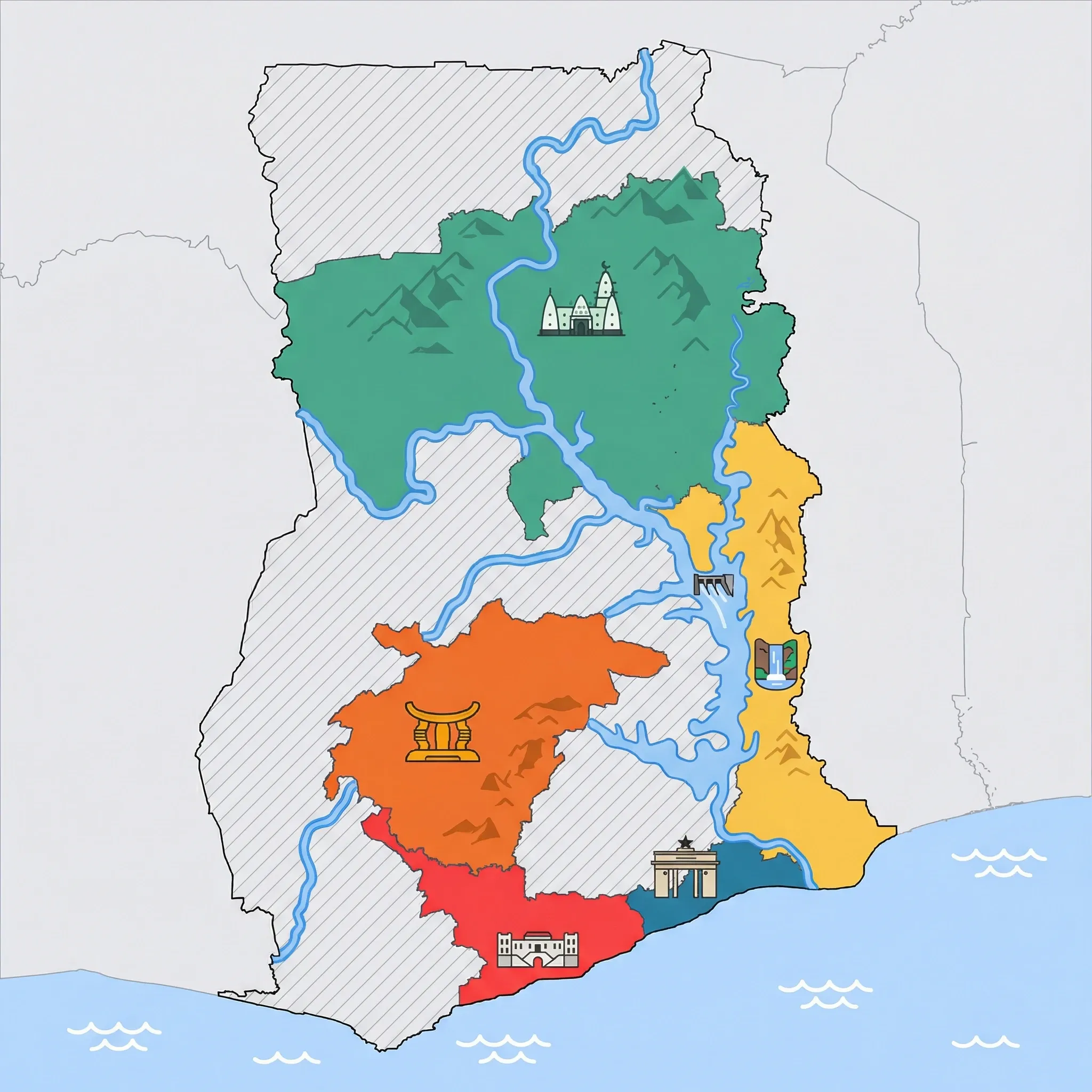
5 Regions
Accra & Greater Accra
The heartbeat of Ghana where culture meets the coast 🇬🇭🌊
Cape Coast & Central Region (slave castles)
Where history echoes and nature soars 🏰🌴
Kumasi & Ashanti Region
The royal heart of the Golden Kingdom 👑🦁
Northern Ghana (Mole NP)
Safari adventures under the savanna sun 🐘🕌
Volta Region (waterfalls, mountains)
Where mountains touch the sky and waterfalls roar ⛰️💦
Click on a region marker to explore details. Use the dropdown to color regions by activity suitability.

Getting There & Around
Getting There
- By Air – Kotoka International Airport (ACC) in Accra is the main hub. Major airlines like Delta, United, British Airways, and Emirates operate direct flights. It is the gateway to the Accra & Greater Accra region.
- Entry Requirements – Most international visitors (including US, UK, and EU citizens) require a visa before travel. A Yellow Fever vaccination certificate is mandatory and checked upon arrival. Check your government website for the latest visa requirements, or use the IATA Travel Centre entry-requirements checker.
- By Land – Border crossings from Ivory Coast (Elubo) and Togo (Aflao) are open but can be chaotic and time-consuming for families. Flying is strongly recommended.
Getting Around
- Domestic Flights – The fastest way to reach the north. Africa World Airlines (AWA) and Passion Air fly daily from Accra to Tamale (for Northern Ghana and Mole National Park) and Kumasi.
- Private Driver – The best option for families. Hiring a car with a driver costs around GHS 1,200–1,800 (approx. $80–120 USD) per day. It offers safety, flexibility for bathroom breaks, and navigation expertise.
- Ride-Hailing Apps – Uber, Bolt, and Yango are widely available, safe, and cheap in Accra and Kumasi. Ideal for short city hops.
- STC Buses – The state-run Intercity STC buses are air-conditioned, reliable, and safe for longer intercity trips, though less flexible than a private driver.
Official Links

Packing List
Mandatory physical document checked before you even leave the plane.
Frequent power cuts ("Dumsor") mean you need backup for phones/fans.
Street lighting is inconsistent and power outages can happen at night.
Essential during Harmattan season (Dec-Mar) when air is thick with dust.
Exchange bureaus often reject notes that are old, torn, or marked.

Activities & Best Times

Adventure & Nature
Very GoodHiking, wildlife, outdoor exploration, ecotourism
Mole National Park is West Africa's premier wildlife destination, offering unique walking safaris and reliable elephant sightings in an authentic savanna setting. Peak season coincides with the height of the dry season when animals congregate at water holes; the rainy season brings tall grass that obscures visibility.
Kakum National Park features an internationally recognized canopy walkway and pristine rainforest trails that offer authentic immersion in West African ecosystems. Travel is best during the dry seasons to avoid the treacherous, muddy conditions and high humidity of the heavy monsoon months.
Home to the ancient meteorite impact crater of Lake Bosomtwe and the Bobiri Butterfly Sanctuary, the region provides unique biodiversity and rainforest immersion for nature-loving families. Outdoor exploration is best during the dry season (December to February) when forest trails are accessible and butterfly activity is at its peak.

City & Cultural
Very GoodUrban tourism, museums, historical sites, architecture
The UNESCO World Heritage slave castles of Cape Coast and Elmina offer a profound, world-class historical narrative that is essential for well-travelled families. Peak months align with the dry season and major heritage festivals like Panafest, while the rainy season from April to June makes exploring the historic towns difficult.
As the heart of the Ashanti Empire, Kumasi offers an authentic immersion into West African history and living craft traditions at Manhyia Palace and specialized weaving villages. The peak months align with major festivals and the drier harmattan period, providing the best conditions for exploring vibrant markets and heritage sites.
As a hub of Pan-African history and the 'Year of Return' movement, Accra offers authentic experiences at the Kwame Nkrumah Memorial and Osu Castle. Peak travel occurs during the 'Detty December' period and August's vibrant street art scene, while heavy May-June rains can disrupt urban exploration.

Sports & Active
Very GoodSport tourism, fitness activities, active recreation
Boasts significant infrastructure for active tourism, including managed hiking trails to Mount Afadjato and the Amedzofe canopy walkway. Conditions are optimal in the dry season to avoid slippery terrain and ensure safe conditions for mountain activities.
The region provides specialized infrastructure for cycling safaris and wilderness trekking, allowing for immersive physical engagement with the savanna landscape. These activities are most enjoyable during the dry Harmattan months when trails are firm and heat is manageable.
Purpose-built nature and trekking trails at Kakum and Mesomagor provide excellent active exploration for families seeking more than just sightseeing. Activity is most enjoyable when trails are dry and firm, specifically during the two dry windows in the regional climate cycle.

Road Trips & Scenic
GoodScenic drives, countryside tours, route-based travel
The Atlantic Coast Heritage Drive provides a high-quality scenic route connecting historic forts and vibrant fishing villages. Drier months ensure better road safety and visibility for a comfortable family touring experience.
The Ashanti Craft Villages Circuit and Lake Bosomtwe scenic routes offer well-defined itineraries for exploring rural heritage and panoramic landscapes. These drives are most enjoyable in the dry months to avoid road deterioration during heavy rains and to ensure clear views of the Mampong Escarpment.
The scenic drive to the Aburi Mountains and the coastal route to Ada provide varied landscapes and cool highland escapes. Dry months ensure safe driving conditions and clear views of the Accra plains and coastline.

Beach & Sea
GoodBeach resorts, marine activities: diving, snorkelling, kite surfing, wind surfing, sailing
The coastline features beautiful, authentic Atlantic beaches such as Anomabo and Brenu Akyinim which offer a scenic contrast to the region's history. The primary peak is during the driest months when the surf is more predictable and humidity is lower for beach-side relaxation.
Ada Foah and Bojo Beach offer distinct coastal experiences ranging from estuary lagoons to Atlantic surf. The sea is calmest and air most pleasant from November to March, while May and June see rougher conditions and significant precipitation.
The Keta coastline provides authentic, uncrowded Atlantic beaches and significant lagoon ecosystems for birdwatching and coastal walks. Visitors should prioritize the dry harmattan months when the humidity is lower and the sea is generally calmer.

Educational & Exploratory
MarginalLearning experiences, scientific sites, historical education
The Mole National Park Information Center provides valuable ecological and conservation education for families, though it serves as a secondary attraction to the park itself. It is best visited alongside the park during peak wildlife viewing months.
The Kakum National Park Visitor Centre provides important scientific context for the region's biodiversity, though it is typically a secondary stop. Peak visitation follows the general tourism pattern for the region's major nature and cultural sites.
The Lake Bosomtwe Visitor Centre offers destination-level scientific insights into the geology and biology of West Africa's only natural lake. It is a valuable educational stop during the high tourism season when facility engagement and guided tours are most available.

Festivals & Seasonal
MarginalEvents, celebrations, seasonal attractions
Significant international events like Panafest and Emancipation Day occur in July and August, offering deep cultural engagement for the global diaspora. These specific windows represent the peak for festival-seekers, while the rest of the year offers little in the way of major organized cultural events.
The Akwasidae Festival is a premier cultural event occurring every 42 days, showcasing the splendor of the Ashanti monarchy. While it happens year-round, the year-end and New Year periods offer the most festive atmosphere for international travelers.
Accra hosts internationally recognized events like AfroFuture in December and the Chale Wote Street Art Festival in August. These specific windows represent the only times the region becomes a global festival destination.

Public Holidays & Calendar Next 12 months
Public holidays, festivals, cultural celebrations, and seasonal natural phenomena coming up in Ghana over the next 12 months.
Loading holidays and events...
Climate & Weather
Accra & Greater Accra
Show Details
| Month | Temp °C | Rain | Humidity |
|---|
Cape Coast & Central Region (slave castles)
Show Details
| Month | Temp °C | Rain | Humidity |
|---|
Kumasi & Ashanti Region
Show Details
| Month | Temp °C | Rain | Humidity |
|---|
Northern Ghana (Mole NP)
Show Details
| Month | Temp °C | Rain | Humidity |
|---|
Volta Region (waterfalls, mountains)
Show Details
| Month | Temp °C | Rain | Humidity |
|---|

Travel Advisory
All major agencies maintain a baseline advisory for travellers to exercise increased vigilance across Ghana, primarily due to crime and regional security threats. While the country is generally stable, specific regional warnings and demographic-based risks necessitate higher awareness than standard travel.
Safety Topics
Traveller Advice (3 groups)

There are reports of sexual assault and harassment targeting women. Crimes often occur at night or in secluded spots; travellers should avoid walking alone after dark.

Visitors should avoid travel between cities after dark due to highway robberies. Be extremely cautious at beaches as coastal currents are powerful and often lack lifeguards.

Same-sex intimacy is criminalized and can lead to imprisonment. Recent legislative efforts have increased hostile rhetoric, discrimination, and the risk of targeted violence or extortion.
Agency Summaries
Safety concerns are higher than in New Zealand, driven by rising crime rates including armed robbery and kidnapping. Terrorism risks are elevated near the northern borders.
While general travel is permitted, the UK advises against all but essential travel to the Bawku Municipal area. There is a notable threat of terrorism in northern border areas and frequent demonstrations in cities.
Irish citizens are urged to be cautious, particularly regarding political gatherings and civil unrest. Comprehensive travel insurance and early visa application are strongly recommended.
Increased caution is advised nationwide due to crime and specific threats against women and LGBTQ+ travellers. There is a higher risk of civil unrest and crime in the northern border regions near Burkina Faso and Côte d'Ivoire.
Travellers should remain highly vigilant due to safety and security concerns, including petty and violent crime. There is a specific warning regarding increased risks for the 2SLGBTQI+ community due to legislative developments.
Heightened vigilance is required because of the risk of violent crime. Terrorism is a significant concern in the north, and local curfews are active in several regions due to security incidents.
Information is provided for general guidance only and does not constitute travel, safety, medical, or legal advice. Conditions may change. Users are responsible for independently verifying information before travel.