

Overview
Greenland is a destination that defies imagination, a place where nature operates on a scale that leaves both children and adults in awe. For families, it offers a safe but wild playground where the air is cleaner than anywhere else on earth and the silence is broken only by the crack of calving glaciers or the howl of sled dogs. While it requires more logistical planning than a standard resort holiday, the rewards are immense. In Nuuk & Southwest, you can experience a blend of modern Arctic living and ancient Norse history, while the Disko Bay area offers the classic visuals of towering icebergs and midnight sun.
Culturally, Greenland is warm and welcoming to children. The Inuit culture places a high value on family, and kids are often met with smiles and patience. Travel here is slow-there are no roads between towns-which forces families to relax into the rhythm of the Arctic. Whether you are sailing past ice cathedrals in Ilulissat & Disko Bay or learning about Viking settlers in the south, the country provides a living classroom on geography, history, and climate that no textbook can match.
Key Attractions
The crown jewel of Greenlandic tourism is the Ilulissat Icefjord (Kangia). This UNESCO World Heritage site is accessible via a family-friendly boardwalk that leads to breathtaking views of massive icebergs trapped at the fjord's mouth. Near here, you can visit Sermermiut, an ancient settlement site where children can see the remains of turf houses used by the Saqqaq, Dorset, and Thule cultures for 4,000 years. For a more active adventure, a boat trip to the Eqip Sermia Glacier allows you to safely watch huge chunks of ice calve into the sea, a thunderous spectacle that fascinates kids.
In the capital, the Greenland National Museum & Archives is a must-visit, housing the famous Qilakitsoq mummies and a collection of traditional kayaks and hunting tools that bring Inuit history to life. Nearby, the Katuaq Cultural Center offers a stunning architectural space inspired by the northern lights, often hosting family-friendly events and a cinema. For art lovers, the Nuuk Art Museum provides a colorful look at Greenlandic expression.
History buffs should head south to Nuuk & Southwest to explore Qassiarsuk (Brattahlíð), the site where Eric the Red settled in the 10th century. Families can walk among the Qassiarsuk (Brattahlid) Historic Farm reconstructions, imagining life as a Viking in the Arctic. Further south, the Hvalsey Church Ruins are the best-preserved Norse ruins in the country, offering a hauntingly beautiful glimpse into the past.
Practical Advice
The best time for families to visit is summer (June to August) for the midnight sun, whale watching, and milder temperatures (5–10°C). Winter (February to April) is for northern lights and dog sledding but requires serious cold-weather gear. Healthcare is high quality in Nuuk but limited in smaller settlements; comprehensive travel insurance including evacuation cover is essential. Be aware that terrain is often uneven-this is not a stroller-friendly country; a sturdy carrier is better for toddlers.
Food & Drink
Typical meal times: Lunch is usually served from 12:00 pm to 1:30 pm, and dinner from 6:00 pm to 9:00 pm. Cafés may serve food throughout the day.
Typical meal costs: Meals are expensive due to import costs. A lunch dish costs 100–160 DKK (approx. $15–24 USD / €13–21 EUR), while a main dinner course runs 200–350 DKK (approx. $30–52 USD / €27–47 EUR).
Dietary requirements: Fresh produce is imported and pricey, making vegetarian and vegan options limited outside Nuuk and Ilulissat. However, Thai restaurants are surprisingly common and can offer vegetable-based dishes. Gluten-free options are rare; bringing your own specialized snacks is highly recommended.
Family-friendly dining: Highchairs are available in larger hotels and restaurants. Thai food (noodles/rice) is a popular and kid-friendly staple across the country. Cafés often have a relaxed atmosphere where children are welcome.
Signature dishes:
- Suaasat – The national soup made from seal meat, boiled with onions and potatoes, often thickened with rice.
- Greenlandic Halibut – Served smoked, dried, or pan-fried, this fish is a local staple and very palatable for children.
- Muskox Burger – A lean, flavorful game meat often served in burger form, making it an adventurous but accessible try for kids.
- Lamb from South Greenland – Free-range lamb known for its tenderness, raised on the herbs of the sub-arctic tundra.
- Kaffemik – Not a single dish but a social event; a traditional open-house gathering with coffee and an abundance of cakes and pastries.

Greenland is one of the world's most expensive destinations. A family of four should budget 4,500–7,000 DKK (approx. $660–1,030 USD / €600–940 EUR) per day for mid-range accommodation, meals, and one major excursion. Flights and ferries between towns add significant extra costs.
Age Suitability





Explore Regions
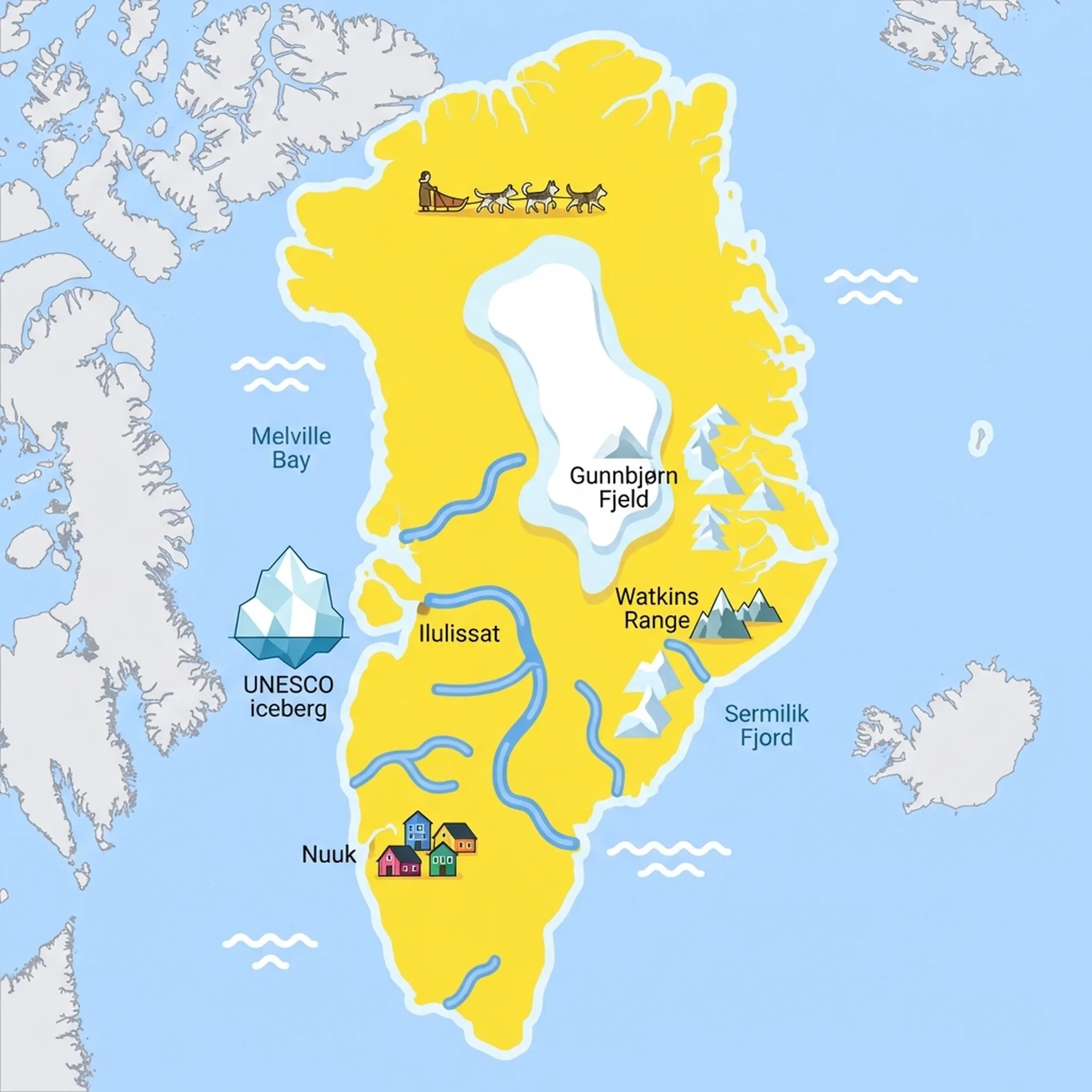
4 Regions
East Greenland (remote)
Where jagged mountains meet the true Arctic wild 🏔️❄️
Ilulissat & Disko Bay (icebergs)
Home of the midnight sun and towering ice giants 🧊☀️
North Greenland (very remote)
The true high Arctic where dogs outnumber people 🐕🛷
Nuuk & Southwest
From urban cool to Viking ruins and green valleys 🏙️🐑
Click on a region marker to explore details. Use the dropdown to color regions by activity suitability.

Getting There & Around
Getting There
- By Air – The main international gateway is Kangerlussuaq (SFJ), with direct Air Greenland flights from Copenhagen. From 2025, new airports in Nuuk and Ilulissat will allow direct international flights. Icelandair also flies from Reykjavik to Nuuk, Ilulissat, and Kulusuk.
- By Sea – There are no car ferries to Greenland. Cruise ships are the only way to arrive by sea.
- Entry Requirements – Greenland is not part of the Schengen Area. EU/EEA, US, and UK citizens do not need a visa for short stays but must carry a valid passport. Travellers requiring a Schengen visa must obtain a specific visa valid for Greenland. Check your government website for the latest visa requirements, or use the IATA Travel Centre entry-requirements checker.
Getting Around
- By Air – There are no roads between towns. Air Greenland operates domestic flights using Dash-8 planes and helicopters, which act as the primary bus service. It is expensive but scenic.
- By Sea – The Sarfaq Ittuk ferry sails along the west coast between Nuuk & Southwest and Ilulissat & Disko Bay. It is a slower, more affordable, and beautiful way to travel, with chances to spot whales from the deck.
- Taxis & Walking – Towns are small and walkable. Taxis are readily available in Nuuk, Ilulissat, and Sisimiut. Public buses exist in Nuuk and Sisimiut.
- Dog Sled – In winter, dog sleds are a traditional and functional transport method in towns north of the Arctic Circle and in East Greenland.

Packing List
Arctic mosquitoes in summer (June-August) are incredibly aggressive and can ruin hikes without face protection.
The midnight sun means 24-hour daylight in summer; thick curtains aren't always guaranteed in accommodation.
Essential for spotting whales, seals, and muskoxen from the shore or ferry decks.
The combination of dry Arctic air and intense sun reflection off the ice causes rapid chapping and sunburn.
It is customary to remove outdoor boots when entering homes and many hostels/lodges; floors can be cold.
Wind and splash protection is vital for zodiac boat tours, even on sunny days, to keep kids warm and dry.

Activities & Best Times

Adventure & Nature
ExcellentHiking, wildlife, outdoor exploration, ecotourism
North Greenland represents one of Earth's last truly wild frontiers, featuring the spectacular Uummannaq Fjord, Heart Shaped Mountain, and some of the largest icebergs in the Arctic. The extreme remoteness and pristine wilderness quality place this region among the world's top adventure destinations, warranting an 'excellent' rating.
East Greenland offers world-class Arctic wilderness experiences that rank among the planet's most pristine and extreme adventure destinations. The region's massive iceberg-filled fjords, complete remoteness, and authentic wilderness immersion quality justify an 'excellent' rating when calibrated internationally against other adventure destinations.
Features world-class Arctic wilderness immersion, including major hiking trails in Flower Valley and unique farm-stays in Igaliku. Tourism is concentrated in the brief summer window when trails are clear of snow and wildlife is active.

City & Cultural
Very GoodUrban tourism, museums, historical sites, architecture
Home to the UNESCO-listed Hvalsey Church ruins and a vibrant modern capital in Nuuk with high-quality museums. The summer peak allows for boat transfers to remote archaeological sites that are inaccessible during the frozen winter months.
Features authentic Greenlandic urban culture, the historic Zion Church, and the architecturally stunning Icefjord Centre. Peak summer months offer a vibrant atmosphere and full access to museums documenting Inuit heritage and Arctic exploration.
Authentic Inuit heritage preserved in remote settlements like Uummannaq and Upernavik, centered around historic museums and landmark churches. Visitation is concentrated in July-August when coastal transport is reliable and museum facilities are most accessible.

Beach & Sea
GoodBeach resorts, marine activities: diving, snorkelling, kite surfing, wind surfing, sailing
Unique Arctic coastal experiences including boat tours among skyscrapers of ice and the distinctive black sand beaches of Disko Island. Sea access is restricted by heavy ice in winter, making the summer months the only viable period for coastal recreation.
A unique Arctic maritime experience focused on coastal exploration and iceberg boat tours rather than traditional swimming. Peak tourism occurs in July and August when sea ice has cleared enough for navigation and marine life sightings are most frequent.
Coastal recreation focuses on boat-based exploration of the Nuuk Fjord system and Narsaq shoreline rather than swimming. Peak summer months provide ice-free waters and necessary light for marine-based sightseeing.

Sports & Active
GoodSport tourism, fitness activities, active recreation
Offers significant trekking infrastructure, notably the multi-day route between Narsarsuaq and Igaliku and the Store Malene trails. These demanding routes require the stable weather and long daylight found in July and August.
Highly developed hiking infrastructure with color-coded routes (Blue, Yellow, Orange) providing challenging treks over rocky terrain with views of the Icefjord. These trails are best navigated when snow-free in summer; winter conditions render the specific hiking infrastructure inaccessible.
The region features internationally recognized trekking infrastructure such as the Valley of Flowers and the Sermilik Way. Activity is strictly seasonal, with peak conditions restricted to the brief Arctic summer when trails are snow-free and manageable for experienced family groups.

Educational & Exploratory
MarginalLearning experiences, scientific sites, historical education
The Greenland National Museum offers destination-level insights into Arctic archaeology and Inuit culture, including the famous mummies. It is best visited during the summer months when regional transport infrastructure is fully operational.
The Ilulissat Museum and Icefjord Centre provide significant scientific insight into glaciology and climate change. While globally relevant, the educational facilities are secondary to the natural landscape and best visited during the primary tourism season.

Ski & Snow
MarginalWinter sports, ski resorts, snow activities

Theme Park & Entertainment
MarginalAmusement parks, family entertainment venues

Public Holidays & Calendar Next 12 months
Public holidays, festivals, cultural celebrations, and seasonal natural phenomena coming up in Greenland over the next 12 months.
Loading holidays and events...
Climate & Weather
East Greenland (remote)
Show Details
| Month | Temp °C | Rain | Humidity |
|---|
North Greenland (very remote)
Show Details
| Month | Temp °C | Rain | Humidity |
|---|
Nuuk & Southwest
Show Details
| Month | Temp °C | Rain | Humidity |
|---|

Travel Advisory
Greenland is considered a very safe destination with low crime and high political stability. While the U.S. maintains an elevated caution level due to environmental and logistical challenges in the Arctic, the consensus among international agencies is that standard safety awareness is sufficient for most travellers. The primary risks are environmental rather than human-made.
Safety Topics
Traveller Advice (2 groups)

Those planning expeditions into remote areas must be entirely self-sufficient. Search and rescue operations can take several days to reach isolated sites. It is essential to travel with professional guides and carry high-grade communication equipment and survival gear.

Greenland is generally a safe and welcoming destination. Same-sex relationships and marriage are legally recognized and socially accepted.
Agency Summaries
Greenland is generally safe with low crime levels. Travellers should be aware of specific local regulations, such as the illegality of importing whale products into the UK or EU, and note that Greenland maintains its own entry requirements separate from the Schengen Area.
Safety conditions are stable with a low crime rate. The primary concerns involve environmental hazards associated with Arctic travel, such as unpredictable weather, potential avalanches, and the isolation of remote territories where emergency response is limited.
The overall risk to safety is minimal. Travellers are reminded that medical and evacuation facilities are scarce in the Arctic region, necessitating comprehensive insurance coverage.
General safety is high, but visitors should prepare for Arctic conditions. Adventure seekers are encouraged to check equipment and local forecasts carefully, as rescue operations in remote areas can be challenging and delayed.
Increased caution is advised due to extreme weather conditions and the significant limitation of emergency and search and rescue services outside of major settlements. Consular assistance for citizens is extremely restricted in this region.
The security environment is comparable to Ireland. The main risks are environmental, including extreme cold and the vast distances between populated areas which hinder search and rescue efforts.
Information is provided for general guidance only and does not constitute travel, safety, medical, or legal advice. Conditions may change. Users are responsible for independently verifying information before travel.