

Overview
Floating in the Lesser Antilles, Guadeloupe is a French overseas region that combines the comforts of Europe with the wild beauty of the Caribbean. The archipelago is dominated by its two main islands, separated by a narrow mangrove channel, giving it a distinctive butterfly shape. For families, this duality is its greatest strength. You can spend the morning hiking through the jungle in Basse-Terre and the afternoon building sandcastles on a sheltered beach in Grande-Terre. The roads are well-maintained, the water is safe to drink in most areas, and the healthcare standards are high, making it a stress-free destination for parents traveling with young children.
The culture is a vibrant mix of French sophistication and Afro-Caribbean warmth. Children will delight in the colorful Madras fabrics, the rhythmic sounds of Gwo Ka drums, and the friendly "Bonjours" exchanged in every village. While French is the official language, the island's welcoming atmosphere transcends language barriers. Whether you are spotting sea turtles, tasting fresh coconut sorbet from a street vendor, or hopping a ferry to the enchanting Les Saintes, Guadeloupe offers a rich, sensory-filled education that feels like a true adventure without the logistical headaches of more rugged destinations.
Key Attractions
For a perfect family day out, start at the Jardin Botanique de Deshaies in Basse-Terre. Formerly owned by French comedian Coluche, this park is immaculately maintained and features a lorry-load of colorful lorikeets that will land on your children's arms to drink nectar-a magical photo opportunity. Just down the coast is the Réserve Cousteau at Malendure Beach. While famous for diving, families can take a glass-bottom boat tour to see the coral gardens and turtles without getting wet, or rent kayaks to explore the Pigeon Islands.
On the flatter Grande-Terre, the Aquarium de la Guadeloupe is a hit with younger children, offering a compact but engaging look at local marine life, including sharks and sea turtles. For a full-day adventure, book a catamaran trip to the Petite Terre Nature Reserve. This uninhabited double-island reserve is a nursery for lemon sharks and iguanas; the water is shallow and crystal clear, allowing even small children to see tropical fish simply by wading in.
If your family enjoys hiking, the Chutes du Carbet (Second Fall Trail) offers a paved path to a viewing platform of a spectacular 110-meter waterfall, accessible even with a sturdy stroller. For a day trip, take the ferry to Les Saintes and visit Fort Napoléon des Saintes. The history is fascinating, but kids will be more excited by the dozens of wild iguanas that roam the moat and gardens. Afterwards, cool off at Plage de Pompierre, a beach protected by a rocky islet that creates a giant, wave-free swimming pool perfect for toddlers.
Practical Advice
The best time to visit is during the dry season from December to May, though this is also peak season. The "Carême" (Lent) period often features carnival celebrations, culminating in the spectacular Carnival of Guadeloupe (Mardi Gras). As a French region, the currency is the Euro (€). EU citizens can enter with an ID card; US and UK citizens generally do not need a visa for short stays. Renting a car is practically mandatory for families as public transport is limited and doesn't serve many tourist sites. Be aware that shops and many restaurants may close on Sunday afternoons.
Food & Drink
Typical meal times: Lunch is strictly from 12:00 pm to 2:00 pm. Many restaurants close the kitchen promptly at 2:00 pm. Dinner usually starts from 7:00 pm to 9:30 pm. snacking is common, but sit-down service has rigid hours.
Typical meal costs: €15–25 (approx. $16–27 USD / £13–21 GBP) for a lunch special (plat du jour); €8–12 (approx. $9–13 USD / £7–10 GBP) for street food like Bokits; €25–45 (approx. $27–49 USD / £21–38 GBP) for a nice dinner. Fine dining can exceed €60 (approx. $65 USD / £50 GBP).
Dietary requirements: Vegetarian options are becoming more common but can be limited in traditional "lolo" (shack) restaurants, often restricted to vegetable sides (gratin, rice). Gluten-free is not widely understood outside tourist hubs. Seafood and nuts are prevalent.
Family-friendly dining: Children are welcome everywhere, but "Kids Menus" are standard French fare (steak haché/nuggets and chips). Highchairs are common in larger restaurants but rare in small roadside lolos. Street food is a great family option for a quick, cheap lunch.
Signature dishes:
- Bokit – A delicious fry-bread sandwich filled with saltfish, chicken, or cheese. It is the ultimate cheap, kid-friendly street food.
- Sorbet Coco – Homemade coconut sorbet traditionally churned in a wooden bucket by local ladies at the beach or markets.
- Accras – Small, fluffy deep-fried fritters usually made with cod (morue) or vegetables. They are the standard appetizer and very popular with kids.
- Poulet Boucané – Smoked chicken cooked over sugar cane stalks, often sold from roadside stands with rice and sauce.
- Tourment d’Amour – A small tart from Les Saintes featuring coconut jam and soft sponge cake-a sweet treat families must try.

Guadeloupe operates on European price levels. While street food is cheap (€5–10), sit-down meals and groceries are comparable to mainland France, sometimes higher due to imports. A family of four should budget €180–250 (approx. $195–270 USD / £155–215 GBP) per day for car hire, mid-range dining, and activities.
Age Suitability




Did you know? Guadeloupe welcomes approximately 735,000 international visitors per year. Most visitors come from Europe.

Explore Regions
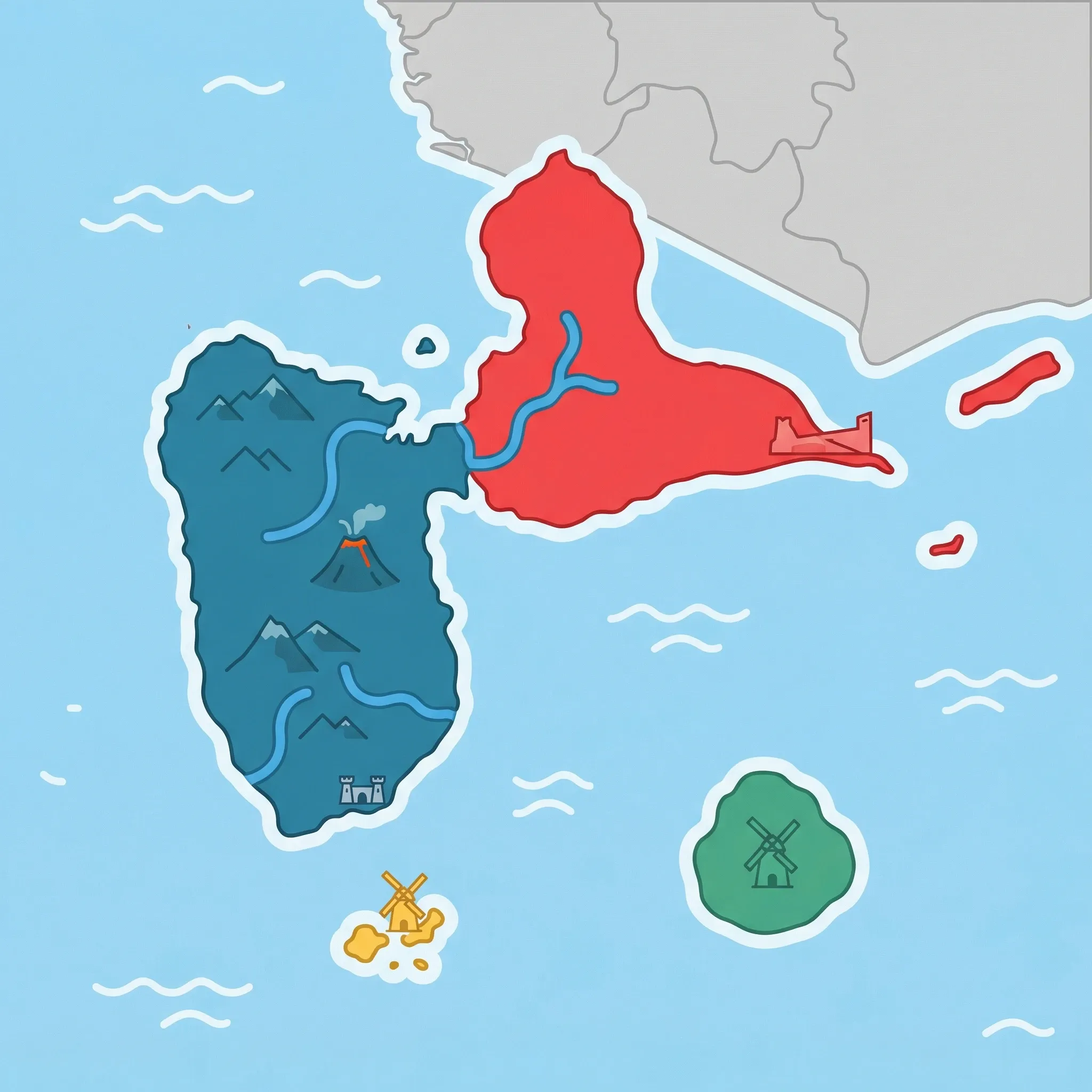
4 Regions
Basse-Terre
Where emerald rainforests meet black sand beaches and volcanic wonders 🌋
Grande-Terre
Turquoise lagoons and white sands for the perfect family escape 🏖️
Les Saintes
A car-free miniature paradise in one of the world's most beautiful bays ⛵
Marie-Galante
Step back in time to authentic island rhythms and endless sugar cane 🎋
Click on a region marker to explore details. Use the dropdown to color regions by activity suitability.

Getting There & Around
Getting There
- By Air – Pointe-à-Pitre International Airport (PTP) is the main gateway. Direct flights arrive daily from Paris (Orly/CDG). North American connections are available via Miami (American Airlines) or Montreal (Air Canada/Air Transat), often seasonally.
- By Sea – The L’Express des Iles ferry service connects Guadeloupe to Martinique, Dominica, and Saint Lucia. It docks at the Bergevin terminal in Pointe-à-Pitre.
- Entry Requirements – Guadeloupe is a French Overseas Region. EU citizens need only an ID card. US, UK, and Canadian citizens do not need a visa for stays up to 90 days. Check your government website for the latest visa requirements, or use the IATA Travel Centre entry-requirements checker.
Getting Around
- Car Hire – Essential for families. Exploring the rainforests of Basse-Terre or the beaches of Grande-Terre requires a vehicle. Roads are excellent (EU standard) but can be winding in the mountains. Traffic around Pointe-à-Pitre is heavy at rush hour.
- Ferries – Reliable services connect the main island to Les Saintes, Marie-Galante, and La Désirade. The crossing to Les Saintes can be choppy; bring sea-sickness meds for children.
- Buses – The Karu'Lis network serves central areas but is difficult to rely on for island-wide touring with children.

Packing List
Essential for rocky beaches and protecting feet from sea urchins, which are common in wilder swimming spots.
Guadeloupe uses standard French plugs (220V). US/UK devices will not fit without an adapter.
Dengue fever is a risk. You need tropical-strength repellent for evenings and rainforest hikes.
Single-use plastic bags are banned in supermarkets; you must bring your own or buy expensive reusable ones.
The ferry channels to Les Saintes and Marie-Galante are notoriously rough; kids will likely need this.
English is not widely spoken outside major hotels. A translation app helps with menus and directions.

Activities & Best Times

Adventure & Nature
ExcellentHiking, wildlife, outdoor exploration, ecotourism
A premier global ecotourism destination featuring the La Soufrière volcano and protected rainforests of the National Park. Drier months are essential for safe hiking on volcano trails and visiting the numerous waterfalls.
Offers dramatic volcanic scenery and excellent biodiversity with major natural features like the Baie des Saintes and Pain de Sucre. Hiking trails are best enjoyed in the cooler, drier months to avoid muddy conditions and extreme tropical heat.
Offers unique natural sites like Gueule Grand Gouffre and rural hiking trails through sugar cane landscapes. Dry months (Dec-Apr) provide the best conditions for outdoor exploration; wet season humidity and rain degrade the experience.
Beach & Sea
ExcellentBeach resorts, marine activities: diving, snorkelling, kite surfing, wind surfing, sailing
The Bay of Les Saintes is internationally recognized as one of the world's most beautiful bays. Pain de Sucre and Pompierre beaches are exceptional by global standards with crystal-clear water and dramatic volcanic backdrops. This is a globally significant beach destination.
Grande-Terre has the most famous and accessible beaches in Guadeloupe (Sainte-Anne, Plage de la Caravelle, Gosier) with white sand and turquoise waters. These are nationally iconic and internationally competitive. Should be differentiated from other regions.
Features pristine, uncrowded beaches like Plage de la Feuillère with high-quality turquoise waters. Peak season (Dec-May) avoids the hurricane risk and heavy rain of late summer/autumn.

City & Cultural
Very GoodUrban tourism, museums, historical sites, architecture
Offers a rich tapestry of French-Caribbean history through the colonial architecture of Basse-Terre and the impressive Fort Delgrès. Cultural vibrancy peaks during the winter months and the early-year carnival period.
Les Saintes offers authentic Breton-Caribbean heritage and Fort Napoléon, but the scale is small. 'Very_good' suggests international cultural significance that isn't present. 'Good' reflects the genuine but intimate cultural experience.
Marie-Galante retains an authentic 'island that time forgot' feel with historic sugar mills and rum distilleries. Drier months are optimal for exploring heritage sites; tourism drops during the high-humidity hurricane season (Jul-Oct).

Road Trips & Scenic
Very GoodScenic drives, countryside tours, route-based travel
The Route de la Traversée is internationally celebrated as one of the Caribbean's premier rainforest drives, cutting through Parc National. This is a signature experience that should be rated higher than Grande-Terre's unnamed coastal circuits.
Named routes like the Circuit du Nord Grande-Terre offer spectacular views of dramatic Atlantic coastlines and rural landscapes. Driving is safest and most scenic during the dry season when visibility is high and roads are not impacted by tropical downpours.
Small-scale scenic loops on Terre-de-Haut and Terre-de-Bas are best explored via electric carts or scooters rather than traditional cars. Optimal driving conditions and visibility occur during the dry season, while heavy rains make narrow island roads less pleasant in the autumn.

Sports & Active
Very GoodSport tourism, fitness activities, active recreation
The region excels in coastal hiking and organized outdoor activity centers like Karukera Land and Yalodé. Peak months offer the manageable temperatures required for active sports, whereas the late summer heat and humidity index can make intense physical activity uncomfortable for international travelers.
Exceptional for active families due to world-class canyoning, volcano trekking, and technical diving. Success for these high-adrenaline activities depends on the stable weather and calmer sea conditions of the dry season.
Provides high-quality hiking infrastructure such as the Le Chameau and Morne Morel trails, which offer significant elevation and panoramic views. Activity peaks during the cooler winter months when humidity is manageable and trail conditions are stable.

Educational & Exploratory
GoodLearning experiences, scientific sites, historical education
Significant sites like the Aquarium de la Guadeloupe and the Beauport sugar heritage center provide high-quality learning opportunities for families. These facilities are most accessible and pleasant to visit during the primary tourism window, avoiding the peak hurricane threat in September and October.
Features significant discovery centers like the Maison de la Forêt and the Ecomusée de la Guadeloupe that highlight unique island ecosystems. These facilities are most accessible during the peak tourism window with stable weather.

Relaxation & Wellness
GoodSpa retreats, wellness centers, peaceful getaways

Festivals & Seasonal
MarginalEvents, celebrations, seasonal attractions
Theme Park & Entertainment
MarginalAmusement parks, family entertainment venues

Public Holidays & Calendar Next 12 months
Public holidays, festivals, cultural celebrations, and seasonal natural phenomena coming up in Guadeloupe over the next 12 months.
Loading holidays and events...
Climate & Weather
Basse-Terre
Show Details
| Month | Temp °C | Rain | Humidity |
|---|
Grande-Terre
Show Details
| Month | Temp °C | Rain | Humidity |
|---|
Les Saintes
Show Details
| Month | Temp °C | Rain | Humidity |
|---|
Marie-Galante
Show Details
| Month | Temp °C | Rain | Humidity |
|---|

Travel Advisory
The majority of major international agencies classify Guadeloupe as a destination requiring only standard safety awareness, similar to many Western countries, though minor crime and seasonal weather risks exist.
Safety Topics
Traveller Advice (5 groups)

Take extra precautions when moving alone at night. Avoid unlit or isolated areas, including beaches after sunset.

When scuba diving, verify the credentials of operators and ensure oxygen equipment is available. Confirm that your insurance covers specific high-risk water activities.

While generally accepted as an overseas department of France, travellers should review general safety guidelines for solo and independent travel.

Infrastructure and services for those with limited mobility generally follow French regulations but may be more limited in rural or mountainous areas.

Maintain standard vigilance against petty theft and avoid carrying large amounts of cash. Secure comprehensive insurance and monitor local weather during hurricane season.
Agency Summaries
Most visits are trouble-free. Standard security vigilance is recommended. Be aware of the risks of petty crime in tourist hotspots and ensure comprehensive travel insurance is in place.
There is no specific travel warning in place. New Zealanders are advised to secure medical insurance that includes evacuation. Be cautious of insect-borne diseases and tap water safety during your stay.
Travelers should maintain standard safety awareness. While major violence is uncommon, petty theft like pickpocketing and bag-snatching is the primary concern for visitors. There is a higher risk of crime at night in certain areas, particularly in the historic center of Pointe-à-Pitre. Additionally, the territory frequently experiences water shortages and rationing.
Ireland advises an elevated level of vigilance due to risks associated with crime and health concerns, specifically mosquito-borne illnesses. Travelers should remain aware of their surroundings and monitor local news outlets.
The U.S. recommends standard safety measures for travel to the French West Indies, including Guadeloupe. Visitors are encouraged to monitor local updates and have contingency plans for emergencies.
Travel is generally safe, but common sense precautions are necessary. Avoid visiting isolated spots and beaches after dark. Be aware of the global threat of terrorism, though no recent incidents have occurred locally. Diving schools and road conditions follow French standards, but extra care is advised.
Information is provided for general guidance only and does not constitute travel, safety, medical, or legal advice. Conditions may change. Users are responsible for independently verifying information before travel.