

Overview
Guyana, often called the "Land of Many Waters," is a hidden treasure on South America's North Atlantic coast. Distinct from its Latin neighbors, it feels culturally Caribbean, with a relaxed vibe, English as the official language, and a diverse population tracing back to India, Africa, and Indigenous Amerindian roots. For families, this means easier communication and a warm, familiar welcome, even when venturing into the wild. The country is dominated by vast, pristine rainforests and golden savannahs that remain largely untouched by mass tourism, offering a true "Lost World" experience for older children and teenagers who love nature.
Traveling here is an adventure in itself. The coast is flat and humid, home to the capital, while the interior rises into majestic tepuis (table-top mountains) and rolling grasslands. Families can canoe through blackwater creeks, sleep in hammocks under the Milky Way, and see wildlife that is elusive elsewhere-like giant anteaters, jaguars, and harpy eagles. While it lacks the polished resorts of the Caribbean islands, Guyana offers something far more memorable: the chance to be real explorers in one of the planet's last great wildernesses.
Key Attractions
No trip to Guyana is complete without witnessing Kaieteur Falls. Five times higher than Niagara, this sheer drop of the Potaro River is one of the world's most powerful single-drop waterfalls. Unlike other global icons, there are no guard rails or crowds here-just raw nature. Small planes land at the airstrip in Kaieteur National Park, allowing families to walk comfortably to the precipice and look for the tiny, poisonous golden frogs that live in the giant tank bromeliads nearby.
Deep in the Rupununi Savannah, Surama Village Eco-Tourism offers a fantastic community-led experience where families can stay in traditional benabs (thatched huts), learn bow-and-arrow skills, and hike Surama Mountain. Nearby, the Kanuku Mountains Protected Area provides a stunning backdrop for spotting the Goliath bird-eating spider or the bizarre capybara. Back in the capital, the Guyana Zoological Park offers a gentler introduction to local wildlife, including the famous West Indian manatees that float in the park's ponds.
In Georgetown, architectural marvels stand as testaments to the colonial past. St. George's Cathedral is one of the tallest wooden buildings in the world and a cool, quiet respite from the tropical heat. Art-loving families should visit the National Art Gallery (Castellani House), housed in a beautiful wooden heritage building, to see works by Guyanese artists that depict the country's folklore and landscapes.
Practical Advice
The best time to visit is during the dry seasons (February to April and September to November), which makes travel to the interior easier and less muddy. A Yellow Fever vaccination certificate is required for entry if arriving from risk countries and is strongly recommended for all travelers; you may be asked to show it upon arrival. Malaria prophylaxis is essential for trips to the interior (but not the coast). Due to the tropical heat, hydration is key for children. Be aware that travel logistics in the Kaieteur Falls & Interior region rely on small aircraft and boats, so pack light using soft duffel bags.
Food & Drink
Typical meal times: Breakfast is early, from 6:30 am to 8:30 am. Lunch is the main meal, served 12:00 pm to 1:30 pm. Dinner is usually 6:30 pm to 8:30 pm, though fast-food spots in Georgetown stay open later.
Typical meal costs: GYD 1,500–3,000 (approx. $7–14 USD / €6.50–13 EUR) for local dining; GYD 4,000–8,000 (approx. $19–38 USD / €17–35 EUR) for mid-range restaurants. Interior lodges are usually all-inclusive.
Dietary requirements: Vegetarian food is widely available and delicious, thanks to the significant Hindu influence. Vegan options like "Seven Curry" (served inside a water lily leaf) are common. Gluten-free is harder to guarantee in remote areas due to the prevalence of bread and roti.
Family-friendly dining: Chinese restaurants are ubiquitous in Georgetown and offer familiar flavors for picky eaters. Local BBQ stands are also popular. In the interior, lodges serve family-style meals and can usually prepare simple pasta or chicken for children if requested in advance.
Signature dishes:
- Pepperpot – An Amerindian stew made with meat, cinnamon, hot peppers, and cassareep (a preservative made from cassava root), traditionally eaten with dense bread at Christmas but available year-round.
- Cook-up Rice – A one-pot dish similar to jambalaya, featuring rice, peas, coconut milk, and various meats or fish.
- Seven Curry – A ceremonial Hindu dish consisting of seven different types of vegetarian curries (pumpkin, mango, potato, etc.) served with rice/roti.
- Bake and Saltfish – Fried dough pockets served with sautéed salted fish, onions, and tomatoes-a classic breakfast.
- Pine Tart – A triangular pastry filled with sweet pineapple jam, perfect for a quick snack.

While street food and basic transport in Georgetown are affordable, the true Guyana experience—visiting the interior rainforests and lodges—is expensive due to logistics. Domestic flights and all-inclusive eco-lodges drive costs up significantly. A family should budget GYD 100,000–160,000 (approx. $480–760 USD / €440–700 EUR) per day if visiting the interior, compared to GYD 30,000–50,000 (approx. $140–240 USD / €130–220 EUR) on the coast.
Age Suitability





Did you know? Guyana welcomes approximately 288,000 international visitors per year. Most visitors come from Americas.

Explore Regions
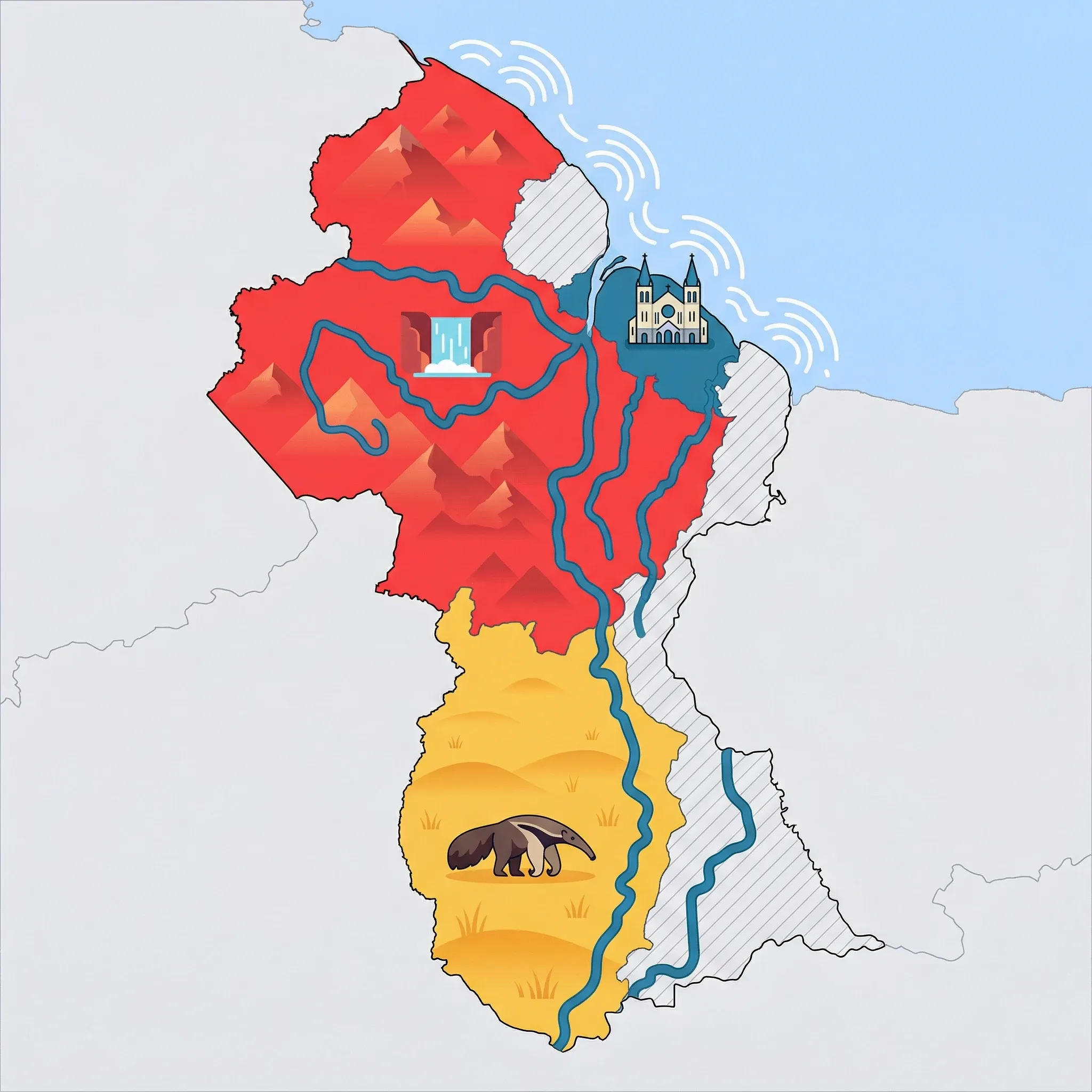
3 Regions
Georgetown
The Garden City of the Caribbean 🇬🇾✨
Kaieteur Falls & Interior
Home to the world's largest single-drop waterfall 🌊🌿
Rupununi Savannah
Where the wild savannah meets the Amazon 🐆🌾
Click on a region marker to explore details. Use the dropdown to color regions by activity suitability.

Getting There & Around
Getting There
- By Air – Cheddi Jagan International Airport (GEO) is the main gateway, located about 40km south of Georgetown. Direct flights arrive from Miami, New York, Toronto, Panama City, and Caribbean hubs like Trinidad.
- By Land – The crossing from Suriname (Moleson Creek ferry) is reliable. The border with Brazil at Lethem involves a bridge crossing, but the road from Lethem to Georgetown is a long, rough 4x4 journey (often 12+ hours) not recommended for young kids unless flying the domestic leg.
- Entry Requirements – US, UK, and EU citizens do not need a visa for stays up to 90 days. A Yellow Fever vaccination certificate is frequently requested upon arrival. Check your government website for the latest visa requirements, or use the IATA Travel Centre entry-requirements checker.
Getting Around
- Domestic Flights – Essential for reaching the Kaieteur Falls & Interior. Small Cessna Caravans operated by Trans Guyana Airways and Roraima Airways connect Georgetown (Ogle Airport) to remote airstrips like Lethem and Kaieteur.
- Taxis – The safest way to navigate Georgetown. Always use official yellow taxis or book via your hotel. Fares are generally fixed but should be agreed upon before entering.
- River Boats – Speedboats and ferries are common for crossing the Demerara and Essequibo rivers. Life jackets are mandatory and usually provided; ensure children wear them.
- Minibuses – While cheap, they are often crowded, driven recklessly, and play very loud music. They are generally not recommended for families with young children or luggage.

Packing List
Extreme humidity can damage cameras and phones; keep electronics in sealed bags with these.
Essential for spotting caiman and nocturnal wildlife without frightening them.
Treat clothing before travel to repel ticks and chiggers, common in the savannah grass.
Protect gear during frequent river crossings and sudden tropical downpours.
The combination of tropical heat and humidity can cause rapid dehydration in children.
Even for kids, these are vital for seeing birds and monkeys high in the rainforest canopy.

Activities & Best Times

Adventure & Nature
Very GoodHiking, wildlife, outdoor exploration, ecotourism
Kaieteur Falls is one of the world's most powerful waterfalls (5x Niagara's height) and a globally significant natural attraction. This is a bucket-list destination that warrants very_good rating to match international calibration standards for world-class natural features.
A premier global destination for wilderness immersion, featuring rare megafauna like giant otters and jaguars across pristine savannahs and the Kanuku Mountains. Peak visitation coincides with the long dry season when wildlife congregates at receding water sources and jungle trails remain accessible for trekking.
The city serves as a lush gateway to Guyana's interior, with the National Park and Botanical Gardens offering unique urban wildlife encounters, including manatees. Optimal visiting occurs during the dry seasons when park trails are accessible and wildlife activity is more visible.

City & Cultural
Very GoodUrban tourism, museums, historical sites, architecture
Home to extraordinary wooden colonial architecture like St. George's Cathedral and the vibrant Stabroek Market, offering a unique fusion of Caribbean and South American culture. Drier months are essential for comfortably exploring the historic quarters and lively street life on foot.
For consistency with Rupununi Savannah's treatment of indigenous heritage. Chenapau Village offers authentic indigenous culture but lacks the international scale or UNESCO recognition needed for 'good' rating. This aligns the classification with Rupununi's 'marginal' rating for similar cultural experiences.
Focuses on authentic Macushi and Wapishana Indigenous heritage at Annai and the Bina Hill Institute, alongside the unique border culture of Lethem. These cultural hubs are best experienced during the dry season when community access and regional travel are most reliable.

Road Trips & Scenic
GoodScenic drives, countryside tours, route-based travel
Georgetown is the starting point for the iconic Linden-Lethem Road, a bucket-list drive through the rainforest to the savannahs. This route is highly weather-dependent, with peak conditions occurring late in the dry seasons when roads are firm and navigable.
The Linden-Lethem road and Pakaraima Safari offer rugged, expedition-style driving through spectacular savannah and mountain scenery. These routes are highly seasonal, becoming difficult or impassable due to mud during the primary and secondary rainy seasons.
The Linden-Lethem Road and South Rupununi Safari routes offer iconic, rugged overland adventures through dramatic tropical landscapes. These routes are strictly seasonal, as heavy rains between May and August often render the unpaved savannah sections impassable for standard vehicles.

Sports & Active
GoodSport tourism, fitness activities, active recreation
Features internationally recognized trekking routes, including the challenging overland approach to Kaieteur and the Mount Roraima ascent. These activities require specific physical preparation and are best attempted when trails are dry and river levels are safer.
Features distinctive gravel cycling routes across the open savannah and challenging mountain treks like Makarapan, supported by community eco-tourism centers. Activities are concentrated in the dry months to ensure safe trail conditions and reliable transport between remote village bases.
Organized sports infrastructure exists at Splashmins and the National Aquatic Centre, catering to swimming and active recreation. Facilities are best utilized during the drier months to avoid the heavy tropical downpours of the two equatorial wet seasons.

Educational & Exploratory
MarginalLearning experiences, scientific sites, historical education

Beach & Sea
MarginalBeach resorts, marine activities: diving, snorkelling, kite surfing, wind surfing, sailing

Theme Park & Entertainment
MarginalAmusement parks, family entertainment venues

Public Holidays & Calendar Next 12 months
Public holidays, festivals, cultural celebrations, and seasonal natural phenomena coming up in Guyana over the next 12 months.
Loading holidays and events...
Climate & Weather
Georgetown
Show Details
| Month | Temp °C | Rain | Humidity |
|---|
Kaieteur Falls & Interior
Show Details
| Month | Temp °C | Rain | Humidity |
|---|
Rupununi Savannah
Show Details
| Month | Temp °C | Rain | Humidity |
|---|

Travel Advisory
The majority of international agencies recommend exercising a high degree of caution in Guyana. This assessment is driven by persistent levels of violent crime and limited emergency response capabilities, though specific regional tensions near the Venezuelan border also contribute to the risk profile.
Safety Topics
Traveller Advice (3 groups)

Maintain a low profile, avoid walking or driving at night, and do not resist robbery attempts. Be especially cautious when using ATMs or visiting banks.

Individuals should consult local laws and exercise discretion, as legal protections and social acceptance vary.

Female travelers should be aware of reports of sexual assault and harassment, particularly in urban areas and at night.
Agency Summaries
New Zealanders are urged to be security conscious due to high rates of violent crime, such as carjacking and sexual assault, particularly in urban environments.
Australia recommends a high level of caution due to threats of violent crime, including armed robbery and kidnapping, as well as ongoing tensions with Venezuela.
The UK provides general guidance highlighting significant crime levels and low police capacity, while noting specific risks associated with road travel and border regions.
The U.S. Department of State advises individuals to rethink travel plans to Guyana because of common violent crime and the limited capacity of local police to manage serious incidents.
Irish citizens are advised to be extremely vigilant due to high crime rates. The government notes limited consular support as there is no permanent Irish embassy in the country.
Canadian authorities suggest travelers maintain high vigilance due to elevated levels of crime across the country and a volatile security situation along the border with Venezuela.
Information is provided for general guidance only and does not constitute travel, safety, medical, or legal advice. Conditions may change. Users are responsible for independently verifying information before travel.