
Click a region to explore
⚠️ SAFETY WARNING: Due to high rates of street crime and limited police capacity, government agencies (including the USA, UK, Canada, and Australia) advise travelers to reconsider travel or exercise a high degree of caution in Georgetown. Armed robbery and pickpocketing are risks, particularly in areas like Stabroek Market and Tiger Bay. Families are strongly urged to consult their own government's official travel advisory before considering a trip, as circumstances and risk assessments vary.
Georgetown is a city of striking contrasts, where 19th-century colonial architecture meets the humid, energetic pulse of the tropics. For families, it serves as the essential introduction to Guyanese culture before heading into the wild interior. The city is laid out in a grid pattern with canals—a legacy of its Dutch heritage—and is famously known as the 'Garden City of the Caribbean' due to its tree-lined avenues. While the heat can be intense, the Atlantic breeze often cools the late afternoons, making it a pleasant time for a promenade.
Culturally, Georgetown is a melting pot of Afro-Guyanese, Indo-Guyanese, and Indigenous influences, which is vividly reflected in the food, music, and festivals. Families visiting with children will find a welcoming, albeit gritty, urban environment. While safety requires vigilance, the city offers educational experiences that are hard to find elsewhere, from historic wooden cathedrals to markets overflowing with tropical fruits that most children have never seen. It is a place to engage with history and nature simultaneously, setting the stage for the adventures that lie beyond the city limits.
Key Attractions
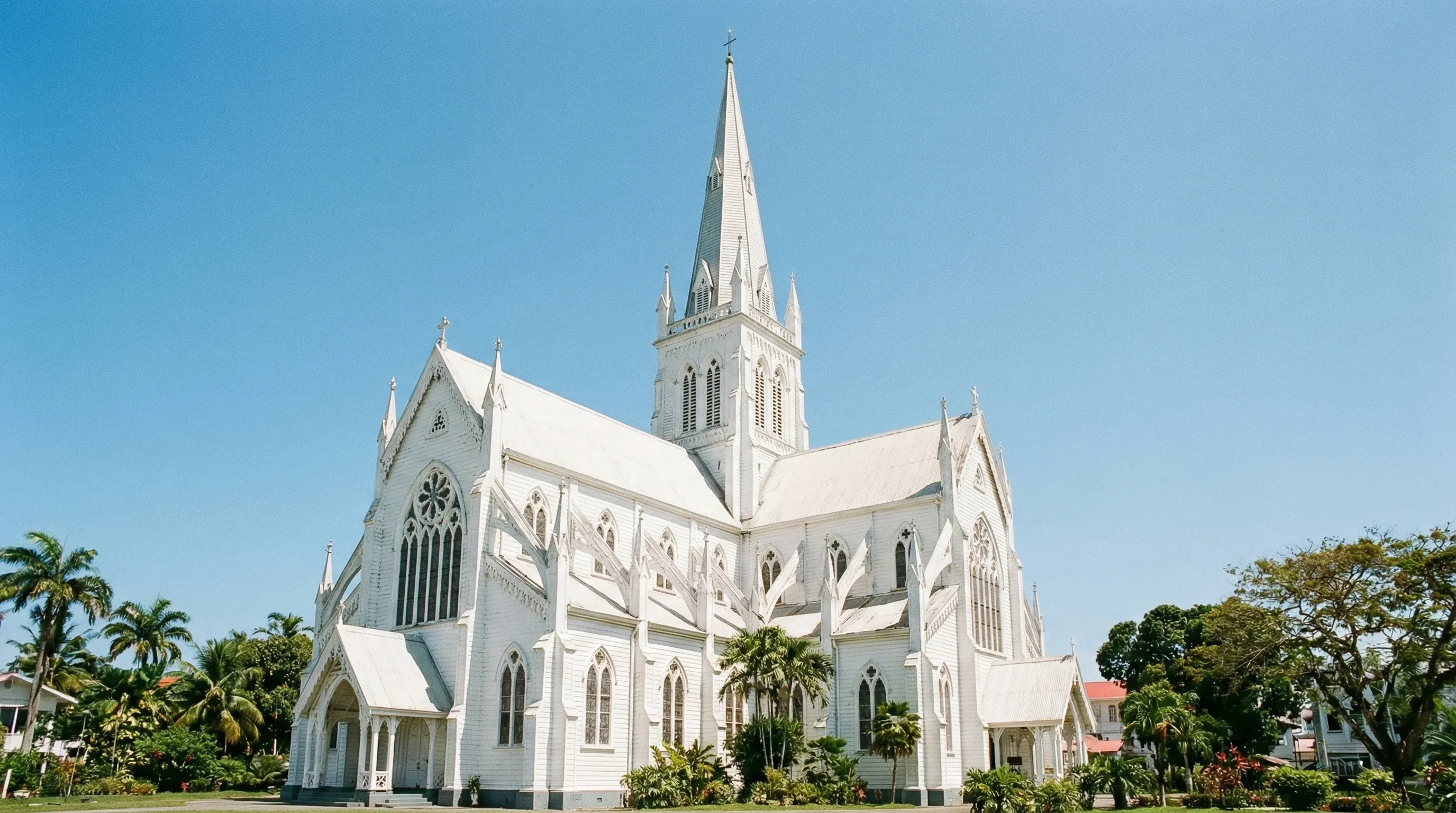
No visit to Georgetown is complete without seeing St. George's Cathedral. As one of the tallest wooden structures in the world, it is an architectural marvel that fascinates both children and adults. The sheer scale of the building, constructed from native hardwood, provides a cool, quiet respite from the city's noise. Just a short distance away, the Stabroek Market offers a sensory overload of sights and smells. While it requires caution and is best visited with a guide or during the morning, the clock tower is an iconic landmark, and the perimeter stalls sell everything from electronics to exotic produce.
For a gentler family outing, the Guyana Zoological Park allows children to see harpy eagles, manatees, and jaguars up close without the rigours of a jungle trek. It is a popular weekend spot for local families and provides an accessible way to learn about the country's biodiversity. Art-loving families should stop by the National Art Gallery (Castellani House). Housed in a beautiful heritage building, it showcases Guyanese art that narrates the nation's complex history and folklore, offering a visual education that is accessible even to younger visitors.
Practical Advice
The best time to visit is during the dry seasons (September to November and February to April). Heavy rains in May/June and December can cause flash flooding. Families should use registered taxis (like those booked by hotels) rather than walking, especially after dark. Electricity is generally 110V (US style), but some hotels use 220V.
Food & Drink
Typical meal times: Breakfast is early, from 7:00 am to 9:00 am. Lunch is the main meal, typically 12:00 pm to 1:30 pm. Dinner is served from 6:30 pm to 8:30 pm.
Typical meal costs: A mid-range family meal costs $4,000–7,000 GYD (approx. $19–33 USD / €17–31 EUR). Street food is cheaper, around $1,000–2,000 GYD (approx. $4.75–9.50 USD / €4.40–8.80 EUR).
Dietary requirements: Vegetarian food is widely available due to the significant Hindu population. Vegan options are common in Indian-influenced restaurants. Gluten-free is harder to guarantee in street food but manageable in hotels.
Signature dishes:
- Pepperpot – An Amerindian meat stew slow-cooked with cassareep (cassava extract) and spices, traditionally eaten with dense bread.
- Cook-up Rice – A one-pot dish with rice, beans, coconut milk, and various meats or fish, often served on weekends.
- Metemgee – A hearty soup of dumplings, plantains, yam, and cassava boiled in coconut milk, showcasing the Creole influence.
Why this score?
The city offers a mix of colonial architecture and urban markets, providing a low-intensity cultural experience compared to the wild interior. While the infrastructure is more rugged than many Caribbean capitals, it is essentially a developed urban environment with standard city hazards.
Why this score?
Georgetown contains Guyana's most advanced medical facilities, including several private hospitals and the main public referral center. While adequate for basic emergencies and stabilized care, specialized treatments often require medical evacuation to nearby countries.
Why this score?
As the primary international gateway and capital, Georgetown receives the bulk of Guyana's 288,000 annual visitors, though it remains a niche destination globally. Most tourists use the city as a base for exploring the interior, visiting landmarks like St. George's Cathedral and the Botanical Gardens.

Georgetown is moderately priced compared to the Caribbean average, but expensive for South America. International hotels charge US/European rates, often $30,000–50,000 GYD (approx. $140–235 USD / €130–220 EUR) per night. Local dining is affordable, with hearty meals for $2,000–3,500 GYD (approx. $9.50–16.50 USD / €8.80–15.50 EUR). Imported goods and electronics are pricey.

Getting Here & Around
Getting Here
- Airports – Cheddi Jagan International Airport (GEO) is the main international hub, located about 45–60 minutes south of the city. Eugene F. Correia International Airport (OGL) is closer to the center and handles regional Caribbean flights.
- Taxi – Official airport taxis are the safest way to reach the city center. Avoid unlicensed drivers soliciting fares in the arrivals hall.
Getting Around
- Taxi – The primary and safest mode of transport for families. Use radio taxis or hotel-arranged cars. Fares are generally negotiated beforehand or fixed by zone.
- Minibus – Ubiquitous and cheap, but often overcrowded, fast-paced, and loud. Not recommended for families with young children or luggage due to safety concerns.
- Walking – Feasible in specific areas like the Promenade Gardens or near St. George's Cathedral during the day, but generally discouraged for long distances due to heat and security risks.
Nearby Airports (2 airports)
Cheddi Jagan Intl
GEOGeorgetown
Ogle
OGLGeorgetown
View full flight map for Guyana →
Official Links

Packing List
Security is a concern in crowded market areas; secure zippers are essential.
Sudden, heavy tropical downpours occur year-round, even in dry seasons.
Mosquitoes carrying Dengue are present in urban areas, not just the jungle.
Many budget to mid-range accommodations lack plugs in bathroom sinks.
Extreme humidity can damage cameras and phones; keep electronics in sealed bags with these.
Essential for spotting caiman and nocturnal wildlife without frightening them.
Treat clothing before travel to repel ticks and chiggers, common in the savannah grass.
Protect gear during frequent river crossings and sudden tropical downpours.
The combination of tropical heat and humidity can cause rapid dehydration in children.
Even for kids, these are vital for seeing birds and monkeys high in the rainforest canopy.

Activities & Best Times

Urban tourism, museums, historical sites, architecture
Home to extraordinary wooden colonial architecture like St. George's Cathedral and the vibrant Stabroek Market, offering a unique fusion of Caribbean and South American culture. Drier months are essential for comfortably exploring the historic quarters and lively street life on foot.

Hiking, wildlife, outdoor exploration, ecotourism
The city serves as a lush gateway to Guyana's interior, with the National Park and Botanical Gardens offering unique urban wildlife encounters, including manatees. Optimal visiting occurs during the dry seasons when park trails are accessible and wildlife activity is more visible.

Scenic drives, countryside tours, route-based travel
Georgetown is the starting point for the iconic Linden-Lethem Road, a bucket-list drive through the rainforest to the savannahs. This route is highly weather-dependent, with peak conditions occurring late in the dry seasons when roads are firm and navigable.

Beach resorts, marine activities: diving, snorkelling, kite surfing, wind surfing, sailing
Georgetown features coastal recreation areas like the Sea Wall and Kingston Beach, though silty Atlantic waters limit traditional swimming and diving appeal. Peak months align with the primary dry windows when sea conditions are calmer and more conducive to coastal walks.

Sport tourism, fitness activities, active recreation
Organized sports infrastructure exists at Splashmins and the National Aquatic Centre, catering to swimming and active recreation. Facilities are best utilized during the drier months to avoid the heavy tropical downpours of the two equatorial wet seasons.

Amusement parks, family entertainment venues
Splashmins Fun Park provides a regional hub for family entertainment and aquatic activities, though it lacks the world-class scale of international theme parks. Activity is most enjoyable during the peak dry months when outdoor water park facilities are fully operational.

Attractions (9 total)



Public Holidays & Calendar Next 12 months
Public holidays, festivals, cultural celebrations, and seasonal natural phenomena coming up in Georgetown over the next 12 months.
Loading holidays and events...

Travel Advisory
The majority of international agencies recommend exercising a high degree of caution in Guyana. This assessment is driven by persistent levels of violent crime and limited emergency response capabilities, though specific regional tensions near the Venezuelan border also contribute to the risk profile.
Safety Topics
Traveller Advice (3 groups)

Maintain a low profile, avoid walking or driving at night, and do not resist robbery attempts. Be especially cautious when using ATMs or visiting banks.

Individuals should consult local laws and exercise discretion, as legal protections and social acceptance vary.

Female travelers should be aware of reports of sexual assault and harassment, particularly in urban areas and at night.
Agency Summaries
New Zealanders are urged to be security conscious due to high rates of violent crime, such as carjacking and sexual assault, particularly in urban environments.
Australia recommends a high level of caution due to threats of violent crime, including armed robbery and kidnapping, as well as ongoing tensions with Venezuela.
The UK provides general guidance highlighting significant crime levels and low police capacity, while noting specific risks associated with road travel and border regions.
The U.S. Department of State advises individuals to rethink travel plans to Guyana because of common violent crime and the limited capacity of local police to manage serious incidents.
Irish citizens are advised to be extremely vigilant due to high crime rates. The government notes limited consular support as there is no permanent Irish embassy in the country.
Canadian authorities suggest travelers maintain high vigilance due to elevated levels of crime across the country and a volatile security situation along the border with Venezuela.
Information is provided for general guidance only and does not constitute travel, safety, medical, or legal advice. Conditions may change. Users are responsible for independently verifying information before travel.