

⚠️ SAFETY WARNING: Due to widespread civil unrest, gang violence, and high rates of kidnapping, government agencies (including the USA, UK, Canada, and Australia) currently advise travelers to avoid all travel to Haiti. The security situation is extremely volatile, with essential infrastructure compromised and limited consular support. Families are strongly urged to consult their own government's official travel advisory before considering a trip, as circumstances and risk assessments vary.
Overview
Haiti occupies the western third of the island of Hispaniola, a land defined by its soaring mountain ranges and deep cultural roots. For families, the country represents a complex tapestry of triumph and struggle. It is the site of the only successful slave revolution in history, a legacy immortalized in its mountaintop fortresses and proud national identity. The landscape ranges from the pine forests of the Massif de la Selle to the hidden coves of the southern coast. While the current security climate makes leisure travel impossible for most, the country remains a place of immense significance, home to a vibrant artistic tradition where brightly painted buses and intricate papier-mâché masks tell stories of resilience.
Culturally, Haiti is distinct from its Caribbean neighbors. The fusion of French, African, and Taino influences creates a unique atmosphere, visible in the gingerbread houses of Port-au-Prince and audible in the rhythmic beats of Rara bands. For those who visit under safer circumstances or for essential purposes, the warmth of the Haitian people is often the most enduring memory. It is a destination that challenges and educates, offering a powerful lesson in history and human fortitude rather than a typical resort holiday.
Key Attractions
The crown jewel of Haitian heritage is undoubtedly the Citadelle Laferrière in the Cap-Haïtien & North region. This massive mountaintop fortress, a UNESCO World Heritage site, was built to defend the newly independent nation. Families can explore its ramparts and see hundreds of original cannons still pointing out to sea-a tangible history lesson that fascinates children and adults alike. Nearby lies the Sans-Souci Palace, once the Versailles of the Caribbean, now a majestic ruin that whispers of past grandeur.
In the Jacmel & South region, nature takes center stage at Bassin Bleu. These cobalt-blue waterfalls and pools are hidden in the lush hills, offering a magical swimming experience in a legendary setting said to be inhabited by water spirits. Jacmel itself is famous for its arts scene and the vibrant Haitian Carnival (Kanaval), where families can see incredible papier-mâché masks being crafted. For those in the capital, the Musée du Panthéon National Haïtien (MUPANAH) in Port-au-Prince houses the anchor of Columbus's ship and the pistol of King Henri Christophe, securely preserving the nation's turbulent history.
Practical Advice
Travel to Haiti currently requires extreme preparation. The best time to visit historically is November to March to avoid hurricane season, but safety is the primary dictator of timing. Visas are generally not required for short stays for US, Canadian, and EU citizens, but a tourist fee is payable at the airport. Malaria and Zika prophylaxis are essential, and families must drink only sealed, purified water to avoid cholera. Comprehensive medical evacuation insurance is non-negotiable.
Food & Drink
Typical meal times: Lunch is the main meal, typically eaten between 12:00 pm and 2:00 pm. Dinner is served later, often from 7:00 pm to 9:00 pm.
Typical meal costs: Street food is cheap but risky for visitors; restaurant meals cost 1,300–2,600 HTG (approx. $10–20 USD / €9–18 EUR). High-end hotel dining runs 4,000–6,600 HTG (approx. $30–50 USD / €28–46 EUR).
Dietary requirements: Haitian cuisine relies heavily on meat and seafood. Vegetarians can rely on rice and beans, plantains, and avocado, but vegan options are not explicitly catered for in most places. Peanuts and cashews are common ingredients.
Family-friendly dining: Hotel restaurants are the safest bet for families, offering familiar international dishes alongside local staples. Kids usually love the fresh tropical fruit and fried plantains.
Signature dishes:
- Soup Joumou – A rich pumpkin soup eaten on Independence Day (Jan 1st) to celebrate freedom; it is a symbol of resilience and very mild for children.
- Griot – Cubes of pork marinated in sour orange and scotch bonnet peppers, then fried until crisp and golden.
- Diri ak Djon Djon – Rice cooked with black mushrooms native to the north, giving it a distinct black color and earthy flavor.
- Pikliz – A spicy pickled slaw of cabbage, carrots, and peppers, served as a condiment with almost every meal (too spicy for most kids).
Safety
The security environment in Haiti is critical. Kidnapping for ransom is a pervasive threat that targets locals and foreigners alike, including children. Gangs control large portions of the capital, blocking major roads and disrupting fuel supplies. Families must prioritize security above all else: avoid all travel to dangerous neighborhoods (such as Cité Soleil), use armored vehicles if possible, and never travel after dark. Medical facilities are severely limited and often lack basic supplies. In the event of unrest, shelter in place and maintain a low profile.

While local goods are inexpensive, safe travel for families is costly due to security requirements. Secure transport and international-standard hotels are priced at a premium. A family of four should expect to spend 35,000–55,000 HTG (approx. $260–415 USD / £205–325 GBP) per day to ensure basic safety standards, reliable power, and secure food.
Age Suitability





Did you know? Haiti welcomes approximately 148,000 international visitors per year. Most visitors come from Americas.
Explore Regions
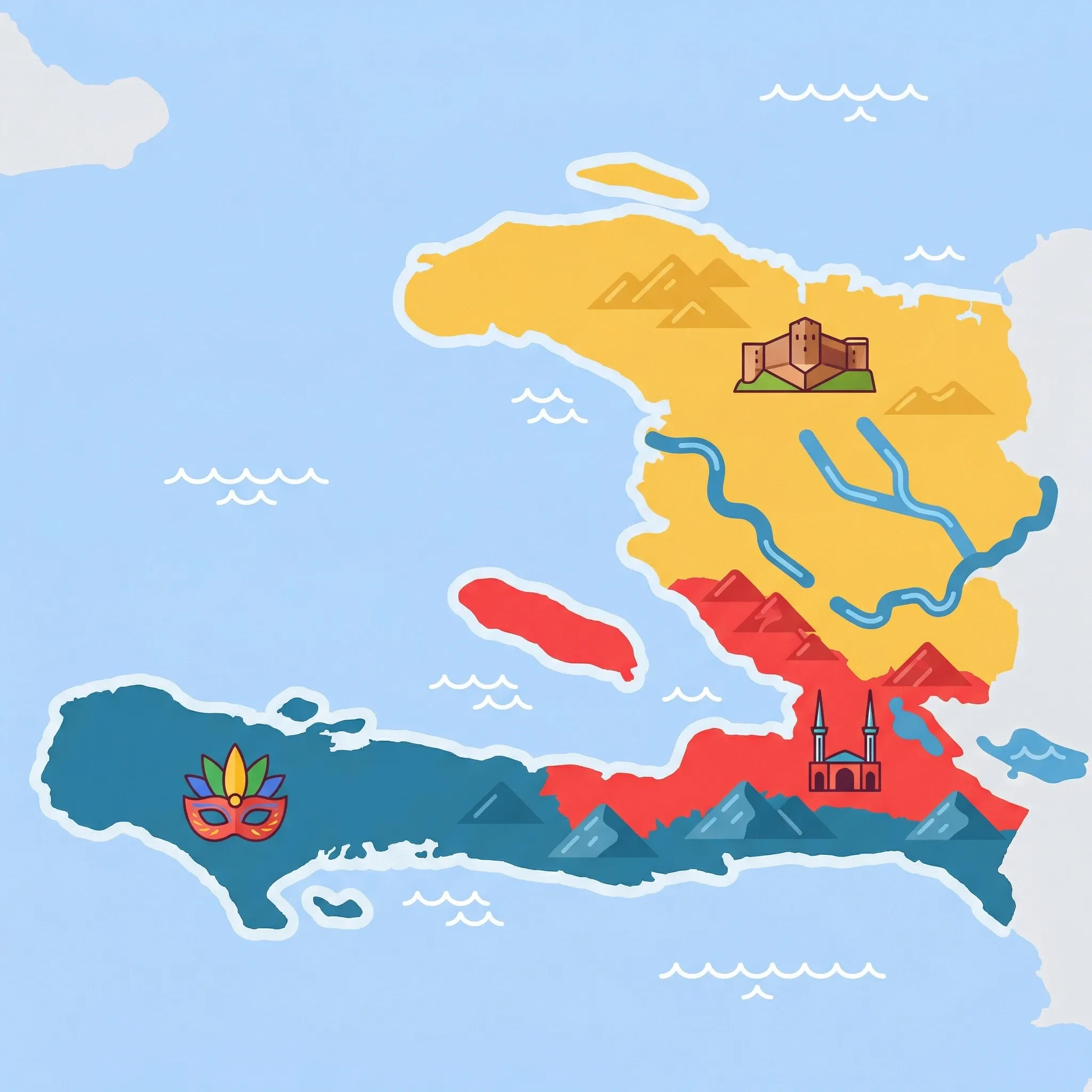
3 Regions
Cap-Haïtien & North
The historic kingdom of mountaintop fortresses 🏰⛰️
Jacmel & South
Where art meets the turquoise waterfalls 🎨🌊
Port-au-Prince
The vibrant, resilient, and intense beating heart of the nation 🇭🇹🏙️
Click on a region marker to explore details. Use the dropdown to color regions by activity suitability.

Getting There & Around
Getting There
- By Air – Toussaint Louverture International Airport (PAP) in Port-au-Prince is the main hub, though flights are frequently suspended due to security. Cap-Haïtien International Airport (CAP) in the north is often a safer alternative gateway.
- By Land – The border with the Dominican Republic is currently closed to all traffic. Crossings are strictly controlled and often militarized; land entry is not a viable option for tourists.
- Entry Requirements – Visitors must pay a tourist fee (approx. $10 USD) upon arrival. Check your government website for the latest visa requirements, or use the IATA Travel Centre entry-requirements checker.
Getting Around
- Private Driver – The only recommended method for families. Hiring a trusted local driver with a well-maintained (ideally armored) vehicle is essential for navigating erratic traffic and avoiding roadblocks.
- Domestic Flights – Sunrise Airways connects Port-au-Prince to Cap-Haïtien and Les Cayes. This is the safest way to travel between regions, bypassing gang-controlled highways.
- Public Transport – "Tap-taps" (painted buses) are cultural icons but are unsafe for tourists due to overcrowding, lack of safety restraints, and high risk of robbery or hijacking.
Official Links

Packing List
Electricity blackouts are frequent and can last for days; keep devices charged for communication.
Cholera is a risk and bottled water may not always be available in emergencies.
ATMs are unreliable or empty; USD is widely accepted for essential payments.
Malaria and Zika are present, and accommodation may not have adequate screening.
Cellular networks can fail during unrest; essential for emergency coordination in remote areas.
Street lighting is non-existent in many areas and indoor power is unreliable.

Activities & Best Times

Adventure & Nature
Very GoodHiking, wildlife, outdoor exploration, ecotourism
Home to the Pic Macaya National Park and the turquoise pools of Bassin Bleu, the region offers exceptional biodiversity and karst landscapes. Winter provides the stable weather necessary for mountain trekking, whereas peak rain in May and October makes trails hazardous.
Home to the UNESCO-listed Citadelle Laferrière and vast national parks, the region provides world-class hiking and ecological immersion. The drier months are peak for trekking to avoid the heavy tropical rains that make mountain trails muddy and difficult in May and autumn.
High-altitude pine forests in Parc National La Visite and ecological reserves offer unique Caribbean wilderness and hiking. Peak season coincides with the driest months for safe trail conditions, while the rainy seasons (May and Aug-Oct) make mountain paths difficult to navigate.

City & Cultural
Very GoodUrban tourism, museums, historical sites, architecture
Jacmel is a cultural treasure known for its unique 'Gingerbread' architecture and a thriving artisan community centered around papier-mâché and painting. The peak season centers on the cooler winter months and the vibrant pre-Lenten atmosphere.
Cap-Haïtien is the cultural soul of Haiti, featuring significant historic sites like the Sans-Souci Palace and iconic cathedrals. The winter months offer the most comfortable walking temperatures for exploring these monumental urban landmarks without extreme humidity.
Features world-class institutions like MUPANAH and a globally recognized art scene at Le Centre d'Art. The winter dry season provides the most comfortable conditions for exploring urban heritage sites and galleries without the intense humidity and heavy seasonal rains.

Beach & Sea
GoodBeach resorts, marine activities: diving, snorkelling, kite surfing, wind surfing, sailing
The region features stunning Caribbean coastlines at Port-Salut and Raymond-les-Bains, offering authentic tropical beauty. Peak months align with the winter dry season and July's warmer waters, while autumn is avoided due to hurricane risks and peak rainfall.
The region offers high-quality coastal experiences like Amiga Island and Cormier Plage, though infrastructure is more limited than major Caribbean hubs. Peak visitation aligns with the drier winter months when sea conditions are calm and underwater visibility is optimal for snorkeling.

Festivals & Seasonal
GoodEvents, celebrations, seasonal attractions
Jacmel Carnival is nationally significant and draws regional tourism from the Caribbean diaspora. While not at the international scale of Trinidad or Rio, it's a genuine cultural event worthy of 'good' status once the festival attraction is added to the database.
Home to the culturally significant Haitian Kanaval in February and Fête Gede in November, offering highly authentic and unique experiences. These specific months represent the only times these world-renowned cultural events occur, with other months lacking major international festival draws.

Road Trips & Scenic
GoodScenic drives, countryside tours, route-based travel
The Route de l'Amitié and the coastal drive to Port-Salut offer dramatic mountain and ocean vistas for adventurous drivers. Travel is best during the dry season to ensure safe passage on winding mountain roads that become treacherous during heavy rainfall.
Scenic mountain routes like Route de Kenscoff and Boutilliers offer spectacular panoramic views of the capital and bay. Visibility is highest and road conditions are most stable during the dry winter months, whereas the rainy season can lead to landslides and poor driving conditions.
Scenic drives through the Massif du Nord and along the Atlantic coast offer spectacular views but are hindered by variable road quality. Travel is best during the dry season to ensure road stability and visibility, particularly on mountain passes.

Sports & Active
GoodSport tourism, fitness activities, active recreation
The high-altitude trails to Pic la Selle and through the Chaîne de la Selle mountains provide significant infrastructure for trekking and mountain cycling. Activity is best supported during the cool, dry season to ensure trail accessibility and comfortable exertion levels.
Activity is centered around significant hiking routes like the trail to the Citadelle, which requires a degree of fitness and provides authentic historical context. Peak months provide the safest and most enjoyable conditions for these strenuous uphill routes.

Public Holidays & Calendar Next 12 months
Public holidays, festivals, cultural celebrations, and seasonal natural phenomena coming up in Haiti over the next 12 months.
Loading holidays and events...
Climate & Weather
Cap-Haïtien & North
Show Details
| Month | Temp °C | Rain | Humidity |
|---|
Jacmel & South
Show Details
| Month | Temp °C | Rain | Humidity |
|---|
Port-au-Prince
Show Details
| Month | Temp °C | Rain | Humidity |
|---|

Travel Advisory
All major agencies have issued their highest warning level for Haiti, citing a complete breakdown of security, pervasive gang violence, and high rates of kidnapping. Travellers are advised to avoid the country entirely and those already present are urged to depart immediately.
Safety Topics
Traveller Advice (4 groups)

Missionaries have been victims of high-profile kidnappings. Religious organizations should reconsider any presence due to targeted criminal threats.

Female visitors, particularly those driving alone, are frequently targeted for carjackings and robberies. There is a high risk of sexual violence in areas with limited police presence.

While not legally prohibited, same-sex relationships face significant public hostility and social stigma, potentially leading to harassment or physical assault.

Aid workers are specifically targeted by criminal groups for kidnapping for ransom due to perceived access to organizational funds.
Agency Summaries
Gangs have overrun major infrastructure, including prisons and airports. Security forces have limited capacity to respond to emergencies, making all areas of the country high-risk.
Australians are urged to leave if they can do so safely. Essential resources like fuel and water are in critically short supply, and gang violence has paralyzed major transport routes.
The security landscape is extremely volatile. With no active UK consular staff on the ground, emergency assistance is essentially unavailable to British nationals in the country.
High risk of violent crime including homicide, sexual assault, and carjacking. Kidnapping is common, targeting foreign nationals and residents alike. US government employees face strict travel restrictions and night curfews.
Irish citizens are warned against all travel due to the collapse of public safety. Diplomatic support is limited as there is no local Irish embassy.
Travel is extremely hazardous due to systemic gang control, frequent kidnappings, and widespread political instability. Civil order is severely compromised, and there is a state of emergency across multiple regions.
Information is provided for general guidance only and does not constitute travel, safety, medical, or legal advice. Conditions may change. Users are responsible for independently verifying information before travel.