

Hungary sits in the heart of Central Europe, a land where history feels alive and accessible rather than stuffy and distant. For families, it is an exceptionally welcoming destination, blending safe, walkable cities with a countryside defined by rolling hills and vast plains. The jewel in the crown is Budapest, a city bisected by the Danube River, where the hilly Buda side offers fairy-tale views and the flat Pest side buzzes with energy. Hungarian culture revolves deeply around water; "taking the waters" in thermal baths is a national pastime that families can enjoy together, with many complexes featuring dedicated children's adventure pools and slides alongside the historic medicinal basins.
Beyond the capital, the pace slows down comfortably. To the west lies Lake Balaton, often called the "Hungarian Sea," where shallow, warm waters make for worry-free swimming with toddlers. To the east, the Great Plain (Puszta) offers a Wild West-style experience with horse herders and vast horizons. The country is compact enough that you can see diverse regions without exhausting travel times, and the cost of living remains lower than in Western Europe, allowing families to enjoy high-quality dining and activities without breaking the bank. Whether you are exploring the caves of Eger or tasting sweet chimney cake in a market, Hungary feels like a well-kept secret that loves children.
Key Attractions
Budapest is the obvious starting point, where Buda Castle and the whimsical turrets of Fisherman's Bastion provide the perfect backdrop for imaginative play. Nearby, the Budapest Zoo & Botanical Garden is one of the oldest in the world, featuring stunning Art Nouveau architecture as well as animals. For water fun, families should not miss Aquaworld Resort Budapest, a massive indoor water theme park, or the outdoor excitement of the City Park Ice Rink in winter (which becomes a boating lake in summer).
Heading to the countryside, Lake Balaton is essential for summer visits. The Tihany Peninsula offers great views and an echo that kids love to test, while Lake Hévíz allows for a unique swim in a biologically active thermal lake. In the north, history comes alive at Eger Castle, where kids can learn about the legendary siege against the Ottomans. For animal lovers, the Nyíregyháza Zoo in the Great Plain is often cited as the best zoo in the country, set in a natural oak forest.
Practical Advice
The best time to visit is late spring (May-June) or early autumn (September), when the weather is mild and crowds are manageable. Summers can be hot, especially in the city, though perfect for Lake Balaton. Hungary uses the Forint (HUF), not the Euro; while cards are widely accepted, carrying some cash is useful for small vendors and toilets. Public transport is excellent, and in Budapest, children under 6 travel free (and often under 14 too-check current rules). Pharmacies are marked with a green cross and are well-stocked.
Food & Drink
Typical meal times: Lunch is the main meal, typically served from 12:00 pm to 2:00 pm. Dinner is usually eaten between 6:00 pm and 9:00 pm.
Typical meal costs: 4,000–7,000 HUF (approx. $10.50–18.50 USD / €10–17.50 EUR) for a main dish in a mid-range restaurant.
Dietary requirements: Vegetarian options are increasingly common in Budapest (look for "Vega" dishes), though traditional rural cuisine relies heavily on meat and dairy. Gluten-free ("gluténmentes") awareness is high in supermarkets and modern restaurants.
Family-friendly dining: Hungarians love children, and most restaurants are welcoming. Highchairs are standard, and "féladag" (half portions) are often available for kids even if not listed. Soups are a staple and a great healthy option for little ones.
Signature dishes:
- Gulyás (Goulash) – A hearty soup (not a stew) with beef, potatoes, vegetables, and plenty of paprika-usually mild enough for kids.
- Lángos – Deep-fried flatbread typically topped with garlic, sour cream, and grated cheese; a favorite beach and street food snack.
- Csirkepaprikás (Chicken Paprikash) – Chicken simmered in a creamy, paprika-infused sauce, usually served with nokedli (small egg dumplings).
- Kürtőskalács (Chimney Cake) – A sweet, hollow, spiral pastry roasted over charcoal and coated in sugar, cinnamon, or walnuts.
- Túró Rudi – A beloved chilled snack made of sweet curd cheese coated in chocolate, found in every supermarket.

Hungary remains one of Europe's better-value destinations. A family of four can expect to spend around 50,000–75,000 HUF (approx. $130–195 USD / €120–180 EUR) per day, covering mid-range accommodation, meals, and entry fees. While <a data-region-id="-7729726023903615806">Budapest</a> prices have risen, they are still significantly lower than Vienna or Paris.
Age Suitability




Did you know? Hungary welcomes approximately 13.2 million international visitors per year. Most visitors come from Europe.
Explore Regions
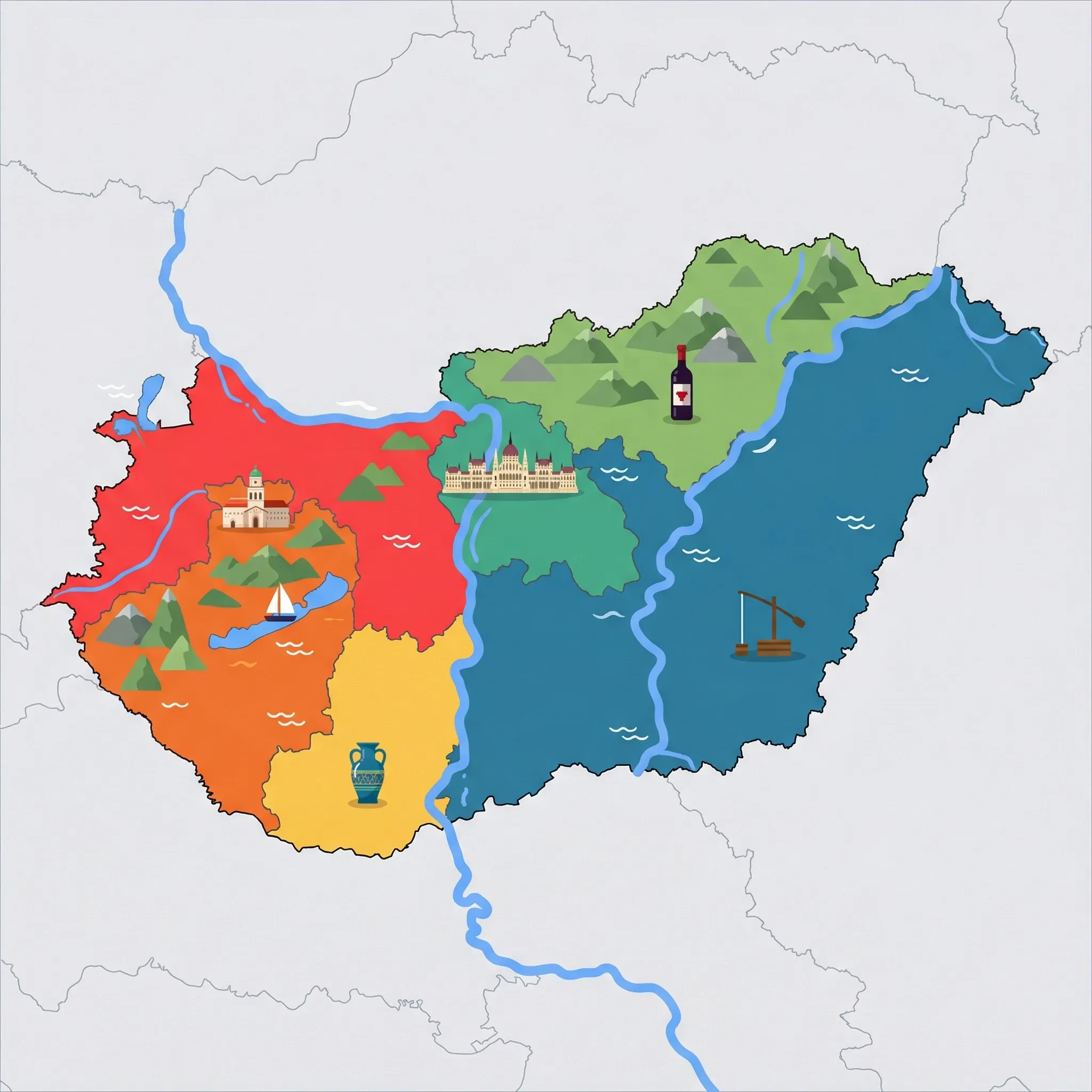
6 Regions
Budapest (standalone)
Thermal baths and fairy tale castles on the Danube 🏰💦
Eger & Northern Highlands (wine)
Historic castles, forest trains, and underground wonders 🏰🌲
Great Plain (Puszta, Hortobagy)
Cowboys, vast horizons, and thermal splashes 🐎🤠
Lake Balaton
Sun, sailing, and shallow sandy shores ⛵☀️
Pécs & Southern Hungary
Mediterranean vibes and colorful culture 🏺☀️
Western Hungary (Sopron, Győr)
Baroque charm and nature at the Austrian border 🏰🛶
Click on a region marker to explore details. Use the dropdown to color regions by activity suitability.

Getting There & Around
Getting There
- By Air – Budapest Ferenc Liszt International Airport (BUD) is the main hub, located about 16 km from the city center. It is well-connected to major European cities and serves as a base for low-cost carriers like Wizz Air.
- By Train – Hungary is a key rail hub in Central Europe. Railjet trains connect Budapest to Vienna (2.5 hours) and Munich (7 hours). The overnight sleeper trains to/from neighbours like Romania are an adventure for older kids.
- By River – River cruises on the Danube are a popular way to arrive from Vienna or Bratislava, docking right in the heart of the capital.
- Entry Requirements – Hungary is part of the Schengen Area. US, UK, Canadian, and Australian citizens usually do not need a visa for short tourist stays. Check your government website for the latest visa requirements, or use the IATA Travel Centre entry-requirements checker.
Getting Around
- City Transport – Budapest has a world-class system (BKK) of trams, metros, and buses. Children under 6 travel free; children aged 6–14 may also travel free with valid ID (check current BKK rules). The historic Metro Line 1 is a fun ride for kids.
- Trains – The national rail operator (MÁV) connects major hubs like Eger and Lake Balaton. Trains are reliable but can be slower in rural areas. Seat reservations are recommended for InterCity lines.
- Car Hire – Useful for exploring the Great Plain or circumnavigating Lake Balaton. Roads are generally good; a vignette (e-toll pass) is required for highways.
- Taxis – Use reputable apps like Bolt or Főtaxi. Avoid hailing cars on the street to prevent overcharging.

Packing List
Strictly mandatory in the swimming lap pools at most thermal baths (like Széchenyi or Gellért).
Required for hygiene in thermal bath walkways; walking barefoot is often prohibited.
Ticks are common in Hungarian forests and the Buda Hills; handy for hiking families.
Towel rentals at baths can be expensive or low quality; bringing your own is cleaner and cheaper.
Essential for summer evenings, especially if staying near Lake Balaton or the Danube river.

Activities & Best Times

City & Cultural
ExcellentUrban tourism, museums, historical sites, architecture
Budapest is a premier global destination for architecture and history, featuring world-class sites like the Parliament and Buda Castle. Peak seasons offer pleasant walking weather and festive winter markets, while hot summers and gray mid-winter months are slightly less optimal.
Boasts high-quality cultural heritage including the Baroque Festetics Palace and the historic Tihany Abbey. Summer and early autumn offer a vibrant atmosphere and full access to galleries, while winter months see reduced visitor services and closures.
Only 1 attraction in database (Early Christian Necropolis). 'Excellent' requires globally top-tier status with multiple major attractions. Pécs is culturally significant but not at the level of European cultural capitals. Downgrade to 'very_good' pending addition of more cultural sites.

Adventure & Nature
Very GoodHiking, wildlife, outdoor exploration, ecotourism
The region offers immersive volcanic landscapes and the Balaton Uplands National Park, providing unique hiking and wildlife viewing. Peak summer is ideal for exploring the lake's ecosystems, while spring and autumn provide comfortable temperatures for trekking.
Offers immersion in the Mecsek Mountains and unique rural experiences like Ladybird Farm and Bőszénfa Deer Farm. Peak season aligns with mild hiking weather and active wildlife, while winter is often too cold and grey for outdoor immersion.
Features UNESCO-listed Lake Fertő and the Pannonhalma Archabbey herb gardens, offering authentic immersion in unique ecosystems and heritage landscapes. Peak months provide optimal conditions for exploring the diverse wetlands and rural demonstration farms.

Sports & Active
Very GoodSport tourism, fitness activities, active recreation
Home to the high-quality 200km Balaton Bike Ring and significant adventure parks like Zamárdi. Peak conditions for cycling and outdoor organized activities occur from late spring through early autumn, with infrastructure mostly closing in winter.
Strong infrastructure for cycling (EuroVelo 13) and national hiking trails (Blue Tour) through the Mecsek range. Optimal conditions exist in the cooler transition months; summer peak can be overly hot for strenuous cycling or hiking.
Boasts internationally recognized cycling infrastructure, including sections of EuroVelo 6 and the B10 Lake Fertő path. Peak season avoids the hottest summer days and coldest winter periods, offering ideal conditions for long-distance cycling.
Theme Park & Entertainment
Very GoodAmusement parks, family entertainment venues
Features major attractions like Aquaworld, one of Europe's largest indoor water parks, and heritage rides at the zoo. Summer months and the Christmas holiday period represent the peak for family-oriented entertainment and resort visitation.
Features significant water and adventure parks such as Annagora and Zobori, which meet solid regional standards. These attractions are strictly seasonal, thriving in the warm summer months and closing or restricting access during the colder half of the year.
Features unique, authentic experiences like the Renaissance Theme Park and several regional water parks. These facilities typically operate fully only during the summer season, with shoulder months offering reduced services.

Educational & Exploratory
GoodLearning experiences, scientific sites, historical education
Pécs Zoo and the Labor Interactive Science Center provide high-quality engagement for families. While these are mostly indoor, visiting is best timed with broader regional peak months when all supporting tourism services are operational.
Purpose-built facilities like the Tisza Lake Ecocentre and the Agora Science Center provide internationally significant ecological and scientific insights. These centers are most engaging from spring through autumn when combined with active exploration of the surrounding natural environments.
Provides interesting geological and natural history at the Tapolca Lake Cave and Lavender House. While authentic, these sites are secondary to the region's main draws and lack the destination-level scale of major international educational hubs.

Festivals & Seasonal
GoodEvents, celebrations, seasonal attractions
Sziget Festival is one of Europe's largest music festivals with 500k+ attendance. This warrants 'good' rating once festival attraction is added.
Driven primarily by the internationally recognized Balaton Sound electronic music festival in July. Beyond this major event, the region lacks a consistent calendar of festivals that would specifically attract global travelers over local residents.
The Mohács Busójárás in February is a world-class UNESCO event attracting global interest, though regional event density is low otherwise. Autumn months offer strong shoulder appeal due to the prominent grape harvest festivals in Villány.

Relaxation & Wellness
GoodSpa retreats, wellness centers, peaceful getaways
Centred on the world-renowned Hévíz Thermal Lake and major thermal bath complexes like Zalakaros. While thermal waters are year-round, families typically visit during warmer months when outdoor lakeside facilities and parks are fully operational.
Anchored by the internationally known thermal waters of Harkány and modern spas in Siklós and Gunaras. Summer is peak for outdoor pool complexes, while the coldest winter months attract wellness tourists seeking indoor thermal heat.
Eger and Egerszalók are established wellness hubs featuring authentic Turkish baths and unique natural salt formations. Peak demand aligns with summer leisure travel and festive winter breaks when the thermal waters are most inviting.

Road Trips & Scenic
GoodScenic drives, countryside tours, route-based travel
The North Shore and Káli Basin offer scenic driving routes through vineyards and volcanic hills with lake views. Best visibility and lush countryside aesthetics are found between May and September, with winter months offering a starker, less appealing landscape.
The Villány-Siklós Wine Route and Mecsek Scenic Loop offer authentic rural landscapes and high-quality stopovers. Spring blooms and autumn harvest provide the best visual and cultural experience, with winter conditions often too bleak for scenic driving.
Offers well-defined scenic routes like the Lake Fertő UNESCO loop and Szigetköz nature drives through pristine landscapes. Peak visibility and the most striking countryside colors are found in late spring and early autumn.

Ski & Snow
MarginalWinter sports, ski resorts, snow activities
The Síaréna Vibe Park offers basic winter sports infrastructure for the region. It remains a marginal choice for international families compared to alpine resorts, with a very short and weather-dependent season.
Limited to the local Pécsi Sípálya on Misina-tető, offering a modest experience for families already in the region. Snow coverage is inconsistent outside the core winter months, making it a purely local alternative to major alpine resorts.
Small-scale ski centers like Kékestető serve domestic needs but lack the vertical drop and infrastructure expected by sophisticated international travelers. The season is short and highly dependent on mid-winter temperatures.

Public Holidays & Calendar Next 12 months
Public holidays, festivals, cultural celebrations, and seasonal natural phenomena coming up in Hungary over the next 12 months.
Loading holidays and events...
Climate & Weather
Budapest (standalone)
Show Details
| Month | Temp °C | Rain | Humidity |
|---|
Eger & Northern Highlands (wine)
Show Details
| Month | Temp °C | Rain | Humidity |
|---|
Great Plain (Puszta, Hortobagy)
Show Details
| Month | Temp °C | Rain | Humidity |
|---|
Lake Balaton
Show Details
| Month | Temp °C | Rain | Humidity |
|---|
Pécs & Southern Hungary
Show Details
| Month | Temp °C | Rain | Humidity |
|---|
Western Hungary (Sopron, Győr)
Show Details
| Month | Temp °C | Rain | Humidity |
|---|

Travel Advisory
All major agencies agree that Hungary is a safe destination requiring only standard travel safety awareness and common sense precautions.
Safety Topics
Traveller Advice (3 groups)

While the capital is generally open, be aware of legislation that may restrict public displays of affection or the depiction of certain identities to minors. Some public rallies or marches may be subject to fines or facial recognition monitoring.

When visiting lakes, forests, or rural areas from spring to autumn, take precautions against ticks which can transmit encephalitis. Check for ticks immediately after outdoor activities.

Exercise caution in tourist districts and on public transport where pickpocketing is common. Avoid large political demonstrations in Budapest and verify menu prices in bars to avoid overcharging scams.
Agency Summaries
Maintain common sense vigilance. Be alert for petty crime on public transport and overcharging scams in nightlife venues. Note that the Australian Embassy in Budapest is closed; assistance is provided via Vienna.
No specific security warnings are in place. Travellers are advised to monitor local conditions and be aware of health risks such as tick-borne encephalitis in rural or wooded areas.
Travellers should maintain standard safety awareness. While Hungary is generally safe, seasonal spring flooding can occur along the Danube and Tisza rivers. Consular assistance for dual citizens may be limited.
Standard precautions are advised. Recent updates highlight specific legal regulations affecting LGBTQ+ public events and the implementation of the new European Entry-Exit System for border crossings.
General safety awareness is recommended. Travellers should stay informed about potential civil unrest in Budapest and maintain vigilance in public spaces due to the global threat of terrorism.
Hungary is classified as a safe destination. Visitors should practice typical safety habits, especially regarding petty theft in crowded Budapest tourist spots, and use only legitimate currency exchange offices.
Information is provided for general guidance only and does not constitute travel, safety, medical, or legal advice. Conditions may change. Users are responsible for independently verifying information before travel.