

⚠️ SAFETY WARNING: Due to the critical risk of arbitrary arrest, detention of foreign nationals, and regional volatility, government agencies including the US, UK, Canada, Australia, and New Zealand advise travellers to avoid all travel (Level 3/4) to Iran. Dual nationals are at specifically high risk. The security situation is unpredictable and can change rapidly. Families are strongly urged to consult their own government's official travel advisory before considering a trip, as circumstances and risk assessments vary significantly by nationality.
Overview
For families who do visit-often on organised tours-Iran reveals itself as a treasure chest of history and culture. Geographically, it is a vast plateau rimmed by the snow-capped Alborz and Zagros mountains, descending into lush forests in the north and moon-like deserts in the centre. The country's heart beats in its public squares and tea houses, where the culture of Taarof (ceremonial politeness) ensures that guests are treated with overwhelming generosity. It is not uncommon for locals to invite families into their homes for tea, eager to show the warmth that defines the Iranian character.
Traveling here with children opens doors; Iranians adore kids, and young travellers often become the bridge for heartwarming interactions. While the cities like Tehran are bustling metropolises, the real magic lies in the historic provinces. From the blue-tiled domes of Isfahan to the mud-brick lanes of Yazd, the landscape feels like a living storybook. However, families must be prepared for strict local laws, including mandatory dress codes for women and girls (usually aged 9+), and the need to carry cash for all expenses.
Key Attractions
A family trip often begins in the capital, where the dazzling Golestan Palace offers a glimpse of Qajar-era opulence with its mirrored halls that fascinate children. For a breath of fresh air, the Azadi Tower provides iconic views, while the Darband mountain trail offers a lively escape with riverside restaurants and fruit leather stalls that kids will love tasting.
Moving south, Isfahan is the undeniable highlight. The Grand Bazaar of Isfahan is a sensory maze where you can watch artisans print tablecloths and hammer copper. Nearby, the Isfahan Aquarium is a modern surprise, walking families through a tunnel of sharks and rare fish. No visit is complete without standing on the balcony of the Ali Qapu Palace to overlook the vast Naqsh-e Jahan Square, where families gather for picnics and horse-drawn carriage rides at sunset.
For a desert adventure, Yazd captivates with its windcatchers and winding alleys. The Yazd Water Museum explains the ancient qanat system in a way that is surprisingly engaging for young minds. Further southeast in Kerman & Southeast, the Shahdad Kaluts (Lut Desert) offer an alien landscape of sand castles formed by the wind-perfect for running and photography. Finally, history comes alive at Naqsh-e Rostam near Shiraz, where colossal tombs carved high into the cliff face leave a lasting impression of the Persian Empire's scale.
Practical Advice
Spring (March–May) and Autumn (September–November) are the best times to visit, avoiding the searing summer heat and cold winters. Visa rules are strict: Citizens of the US, UK, and Canada must be on a government-approved guided tour at all times. Families should bring a good medical kit, as specific pediatric medicines may be hard to find.
Food & Drink
Typical meal times: Lunch is the main meal, eaten from 1:00 pm to 3:00 pm. Dinner is served late, typically from 8:00 pm to 10:00 pm.
Typical meal costs: 3,000,000–7,000,000 IRR (approx. $2.50–6.00 USD / €2.30–5.50 EUR). Inflation is high, so prices change frequently.
Dietary requirements: Persian cuisine relies heavily on meat (lamb/chicken) and rice. Vegetarians can rely on eggplant dishes (kashk-e bademjan) and fresh breads, but strict vegan options are rare in standard restaurants. Nuts (walnuts, pistachios) are common in stews and desserts.
Family-friendly dining: Iranians love picnicking; buying fresh bread, cheese, and fruit for a park lunch is a great family experience. Restaurants are very child-friendly, though highchairs are not always available.
Signature dishes:
- Chelo Kabab Koobideh – Minced lamb skewers served with saffron rice, grilled tomato, and butter; the national staple kids usually enjoy.
- Fesenjan – A rich, sweet-and-sour stew made from pomegranate molasses and ground walnuts, usually with chicken or duck.
- Tahdig – The crispy, golden-crusted rice from the bottom of the pot; often the most fought-over part of the meal.
- Dizi (Abgoosht) – A hearty lamb and chickpea stew where the broth is eaten with bread, and the solids are mashed together; a fun, interactive meal.
Safety
Aside from the political risks mentioned in the warning, street crime is relatively low but rising due to economic hardship. Bag snatching by motorcycle riders is a risk in large cities like Tehran; keep bags on the side away from the road. Traffic is chaotic and crossing the street requires extreme caution-hold children's hands tightly. Avoid all political gatherings, photography of government buildings, and be mindful that alcohol is strictly illegal.

Despite high inflation, Iran remains very affordable for foreign travelers with hard currency. A family of four can eat a feast for 15–25 million IRR (approx. $12–20 USD / €11–18 EUR). Mid-range hotels cost 20–50 million IRR (approx. $16–40 USD / €15–37 EUR) per night. Entry fees to museums are higher for foreigners but still low by international standards.
Age Suitability





Did you know? Iran welcomes approximately 882,000 international visitors per year. Most visitors come from Middle East.
Explore Regions
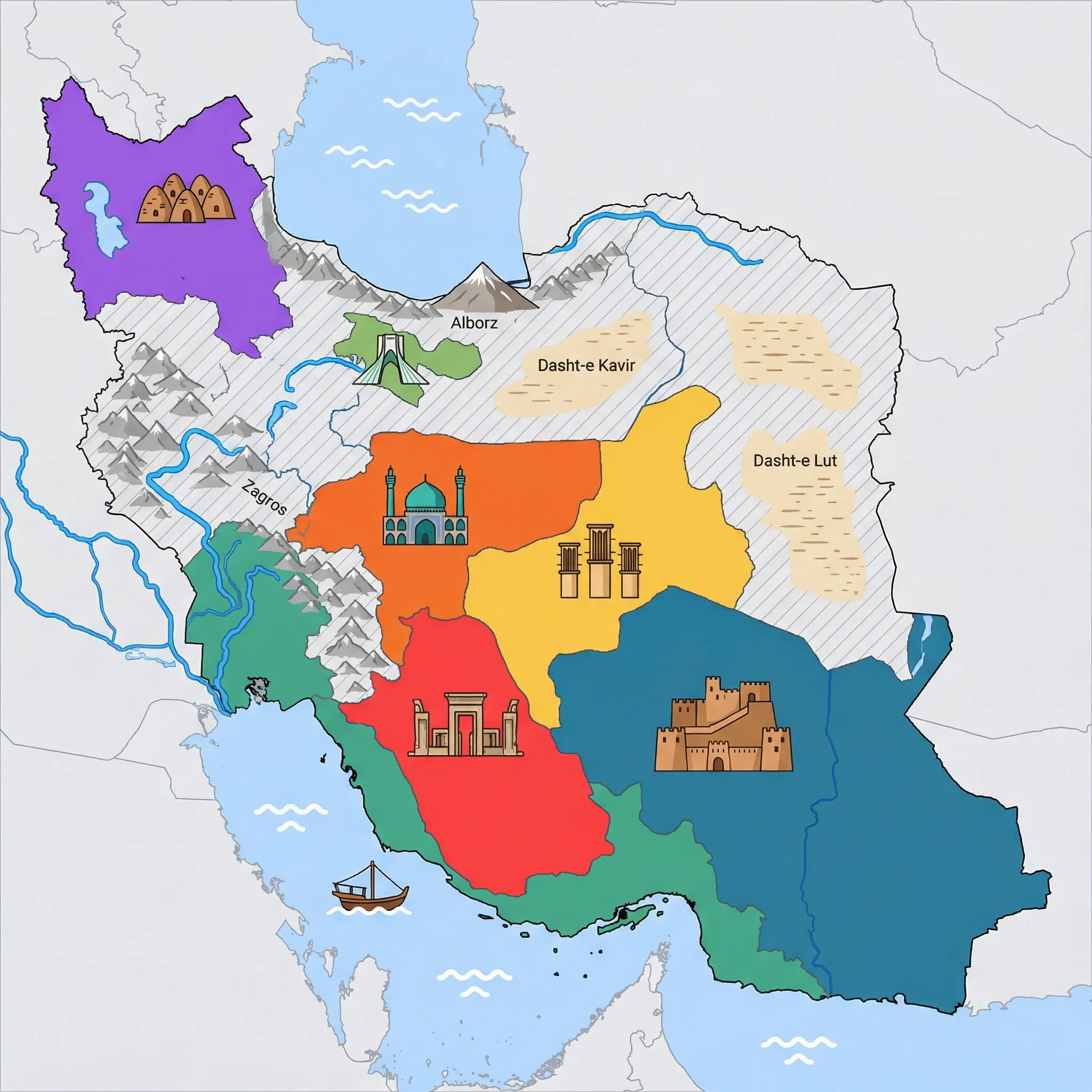
7 Regions
Isfahan
A turquoise jewel of architecture and gardens 🕌✨
Kerman & Southeast
Desert adventures among ancient citadels 🏜️🏰
Persian Gulf Coast
Mysterious canyons, dolphins, and red sands 🐬🌊
Shiraz & Persepolis
The city of poetry, roses, and ancient empires 🌹🏛️
Tabriz & Northwest
Cave villages and the world's largest covered bazaar 🏔️🛍️
Tehran
Big city energy at the foot of the mountains 🏙️🏔️
Yazd
A mud-brick maze of wind towers and eternal fires 🔥🏙️
Click on a region marker to explore details. Use the dropdown to color regions by activity suitability.

Getting There & Around
Getting There
- By Air – Imam Khomeini International Airport (IKA) in Tehran is the main hub. Major connections come via Dubai, Doha, or Istanbul.
- Entry Requirements – Critical: US, UK, and Canadian citizens must obtain a visa in advance and be accompanied by a government-approved guide from arrival to departure. EU citizens can often apply for an E-Visa. Check your government website for the latest visa requirements, or use the IATA Travel Centre entry-requirements checker.
- By Land – Border crossings exist with Turkey and Armenia (e.g., for Tabriz & Northwest), but rules fluctuate frequently.
Getting Around
- Private Driver / Tour – For US, UK, and Canadian citizens, a pre-arranged guide/driver is mandatory. This is also the most stress-free way for families to travel between cities like Shiraz & Persepolis.
- VIP Buses – The intercity bus network is excellent. "VIP" buses feature airline-style reclining seats and legroom, costing very little (often under $5 USD per seat). They are safe and comfortable for children.
- Domestic Flights – Essential for covering vast distances, such as from Tehran to the Persian Gulf Coast. Prices are low but booking usually requires a local travel agent.
- Ride-Hailing Apps – Snapp (the local Uber) is widely used in cities. It is extremely cheap and convenient, removing the need to haggle with taxi drivers.

Packing List
International credit/debit cards (Visa/Mastercard) do NOT work in Iran. You must bring enough cash for the entire trip.
Social media (Instagram, WhatsApp, Facebook) and many news sites are blocked. Install a reliable VPN before arrival.
Mandatory for all females aged ~9 and up in public areas. A loose tunic (manteau) covering hips and a scarf are required.
Most public restrooms are squat toilets with a hose (bidet) but no paper. Carry your own supply.
You will remove shoes frequently at mosques, shrines, and traditional restaurants. Laces become a hassle.
Long bus or car journeys between cities can drain devices, and outlets aren't always accessible on the go.

Activities & Best Times

Adventure & Nature
ExcellentHiking, wildlife, outdoor exploration, ecotourism
Yazd offers world-class desert trekking and high-altitude hiking on Mount Shirkuh, providing a highly authentic Silk Road experience. Peak seasons avoid the dangerous extreme heat of the central desert summer and the sharp sub-zero temperatures of winter nights.
A world-class destination for geology and marine ecology, featuring the Qeshm UNESCO Global Geopark, salt caves, and the vibrant red sands of Hormuz Island. Nature exploration is best during the cool winter months; the summer heat makes trekking and outdoor exploration dangerous.
The UNESCO-listed Lut Desert and its iconic Kaluts offer a world-class wilderness experience for sophisticated families seeking authenticity. Peak months provide manageable temperatures for exploring the surreal geology, while summer months are dangerously hot as this is one of the world's warmest environments.

City & Cultural
ExcellentUrban tourism, museums, historical sites, architecture
A UNESCO World Heritage site renowned for its mud-brick architecture, ancient windcatchers, and Zoroastrian heritage. The mild spring and autumn months provide the most comfortable conditions for exploring the atmospheric labyrinth of the Fahadan district.
Home to UNESCO-listed Persepolis and Pasargadae, the region offers world-class archaeological sites and the iconic Persian garden culture of Shiraz. Peak spring months (April-May) are legendary for the scent of orange blossoms and mild temperatures, while summer heat exceeding 40°C is prohibitive for sightseeing.
Offers a rich tapestry of Bandari culture, Portuguese colonial history, and unique subterranean architecture like the Kariz Underground City. The winter climate is perfect for exploring the historic quarters and vibrant markets of Bandar Abbas and the islands.

Sports & Active
Very GoodSport tourism, fitness activities, active recreation
The region features dedicated desert adventure infrastructure and internationally recognized trekking routes. Activity is concentrated in the shoulder and peak months when the climate allows for high-exertion activities without the risk of extreme heat exhaustion.
Tehran is a premier destination for rock climbing and technical hiking, with Darband and Darakeh serving as world-class gateways to the Alborz. Optimal conditions occur during the shoulder seasons when temperatures are moderate for strenuous activity.
The region features high-quality cycling paths and established diving centers, particularly on Kish Island. Active sports are highly seasonal due to the intense coastal heat, with the November to March window being the only viable time for high-exertion activities.

Ski & Snow
Very GoodWinter sports, ski resorts, snow activities
High-altitude resorts like Dizin and Shemshak offer excellent dry powder and long seasons that rival European resorts for vertical drop. Tochal is uniquely accessible via one of the world's longest gondola lifts directly from the city's edge.
Resorts like Alvares and Sahand offer high-altitude skiing with a unique, authentic atmosphere and reliable natural snow. The season is relatively short, peaking in mid-winter when snow cover is deepest and resort infrastructure is fully operational.
Sepidan and Pooladkaf provide a rare opportunity for skiing in the southern Zagros, though infrastructure is modest by international standards. The season is short, typically peaking in January and February when high-altitude snow is most reliable.

Beach & Sea
GoodBeach resorts, marine activities: diving, snorkelling, kite surfing, wind surfing, sailing
Darak Beach, where desert dunes meet the Arabian Sea, provides a unique and authentic coastal experience for adventurous families. The peak winter months offer a pleasant escape with moderate humidity and comfortable air temperatures compared to the oppressive heat of the summer monsoon season.
Chitgar Lake provides artificial beach recreation for locals but lacks the marine biodiversity or scale of international sea resorts. It is strictly a summer destination for leisure seeking and water-based cooling.
International calibration violation. Iran's Persian Gulf beaches do not compete with internationally recognized beach destinations (Caribbean, Mediterranean, SE Asia) due to infrastructure limitations and conservative regulations. While Kish and Qeshm offer unique experiences for regional tourists, they should not be rated 'good' by global beach holiday standards. 'Marginal' is appropriate.

Educational & Exploratory
GoodLearning experiences, scientific sites, historical education
The UNESCO-listed Shahr-e Sukhteh (Burnt City) is an internationally significant archaeological site offering profound insights into prehistoric civilization. Optimal visiting conditions are during the cooler months as the site is highly exposed to the desert elements.
The Tehran Book Garden is a massive, world-class facility dedicated to science and literacy that serves as a primary motivator for families. Visitation mirrors the city's general cultural peak when travel logistics and urban air quality are most favorable.
The Qeshm Island Geopark and various marine biology museums offer significant scientific learning opportunities regarding Persian Gulf ecosystems. While indoor museums are accessible year-round, the associated outdoor geological sites are best visited in the cooler half of the year.

Relaxation & Wellness
GoodSpa retreats, wellness centers, peaceful getaways
Authentic Persian wellness experiences are available at the historic Ganjali Khan Bathhouse and the therapeutic hot springs of Jooshan. These thermal activities are most restorative and popular with international travelers during the cool winter and autumn months.
Authentic historic hammams such as Hammam-e Khan offer a unique traditional Persian wellness experience. These indoor bathhouses are particularly appealing as restorative escapes during the cooler winter and spring months.
Historic bathhouses offer an authentic Persian spa experience, focusing on traditional massage and thermal culture rather than modern luxury. These indoor facilities are year-round, but more pleasant when the city's external environment is not extremely hot.

Road Trips & Scenic
GoodScenic drives, countryside tours, route-based travel
Iconic routes through the Kaluts and the heritage circuit between Kerman and Rayen offer spectacular scenery and well-maintained road infrastructure. These drives are best enjoyed in late autumn and early spring when visibility is high and the extreme desert heat is absent.
Scenic desert loops like the Yazd–Kharanaq–Meybod route offer spectacular arid landscapes and historic stopovers. Spring and autumn provide optimal visibility and pleasant temperatures for long-distance driving and exploration.
The Chalus Road (Road 59) is internationally celebrated as one of the most scenic mountain drives in Asia, carving through the Alborz to the Caspian Sea. Winter driving is often dangerous or impossible due to heavy snow and frequent pass closures.

Theme Park & Entertainment
GoodAmusement parks, family entertainment venues
Modern facilities like Opark provide high-quality aquatic entertainment that meets international safety and design standards. Seasonal operation is strictly tied to the warm months, with summer being popular despite the heat due to evening availability.
Kish Island serves as a major regional entertainment hub with facilities like Ocean Water Park and Dolphin Park Kish. These are most enjoyable when air temperatures are moderate, as the outdoor nature of these parks makes them uncomfortable during the peak summer heat.
Features several significant venues including the City of Dreams and Absar Water Park, providing reliable family entertainment. These outdoor-oriented parks are most enjoyable during the mild spring and autumn months, as summer temperatures frequently exceed comfortable levels for children.

Festivals & Seasonal
MarginalEvents, celebrations, seasonal attractions
Nowruz (Persian New Year) in late March is the region's most significant cultural event, though the city often empties as locals travel. While authentic, international families may find some services limited during the peak holiday fortnight.
Nowruz (March) and Shiraz Day (May) offer profound cultural immersion, though international families should be aware of domestic holiday crowds. Outside these windows, the region lacks the major recurring international events required for a higher rating.

Public Holidays & Calendar Next 12 months
Public holidays, festivals, cultural celebrations, and seasonal natural phenomena coming up in Iran over the next 12 months.
Loading holidays and events...

Climate & Weather
Isfahan
Show Details
| Month | Temp °C | Rain | Humidity |
|---|
Kerman & Southeast
Show Details
| Month | Temp °C | Rain | Humidity |
|---|
Persian Gulf Coast
Show Details
| Month | Temp °C | Rain | Humidity |
|---|
Shiraz & Persepolis
Show Details
| Month | Temp °C | Rain | Humidity |
|---|
Tabriz & Northwest
Show Details
| Month | Temp °C | Rain | Humidity |
|---|
Tehran
Show Details
| Month | Temp °C | Rain | Humidity |
|---|

Travel Advisory
Extreme security risks are present across the country due to ongoing military conflict, the high likelihood of arbitrary detention of foreigners, and significant civil unrest. All major travel agencies unanimously advise against any travel.
Safety Topics
Traveller Advice (4 groups)

Anyone currently in the country should remain indoors in a reinforced structure, maintain a supply of food and water, and monitor international news as airspace and borders may close without notice.

Same-sex relations are criminalized and can result in severe legal penalties, including the death penalty.

Media professionals face an elevated risk of being charged with espionage or security-related offenses, which may lead to prolonged detention or capital punishment.

Strict dress codes are enforced by law; women and girls over age ten are required to wear headscarves in public and in identification photos.
Agency Summaries
Travel is strongly discouraged due to extreme risks of terrorism, civil disturbance, kidnapping, and the arbitrary imprisonment of foreign citizens. The government has no diplomatic presence in Iran and cannot provide emergency services.
Authorities advise against any travel to Iran due to active military operations and strikes across the nation. Individuals currently in the country should remain in secure locations and should not expect assisted departure from the government.
New Zealanders are advised to exit the country immediately if possible. The situation is characterized by military strikes, volatile civil unrest, and the risk of disappearing or being detained without cause.
The security environment is highly unstable due to ongoing military conflict, civil unrest, and the severe threat of arbitrary detention. Consular assistance is extremely limited as embassy operations are currently suspended.
The government warns against all travel due to heightened regional tensions and military activity. British and dual nationals are at an exceptionally high risk of being arrested or detained on baseless charges.
A highest-level alert is in place following air strikes on major cities. Citizens are urged to avoid all travel, shelter in place if already present, and stay away from military installations.
Information is provided for general guidance only and does not constitute travel, safety, medical, or legal advice. Conditions may change. Users are responsible for independently verifying information before travel.