
⚠️ SAFETY WARNING: Due to political volatility, the ongoing threat of terrorism, and armed conflict, government agencies (including CA, USA, UK, AU, IE, NZ) advise travelers to avoid all travel to Federal Iraq and advise against all but essential travel to the Kurdistan Region (L3/L4). The security situation is unpredictable and can change rapidly. Kidnapping and violent crime remain significant risks. Families are strongly urged to consult their own government's official travel advisory before considering a trip, as circumstances and risk assessments vary.
For families with extensive travel experience who choose to visit, Iraq offers a journey into the very heart of history. This is the land of Mesopotamia, where writing, law, and agriculture were born between the Tigris and Euphrates rivers. While the scars of recent conflict are visible, so too is an enduring spirit of hospitality that often overwhelms visitors. Travelers are frequently invited for tea, meals, and conversation, with children treated as honored guests everywhere they go. The landscape shifts dramatically from the snow-capped Zagros Mountains in the Kurdistan Region (Erbil, Sulaymaniyah) to the date palm groves and wetlands of the south.
Culturally, Iraq is a mosaic of ethnicities and religions, offering deep educational value for older children. Exploring the Baghdad of "1001 Nights" fame or the biblical sites near Basra & South brings history textbooks to life in a way no classroom can. However, this is not a typical family holiday destination; infrastructure can be challenging, summer heat is intense, and security checkpoints are a constant reality. It is a destination for those seeking profound cultural exchange and historical witness rather than relaxation.
Key Attractions
In the north, the Erbil Citadel constitutes one of the longest continuously inhabited sites in the world. Families can wander its restored paths and visit the Kurdish Textile and Cultural Museum to understand the region's artistry. Just a short drive away, Sami Abdulrahman Park offers a vast green space where local families gather, providing a safe and relaxed environment for children to play and mix with locals.
Central Iraq holds the legendary Ancient City of Babylon. Walking through the reconstructed Ishtar Gate and seeing the foundations of the Processional Way is an awe-inspiring experience for young historians. In the capital, Al-Mutanabbi Street comes alive on Fridays with booksellers, artists, and families enjoying the intellectual heart of the city. Nearby, a boat ride past Abu Nuwas Street and Tigris Corniche offers a gentler perspective of Baghdad.
In the deep south, The Ahwar of Southern Iraq (Mesopotamian Marshes) is a UNESCO World Heritage site of unique natural beauty. Families can take long, slender mashoof boats through the reeds, spotting water buffalo and migratory birds, and visiting floating reed houses (mudhif) that have been built in the same style for millennia. Near Nasiriyah, the massive Great Ziggurat of Ur stands as a testament to the Sumerian civilization and is often cited as the birthplace of Abraham.
Practical Advice
The best time to visit is spring (March–April) or autumn (October–November), when temperatures are mild. Summers (June–September) are dangerously hot, often exceeding 50°C (122°F). As of March 2025, visitors from many countries (including the UK, US, and EU) must apply for an e-Visa in advance; the visa-on-arrival scheme has been suspended. Cash is king in Iraq; carry sufficient USD or EUR to exchange for Iraqi Dinar (IQD) at local exchanges, as international ATMs are unreliable outside major luxury hotels.
Food & Drink
Typical meal times: Lunch is the main meal, typically served from 1:00 pm to 3:00 pm. Dinner is eaten late, usually from 8:00 pm to 10:00 pm.
Typical meal costs: 15,000–35,000 IQD (approx. $11–26 USD / €10–24 EUR) for a mid-range meal. Street food like falafel or shawarma costs around 1,000–3,000 IQD (approx. $0.75–2.25 USD / €0.70–2.10 EUR).
Dietary requirements: Iraqi cuisine is meat-heavy, but vegetarians can rely on excellent hummus, baba ghanoush, fresh salads, and falafel. Gluten-free travelers may struggle as bread (samoon and khubz) is central to every meal. Allergies (nuts, dairy) are not always well-understood, so carry a translated card.
Family-friendly dining: Children are adored in Iraq and welcomed in all restaurants. While highchairs and kids' menus are rare, staff will often go out of their way to accommodate young ones. Sharing dishes family-style is the norm.
Signature dishes:
- Masgouf – The national dish of carp, slit open and grilled vertically next to an open fire, often served with pickles and lemon.
- Dolma – Vegetables (onions, peppers, vine leaves) stuffed with spiced rice and minced meat, cooked until tender and tangy.
- Quzi – Slow-cooked lamb served over spiced rice with raisins and almonds, a festive dish loved by families.
- Kleiha – Date-filled cookies often spiced with cardamom, traditionally baked for holidays and perfect for a sweet snack.
Safety
Safety is the primary concern. Travelers should hire a reputable local guide and driver for all movements; self-driving is not recommended due to checkpoints and aggressive driving. Avoid all protests and large political gatherings. The Kurdistan Region is generally more stable than Federal Iraq, but caution is still required. Always keep copies of passports and visas handy, as checkpoints are frequent. Dress modestly to respect local customs and blend in; for women, a headscarf is essential when visiting religious sites and recommended in conservative areas.

While local food and entry fees are low, the cost of safe logistics (drivers, guides, secure hotels) raises the budget. A family of four can expect to spend around 350,000–550,000 IQD (approx. $260–420 USD / €240–390 EUR) per day for a comfortable trip with a private driver and mid-range accommodation.
Age Suitability





Explore Regions
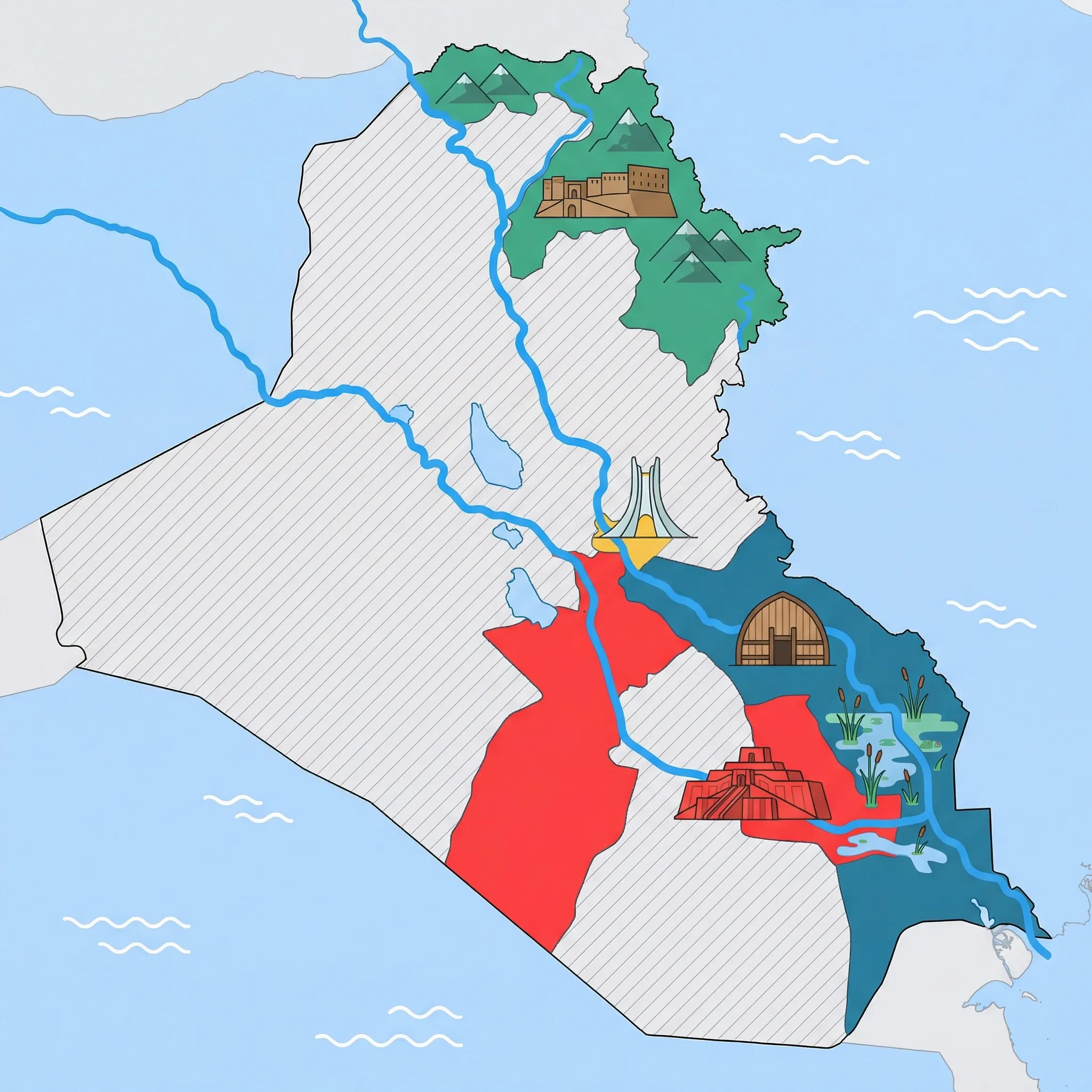
4 Regions
Ancient sites (Babylon, Ur)
Where history began: explore the legendary Cradle of Civilization 🏺
Baghdad
The City of Peace: rich culture, historic rivers, and resilient spirit 🌴
Basra & South
Where the Tigris meets the Euphrates: marshes, legends, and waterways 🛶
Kurdistan Region (Erbil, Sulaymaniyah)
Mountains, myths, and warm hospitality in the Zagros peaks 🏔️
Click on a region marker to explore details. Use the dropdown to color regions by activity suitability.

Getting There & Around
Getting There
- By Air – Baghdad International Airport (BGW) and Erbil International Airport (EBL) are the main gateways. Major carriers like Turkish Airlines, Qatar Airways, and Emirates serve these hubs.
- By Land – Border crossings with Turkey (Ibrahim Khalil) are commonly used for entering the Kurdistan Region, though queues can be long. Borders with Syria and Iran are generally not recommended for tourists.
- Entry Requirements – As of March 2025, citizens of the UK, US, EU, and others must obtain an e-Visa before travel; VOA is suspended. Check your government website for the latest visa requirements, or use the IATA Travel Centre entry-requirements checker.
Getting Around
- Private Driver – The safest and most efficient way to explore, especially for families. Navigating checkpoints and Arabic signage is difficult for foreigners.
- Taxis – Available in cities; apps like Careem operate in Baghdad and Kurdistan Region (Erbil) and are safer than hailing street cabs.
- Domestic Flights – Iraqi Airways and other local carriers connect Baghdad to Basra, Erbil, and Sulaymaniyah, avoiding long and potentially risky road journeys.

Packing List
Power cuts are frequent and daily, even in hotels; keep devices charged.
Street lighting can be sporadic and power outages may leave areas in darkness.
Essential for cultural respect and entering the many religious shrines.
Dust is ubiquitous and public bathroom facilities may lack soap/water.
International ATMs are rare/unreliable; you must bring cash to exchange.
Cities are noisy with generators, traffic, and calls to prayer at all hours.

Activities & Best Times

Adventure & Nature
Very GoodHiking, wildlife, outdoor exploration, ecotourism
The Mesopotamian Marshes are a UNESCO World Heritage site offering a unique, authentic ecosystem for birdwatching and traditional cultural immersion. Peak visitation occurs during the mild winter when migratory bird populations are highest and temperatures allow for long boat excursions.
Features the spectacular Zagros Mountains and nature reserves like Barzan, offering deep immersion in rugged landscapes. Peak conditions occur in spring when the mountains are lush and green before the extreme heat of the Mesopotamian summer.
The Mesopotamian Marshes provide a unique, authentic wetland ecosystem for birdwatching and cultural immersion into the Ma'dan lifestyle. Winter is the optimal period for wildlife viewing and avoiding the extreme humidity and heat that characterize the region from late spring through early autumn.

City & Cultural
Very GoodUrban tourism, museums, historical sites, architecture
Home to iconic UNESCO World Heritage sites like Babylon and the Ziggurat of Ur, this region offers globally significant archaeological depth for sophisticated travelers. Visitation peaks in spring and autumn when temperatures are mild enough for the extensive walking required to explore these vast open-air ruins.
Home to the UNESCO-listed Erbil Citadel and the culturally vibrant city of Sulaymaniyah, providing authentic Middle Eastern urban heritage. The most comfortable periods for exploring historic quarters are the temperate months of spring and autumn.
Baghdad holds immense historical significance as the former seat of the Abbasid Caliphate, featuring rare medieval architecture and world-class collections at the Iraq Museum. The spring and autumn months offer the most comfortable temperatures for walking the historic districts and riverside markets.

Road Trips & Scenic
GoodScenic drives, countryside tours, route-based travel
The historic Hamilton Road and Hawraman Valley offer world-class scenic driving through dramatic mountain passes and canyons. Driving conditions are best in mid-season to avoid winter mountain snow and the severe 40C+ temperatures of July and August.
Scenic routes through the marshes and along the river offer unique landscapes, though travel is hampered by limited tourist infrastructure. Driving conditions and visibility are most favorable during the dry, cooler winter period.

Sports & Active
GoodSport tourism, fitness activities, active recreation
Offers established hiking routes like the Zagros Mountain Trail and modern facilities at Korek Mountain Resort. Activity is highly seasonal, peaking during the mildest months when mountain trails are most accessible for trekking and climbing.
Active pursuits are primarily limited to marsh boating and local water parks, lacking specialized international sport venues. These activities are physically pleasant only during the mild winter months before the extreme summer heat begins.
Dedicated infrastructure like the Abu Nuwas riverside path supports cycling and walking in a scenic urban environment. These activities are highly seasonal, as the extreme heat of the long summer season effectively halts outdoor physical exertion.

Festivals & Seasonal
GoodEvents, celebrations, seasonal attractions

Beach & Sea
MarginalBeach resorts, marine activities: diving, snorkelling, kite surfing, wind surfing, sailing

Educational & Exploratory
MarginalLearning experiences, scientific sites, historical education
The region hosts university-linked science museums and historically significant sites like the Tree of Knowledge. While informative, these facilities are supplementary attractions rather than primary international travel motivators.
Contains significant historical sites like the Amna Suraka museum, offering unique insights into Kurdish history and resilience. While educationally profound, these sites are typically side-activities rather than primary international travel motivators.
A single specialized natural history museum does not constitute educational tourism infrastructure. Educational classifications require concentration of learning institutions (multiple museums, science centers, university programs). This should be removed entirely rather than rated marginal.
Theme Park & Entertainment
MarginalAmusement parks, family entertainment venues
Local amusement parks like Basra Land cater to regional families but lack the world-class infrastructure sought by international travelers. Operations and outdoor comfort are strictly seasonal, aligning with the pleasant temperatures of the winter months.
Babylon Fun City offers a localized entertainment option for families, though it lacks the international scale and quality found at major global theme park destinations. Use is highly seasonal, as the intense desert summer heat renders outdoor amusement facilities practically unusable for most of the year.
Features regional attractions like the Pank Resort alpine coaster and various water parks, though they lack the scale of global theme park destinations. Visitation is strongest during temperate school holiday periods.

Relaxation & Wellness
MarginalSpa retreats, wellness centers, peaceful getaways

Public Holidays & Calendar Next 12 months
Public holidays, festivals, cultural celebrations, and seasonal natural phenomena coming up in Iraq over the next 12 months.
Loading holidays and events...

Climate & Weather
Ancient sites (Babylon, Ur)
Show Details
| Month | Temp °C | Rain | Humidity |
|---|
Baghdad
Show Details
| Month | Temp °C | Rain | Humidity |
|---|
Basra & South
Show Details
| Month | Temp °C | Rain | Humidity |
|---|
Kurdistan Region (Erbil, Sulaymaniyah)
Show Details
| Month | Temp °C | Rain | Humidity |
|---|

Travel Advisory
All major agencies maintain their highest possible warning level for Iraq. Travel is extremely dangerous due to ongoing regional conflict, terrorism, and kidnapping. Foreigners are advised to leave immediately or shelter in place.
Safety Topics
Traveller Advice (6 groups)

Homosexual acts are not explicitly criminalized by national law but are often prosecuted under morality and indecency statutes. Public displays of affection are highly risky and social hostility is extreme.

Travellers should depart the country immediately while commercial options exist. If departure is not possible, stay in secure accommodation, remain away from windows, and maintain a supply of food, water, and essential medication.

Religious sites and large gatherings for festivals are frequent targets for terrorist attacks. Security near shrines is heavy, but the threat of large-scale bombings remains critical.

Conservative dress is necessary throughout the country. Women may face harassment or unwanted attention, and should avoid travelling alone, especially after dark.

Media personnel are at high risk of injury, detention, or death in active conflict zones. Accreditation does not guarantee safety, and journalists may be targeted by militant groups.

International aid workers face extreme risks of targeted kidnapping and violence. Security protocols must be strictly followed, and professional security coordination is essential for those remaining in the country.
Agency Summaries
Global Affairs Canada advises against any travel to Iraq because of the volatile security environment, the possibility of armed conflict, and the danger of terrorist activity. Airspace in the region is currently closed.
The U.S. Department of State has issued a country-wide 'Do Not Travel' order due to kidnapping, terrorism, civil unrest, and armed conflict. Non-emergency government personnel were ordered to depart the country on March 2, 2026.
Smartraveller recommends that Australians do not visit Iraq under any circumstances. The safety situation is extremely dangerous due to the high threat of terrorism, ongoing conflict, and volatile social unrest.
Ireland strongly advises against all travel to Iraq due to the critical security situation. Citizens currently in the country should consider leaving while safe routes are available or shelter in place if air travel is disrupted.
SafeTravel maintains a 'Do Not Travel' warning for all of Iraq, including the Kurdistan Region. New Zealanders are warned of extreme risks from military strikes, terrorism, and organized crime.
The Foreign, Commonwealth & Development Office advises against all travel to both Federal Iraq and the Kurdistan Region. This follows a recent escalation in regional hostilities and a high risk of further unpredictable events.
Information is provided for general guidance only and does not constitute travel, safety, medical, or legal advice. Conditions may change. Users are responsible for independently verifying information before travel.