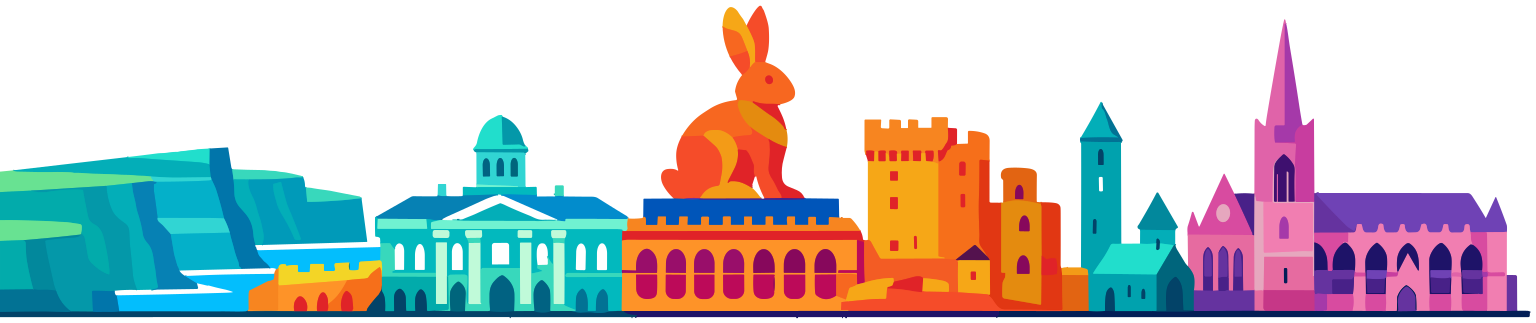

Ireland is affectionately known as the Emerald Isle, a nickname that becomes immediately obvious the moment you break through the clouds. For families, this small but spirited island offers a perfect mix of outdoor adventure, approachable history, and a culture that genuinely cherishes children. From the cosmopolitan buzz of the Dublin & East Coast to the dramatic cliffs of the west, the landscape is a playground of rolling hills, rugged coastlines, and mysterious ruins. The climate is mild but famously changeable-locals often joke you can see four seasons in one day-so flexibility and waterproofs are key. However, the lush green grass and vibrant rainbows are the beautiful payoff for the frequent showers.
Culturally, Ireland is incredibly welcoming. The concept of Céad Míle Fáilte (a hundred thousand welcomes) is real; you will find that children are fussed over in restaurants, hotels, and shops. The pace of life, especially outside the main cities, is relaxed, allowing families to slow down and enjoy the journey. Whether you are seeking the thrill of a medieval banquet, the simple joy of a crab-fishing line off a harbour wall, or a hike through a mossy forest straight out of a storybook, Ireland delivers memories that feel timeless.
Key Attractions
No family trip to Ireland is complete without visiting the capital. Dublin Zoo in Phoenix Park is one of the world's oldest and most respected zoos, offering vast habitats that allow children to see elephants and tigers up close. Just a short drive north lies Malahide Castle, which combines a historic fortress with a massive playground and butterfly house, making it an easy win for mixed-age groups. For a deeper dive into ancient mystery, the prehistoric passage tombs at Brú na Bóinne (Newgrange & Knowth) are older than the pyramids and offer a fascinating, slightly spooky look into the past that captures the imagination of older kids.
Heading west to the Wild Atlantic Way North, the landscape becomes more dramatic. The Cliffs of Moher are the country's most iconic natural landmark; while the heights are dizzying, safe paved paths make it accessible for families to witness the power of the Atlantic. Nearby, Bunratty Castle & Folk Park is an absolute essential. It is an immersive 19th-century village complete with farm animals, costumed characters, and a medieval castle where you can even book a traditional banquet dinner that kids love. Further inland in the Midlands & Shannon region, Lough Key Forest & Activity Park offers canopy walks and adventure puzzles that break up the driving perfectly.
Down in the Wild Atlantic Way South, the magic continues. Blarney Castle & Gardens is famous for the Stone of Eloquence, but for families, the real draw is the Poison Garden (viewed from a safe distance!) and the magical Rock Close grounds filled with "witch's stones" and waterfalls. Just outside Cork city, Fota Wildlife Park provides a unique open-environment experience where kangaroos and lemurs hop freely near the paths, offering a wilder experience than a standard zoo. Finally, a jaunt around the Ring of Kerry offers stunning coastal views, though families might prefer the shorter, horse-drawn cart trips through the Gap of Dunloe.
Practical Advice
The best time to visit is from May to September when the days are long (light until 10:00 pm in midsummer) and the weather is warmest. However, rain is possible at any moment, so pack layers. Renting a car is almost essential for a family trip, as it allows you to explore the rural nooks and crannies where the real magic lies. Be prepared for narrow, winding roads-driving times often take longer than the GPS predicts.
Food & Drink
Typical meal times: Lunch is typically served from 12:30 pm to 2:00 pm. Dinner service usually runs from 6:00 pm to 9:00 pm. Note that in smaller towns, kitchens in pubs may close strictly at 9:00 pm, so it is wise to eat earlier with children.
Typical meal costs: €60–100 (approx. $65–110 USD / £50–85 GBP) for a family dinner of two adults and two children. A pub main course generally costs €16–25 (approx. $17–27 USD / £14–21 GBP).
Dietary requirements: Ireland is excellent for dietary needs. Vegetarian and gluten-free options are standard in almost all restaurants and cafes. Allergens are legally required to be listed on menus, making it safe for families with specific intolerances.
Family-friendly dining: Pubs are the heart of social life and are generally very family-friendly until around 9:00 pm. Most offer a children's menu ("goujons and chips" is a staple) and highchairs. Staff are usually very accommodating to young ones.
Signature dishes:
- Seafood Chowder – A creamy, hearty soup packed with fresh Atlantic fish and shellfish, usually served with brown bread. It is a warming lunch staple.
- Soda Bread – A dense, delicious brown bread made with buttermilk, best eaten slathered with Irish butter.
- Bacon and Cabbage – The traditional comfort food precursor to corned beef, served with a white parsley sauce and potatoes.
- Boxty – A traditional potato pancake from the north-west, somewhere between a hash brown and a tortilla, often filled with savory ingredients.
- Full Irish Breakfast – A massive morning feast with sausages, rashers (bacon), eggs, black and white pudding, and fried tomato.

Ireland is a relatively expensive destination, comparable to the UK or France. A family of four can expect to spend around €250–350 (approx. $270–380 USD / £210–300 GBP) per day including car hire, mid-range accommodation, meals, and attraction tickets. Entry fees for major sites like castles and zoos can add up, so look for family tickets which offer significant discounts.
Age Suitability





Did you know? Ireland welcomes approximately 11.0 million international visitors per year. Most visitors come from Europe.
Explore Regions
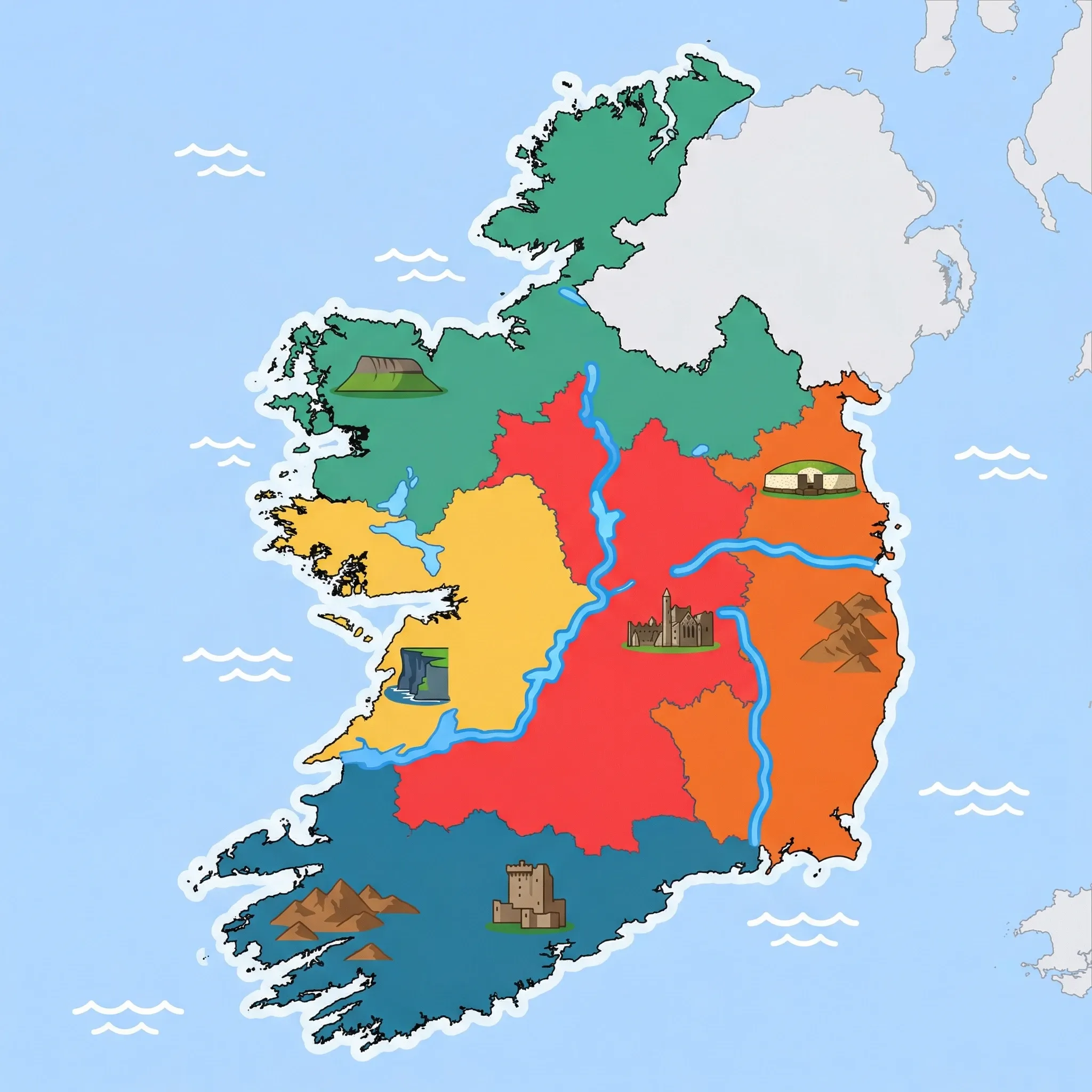
5 Regions
Dublin & East Coast
Viking treasures, city buzz, and ancient green valleys 🏰🦌
Midlands & Shannon
River adventures and secret castles in Ireland's green heart 🌳🛶
West & Connemara
Wild mountains, white sands, and the true Irish spirit 🏔️🎻
Wild Atlantic Way North (Clare, Galway, Cliffs of Moher)
Lunar landscapes, soaring cliffs, and underground secrets 🦅🎻
Wild Atlantic Way South (Cork, Kerry, Ring of Kerry)
Epic drives, magical castles, and the kingdom of green 👑🐬
Click on a region marker to explore details. Use the dropdown to color regions by activity suitability.

Getting There & Around
Getting There
- By Air – Dublin Airport (DUB) is the primary gateway, with extensive connections to the US, UK, and Europe. Shannon Airport (SNN) is excellent for direct access to the West & Connemara, while Cork Airport (ORK) serves the south.
- By Sea – Ferries connect Dublin and Rosslare to the UK (Holyhead, Fishguard, Pembroke) and France (Cherbourg, Roscoff). This is a popular option for families bringing their own car.
- Entry Requirements – Ireland is not part of the Schengen Area. EU and UK citizens travel freely. US, Canadian, and Australian citizens generally do not need a visa for tourism stays up to 90 days. Check your government website for the latest visa requirements, or use the IATA Travel Centre entry-requirements checker.
Getting Around
- Car Hire – The most practical way to explore rural Ireland and the Wild Atlantic Way North. Driving is on the left. Roads in rural areas can be very narrow, often with room for only one vehicle, so confidence is required.
- Trains – Iarnród Éireann operates clean and comfortable intercity services connecting Dublin to major hubs like Cork, Galway, and Belfast. It is great for city-hopping but less useful for reaching rural sights like the Cliffs of Moher.
- Buses – Bus Éireann provides an extensive network connecting almost every town. Expressway services are faster for intercity travel. Children under 5 often travel free or at discounted rates.

Packing List
Essential for walking on narrow rural roads which often lack sidewalks/pavements.
Ticks are common in tall grass and national parks like Killarney; useful for hikers.
Rain often blows sideways; a jacket alone won't keep legs dry during outdoor walks.
Supermarket trolleys and some older parking meters require €1 or €2 coins to operate.
Back roads and coastal drives are extremely twisty and can unsettle little stomachs.

Activities & Best Times

Adventure & Nature
ExcellentHiking, wildlife, outdoor exploration, ecotourism
Boasts world-class landscapes in Killarney National Park and Fota Wildlife Park, offering immersive wilderness and wildlife experiences. Best visited from late spring to early autumn when trails are accessible and boat trips to the Skelligs are operational.
The Burren's unique karst landscape and the iconic Cliffs of Moher offer world-class hiking and geological exploration. Peak season provides necessary daylight and manageable trail conditions, while winter months are frequently too wet and windy for safe coastal exploration.
Connemara National Park and the Twelve Bens offer a raw, world-class Atlantic wilderness experience perfect for hiking and wildlife spotting. Peak summer provides the essential daylight and milder weather needed to navigate the rugged, often boggy terrain safely.

City & Cultural
Very GoodUrban tourism, museums, historical sites, architecture
Skellig Michael is UNESCO-listed and Blarney Castle is iconic, but the region lacks the density of world-class cultural institutions required for 'excellent'. Cork city and heritage sites justify strong 'very_good' rating without overstating international significance.
Galway city and Bunratty Castle are significant cultural assets, but do not reach the global cultural dominance required for 'excellent'. That tier should be reserved for cities with multiple UNESCO sites and internationally renowned cultural institutions.
Dublin is a significant European capital with strong literary heritage and historic sites, but lacks the UNESCO heritage density and global cultural dominance of truly excellent cities like Rome, Paris, or Istanbul. Trinity College, Dublin Castle, and the Book of Kells are nationally iconic but not internationally dominant cultural institutions.

Sports & Active
Very GoodSport tourism, fitness activities, active recreation
Premier infrastructure for hiking via the Kerry Way and Dingle Way, alongside major adventure centers like Ballyhass. Optimal trekking conditions occur in the drier, brighter summer months, as winter conditions on the peninsulas can be hazardous.
Features exceptional adventure centers and recognized trekking routes like the Western Way and Diamond Hill. The infrastructure supports diverse active tourism, which is most accessible during the drier and more stable weather of late spring and summer.
Renowned for world-class Atlantic surfing at Lahinch and extensive dedicated routes like the Burren Way for cycling and trekking. Optimal conditions occur during the warmer, drier months; the Atlantic winter brings extreme swells and conditions only suitable for elite professionals.

Educational & Exploratory
GoodLearning experiences, scientific sites, historical education
Offers significant scientific and historical engagement through Mizen Head Signal Station and Dingle Oceanworld Aquarium. Educational programs and site access are most robust during the primary tourism season when visitor centers are fully staffed.
Significant geological and marine learning opportunities exist at the Burren Aillwee Experience and the Cliffs of Moher Atlantic Edge. Facilities are best experienced during the main tourism season when all educational programs and tours are fully operational.
Features internationally significant sites like the Brú na Bóinne Visitor Centre and the National Museum, offering deep dives into Neolithic history and natural science. These facilities are mostly indoor-based, making them viable across much of the year, though peak tourism occurs in summer.

Festivals & Seasonal
GoodEvents, celebrations, seasonal attractions
Home to the internationally significant Galway Arts Festival in July and the Oyster Festival in September, attracting sophisticated global audiences. Outside of these key event windows and the festive December period, the international festival scene is relatively quiet.
St. Patrick's Festival is internationally significant with 5+ million participants globally, making Dublin a major festival destination in March. The Winter Solstice at Newgrange adds unique seasonal appeal. This justifies 'good' rather than 'marginal'.
Anchored by the internationally recognized Rose of Tralee in August and the Guinness Cork Jazz Festival in October. Tourism peaks sharply around these specific event dates, which draw sophisticated global audiences.

Relaxation & Wellness
GoodSpa retreats, wellness centers, peaceful getaways
Offers unique, authentic wellness experiences through traditional seaweed baths and the historic spa heritage of Lisdoonvarna. While some facilities are year-round, the restorative appeal is highest when the surrounding coastal scenery is accessible and pleasant.
Distinctive regional wellness experiences like seaweed baths in Dingle and Ballybunion offer a unique, authentic local tradition. These facilities are most appealing during months when the surrounding coastal scenery can be enjoyed comfortably.

Road Trips & Scenic
GoodScenic drives, countryside tours, route-based travel
The Ring of Kerry and Slea Head Drive are globally recognized scenic routes with dramatic coastal views. Peak months provide the necessary daylight hours and visibility required to safely navigate narrow mountain passes and coastal cliffs.
Includes world-famous scenic stretches like the Wild Atlantic Way and the Sky Road, offering spectacular coastal vistas. Peak months provide the clear visibility and longer days necessary to fully appreciate the dramatic Atlantic landscapes.
The Wild Atlantic Way and Sky Road offer spectacular coastal driving vistas that are globally celebrated. Peak months provide the visibility and daylight needed to enjoy the scenery, while winter driving is often hampered by mist, heavy rain, and early darkness.

Theme Park & Entertainment
GoodAmusement parks, family entertainment venues
Family-focused attractions like the Aqua Dome and West Cork Model Railway Village provide high-quality regional entertainment. Peak visitation is strictly tied to school holiday windows and warmer weather for outdoor exhibits.
Emerald Park and the National Aquatic Centre provide significant family entertainment that meets international standards for variety and safety. Operations are highly seasonal, with full access and best conditions found during the summer school holiday period.
Offers regional family entertainment at Leisureland and Killary Water Park, which are suitable for local recreation but lack international destination status. These facilities operate primarily during the summer school holiday window.

Beach & Sea
MarginalBeach resorts, marine activities: diving, snorkelling, kite surfing, wind surfing, sailing
Notes explicitly state 'Atlantic waters remain cold year-round, limiting comfortable swimming'. Blue-flag beaches indicate quality management but cannot overcome fundamental climate limitations for beach holidays.
Notes explicitly state 'Atlantic waters remain cool year-round' and 'limited swimming season'. This makes beaches scenic but unsuitable for traditional beach holidays. 'Good' overstates suitability when water temperature is a limiting factor.
Notes acknowledge 'Atlantic waters are cold outside summer months'. Lahinch and the Cliffs offer dramatic maritime scenery but limited swimming comfort. International beach holiday standards require warm, swimmable waters for 'good' rating.

Public Holidays & Calendar Next 12 months
Public holidays, festivals, cultural celebrations, and seasonal natural phenomena coming up in Ireland over the next 12 months.
Loading holidays and events...
Climate & Weather
Dublin & East Coast
Show Details
| Month | Temp °C | Rain | Humidity |
|---|
Midlands & Shannon
Show Details
| Month | Temp °C | Rain | Humidity |
|---|
West & Connemara
Show Details
| Month | Temp °C | Rain | Humidity |
|---|
Wild Atlantic Way North (Clare, Galway, Cliffs of Moher)
Show Details
| Month | Temp °C | Rain | Humidity |
|---|
Wild Atlantic Way South (Cork, Kerry, Ring of Kerry)
Show Details
| Month | Temp °C | Rain | Humidity |
|---|

Travel Advisory
The majority of major agencies agree that Ireland is a safe destination requiring only standard safety awareness. No significant elevated risks are reported across the country.
Safety Topics
Traveller Advice (3 groups)

Ireland is considered an inclusive and safe environment for sexual and gender minorities, with strong legal protections and a generally welcoming public atmosphere.

The country is generally safe for solo female travellers. Standard precautions should be taken when walking alone at night in less-frequented or poorly lit areas.

Maintain standard safety vigilance, especially in crowded tourist areas and public transport hubs where petty theft is more frequent. Keep digital copies of travel documents and monitor local media for news on protests.
Agency Summaries
Ireland is overall safe, but visitors should be wary of petty crime, especially in Dublin. There is a slight increase in rental car break-ins at scenic locations and a risk of protests in urban centers.
Visitors should maintain standard safety levels. Awareness of potential for civil unrest and the general threat of terrorism in Europe is recommended, although Ireland has no recent history of attacks.
Travellers should maintain standard safety awareness as they would in their home country. While generally safe, petty crime like theft and bag snatching occurs, particularly in major cities and tourist spots.
No specific travel restrictions are in place. Visitors should ensure they have proper insurance and be aware of local laws. Cross-border travel to Northern Ireland may involve different entry requirements.
Standard safety measures are recommended. Travellers are advised to monitor local alerts and enroll in security notification programs. Immigration officials may request proof of travel intent and sufficient funds at the border.
Information is provided for general guidance only and does not constitute travel, safety, medical, or legal advice. Conditions may change. Users are responsible for independently verifying information before travel.