
Italy is arguably the most family-friendly country in Europe, a place where children are not just tolerated but genuinely adored. Geographically, the country stretches from the icy granite peaks of the Alps in the north to the subtropical Mediterranean waters of the south. This dramatic variety means you can hike in the Dolomites & South Tyrol one day and build sandcastles in Sicily the next. The country is a living classroom where history is etched into every stone, yet it feels vibrant and modern, with high-speed trains whizzing between ancient cities.
Culturally, the Italian attitude towards family is warm and inclusive. In squares (piazze) across the country, you will see children playing football while parents chat nearby, often late into the evening. Exploring regions like Tuscany (Florence, Siena, Chianti) or Rome & Lazio isn't just about museums; it's about experiencing a lifestyle that prioritizes connection, food, and beauty. Whether you are navigating the canals of Venice & Veneto or driving the coast of Liguria (Cinque Terre, Genoa), the pace of life invites you to slow down and savor the moment.
Key Attractions
For high-energy family fun, the Italian Lakes (Como, Garda, Maggiore) are a premier destination, home to Gardaland Resort, the country's largest theme park with rides for all ages. Nearby, you can explore the stunning Borromeo Palace and Gardens (Isola Bella), where white peacocks roam freely in terraced gardens that look like they float on water. In the northeast, Venice & Veneto offers Caribe Bay, an award-winning water park that recreates a Caribbean island, perfect for cooling off after sightseeing.
If your family loves animals and nature, the Aquarium of Genoa in Liguria (Cinque Terre, Genoa) is a must-visit; it is the largest aquarium in Italy and offers incredible marine exhibits. In the capital, the Bioparco di Roma (Children's Farm) provides a green oasis within the Villa Borghese park. For a unique prehistoric experience, head to the Dolomites & South Tyrol to visit ArcheoParc Schnals, an interactive open-air museum where kids can learn about Ötzi the Iceman and try Stone Age skills like archery and bread-making.
History comes alive in Naples & Campania (Amalfi, Pompeii). While the ancient ruins are fascinating, younger kids might prefer Edenlandia, a historic amusement park in Naples that has entertained generations. Further south in Sicily, the Etnaland theme and water park sits at the foot of a volcano, offering a thrilling mix of education and adrenaline.
Practical Advice
The best times to visit are late spring (May-June) and early autumn (September-October) to avoid the intense summer heat and peak crowds. August is Ferragosto season, when many Italians go on holiday, leaving cities empty but coastal areas packed. Italy is part of the Schengen Area, so visa rules are standard for Europe. Health care is excellent, and pharmacists can often dispense advice and medication for minor ailments. Public restrooms can be scarce, so carry small change (€0.50-€1) as many are pay-to-use.
Food & Drink
Typical meal times: Lunch is strictly from 12:30 pm to 2:30 pm. Dinner restaurants rarely open before 7:30 pm, and families often dine at 8:30 pm or later.
Typical meal costs: €60–100 (approx. $65–110 USD / £50–85 GBP) for a family of four at a mid-range trattoria. A pizza margherita typically costs €6–10 (approx. $6.50–11 USD / £5–8.50 GBP).
Dietary requirements: Italy is surprisingly excellent for coeliacs. The Italian Celiac Association (AIC) is very active, and you will find senza glutine (gluten-free) options, including pasta and pizza, in most pharmacies and supermarkets, as well as many restaurants.
Family-friendly dining: Children are welcome everywhere. While "kids' menus" are rare, restaurants will happily make a simple pasta al pomodoro (pasta with tomato sauce) or pasta in bianco (plain pasta with oil/butter) on request. Highchairs (seggiolone) are generally available.
Signature dishes:
- Pizza Margherita – The queen of Italian cuisine, featuring a thin base, San Marzano tomato sauce, mozzarella di bufala, and fresh basil.
- Risotto alla Milanese – A creamy, saffron-infused rice dish from Milan & Lombardy that is mild and comforting for children.
- Trofie al Pesto – Twisted pasta shapes with a bright green basil, pine nut, and parmesan sauce, a staple of Liguria (Cinque Terre, Genoa).
- Gelato – Italian ice cream, denser and more flavorful than regular ice cream; fruit flavors (sorbetto) are usually dairy-free.
- Arancini – Fried rice balls stuffed with ragù, peas, and mozzarella, a perfect handheld snack from Sicily.

A family of four can expect to spend around €200–300 (approx. $215–325 USD / £170–255 GBP) per day for mid-range accommodation, meals, and activities. Dining is generally good value, with high-quality pizza and pasta available cheaply, but accommodation in major tourist hubs like Rome and Venice drives up the daily average.
Age Suitability




Did you know? Italy welcomes approximately 57.7 million international visitors per year.
Explore Regions
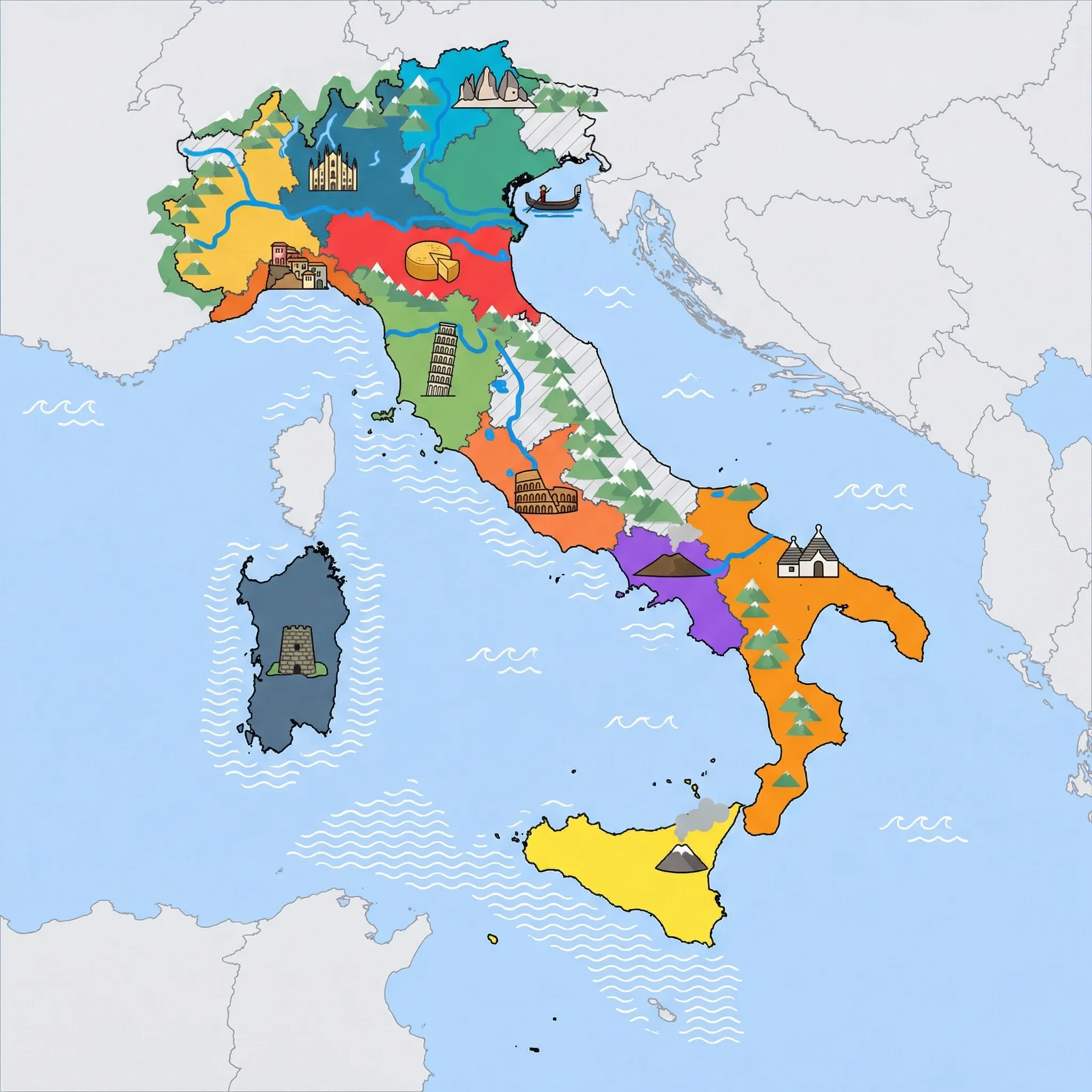
12 Regions
Dolomites & South Tyrol
majestic peaks and mythical legends in Italy's alpine playground 🏔️🌲
Emilia-Romagna (Bologna)
Fast cars, slow food, and endless sandy beaches 🍝🏎️🏖️
Italian Lakes (Como, Garda, Maggiore)
Where alpine mountains meet Mediterranean waters 🚤🏰🎢
Liguria (Cinque Terre, Genoa)
Colorful vertical villages and the home of pesto 🌿🏘️🌊
Milan & Lombardy
Fashion, finance, and rooftop views in Italy's modern heart 👠🏙️🏰
Naples & Campania (Amalfi, Pompeii)
Ancient ruins, active volcanoes, and the birthplace of pizza 🍕🌋🍋
Puglia & Southern Italy
Cone-shaped houses, olive groves, and two seas 🫒🏠🌊
Rome & Lazio
Gladiators, gelato, and the Eternal City 🏛️⚔️🍦
Sardinia
Caribbean-style beaches and ancient mysteries in the Mediterranean 🏝️🐚🌞
Sicily
Street food, Greek temples, and fire-breathing mountains 🌋🏛️🍊
Tuscany (Florence, Siena, Chianti)
Rolling hills, Renaissance art, and the world's most famous tower 🎨🍷🌲
Venice & Veneto
A floating city, glass blowers, and Romeo's home 🎭🛶🦁
Click on a region marker to explore details. Use the dropdown to color regions by activity suitability.

Getting There & Around
Getting There
- By Air – Rome Fiumicino (FCO) and Milan Malpensa (MXP) are the primary intercontinental gateways. Venice Marco Polo (VCE) is convenient for Venice & Veneto and the Dolomites.
- By Train – High-speed rail connects Italy to France, Switzerland, and Austria. The EuroCity service through the Brenner Pass offers spectacular views for those approaching from the north.
- By Sea – Ferries connect coastal ports like Ancona, Bari, and Venice with Croatia, Greece, and Albania. Cruise ships frequently dock at Civitavecchia (for Rome) and Naples.
- Entry Requirements – Italy is a Schengen Area member. US, UK, Canadian, and Australian citizens do not typically need a visa for short tourist stays (up to 90 days). Check your government website for the latest visa requirements, or use the IATA Travel Centre entry-requirements checker.
Getting Around
- Trains – The Frecciarossa and Italo high-speed trains are the best way to move between major cities like Rome, Florence, and Milan. They are fast, reliable, and comfortable. Children under 15 often travel free or with significant discounts on family fares.
- Car Hire – Essential for exploring rural regions like Tuscany (Florence, Siena, Chianti) or the Dolomites & South Tyrol. Be aware of ZTL zones (restricted traffic areas) in historic city centers to avoid heavy fines.
- Ferries – A scenic way to reach Sardinia and Sicily, or to navigate the Italian Lakes (Como, Garda, Maggiore).
- City Transport – Major cities have metro, tram, and bus networks. In Venice, the vaporetto (water bus) is the main mode of public transport and a fun experience for kids.

Packing List
Strict dress codes in churches (St. Peter's, St. Mark's) require covered shoulders and knees even in summer heat.
Tiger mosquitoes (zanzare) are aggressive and common in summer, especially in the Po Valley, Venice, and lake areas.
Older Italian sockets use a unique vertical 3-pin row that standard 2-pin European plugs often don't fit.
Rome and other cities have 'nasoni' (public fountains) dispensing fresh, cold, free drinking water throughout the streets.
Small-wheeled umbrella strollers often break on cobblestones (sanpietrini); a carrier is better for Venice's many bridges.

Activities & Best Times

Adventure & Nature
ExcellentHiking, wildlife, outdoor exploration, ecotourism
Offers authentic immersion in Alpine-prealpine landscapes with world-class lake vistas and extensive trail networks. Summer provides peak accessibility for high-altitude adventure parks, while winter conditions and facility closures limit the nature experience.
The Cinque Terre and Portofino National Parks provide globally unique coastal hiking trails and dramatic terraced landscapes for active families. While summer is popular, spring and September offer the best trail conditions before heavy autumn rains and winter maintenance lead to trail closures.
The Appennino Tosco-Emiliano and Foreste Casentinesi National Parks provide authentic wilderness immersion and extensive hiking trails for sophisticated families. These natural areas are best explored from late spring through early autumn when trails are fully accessible and ecosystems are most vibrant.

City & Cultural
ExcellentUrban tourism, museums, historical sites, architecture
Milan is a world-class center for fashion, design, and history, featuring iconic landmarks like the Duomo and Leonardo's Last Supper. Peak seasons align with mild weather and major cultural events, while August is considered the off-season as the city's local life diminishes during the annual Ferragosto closures.
Home to world-class UNESCO sites like Pompeii and the Royal Palace of Caserta, offering unparalleled historical depth and authentic Neapolitan culture. Best visited in spring and autumn to avoid the intense summer heat and winter rains while enjoying full access to historic sites.
Venice and Verona offer world-class historic sites and authentic Italian urban heritage that are global benchmarks for culture. Peak seasons avoid the high flood risks of late autumn and the extreme dampness of winter while offering pleasant walking conditions.

Theme Park & Entertainment
Very GoodAmusement parks, family entertainment venues
Host to Gardaland and Leolandia, offering high-quality family infrastructure that ranks among Europe's best. Optimal visiting coincides with full summer operations, as parks move to limited or no service during the winter months.
Home to Gardaland, one of Europe's premier destination theme parks with high-quality themed experiences suitable for international families. Peak months align with full operating schedules and school holiday periods, while winter sees most parks closed.
Etnaland is a major regional draw combining theme and water park elements that appeal to international families. Operations are strictly seasonal, peaking during the hot summer months when the aquatic facilities are most desirable.

Sports & Active
GoodSport tourism, fitness activities, active recreation
High-quality adventure parks and specialized outdoor infrastructure provide structured active experiences for families. Facilities are typically operational from spring through autumn, with summer offering the most consistent access to all attractions.
The lakes and pre-Alps offer excellent infrastructure for cycling and climbing, including internationally recognized adventure centers. Facilities are primarily operational from late spring through early autumn, with colder winter months being unsuitable for these specific activities.
Offers specialized infrastructure including major ziplines and outdoor adventure centers in rugged scenic locations. Peak conditions occur in late spring and early autumn when weather is reliable and temperatures are comfortable for physically demanding outdoor activities.

Beach & Sea
GoodBeach resorts, marine activities: diving, snorkelling, kite surfing, wind surfing, sailing
The Amalfi Coast and Capri offer iconic Mediterranean beach experiences with high-end appeal and crystal-clear waters. Peak visitation occurs during the hot summer months when sea temperatures are ideal and all ferry services and beach clubs are fully operational.
Puglia features iconic limestone coastal spots like Lama Monachile and Baia delle Zagare with clear Adriatic and Ionian waters. Peak swimming occurs from June to September when sea temperatures are highest, while shoulder months offer quieter beaches but cooler water.
Home to iconic turquoise waters and white sand beaches like La Pelosa and Cala Mariolu, offering a quintessential Mediterranean coastal experience. Peak summer provides optimal swimming and sailing conditions, while the off-season is too cold for marine activities.

Educational & Exploratory
GoodLearning experiences, scientific sites, historical education
Features the MUSE Science Museum, a destination-level educational facility that offers world-class interactive learning for families. While museums are indoor, the overall educational experience is best during the warmer months when sites like ArcheoParc are fully operational.
Specialized facilities like the Civic Aquarium of Milan provide high-quality educational detours for families visiting the region. These sites are most popular during the spring and autumn school trip seasons, though they remain accessible as indoor options during much of the year.
Niche educational opportunities exist through the Naples Aquarium and marine research centers, providing scientific engagement for families. While these facilities are often indoors, peak timing aligns with broader regional travel seasons to ensure availability of guided programs.

Public Holidays & Calendar Next 12 months
Public holidays, festivals, cultural celebrations, and seasonal natural phenomena coming up in Italy over the next 12 months.
Loading holidays and events...
Climate & Weather
Dolomites & South Tyrol
Show Details
| Month | Temp °C | Rain | Humidity |
|---|
Emilia-Romagna (Bologna)
Show Details
| Month | Temp °C | Rain | Humidity |
|---|
Italian Lakes (Como, Garda, Maggiore)
Show Details
| Month | Temp °C | Rain | Humidity |
|---|
Liguria (Cinque Terre, Genoa)
Show Details
| Month | Temp °C | Rain | Humidity |
|---|
Milan & Lombardy
Show Details
| Month | Temp °C | Rain | Humidity |
|---|
Naples & Campania (Amalfi, Pompeii)
Show Details
| Month | Temp °C | Rain | Humidity |
|---|

Travel Advisory
The international community is divided on Italy's risk profile. While half of the major agencies maintain a baseline safety rating, several key partners have elevated their warnings to L1 due to an increased threat of terrorism and security complexities surrounding the 2026 Winter Olympics. Visitors should exercise higher vigilance than usual.
Safety Topics
Agency Summaries
Heightened caution is advised due to the risk of terrorism. Extremist groups continue to plan attacks against public spaces, transit hubs, and tourist locations. Travelers should also be aware of new domestic laws affecting international surrogacy arrangements.
Travellers should remain highly vigilant in Italy due to a persistent threat of terrorism. Heightened security and potential for civil unrest are expected in Northern Italy during the 2026 Winter Olympics. Petty crime remains a significant concern in all major tourist hubs.
Standard safety awareness is recommended. Be particularly careful with personal belongings in tourist areas and on trains to avoid theft. Extra crowds and security will be present in Milan and Verona for the 2026 Winter Paralympics.
Take typical safety measures while traveling. Monitor local news for strike information and maintain awareness of your surroundings in urban centers to prevent petty theft.
There are elevated security concerns in Italy compared to New Zealand, primarily due to the threat of terrorism and the potential for civil unrest. Travelers should stay informed via local media and maintain high vigilance in public areas.
Most visits to Italy are safe, though travelers should watch for pickpockets in crowded cities and on public transport. Be prepared for increased security and travel disruptions during major sporting events in early 2026. A general threat of terrorism exists.
Information is provided for general guidance only and does not constitute travel, safety, medical, or legal advice. Conditions may change. Users are responsible for independently verifying information before travel.