

⚠️ SAFETY WARNING: Western governments (including the US, UK, and France) currently advise exercising increased caution in Côte d'Ivoire due to crime and civil unrest. Do not travel to the northern border regions (bordering Mali and Burkina Faso) or Comoé NP & North due to a high risk of terrorism and kidnapping. Avoid all political demonstrations and large crowds. Families should stick to the southern and central regions, including Abidjan, Yamoussoukro, and the coast, where the security situation is generally stable but vigilance is required.
Overview
Côte d'Ivoire is a powerhouse of West African culture, a land where skyscrapers rise from tropical lagoons and red-earth roads lead to misty mountains. For families, it offers a sensory-rich education in history, nature, and resilience. Abidjan, the economic capital, is often called the "Manhattan of the Tropics," a bustling metropolis of bridges and boats that introduces children to modern African life. Beyond the city, the pace slows down to the rhythm of ocean waves and village drums.
The country is the world's largest cocoa producer, meaning your children can see exactly where their chocolate begins-a fascinating lesson in agriculture and trade. While French is the official language and English is not widely spoken, the Ivorian spirit of Akwaba (welcome) transcends language barriers. Traveling here requires some patience and preparation, but the reward is an authentic connection with a country that boasts vibrant art, distinct music styles like Zouglou and Coupé-Décalé, and diverse landscapes ranging from the surf-ready Atlantic coast to the verdant peaks of Man & Western Mountains.
Key Attractions
Start your journey in the south with a visit to Grand-Bassam & Coast. The Historic Town of Grand-Bassam (Quartier France) is a UNESCO World Heritage site where families can wander through crumbling colonial architecture that feels like a movie set. Inside the National Museum of Costume (Musée National du Costume), kids can see the colorful traditional dress of the country's many ethnic groups. For relaxation, head to Assinie-Mafia Beach, a pristine stretch of sand popular with locals and expats for weekend escapes.
In the center of the country, the capital Yamoussoukro offers a surreal experience. The Basilica of Our Lady of Peace is one of the largest churches in the world-its sheer scale is jaw-dropping for visitors of all ages. Nearby, you can spot hippos and crocodiles at the presidential palace lake (often associated with Lake Kossou in broader regional tours). For active families, the western highlands offer the La Dent de Man, a rocky tooth-shaped peak perfect for adventurous hikers, and the Sacred Monkey Forest of Gbepleu, where friendly monkeys interact with visitors in a protected sacred grove.
Back in Abidjan, cultural immersion continues at the Musée des Civilisations de Côte d'Ivoire, which holds an incredible collection of masks and artifacts. The city's skyline is dominated by St. Paul's Cathedral, a stunning modern architectural feat with stained glass that tells the story of Christianity in Africa. Nature lovers can escape the city noise at the Jardin Botanique de Bingerville, a peaceful green space perfect for a family picnic.
Practical Advice
The best time to visit is during the dry season from November to March. A Yellow Fever vaccination certificate is mandatory for entry-you will be checked upon arrival. Malaria prophylaxis is highly recommended for all family members. As English is not widely spoken outside luxury hotels, downloading an offline French translation app or carrying a phrasebook is essential. Cash (West African CFA Franc) is king; credit cards are rarely accepted outside major hotels and supermarkets.
Safety
Beyond the specific border warnings, general safety in Abidjan requires
Family Travel Notice
Ensure children are up-to-date on all vaccinations, including yellow fever and polio, and be aware that pediatric medical services are limited outside the commercial capital.
Age Suitability






Explore Regions
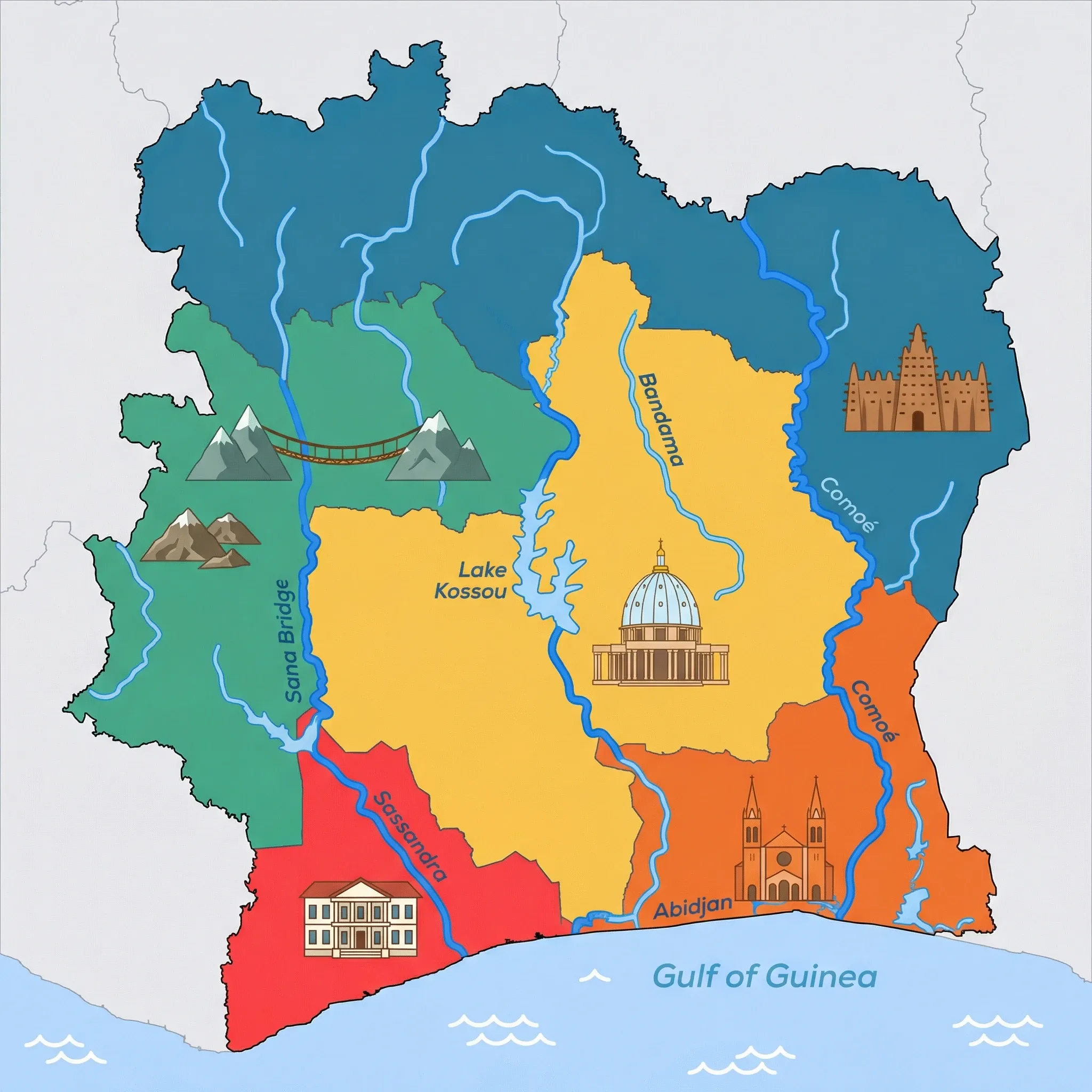
5 Regions
Abidjan
The pulsing heart of West African culture and lagoons 🇨🇮✨
Comoé NP & North
Ancient mud mosques and savannah horizons 🦁🕌
Grand-Bassam & Coast
Colonial ghosts and golden sands 🌊🏛️
Man & Western Mountains
Misty mountains and sacred monkeys ⛰️🐒
Yamoussoukro & Central
The quiet capital of giants and crocodiles 🐊⛪
Click on a region marker to explore details. Use the dropdown to color regions by activity suitability.

Getting There & Around
Getting There
- By Air – Félix-Houphouët-Boigny International Airport (ABJ) in Abidjan is the main hub. Direct flights arrive from Paris (Air France, Corsair), Brussels, Dubai, and New York. Regional connections link to Accra, Lagos, and Dakar.
- By Land – Border crossings can be unpredictable. The borders with Mali and Burkina Faso are dangerous and should be avoided. Crossings from Ghana (Elubo) are common but can be chaotic; private transport is recommended over public bush taxis for families.
- Entry Requirements – A Yellow Fever vaccination certificate is mandatory for all travelers over 9 months old. Visas are required for most non-ECOWAS citizens; an e-visa system is available for arrivals at Abidjan airport (must be pre-enrolled online). Check your government website for the latest visa requirements, or use the IATA Travel Centre entry-requirements checker.

Packing List
Mandatory for entry; you will be refused entry without the original physical card.
English is rarely spoken outside international hotels; basic French is essential for daily interactions.
Power outages can occur, and voltage fluctuations may damage sensitive electronics.
The heat and humidity are intense; keeps water cold during long excursions.
Sudden tropical downpours are common, and lagoon boat trips are a highlight.
Air conditioning is not guaranteed in smaller shops or restaurants; helps manage the humidity.

Activities & Best Times

Adventure & Nature
Very GoodHiking, wildlife, outdoor exploration, ecotourism
Boasts the unique urban primary rainforest of Parc National du Banco and high-quality agritourism at Domaine Bini. Best visited during dry windows to avoid the heavy monsoon rains that can make forest trails muddy and inaccessible.
Offers unique highland trekking to the Dent de Man and Mount Tonkoui, providing a rare mountainous landscape within West Africa. Peak visits occur during the dry season (Dec-Feb) for optimal trail safety and panoramic visibility, while heavy rains from June to October make mountain paths treacherous.
Strong offering focused on lagoon ecosystems and mangroves, notably at Îles Ehotilé National Park and Dahliafleur Nature Reserve. Best visited in the driest months for trail accessibility and wildlife viewing, while the peak rainy season (June) makes wetland exploration difficult.

City & Cultural
Very GoodUrban tourism, museums, historical sites, architecture
Home to the record-breaking Basilica of Our Lady of Peace, the city provides a unique architectural and political history experience that is internationally distinctive. Peak months coincide with the dry season, offering comfortable conditions for visiting monuments, while the monsoon period (June-September) brings high humidity and heavy rains.
Home to the UNESCO World Heritage site of Grand-Bassam, featuring evocative colonial architecture and the National Museum of Costume. The historic 'Quartier France' provides a unique cultural atmosphere for families, best enjoyed outside the deluges of the primary rainy season.
The UNESCO Sudanese mosques are significant heritage, but this represents a single cluster of sites rather than the comprehensive cultural destination density required for 'very_good.' The rating should reflect nationally significant but not internationally outstanding status.

Road Trips & Scenic
GoodScenic drives, countryside tours, route-based travel
Offers scenic coastal drives to the historic colonial capital of Grand-Bassam and the stylish resort area of Assinie. The dry season ensures clear visibility and safe driving conditions for these popular regional routes.
The 'Route des Montagnes' is one of the most scenic drives in the country, winding through mist-covered peaks and lush valleys. Driving conditions are best in the dry season when dirt spurs to viewpoints are stable, whereas the rainy season brings significant risk of washouts and mud.
Named circuits like the Sudanic Mosque Route offer scenic transit through traditional landscapes, though road conditions require robust preparation. Travel is best during the dry season to ensure accessibility on unpaved secondary routes that link the historic mosques and weaver villages.

Sports & Active
GoodSport tourism, fitness activities, active recreation
Provides designated hiking and cycling routes within Parc National du Banco and family-friendly recreation at Doraville. Optimal conditions for trail-based sports occur during the dry months when infrastructure is most usable.
The region serves as the country's primary hub for technical hiking and trail running, with established routes up Mount Tonkpi and Nimba. Peak months align with the dry season to ensure safe footing on steep gradients, while the humid rainy months are avoided due to extreme trail degradation.
Offers specialized infrastructure including surfing at Assinie and hiking trails within nature reserves. Activity levels are highest when dry weather permits consistent use of outdoor facilities and manageable lagoon conditions.

Beach & Sea
GoodBeach resorts, marine activities: diving, snorkelling, kite surfing, wind surfing, sailing
Features upscale beach clubs in Assinie-Mafia and the historic shores of Grand-Bassam, offering a sophisticated coastal escape. Peak conditions occur during the main dry season when the Atlantic is calmest and sunshine is most consistent.
Features the high-end resort enclave of Assinie-Mafia and the historic shores of Grand-Bassam, offering a sophisticated coastal experience by West African standards. Peak season aligns with the main dry season when Atlantic swells are manageable and humidity is lower; heavy rains in May-July significantly degrade the beach experience.

Educational & Exploratory
MarginalLearning experiences, scientific sites, historical education

Theme Park & Entertainment
MarginalAmusement parks, family entertainment venues

Festivals & Seasonal
MarginalEvents, celebrations, seasonal attractions

Public Holidays & Calendar Next 12 months
Public holidays, festivals, cultural celebrations, and seasonal natural phenomena coming up in Ivory Coast over the next 12 months.
Loading holidays and events...

Climate & Weather
Abidjan
Show Details
| Month | Temp °C | Rain | Humidity |
|---|
Comoé NP & North
Show Details
| Month | Temp °C | Rain | Humidity |
|---|
Grand-Bassam & Coast
Show Details
| Month | Temp °C | Rain | Humidity |
|---|
Man & Western Mountains
Show Details
| Month | Temp °C | Rain | Humidity |
|---|
Yamoussoukro & Central
Show Details
| Month | Temp °C | Rain | Humidity |
|---|

Travel Advisory
A unanimous consensus among major international agencies suggests that travellers should exercise a high degree of vigilance. While the general safety situation allows for travel, significant risks from violent crime and terrorism persist, especially in the northern border regions which are subject to more severe restrictions.
Safety Topics
Traveller Advice (5 groups)

Ensure children are up-to-date on all vaccinations, including yellow fever and polio, and be aware that pediatric medical services are limited outside the commercial capital.

Personnel working near the northern borders with Mali and Burkina Faso should follow strict security protocols due to the elevated risk of kidnapping by extremist groups.

Discretion is recommended as social and legal attitudes toward sexual orientation may be more conservative than those in many Western countries.

Solo female travellers should take additional security precautions, particularly when moving around at night or in less populated urban areas.

Travellers should maintain high personal security awareness, avoid displaying expensive items, and stay informed through local news about potential protests or safety incidents.
Agency Summaries
Visitors should maintain a high level of security awareness and monitor local developments closely, particularly during periods of political sensitivity.
New Zealanders are advised to exercise increased caution throughout Côte d'Ivoire due to terrorism, violent crime, and the possibility of civil unrest.
The UK advises against all travel to northern border areas and Comoé National Park due to terrorism and kidnapping risks. Standard safety measures apply elsewhere.
Australians should exercise a high degree of caution across the country, primarily due to violent crime threats and the potential for civil disturbance.
Travellers should remain highly vigilant due to prevalent crime and the threat of terrorism. Significant regional warnings are in place for areas bordering Mali and Burkina Faso.
Increased caution is recommended due to crime, terrorism, civil unrest, and health risks. The northern border region remains under a strict 'Do Not Travel' advisory.
Information is provided for general guidance only and does not constitute travel, safety, medical, or legal advice. Conditions may change. Users are responsible for independently verifying information before travel.