
Overview
Japan is an archipelago of over 6,000 islands that stretches from the snowy wilderness of Hokkaido in the north to the subtropical beaches of Okinawa & Ryūkyū Islands in the south. For families, it is arguably the most stress-free destination in Asia. The streets are impeccably clean, public transport is punctual to the second, and it is consistently ranked as one of the safest countries in the world. Children are welcomed everywhere, and the culture of omotenashi (hospitality) ensures that help is always at hand, even if there is a language barrier.
The country offers a dizzying contrast that keeps children engaged: one day you might be exploring a centuries-old wooden temple in Kyoto & Classical Japan, and the next you are interacting with cutting-edge robots or visiting the home of their favourite anime characters in Tokyo. Beyond the cities, the Chūbu & Japanese Alps offer hiking and skiing, while the coastal regions provide unique experiences like walking through floating shrines. Whether your family loves nature, history, or pop culture, Japan delivers it all with unique style and efficiency.
Key Attractions
No family trip is complete without exploring the capital. In Tokyo, the Ghibli Museum is a magical, whimsical destination for fans of Studio Ghibli films (tickets must be booked months in advance). For thrill-seekers, a day trip to Fuji-Q Highland offers world-record-breaking roller coasters with a backdrop of Mount Fuji. Moving west to the cultural heart of the country, Kyoto offers the iconic Fushimi Inari-taisha, where families can hike through thousands of vermilion torii gates-a perfect spot for active kids to burn off energy. Nearby, the Arashiyama Bamboo Grove provides a fairytale atmosphere that feels like stepping into another world.
Further west in the Chūgoku & Western Honshu region, history comes alive. The Itsukushima (Miyajima) shrine, with its famous floating gate, is famous not just for its beauty but for the tame deer that roam the island, which children love to feed. For a powerful educational experience, older children can visit the Hiroshima Peace Memorial (Genbaku Dome). If you are venturing to the northern island of Hokkaido, the Asahiyama Zoo is renowned for its innovative enclosures that allow visitors to see animals from unique angles, such as glass tubes for swimming penguins.
For a quintessential samurai experience, Himeji Castle is the finest surviving example of Japanese castle architecture. Known as the "White Heron Castle," its labyrinthine grounds and steep wooden stairs feel like a real-life ninja fortress. In the central mountains, the Daio Wasabi Farm offers a surprisingly fun rural excursion where brave kids can try wasabi-flavoured ice cream while exploring pristine water mills.
Practical Advice
Best time to visit: Spring (March–May) for cherry blossoms and mild weather, or Autumn (October–November) for stunning fall foliage. Summer (June–August) is hot, humid, and rainy. Winter is great for skiing in the north but cold in the cities.
Family logistics: Use the Takkyubin (luggage forwarding) service found at airports and convenience stores to send large suitcases between hotels-this is a game-changer for families, allowing you to travel hands-free on trains. Public toilets are everywhere and clean, but often lack paper towels, so carry a handkerchief.
Etiquette: Trains are quiet zones; keep voices low. Shoes must be removed at temples, traditional inns (ryokan), and some restaurants. Socks without holes are a must!
Food & Drink
Typical meal times: Lunch is typically 11:30 am to 2:00 pm. Dinner is served from 6:00 pm to 9:00 pm, though restaurants in big cities stay open later.
Typical meal costs: ¥1,000–2,500 (approx. $7–17 USD / €6–16 EUR) for casual meals like ramen or set lunches; ¥3,500–10,000+ (approx. $23–65 USD / €22–62 EUR) for nice dinners.
Dietary requirements: Vegetarianism can be challenging as fish stock (dashi) is used in almost everything, even vegetable dishes. strictly vegan options are growing in Tokyo and Kyoto but require research. Nut allergies are less common but awareness is improving; carry a translated allergy card.
Family-friendly dining: "Family Restaurants" (known as Famiresu like Gusto or Denny's) offer kid menus and drink bars. Kaitenzushi (conveyor belt sushi) is affordable, fun, and allows kids to pick exactly what they want. Convenience stores (7-Eleven, Lawson, FamilyMart) sell high-quality rice balls (onigiri) and fried chicken perfect for picky eaters.
Signature dishes:
- Sushi – Fresh fish on vinegared rice. Kaitenzushi shops are the most family-friendly way to enjoy this.
- Ramen – Wheat noodles in savoury broth (soy, miso, or pork bone). Slurping is encouraged!
- Tempura – Battered and deep-fried seafood and vegetables; a safe and crunchy option for children.
- Okonomiyaki – A savoury pancake containing cabbage and various toppings, often cooked on a griddle at your table-fun for kids to watch.
- Karaage – Japanese-style fried chicken, marinated in soy sauce and ginger. Universally loved by children and available everywhere.

While traditionally an expensive destination, current exchange rates make Japan surprisingly affordable for Western travelers. A family can expect to spend ¥25,000–45,000 (approx. $165–300 USD / €155–280 EUR) per day for mid-range hotels, meals, and transport. Convenience store meals are a high-quality budget saver.
Age Suitability





Did you know? Japan welcomes approximately 36.9 million international visitors per year. Most visitors come from East Asia and the Pacific.

Explore Regions
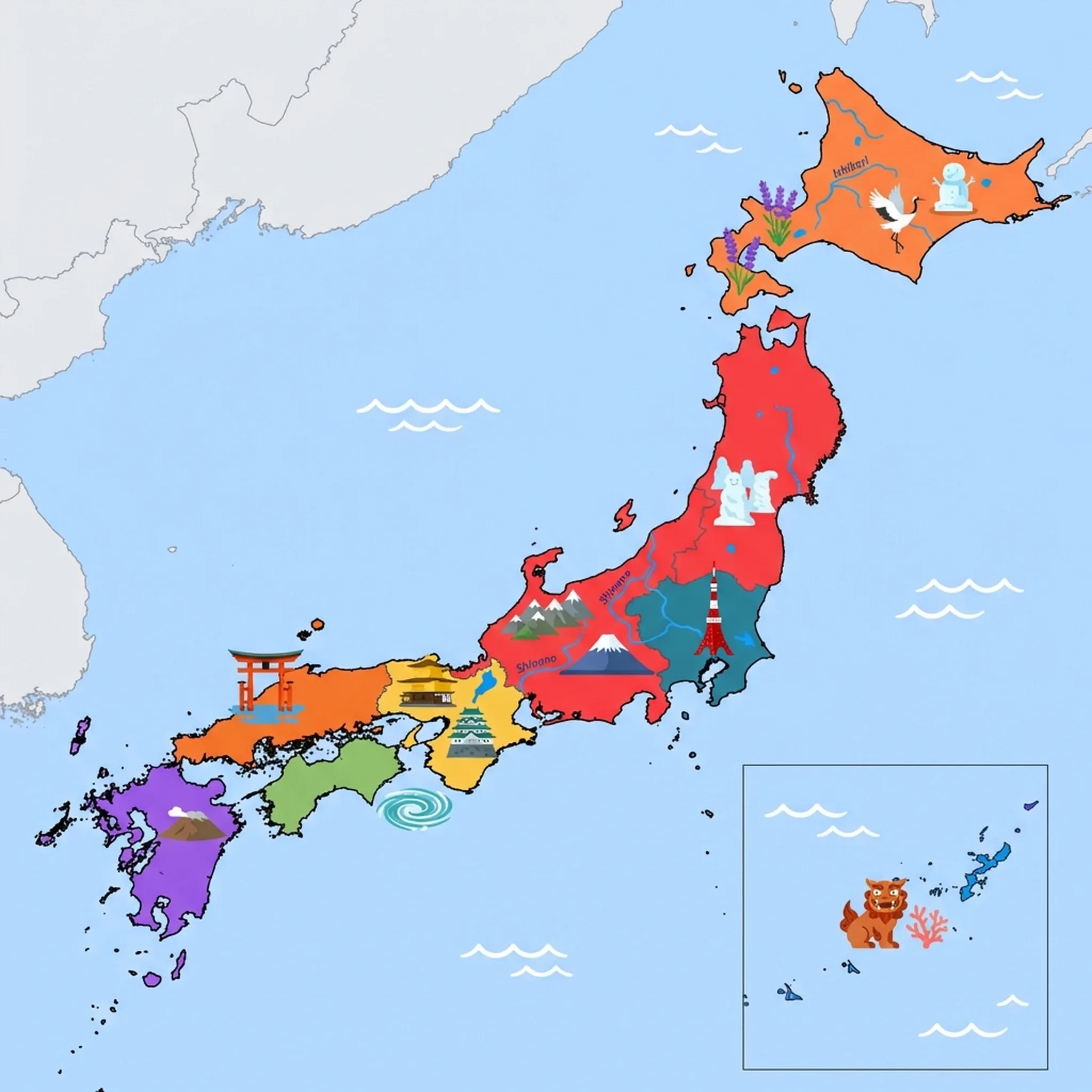
9 Regions
Chūbu & Japanese Alps
Snow monkeys, samurai towns, and soaring peaks 🏔️🐒
Chūgoku & Western Honshu
Floating shrines, friendly deer, and history ⛩️🦌
Hokkaido
Japan's untamed wilderness and winter wonderland 🐻❄️
Kantō & Tokyo Megalopolis
Neon lights, anime dreams, and ancient temples 🗼🍣
Kyoto & Classical Japan
Temples, takoyaki, and timeless tradition ⛩️🐙
Kyūshū
Volcanoes, ramen, and hot spring steam 🍜🌋
Okinawa & Ryūkyū Islands
Turquoise seas, coral reefs, and island time 🌺🐢
Shikoku
Pilgrims, udon noodles, and wild rivers 🍜🌊
Tōhoku
Samurai history, summer festivals, and deep snow 👹❄️
Click on a region marker to explore details. Use the dropdown to color regions by activity suitability.

Getting There & Around
Getting There
- By Air – Major international gateways are Narita (NRT) and Haneda (HND) for Kantō & Tokyo Megalopolis, and Kansai International (KIX) for Kyoto & Classical Japan. Direct flights connect to major hubs globally.
- By Sea – International ferries connect Fukuoka in Kyūshū with Busan, South Korea.
- Entry Requirements – Citizens of the US, UK, EU, Australia, and many others are currently visa-exempt for short stays (usually 90 days). Visitors must complete a digital immigration form (Visit Japan Web) for smoother entry. Check your government website for the latest visa requirements, or use the IATA Travel Centre entry-requirements checker.
Getting Around
- Trains – The Shinkansen (bullet train) network is world-famous for speed and punctuality. The Japan Rail Pass can be good value for long-distance travel, but calculate costs first. Children aged 6–11 pay half price; under 6 travel free (non-reserved).
- City Transport – Tokyo and Osaka have extensive subway networks. Buy a rechargeable IC card (Suica, Pasmo, or ICOCA) for each family member for tap-and-go ease. Note that Kantō & Tokyo Megalopolis rush hours (7:30 am–9:00 am) are intensely crowded and best avoided with strollers.
- Car Hire – Generally unnecessary in cities but recommended for exploring rural areas like Hokkaido or Okinawa & Ryūkyū Islands. Driving is on the left.
- Luggage Forwarding – The Takkyubin service (e.g., Yamato Transport) allows you to ship bags between hotels overnight for a small fee, keeping your hands free for children.

Packing List
Public bins are extremely rare; you are expected to carry your rubbish home or to your hotel.
Most public restrooms do not provide paper towels or hand dryers.
You will remove shoes frequently at temples, restaurants, and fitting rooms. Laces are a hassle.
Japan is still cash-heavy and you will accumulate many coins (¥100, ¥500) quickly.
Japanese brands are often weaker than Western ones; bring your preferred brand from home.

Activities & Best Times

Adventure & Nature
ExcellentHiking, wildlife, outdoor exploration, ecotourism
Home to the rugged Iya Valley and sacred pilgrimage routes, Shikoku offers an authentic immersion into Japan's deep wilderness. Temperate spring and autumn months are ideal for trekking vine bridges and mountain trails without oppressive humidity.
Home to the world-class Japanese Alps and the iconic Tateyama Kurobe Alpine Route. Peaks occur during the opening of alpine trails in late spring and the spectacular autumn foliage, with deep winter snow making high-altitude exploration inaccessible.
Features iconic sites like the Arashiyama Bamboo Grove and the spiritual Kumano Kodo pilgrimage trails, providing high-quality immersion in Japanese landscapes. Optimal conditions are found in the mild spring and autumn, as mountain paths can be slippery in winter and oppressively hot in mid-summer.

City & Cultural
ExcellentUrban tourism, museums, historical sites, architecture
Features the world-renowned Setouchi art islands and the historic Dogo Onsen, offering a sophisticated blend of contemporary art and ancient heritage. Spring and autumn provide the best conditions for exploring gardens and outdoor art installations.
Tokyo is a global benchmark for urban culture, offering an unparalleled mix of hyper-modernity, world-class museums, and UNESCO heritage sites like Nikko. Spring and autumn provide ideal temperatures and iconic aesthetics, while the extreme humidity of July and August makes urban exploration uncomfortable.
Features authentic heritage sites like Kanazawa's Kenrokuen and the preserved villages of Shirakawa-go and Takayama. Spring and autumn offer world-class aesthetics and comfort, whereas extreme humidity in summer and bitter cold in winter detract from the urban experience.

Beach & Sea
Very GoodBeach resorts, marine activities: diving, snorkelling, kite surfing, wind surfing, sailing
Upgrade to very_good - Okinawa has genuine subtropical credentials with crystal-clear waters, significant reef systems, and established beach resort infrastructure. Competitive with regional Southeast Asian destinations.
Naruto Whirlpools and 'mirror beaches' are scenic spectacles but not beach destinations. Downgrade to marginal.
KEEP - Appropriately rated. Enoshima and Yuigahama are accessible urban beaches but not destination-level.

Sports & Active
Very GoodSport tourism, fitness activities, active recreation
Boasts world-class cycling infrastructure on the Shimanami Kaido and extensive trekking via the 88-temple pilgrimage. These activities are most enjoyable during the mild temperatures of the shoulder seasons.
Specialized infrastructure like the Mobility Resort Motegi and regional adventure parks provide quality facilities for active families. The temperate spring and autumn months are the most suitable for these physically demanding outdoor activities.
Infrastructure such as Hakuba Iwatake and the Mishima Skywalk supports diverse outdoor sports and active exploration. Ideal conditions are found in stable weather windows, while winter focus shifts away from non-skiing active infrastructure.

Theme Park & Entertainment
Very GoodAmusement parks, family entertainment venues
Boasts world-class entertainment hubs including Tokyo Disney Resort and Fuji-Q Highland, which are global leaders in themed experiences. Families should avoid the peak heat of summer when outdoor queuing becomes strenuous, favoring the milder shoulder or peak months for a better experience.
Boasts internationally significant attractions including Ghibli Park and Legoland Japan. Peak visitation aligns with school holidays and pleasant weather, though the parks remain accessible in shoulder months for those seeking shorter queues.
Home to Universal Studios Japan and the specialized Nijigen no Mori park, providing world-class entertainment for families. Peak periods coincide with school holiday festivities and temperate weather, though winter months are often too cold for comfortable outdoor park experiences.

Relaxation & Wellness
GoodSpa retreats, wellness centers, peaceful getaways

Road Trips & Scenic
GoodScenic drives, countryside tours, route-based travel

Educational & Exploratory
GoodLearning experiences, scientific sites, historical education
Features internationally recognized facilities such as the Sumida and Sunshine Aquariums that offer high-level scientific engagement. While primarily indoor and accessible year-round, these sites are best visited outside of the crowded summer holiday peak to ensure an intimate learning environment.
High-quality scientific engagement via the Port of Nagoya and Gifu freshwater aquariums provides substantial educational value. These indoor facilities are reliable year-round but peak during family travel seasons.
The Osaka Aquarium Kaiyukan and Toba Aquarium are destination-level facilities providing immersive marine education for families. These indoor attractions remain accessible year-round, making them excellent alternatives during the wetter or more extreme climate periods.

Festivals & Seasonal
MarginalEvents, celebrations, seasonal attractions

Ski & Snow
MarginalWinter sports, ski resorts, snow activities

Public Holidays & Calendar Next 12 months
Public holidays, festivals, cultural celebrations, and seasonal natural phenomena coming up in Japan over the next 12 months.
Loading holidays and events...

Climate & Weather
Chūbu & Japanese Alps
Show Details
| Month | Temp °C | Rain | Humidity |
|---|
Chūgoku & Western Honshu
Show Details
| Month | Temp °C | Rain | Humidity |
|---|
Hokkaido
Show Details
| Month | Temp °C | Rain | Humidity |
|---|
Kantō & Tokyo Megalopolis
Show Details
| Month | Temp °C | Rain | Humidity |
|---|
Kyoto & Classical Japan
Show Details
| Month | Temp °C | Rain | Humidity |
|---|
Kyūshū
Show Details
| Month | Temp °C | Rain | Humidity |
|---|

Travel Advisory
All six major agencies agree that Japan is a safe destination where standard travel safety awareness is sufficient for visitors.
Safety Topics
Traveller Advice (3 groups)

Ensure you carry your original passport with you at all times as it is a legal requirement for foreign nationals in Japan.

While Japan is very safe, female travelers should remain vigilant in popular nightlife districts due to reported incidents of harassment or assault.

Japan is generally welcoming, but travelers should be aware that same-sex marriage and some related legal protections are not yet fully recognized by national law.
Agency Summaries
Travelers should follow standard safety protocols and stay informed of weather alerts and local guidance from Japanese authorities.
Japan is considered safe for New Zealanders, though awareness of seismic activity and petty crime in entertainment areas is advised.
The overall risk level is low, but travelers should be aware of regional risks such as earthquakes and potential crime in urban nightlife districts.
Japan offers a stable environment similar to Australia, with low crime rates but specific risks related to nightlife scams and natural disasters.
Standard safety measures are sufficient for travel to Japan. Visitors are encouraged to register for security updates and review local medical laws.
Japan is generally safe for travelers, though visitors should remain alert to natural hazards and stay informed via local media.
Information is provided for general guidance only and does not constitute travel, safety, medical, or legal advice. Conditions may change. Users are responsible for independently verifying information before travel.